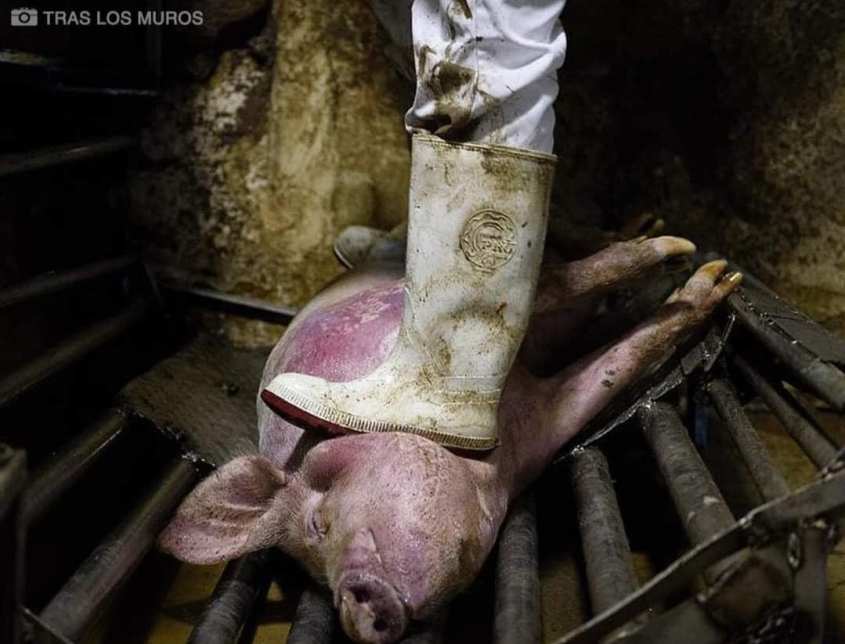
Australia: NSW laws criminalising secret recordings of animal cruelty ‘too great a burden on speech’, high court hears.

Source – Guardian, London.

NSW laws criminalising secret recordings of animal cruelty ‘too great a burden on speech’, high court hears | Animal welfare | The Guardian

NSW laws criminalising secret recordings of animal cruelty ‘too great a burden on speech’, high court hears

Animal rights group in legal fight against laws which provide no public-interest exemption for use of footage

Laws criminalising the use of secretly recorded vision of animal cruelty and abuse are posing “too great a burden on speech”, animal rights activists have told the high court.

The Farm Transparency Project, an Australian animal advocacy group, launched a case earlier this year arguing New South Wales laws restricting the use of covert footage were an unfair burden on freedom of political communication.

The state’s Surveillance Devices Act criminalises the use of footage or audio that was obtained using a listening device or hidden camera, but, unlike other states, gives no public-interest exemption.

The laws have been used to pursue activists on criminal charges and have prevented media outlets from using footage depicting cruelty or abuse in abattoirs and knackeries across the state.

Guardian Australia was recently prevented from showing secretly recorded footage of ex-racehorses being sent for slaughter at NSW pet food factories, a clear breach of industry rules.

In its written submissions to the high court, the Farm Transparency Project said the case was not about how activists were perceived by the general public.

“It is about the law that is challenged,” it said.

“Whether the plaintiffs are viewed as admirable activists, or vulgar vigilantes, or something in between, is irrelevant. If anything, the case is about the publishers whose freedom to publish is curtailed.”

The submissions point to similar laws in Victoria, the Northern Territory, South Australia and Western Australia, which contain carve-outs allowing the use of such footage that accommodates the implied right to freedom of political communication.

“That is essentially because the blanket prohibition is too great a burden on speech, having regard to the legitimate social interests in the publication of surveillance device material, especially to ‘blow the whistle’,” the transparency project argues.

“It is not to be overlooked that vigilantism cannot be condoned. But this is to highlight the importance of careful balancing – in each case – of where the public interest lies, which in turn, highlights the importance of a ‘public interest’ exemption.”

The submissions point to the greyhound live baiting scandal as an example of a public interest served by the publication of such footage. That video helped spark a public inquiry and a finding that the NSW industry had lost its social licence, prompting a proposed ban that was not implemented after a backlash.

‘Horrific scene’: more than 35 horses shot dead on outback Queensland property

Read more

The Farm Transparency Project executive director, Chris Delforce, has said previously the case has broader implications for so-called “ag-gag” laws across the country.

Delforce said challenging the validity of the law would help prevent other jurisdictions from enacting similar blanket bans.

“We’ve had enough – these industries need more transparency, not less,” he said. “The animals suffering in our nation’s farms, slaughterhouses and knackeries deserve to have their stories told, and the Australian public deserves the opportunity to hear them.”

Not all animal rights groups support the use of hidden cameras. The RSPCA is opposed to using unlawful means to fight for animal welfare.

The high court is expected to receive submissions from the NSW government this week, and Farm Transparency Project will be given a chance to reply next month.

Regards Mark

South Korea: Said Last Week It Will Launch a Task Force To Consider Outlawing Dog Meat Consumption – But It Will Not Be Easy To Get There !

FILE - Dogs are seen in a cage at a dog meat farm in Siheung, South Korea, Feb. 23, 2018. South Korea said Thursday, Nov. 25, 2021, it'll launch a government-led task force to consider outlawing dog meat consumption, about two months after the country's president offered to look into ending the centuries-old eating practice. (AP Photo/Ahn Young-joon, File)
FILE – Dogs are seen in a cage at a dog meat farm in Siheung, South Korea, Feb. 23, 2018. South Korea said Thursday, Nov. 25, 2021, it’ll launch a government-led task force to consider outlawing dog meat consumption, about two months after the country’s president offered to look into ending the centuries-old eating practice. (AP Photo/Ahn Young-joon, File)

25/11/21

SEOUL, South Korea (AP) — South Korea on Thursday said it will launch a task force to consider outlawing dog meat consumption after the country’s president offered to look into ending the centuries-old practice.

Restaurants that serve dog meat are dwindling in South Korea as younger people find dog meat a less appetizing dining option and pets are growing in popularity. Recent surveys indicate more people oppose banning dog meat even if many don’t eat it.

In a statement, seven government offices including the Agriculture Ministry said they decided to launch the group comprising officials, civilian experts and people from related organizations to deliver recommendations on possibly outlawing dog meat consumption. It said authorities will gather information on dog farms, restaurants and other facilities while examining public opinion.

“As the number of families with pet animals has risen rapidly and public interest in animal rights and welfare has grown in our country, there have been increasing voices saying that it’s difficult now to see dog meat consumption as just traditional food culture,” Prime Minister Kim Boo-kyum, the country’s No. 2 official, said ahead of the statement’s release.

The government says the initiative, the first of its kind, doesn’t necessarily guarantee the banning of dog meat. The joint statement noted that “public awareness of the basic right (to eat preferred foods) and animal rights issues are tangled in a complicated manner” when it comes to dog meat consumption.

The seemingly vague stance drew quick protests from both dog farmers and animal rights activists.

Farmers say the task force’s launch is nothing but a formality to shut down their farms and dog meat restaurants, while activists argue the government’s announcement lacks resolve to outlaw dog meat consumption.

Ju Yeongbong, general secretary of an association of dog farmers, accused the government of “trampling upon” the people’s right to eat what they want and farmers’ right to live.

Lee Won Bok, head of the Korea Association for Animal Protection, called the government’s announcement “very disappointing” because it didn’t include any concrete plans on how to ban dog meat consumption.

“We have deep doubt about whether the government has a resolve to put an end to dog meat consumption,” Lee said.

About 1 million to 1.5 million dogs are killed each year for food in South Korea, a decrease from several millions about 10-20 years ago. Thousands of farmers currently raise a total of about 1 million to 2 million dogs for meat in South Korea, according to Ju’s organization.

Ju said the farmers, mostly poor, elderly people, want the government to temporarily legalize dog meat consumption for about 20 years, with the expectation that demand will gradually taper off. Lee said animal rights organizations want a quicker end of the business.

“South Korea is the only developed country where people eat dogs, an act that is undermining our international image,” Lee said. “Even if the K-pop band BTS and the (Korean drama) Squid Game are ranked No. 1 in the world, foreigners are still associating South Korea with dog meat and the Korean War.”

Lee accused many farmers of animal cruelty and other illegal activities when they raise and slaughter their dogs. Ju said that activists “exaggerated” such information, and that it only applies to a small number of farms.

According to Lee, dogs are consumed as food in North Korea, China and Vietnam as well as in South Korea.

In September, President Moon Jae-in, a dog lover, asked during a meeting with the prime minister “if it’s time to carefully consider” a ban on dog meat consumption, sparking a new debate over the issue.

Dog meat is neither legal nor explicitly banned in South Korea.

South Korea to launch task force on banning dog meat | AP News

Regards Mark

UK: Less Than 24 Hours To Call For Better Food Labelling. Please Sign NOW

The UK Government is currently collecting evidence on mandatory method of production labelling. As part of our response, we will be submitting the signatures of everyone who has signed our petition. Please stand up for farmed animals by adding your name now.

Time to change food labelling

Hi,

Meat and dairy labels are confusing and can be misleading. They can hide animal cruelty. Join me in calling for all products to be honestly labelled by farming system:

Join 142,000 others demanding change:

Little time left – please sign immediately;

Thank you;

Regards Mark

“Why are so many people so cruel to their dogs?”

“Why are so many people so cruel to their dogs?”

That is the question The Post’s Gene Weingartenset out to answer when he spent three days in the field with workers from PETA who investigate complaints of cruelty.

The closest he came to any kind of answer — after witnessing one instance after another after another of dogs chained or caged in truly horrific conditions — is because they can.
Hopefully, though, his searing exposé will wake up local and state officials to the need to ban the unattended tethering of dogs.

Dogs are naturally social beings.
They need interaction with humans and/or other animals, but it sadly is commonplace for owners to leave their dogs outside in all weather extremes, attached to some stationary structure or imprisoned in a pen.

“It occurs all over the country,” Mr. Weingarten wrote, “the pitiless 24-hour-a-day chaining of dogs to lifelong sentences of misery and madness.”

In addition to the psychological effects — otherwise friendly dogs becoming neurotic, unhappy, often aggressive — there are the physical ailments that result from being continuously chained.
Necks become sore and raw; collars can grow into their skin, and they are vulnerable to parasites and insects.

Often they are denied food and water. Four of the dogs rescued by PETA during the three days of Mr. Weingarten’s reporting were so damaged they had to be euthanized.

“I have been doing this for 25 years, and I still don’t understand it,” Daphna Nachminovitch, PETA’s senior vice president of cruelty investigations, told us about what she sees as the disconnect between someone deciding to own a dog and then utterly failing to understand its most basic needs.

While she acknowledged that “you can’t force people to love and respect and show kindness to animals,” Ms. Nachminovitch stressed that it is possible to impose and enforce some basic rules of decency and humanity.
PETA has led the effort to try to persuade state and localities to ban the brutal practice of leaving dogs unattended for hours on end tethered to a chain or trapped in a pen.

Twenty-two states and D.C. have laws that attempt to limit the number of hours or specifying what kind of collar or length of chain is allowed.
But those efforts have come up short.
None have banned unattended tethering entirely.
There has been some success at imposing prohibitions at the local level but, as Mr. Weingarten reported, they represent less than 1 percent of all cities, towns and counties in the country.

As Mr. Weingarten wrote, “There is a terrible power that comes with being human. But there is a potentially beautiful power in that, too. In this brutally unequal world, isn’t that part of the covenant with our pets?
Don’t we owe them that much dignity?”
Animals are helpless, but when it comes to making their lives more bearable, people are not.

https://www.washingtonpost.com/opinions/2021/11/25/animal-cruelty-dogs-hurt-because-they-can/

And I mean…“There is a terrible power that comes with being human. But there is also a potentially beautiful power in this … “

The Austrian animal ethicist Helmut Kaplan also has this theory treated:

“The all-important question is: Has there ever been something like an education for peace, a training for peacefulness, an introduction to being good?
Has a moral sensorium ever been developed here that one can address, that one can appeal to?
Is it possible to educate people about morality, to be good or at least to want to be good at all?

At least there is a glimmer of hope – albeit a paradox: it can be influenced, the motivation for morality, an education for discord is undoubtedly possible.
But if a negative moral shaping of the human being is possible, then positive attempts at influencing could also have a chance of success.

In the case of the education in torture and murder in the Third Reich, for example, one came up with a lot.
This “educational work” was impressive.
The successes in the negative shaping of the human being, however, also give cause for hope, as already mentioned: If the education to the monster can be carried out so efficiently, then the education to the human being, to the morally thinking and acting human being, should also be possible”.

Personally, however, I have little hope that the described process of training to torture and killing could also lead to significant successes in the opposite direction.
I think the development towards inhuman and immorality is much easier than the other way round.

Mainly because even the very best animal protection law does not grant animals any rights, but only restricts the power of disposition of humans. Humans have rights, animals suffer under the violence of those who have rights to it.

Therefore: without the recognition of animals as subjects of rights that has to exist without being asked for, fascism against ALL animals will never end.

My best regards to all, Venus

England: Action needed from the Bern Convention to end the UK’s unethical badger cull.


Action needed from the Bern Convention to end the UK’s unethical badger cull

29 November 2021

Badger Trust

News

Today marks the 41st meeting of the Standing Committee of Bern Convention institutions, but unfortunately the UK’s continued culling of badgers, as part of its strategy for tackling bovine TB in cattle, will not be on the agenda.

The badger is a protected species, and is listed on Appendix III of the Bern Convention.Britain is home to over 25% of the European badger population. However, with more than 140,000 badgers killed under licence since the cull policy started in 2013, and with culling set to continue at least until 2025 under confirmed UK Government plans, that population is coming under severe pressure..  

Born Free Foundation, the Badger Trust and Eurogroup for Animals submitted a complaint to the Bern Convention in 2019 against the UK’s ongoing badger culling policy.

The Bern Convention (Council of Europe Convention on the Conservation of European Wildlife and Natural Habitats), to which the UK has been a signatory since 1982, aims to ensure the conservation and protection of Europe’s wildlife, and regulates the exploitation of species listed in Appendix III, which includes badgers.

The NGOs’ complaint was put on ‘standby’ by the Bern Standing Committee in 2020, with a request for further information, the first time a complaint made against the UK Government had not been dismissed at the initial stage. Additional evidence was submitted at the end of July 2021 and this was considered at Bureau level in September.

Whilst the complaint has not yet been dismissed, it continues to be maintained in ‘standby’ mode, with further information to be provided by the complainants and the UK Government in July 2023. Unfortunately, many thousands more badgers will be culled before the Bern Convention next considers this matter.

Whilst the UK government asserts that the cull supports their efforts to control bovine Tuberculosis, the Badger Trust and other NGOs have presented overwhelming evidence that it is ineffective and unethical. 

Despite disappointment at the lack of action to protect badgers, campaigning against the cull will continue at national and international levels.

Learn more about our complaint to the Bern Convention:

File

Briefing – The UK Government’s badger cull infringes the Bern Convention292.22 KB

WAV related articles:

England: Setts, Drugs and Rock n Roll. Dr Brian May Speaks In Defence of Badgers at Oxford University. – World Animals Voice

England: 28/4 – Wildlife In The Garden Tonight – Foxes and Badgers. – World Animals Voice

England: Bovine TB Up By 130% – Higher Than When Badger Culls Began. Badgers Being Killed To Pacify Farmers; While They Take No Responsibility for Biosecurity. – World Animals Voice

England: What Good People Do For Wildlife – New Artificial Badger Sett Made For Schoolchildren; So They Can Learn About Badgers. – World Animals Voice

China: Terrified Badgers Bludgeoned For Paint, Shaving and Make Up Brushes. – World Animals Voice

England: Nothing like a good old belly scratch! – World Animals Voice

England: The Badger. – World Animals Voice

Regards Mark

European zoos want to cull gorillas!

Gorillas in the wild are critically endangered. Too many of them live in European zoos. Now some are supposed to die. The outcry is great.

They actually live in the African rainforest, are intelligent, sensitive and threatened with extinction in the wild: Western lowland gorillas, the smallest of the four gorilla species, are between 1.20 and 1.80 meters tall and in tests achieve an intelligence quotient between 70 and 90
People don’t do much better on average, most people score somewhere between 85 and 115…

In the wild they are critically endangered. The exact number of western lowland gorillas is not known because they inhabit some of the most dense and remote rainforests in Africa.
Because of poaching and disease, the gorilla’s numbers have declined by more than 60% over the last 20 to 25 years.

In contrast, so many of these gorillas live in European zoos and animal parks that it is getting crowded. From a certain age, male animals are often kept separate from younger and female conspecifics.

Zoo operators are therefore considering killing male lowland gorillas, reports the Guardian.
This emerges from previously secret documents from the European Association of Zoos and Aquaria (EAZA).

Castration and culling – that is, targeted killing – are options for reducing overpopulation in zoos, according to the association’s papers. Currently, 463 such gorillas live in the almost 70 EAZA zoos, 212 of them are male.

The gorilla action plan, released to stakeholders in zoos, admits that culling would be “the most appropriate tool if strictly talking from the biological point of view,” but that the decision could be unpopular with the public.

“From a biological point of view, killing is the best means.
“It is wrong in many ways to castrate or kill a healthy gorilla for human convenience.”
Ian Redmond, BBC presenter

Animal rights activists are appalled by the plans.
The lowland gorillas are threatened with extinction and are protected by international law.

The conservationist Damian Aspinall, whose foundation has already released gorillas, wants to save the animals.
“It’s so sad that zoos are considering killing gorillas when they can be released into the wild,” Aspinall said.

The world community has only just committed to protecting biodiversity.

However, the release into the wild is difficult, especially with great apes, says primate expert Garrod.

Gorillas from Europe, for example, could introduce diseases into the African wilderness, which would have devastating effects.
In addition, an area would have to be found that is far away from other gorillas – and from villages, in order to avoid conflicts between animals and humans.

Poachers and disease have decimated the population by more than half in the past few decades.

An EAZA spokeswoman confirmed the killing plans to the Guardian as “part of the management plan” (!!!)
The zoos would, however, support reintroduction if the conditions are suitable.

But she also emphasized that there had been no culls so far and that the association would not currently recommend this explicitly. Castration, on the other hand, is common practice to control the number of animals.

Continue reading “European zoos want to cull gorillas!”

EU: Member States – Insects Authorised for Human Food and Animal Feed.

House Crickets

Insects authorised for food and feed

25 November 2021

If the legal framework is still in development, why are authorisation procedures moving forward?

The European Commission (EC) will ask Member States to authorise two new insect species for human consumption on 30 November (Comitology). Previously the EC had told Members of the European Parliament (MEPs) in a written answer that “the Commission will continue to develop the legal framework for insects”.

During the last meeting of the Standing Committee on Plant, Animals, Feed and Food (PAFF), an Implementing Act authorised the sale of Locusta Migratoria, commonly known as grasshoppers, as a novel food. On 30 November, the Commission will present a draft implementing act to authorise Tenebrio Molitor, mealworms, and Acheta Domesticus, house crickets as a novel food.

Mealworms

These authorisations follow an amendment to the “Feed Ban” which allowed the use of processed insects in poultry and pig feed. Although authorisations for feed and food products may differ from a toxicological point of view, in terms of the market for the insect producing industry, both are connected and share similar areas of concern. 

The time is now to have a broader political discussion on how to develop an appropriate framework for this growing industry. There is still a significant lack of knowledge surrounding insects and how best to rear them industrially. Taking hasty authorisation decisions today may prove costly further down the line.

Specifically, Eurogroup for Animals suggest considering carefully the following points:

  • Industrial insect farming’s ecosystem impacts: Large scale insect farming may have consequences for local ecosystems, threaten food security and biodiversity. In addition to the destruction of crops or forests, high insect concentrations pose a health hazard as they can spread pathogens, can be parasitic and create extra competition for resources for other species. 
  • The changing climate increases the capacity of invasive alien species to establish: An increased risk of insect-borne pathogens would pose an additional threat to already struggling wild-living insects that are essential for the ecosystem, such as pollinators. Beyond the economic impact, the impact on local ecosystems would compromise both biodiversity and food security. Accidental releases from insect farms can, therefore, lead to inordinate concentrations of a species in a given area or the introduction of invasive alien species into European ecosystems. The economic consequences could be significant, considering that invasive species are the cause of a 14% reduction in global food production.
  • Industrial insect farming is energy intensive and has potential high climate and environmental impacts: While insect protein is touted as an alternative feed that requires less land use, this case can only be made if the insects are fed on by-products. In practice, most producers do not rely on food waste to feed their insects. Life Cycle Analyses (LCA) show that insect farming is energy intensive and uses more land than generally assumed. The EU’s goal “to reduce the environmental and climate footprint of the EU food system” by ensuring that the food chain has a neutral or positive environmental impact may be incompatible with the generalisation and intensification of insect farming. In fact, the EFSA notes that the environmental impact of insect farming will be comparable to other forms of animal production.
  • Placing industrial insect production into the EU’s broader goals: promoting a sustainable food system instead of boosting factory farming: Insect-derived protein is presented as a solution to diminish the use of imported soy and other feed crops linked to deforestation, as well as replacing the use of fishmeal from depleted oceans. Promoting industrial insect production will, ultimately, sustain intensive animal production models instead of facilitating the transition to a sustainable food system as envisaged by the European Green Deal.  A sustainable food system should focus on reducing the amount of animal products and supplying them from systems with higher welfare standards. Animal consumption patterns, therefore, should shift primarily to plant-based diets. Boosting industrial insect production for animal feed will sustain factory farming with its serious animal welfare and environmental concerns. Indeed, the European Commission’s Agricultural Outlook forecasts that the increased supply of insect meal and lower prices could support conventional intensive animal production if the practice is fully commercialised and existing restrictions lifted. 

Read the position paper:

File

Position Paper – Insect farming: a false solution for the EU’s food system – October 202148


Or you can go Vegan !

Regards Mark


New report presents key recommendations to improve animal welfare under the modernised EU-Chile trade agreement.

25 November 2021

Press Release

In the midst of national elections in Chile, Eurogroup for Animals and Vegetarianos Hoy launched a report calling on the EU and Chile to better address animal welfare in their modernised trade agreement. The conclusion of the first EU-Chile agreement, back in 2002, was followed by increased intensification in the Chilean livestock and aquaculture sectors. The new text must do better and contribute to a transition towards sustainable food systems, in which the animals’ wellbeing is promoted and respected.

The first round of the Chilean presidential and parliamentary elections just occured last weekend. In the run up to these elections, the debate around the finalisation and ratification of the modernised EU-Chile association agreement increased in the EU. The two leading candidates that will run against each other in the second electoral round (19/12) have not expressed clear opposition to concluding such an agreement with the EU. 

In 2002, when the EU and Chile concluded their first trade agreement, they added, for the first time ever, provisions on animal welfare cooperation. Even if this cooperation was only based on animal welfare standards established by the World Organisation for Animal health (OIE), the inclusion of these provisions contributed to fast-forwarding the adoption by the Chilean government of a national law on the protection of animals in 2009. 

As negotiations are ending, Eurogroup for Animals and the Chilean based organisation Vegetarianos Hoy reiterate their call on both partners to seize the opportunity offered by the modernisation of the EU-Chile agreement to guarantee that EU-Chile trade does not have a detrimental impact on animals, and that the new trade deal contributes to a transition towards sustainable food systems that would benefit animals, people and the environment.  

The timing has never been better for the EU to engage with Chile on this topic: the Chilean Parliament is currently debating two pieces of legislation about the legal status of animals and cage-free egg production. 

There is also urgency to act. Since the entry into force of the 2002 trade agreement, the livestock industry in Chile has grown and intensified significantly. Exports of Chilean salmon, chicken and pig meat to the EU have increased as well, and, as the 2002 agreement did not condition trade preferences with the respect of any animal welfare-related conditions, this trade between the EU and Chile has indirectly contributed to the spread of this more intensive model of livestock farming – which is not only detrimental to animal welfare, but also fuel global challenges such as the spread of zoonoses, the surge of antimicrobial resistance, biodiversity loss, deforestation and climate change.  

This phenomenon could even worsen as Chilean producers indicated more market access would provide them with more incentives to develop their exports to the EU. If the modernised EU-Chile trade agreement were to provide such significant market access to Chilean animal products, it should also condition this preferential access to the respect of EU-equivalent or higher animal welfare standards. Moreover, the modernised deal must include ambitious provisions on animal welfare cooperation, with a recognition of animal sentience and cooperations aiming at regulatory alignment with EU rules.

The first EU-Chile agreement was a turning point for animal welfare in trade policy. Yet, the intensification of livestock farming and aquaculture that followed shows that stronger tools are needed to ensure trade policy does not negatively impact animals. The EU must use the modernisation process around the EU-Chile agreement  to condition the granting of further market access on the respect of EU-equivalent animal welfare standards. By doing so the EU would not only contribute to improving the welfare of animals, but also incentivise farmers and producers to switch to more sustainable and humane methods of production.

Reineke Hameleers, CEO, Eurogroup for Animals

All eyes are on the EU to reconcile the objectives of the Green Deal, and, as foreseen in the Farm-to-Fork strategy, use its trade policy to “obtain ambitious commitments from third countries in key areas such as animal welfare”.

Chile – Animal Protection in EU Trade Negotiations

File

Briefing: Chile | Animal Protection in EU Trade Negotiations – November


Regards Mark

India: A Message Of Thought From Erika At Animal Aid Unlimited (India).

See all the fantastic work of Animal Aid Unlimited by viewing our past posts at:

https://worldanimalsvoice.com/?s=animal+aid+unlimited

I communicate regularly with Erika, joint founder of the superb AAU; and she sent this very sentimental message tonight. Use the above link if you wish to make a donation to this superb rescue organisation.

Regards Mark

—————————————————-

Dear Mark,

Even if, when you give to help the animals here, you are not consciously thinking “this gift is in memory of xyz,” it possibly is, in a sense, given in their memory—a tribute to the way they have shown us, given us profound, unforgettable, sparkling new love. And then they left us one day. If ever that sense of “he had to go;” “she needed to continue her journey” “they are angels called home,”—whatever phrasing comes to you, your heart pleaded for things to be otherwise, but in the end you said goodbye. Yet they stay in your heart.

I feel like whatever I do for animals, whether very modest and small (like fundraising for their food) or very spectacular and grand (like cleaning a LOT of poop and pee over the years) – some aspect of my service is done in the memory of someone(s) I have loved and had to say goodbye to. Or maybe it is not really right to say “in their memory”—it’s more like, they gave me the fuel I need now. They poured themselves into me and their sweetness somehow multiplies, grows, never fades, never leaves us, and then somehow merges and blends with other love we have for other animals, and for one another.

So I want to share with you right now that I fostered a dog—Bebe—for the first time in ages, inside the house in the beginning of October. I’d had sort of a moratorium on foster dogs because I have so many animals just outside the gate in Animal Aid, and they always triggered a trauma in the cats. But for some reason I decided to foster an abandoned little French bulldog-y type of about, I guess 2 years. She had one eye, severe anemia, seizures, rolling fevers and she wasn’t house trained at all. I don’t know if she’d ever spent time outdoors. She trembled if a voice was raised. She would pee inside and then try to hide. You could guess the history. We thought, at first, that maybe she had an infection somewhere, causing fever that triggered seizures. We treated her with antibiotics and anti-seizure medication. For a happy week she seemed to be on a recovery trail. Her fever went down, she got a bit of energy and even chased balls and trotted around the house and always ate like a trooper. But suddenly, she fell apart. This time her fever raged and she couldn’t hold down a drop of food. There was blood in her stool. We gave her drips that increased the production of blood plasma, liver tonic, antacid, anti-seizure medication, anti-nausea medicine, multi vitamins, –but after 2 weeks she was almost comatose and we had to say goodbye.

It astonishes me how much I miss her.  I live in the midst of 400, 500 dogs, and dozens of them are absolutely my darlings, but Bebe I fell in love with like an explosion. Now, sitting here writing this, my arms are oddly empty. My fingers feel pointlessly efficient, no longer having to contort myself to reach the keyboard without her pug nose and bulging eye and velvety fur interfering with me on my lap. Without glancing down to see her ears that so innocently, so humbly flattened backwards like a blush. And best of all, her complete melting on my lap, to sleep, to dream, pliant in her total trust.

She came and left my life in less than a month, but time has no meaning in love. Habits, yes; we may miss some of our habits and they intensify with time, but I’m not talking about habits. I’m talking about the miracle of love that overtook me somewhere, somehow during these few days of cleaning her pee at 4.30 in the morning, her effort to be just a good girl, just the best girl, shining so brightly through her one protruding over-bred eye.

Well, now I have shared this episode with you and I feel a little better because I know, even if you can’t find time to write me back, I know you know. I know you’ve been here in your own version of this feeling of emptiness.

And I know, too, you’ve gone on to love again, (and again,) even more familiar with love, even more, ever more. We have these Beings to thank for that gift of love which is at the heart of all the animals you’ve helped save with your donations. How beautiful they were, how beautiful they have made you.

Erika