The end of an intrigue master’s era

From the Greek press-Hatzopoulos

It is a bad idea to continue to blindly trust the new government coalition – no matter what colors it will consist of.
The grand coalition (red / black) “can” continue, or the “traffic light coalition” (red / green / yellow) comes to power.
The main thing is that the new one can continue to simulate democracy.

Especially in the Corona crisis, all parties have proven several times that they are not so strict about honesty and that they were actively involved in dishonest manipulation and advocated the suppression of open discourse.
Transparency and democratic processes will therefore also be completely foreign to the next apparatus.

It looks even worse with the active changes in the animal sector.
The only parties that promised a lot for the animals (and percentage would be suitable ) were the Greens and the Left.

The left is out of the question after the elections, and nothing positive can be expected from the Greens, as they were known in the Merkel era as those with the strategy of good promises and outrageous betrayal.

The even worse news is: it is almost impossible that the federal mom Merkel disappears by herself before December 18, 2021, because only then will she get the sit-out record of 5,870 days in office.

This record is far more important than anything else in this banana republic at the moment.
Even Corona cannot prevent that.

My best regards to all, Venus

UK: OPINION: Why The CO2 Shortages Make It The Best Time To Go Vegan.

‘Gassing methods can cause horrendous suffering to animals in their last moments.

Pigs are lowered into a chamber containing at least 70 percent CO2 in air.

During this time they will struggle, gasp for breath, squeal, and climb over each other until they finally lose consciousness.

The pigs must remain in the gas mixture until they are completely unconscious which can take up to 30 seconds. After this, the animals are then shackled by one hind leg, hoisted and their throats cut to drain their blood’.

Regards Mark

OPINION: Why The CO2 Shortages Make It The Best Time To Go Vegan (plantbasednews.org)

OPINION: Why The CO2 Shortages Make It The Best Time To Go Vegan

The UK meat industry is reaching ‘breaking point’ and warns Christmas will be cancelled as it fears CO2 slaughters will be stopped…

This week’s headlines are overrun with the issues surrounding the current surge in gas prices. And, the knock-on effect they are expected to have on the UK’s food security.  Damning reports from both farmers and meat processors warn that the CO2 shortages could cancel Christmas, and that the meat industry is reaching breaking point. This is affecting the slaughter process of pigs, poultry, and beef, as well as packaging. 

Siobhan Dolan from vegan charity Viva! explains the connection between CO2 and the meat industry.

CO2 shortages and the meat industry

For billions of animals slaughtered each year in the UK, CO2 is the last thing they will breathe before dying.

In fact, this technique of slaughter, known as gassing, is the most common slaughter technique for many intensively farmed animals.

This is usually because it is the cheapest and quickest way to kill many animals at once. While it has often been thought to cause less suffering than other visibly more brutal methods, this is not true. And, gassing methods can cause horrendous suffering to animals in their last moments.

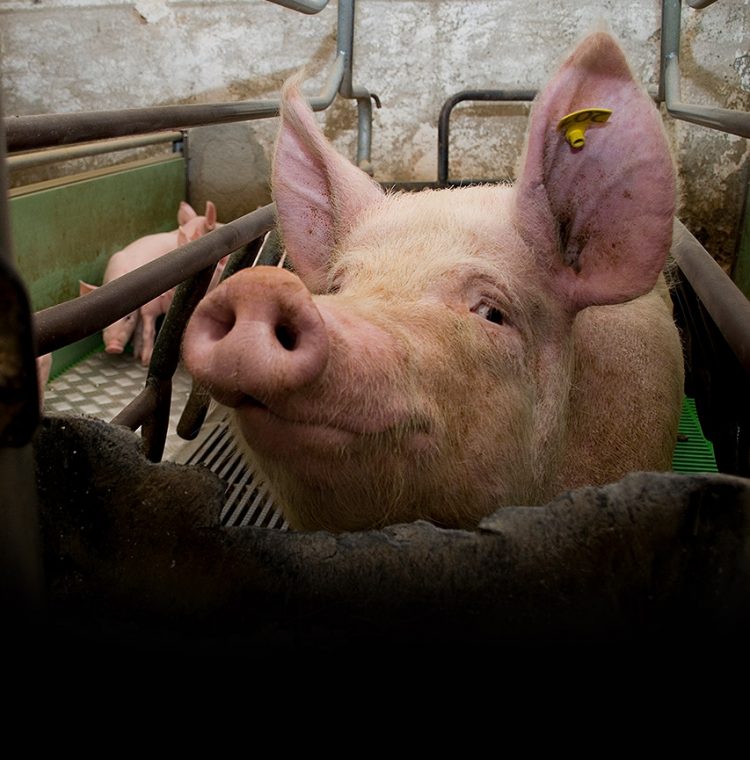
Pigs are lowered into a chamber containing at least 70 percent CO2 in air.

During this time they will struggle, gasp for breath, squeal, and climb over each other until they finally lose consciousness.

The pigs must remain in the gas mixture until they are completely unconscious which can take up to 30 seconds. After this, the animals are then shackled by one hind leg, hoisted and their throats cut to drain their blood.

The length of time it takes to kill pigs and the acute distress it causes have led to calls to ban the CO2 stunning method.

How birds are slaughtered with CO2

Most poultry birds killed in the UK face a similar fate. Birds are transported to slaughterhouses in crates.

Then, while still in the crates, they are placed into a chamber. Here, they are exposed to either concentrations of CO2 or a mixture of inert gases (nitrogen and argon). The gas mixture deprives birds of oxygen, causing them to lose consciousness and die. 

In a nutshell, CO2 is used to slaughter millions of animals each year in the UK. And, the current shortage could pose significant delays to the number of animals processed for slaughter.  

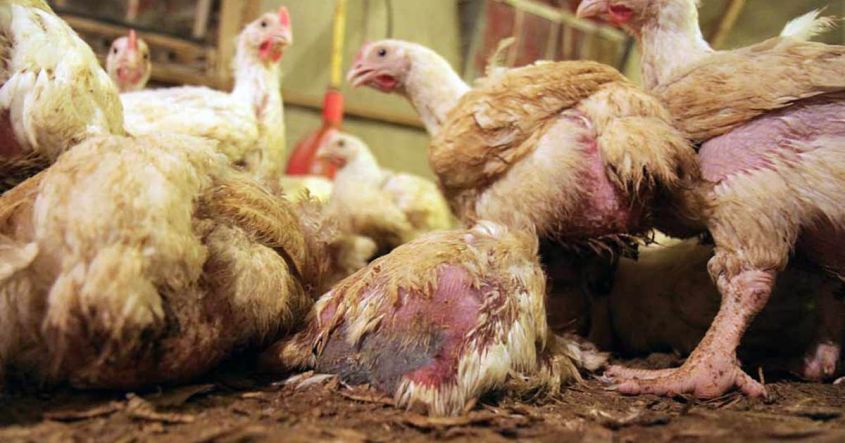
Factory farmed animals are bred and reared in filthy, overcrowded sheds. As a result, they often suffer from disease, injury, and psychological problems.

In these environments, profits take priority over animal welfare and Viva!’s countless investigations prove that animals suffer for food production.

Why are animals allowed to be killed like this?

Conditions on factory farms are likely to deteriorate even further. And, animals will experience prolonged suffering on factory farms if delays occur at slaughterhouses as the industry is predicting.

There are also reports from the industry regarding the possibility of animals being destroyed (killed) on farms, should the issue continue.

However, shouldn’t the bigger question be; why are we allowing animals to be kept in these conditions, killed in this way, and continuing to eat them?

Especially, considering how much we understand about animal sentience and the impact animal agriculture is having on the climate crisis? 

CO2 shortages might mean you can’t eat turkey this Christmas, but there are plenty of incredible meat alternatives on the market that can win over even the most dedicated carnivores.

Veganism – Now might be a good time to give it a go…

Netherlands: Dutch Farmers Face Calls To Reduce Livestock By 30% To Help Protect The Planet.

Quote from article:

This is significant given the number of land animals being raised for food in the country.

The Netherlands has more than 100 million chickens, 12 million pigs, four million cows, and 600,000 goats, according to DutchNews. It’s also the EU’s largest meat exporter’.

Dutch Farmers Face Calls To Reduce Livestock By 30% To Help Protect The Planet

The proposals sparked protests from the farming community, while environmentalists call for more action

Farmers in the Netherlands are facing calls to cut livestock production by almost a third. The proposal is in response to the ongoing ‘nitrogen crisis’ that the country faces, including concerns about ammonia pollution. 

Is nitrogen dangerous?

Nitrogen is the most abundant element in our atmosphere – making up around 78 percent of the atmosphere, according to NASA. It’s essential for life, but too much can damage the ecosystem. 

Excess nitrogen can leach into underground water sources or enter oceans via agricultural runoff. This can lead to algae blooms, which deplete oxygen in the water and can create aquatic dead zones. Dead zones typically cannot support life of any kind. 

Ammonia is made of nitrogen and hydrogen. In high concentrations, ammonia can cause respiratory problems, dermatitis, eye irritation and in severe cases, blindness or death. 

What is the nitrogen crisis?

In 2019, the Council of State – the highest Dutch administrative court – ruled that the government was breaching EU law, stating that the country’s efforts to reduce excess nitrogen in vulnerable natural areas were insufficient. 

Up to 18,000 infrastructure and construction projects were halted in an attempt to lower emissions. The government also reduced daytime speed limits to 100km per hour (62mi) on motorways.

But according to the National Institute for Public Health and the Environment, animal husbandry and manure applications are the chief culprits of nitrogen oxide and ammonia pollution.

This is significant given the number of land animals being raised for food in the country. The Netherlands has more than 100 million chickens, 12 million pigs, four million cows, and 600,000 goats, according to DutchNews. It’s also the EU’s largest meat exporter.

The proposals

Farmers could have to reduce numbers of dairy cows, pigs, and poultry.

The finance and agriculture ministry has published two proposals to cut livestock numbers by 30 percent. According to The Guardian, it’s one of the ‘most radical plans of its kind in Europe’. 

Both proposals use buy-back schemes to reduce animal numbers – including dairy cows, pigs, and poultry. One proposal also subsidizes sustainable land management and livestock housing, while the other focuses on price incentives, such as a levy on ammonia emissions. 

“We are a relatively small country with a lot of inhabitants, industry, transport and agriculture, so we are reaching the limits of what nature can take,” Rudi Buis, a spokesperson for the agriculture ministry, told The Guardian. “There is a high level of urgency for us to tackle the nitrogen compounds problem. This means that in the near future, choices must be made.”

Farming community’s response

The proposals have attracted criticism from members of the farming community. The Farmer’s Defence Force (FDF), which has nearly 60,000 members in its Facebook group, was established to help farmers who are under ‘attack of environmental extremists’.

On its website, FDF calls the nitrogen reduction plans ‘disgusting’. In July, FDF and fellow farming group Agractie staged protests in multiple regions in the Netherlands. 

Some of the demonstrations saw farmers filling the roads with hundreds of tractors.

“The snow is not blackened by farming activities, the air is not poisoned with heavy metals by farming activities. You will not find increased cancer rates around farms,” FDF writes on its website. “The air was clean during the lock-downs – when the farmer plowed on and industry and air traffic came to a virtual standstill.”

The groups are planning further protests in the coming weeks. 

‘Step in the right direction’

Meanwhile, other groups have pushed for more to be done to protect the planet.

Coalition party D66 previously proposed reducing the number of livestock in the Netherlands by 50 percent. 

D66 parliamentarian Tjeerd de Groot spoke to RTL Nieuws about the issue in 2019.

“[Seventy] percent of Dutch nitrogen emissions come from agriculture, a large part of which comes from intensive livestock farming. That is huge,” de Groot said, per the NL Times

“At the same time, the contribution of intensive livestock farming to our own economy is not even one percent. The ratio is completely missing.”

Bram van Liere, of environmental organization Friends of the Earth Netherlands, applauded the move.

“It’s a step in the right direction,” van Liere said to The Guardian. “We would do more on buying out farmers and helping them transition to sustainable agriculture.”

Dutch Farmers Face Calls To Reduce Livestock By 30% To Help Protect The Planet – Plant Based News

Regards Mark

Archaic, barbaric structures must be abolished

AnimaNaturalis España has infiltrated a cruel folk fiesta of cowardly, disgusting sadists and keeper of “tradition”.

It is about a competition in which balls consisting of tar and sulfur are attached to the horns of the bull and set on fire. The tar slowly melts and begins to drip, causing deep burns to the animal. The burning liquid penetrates his eyes and scorches them.

The bull, of course, panics and desperately tries to put out its burning horns. If this does not happen, the bull will be burned alive.

The audience roars with pride that they uphold a culture of prehistoric men.

https://fb.watch/8hnuUJ5EA3

As civilized people, we cannot justify barbaric practices by saying that they have a “long tradition”.
In less developed countries there is also “traditional stoning” and maybe there is also “traditional slavery” somewhere.
If a “tradition” keeps people in archaic, barbaric structures, it should be abolished

My best regards to all, Venus

USA: Alliance to End Chickens as Kaporos.

With thanks to Stacey at ‘Our Compass’ as always;

Stacey | Our Compass (our-compass.org)

Regards Mark

Source Alliance to End Chickens as Kaporos

Do note, for those triggered by “Asian wet markets” as being “responsible” for Covid19 and subsequent, bigoted, targeted hatred towards Asians, Kaporos is a WET MARKET, in the USA (animal exploitation in any form fuels animal exploitation in ALL forms, if you’re not vegan, don’t complain about animal exploitation in “other places” as you directly contribute to it):

Kaporos, Largest Live Animal Wet Market in the United States, Opens Ahead of Yom Kippur

Source Alliance to End Chickens as Kaporos

We’re delighted to inform our supporters that our Alliance to End Chickens as Kaporos Team succeeded in rescuing 708 chickens this month from the streets of Brooklyn.

We will publish a full Report on this year’s activities and accomplishments very soon. We thank everyone who has contributed to the success of our campaign.

The Alliance to End Chickens as Kaporos is an association of groups and individuals who seek to replace the use of chickens in Kaporos ceremonies with money or other non-animal symbols of atonement. The Alliance does not oppose Kaporos per se, only the cruel and unnecessary use of chickens in the ceremony.

For more information and background on what “Chicken” Kaporos is, please see HERE

VEGAN Links and Info:

Download Your FREE Vegan PDF HERE

Order a FREE vegan kit HERE

Dairy-Free Info HERE

Take the Dairy-Free Challenge HERE

Click HERE for more Dairy-Free

Fish alternatives can be found HERE

Learn about eggs HERE

Find bacon alternatives HERE and HERE

Take PETA’s Cruelty-Free Shopping Guide along with you next time you head to the store! The handy guide will help you find humane products at a glance. Order a FREE copy HERE

Searching for Cruelty-Free Cosmetics, Personal-Care Products, Vegan Products, or more?
Click HERE to search.

Free PDF of Vegan & Cruelty-Free Products/Companies HERE

Click HERE to find out How to Wear Vegan!

Want to do more than go vegan? Help others to do so! Click below for nominal, or no, fees to vegan literature that you can use to convince others that veganism is the only compassionate route to being an animal friend:

PETA HERE

Vegan Outreach HERE

Get your FREE Activist Kit from PETA, including stickers, leaflets, and guide HERE

Have questions? Click HERE

species fascism

Imagine that on the day you were born someone else had already planned your entire future and the day of your execution …
Just because you were born to the ” wrong ” species.

This is how humans decided about the fate of other animals
And that’s called species fascism

The question becomes: can we affect a measurable change if we do not cooperate with the caste of slave owners, animal exploiters and abusers?
The obligation is to affect an effective strike against species fascism.
And the only way to achive that is to go vegan.
This is the only way.

My best regards to all, Venus

Kering Group and all of its brands are now fur-free: ‘The right thing to do’

One of the world’s largest luxury fashion companies, Kering Group, is ditching fur for good: citing ethical and ‘modernity’ reasons.

Kering is the parent company of Gucci, Alexander McQueen, Yves Saint Laurent, and Balenciaga.

Additionally, Bottega Veneta, Boucheron, Girard-Perregaux, Qeelin, Pomellato, Ulysse Nardin, Brioni, and more.

Most of Kering’s brands had already dropped fur from their collections.
Now, Yves Saint Laurent and Brioni have followed suit.

This means the entire fashion conglomerate is now fur-free.

‘The right thing to do’

Kering, which brought in €13.1 billion of revenue last year, started going fur-free back in 2017.
This is when Gucci, which was founded 100 years ago, stopped using fur.

François-Henri Pinault is the chairman and CEO of Kering. He said in a statement sent to Plant Based News: “Going entirely fur free is just the right thing to do. We do it out of conviction, for the sake of ethics and modernity.”

In a separate statement, Pinault explained:

“For many years, Kering has sought to take the lead in sustainability, guided by a vision of luxury that is inseparable from the very highest environmental and social values and standards.
When it comes to animal welfare, our Group has always demonstrated its willingness to improve practices within its own supply chain and the luxury sector in general.”

“The time has now come to take a further step forward by ending the use of fur in all our collections. The world has changed, along with our clients, and luxury naturally needs to adapt to that,” he added.

‘A new era’
PJ Smith, Director of Fashion Policy at the Humane Society of the United States (HSUS), commended the move.
HSUS worked with Gucci in 2017 to announce its fur-free policy.

“Kering is synonymous with luxury fashion, and with this announcement, it marks a new era for what is considered luxury to now include what is socially responsible, ethical and innovative,” Smith said.
“We hope the rest of the fashion industry will take notice choosing compassion and innovation over an outdated idea of luxury.”

Starting from the Fall 2022 collections, none of the Kering’s houses will use fur.

However, the group’s brands still produce items with wool and leather.
The company says the production of these materials will be monitored under its set of animal welfare standards, which it published in 2019.

https://plantbasednews.org/lifestyle/fashion/luxury-fashion-kering-group-fur-free/

And I mean…Leather is just skin without fur, so the next step must be leather-free.
Even so, this decision is another blow to the fur industry and makes us happy.

They call it ethical & humane choices, but in reality they’re only going fur-free because of pressure

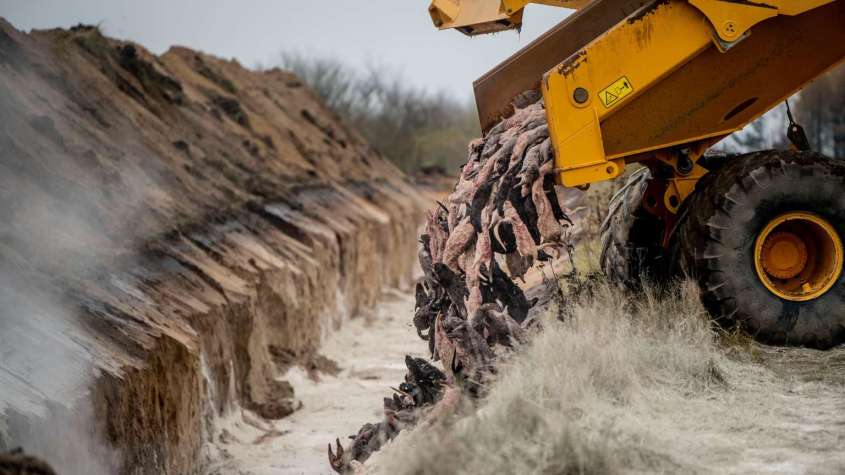
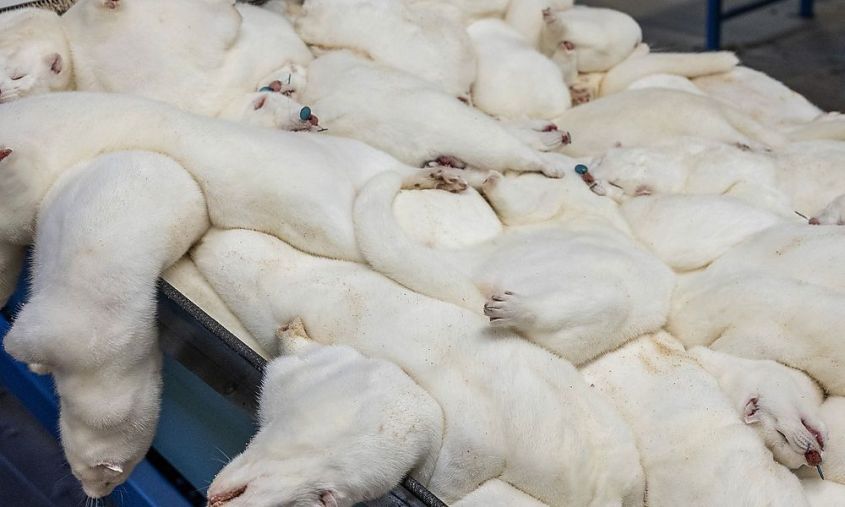
May not have happened if fur farms weren’t closed due to the COVID outbreak in mink farms.
They realized that sourcing fur from intensive animal husbandry is risky and therefore not a stable investment.

All the same! the result counts! And the result saves millions of animals from torture and murder.
It is still a positive move forward and with it the list of fur-free fashion houses is getting longer and longer

My best regards to all, Venus

UK: British Government refuses to halt post-Brexit Faroes trade deal despite whale and dolphin massacres.

Government refuses to halt post-Brexit Faroes trade deal despite whale and dolphin massacres

Exclusive: Department for International Trade defies plea for sanctions after nearly 1,500 mammals killed

The government has refused to suspend a free-trade deal with the Faroe Islands over whale and dolphin massacres, in defiance of calls from conservationists.

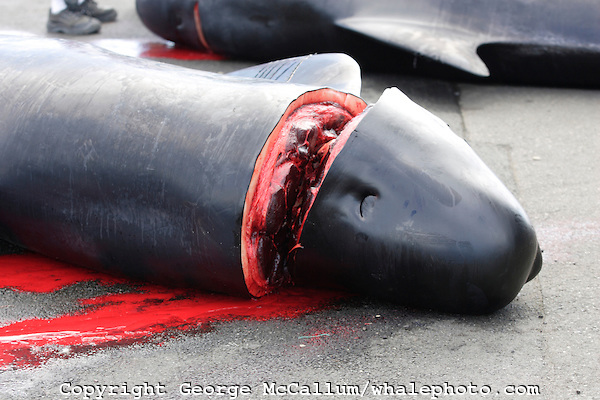
Hunters caused widespread outrage last week when they wiped out a super-pod of 1,428 dolphins – thought to be the worst bloodbath of the mammals in the islands’ history.

Just 10 days later, they responded to the global revulsion by slaughtering 53 pilot whales only a few miles from the first massacre.

Wildlife campaigner Dominic Dyer has called for ministers to suspend the £580m post-Brexit agreement that the government agreed with the Faroe Islands in 2019 “until the slaughter ends for good”.

More than 21,000 people have signed a petition on the government website backing the plea in three days.

The government told The Independent it is “extremely concerned about the sustainability and welfare implications for the animals involved in these hunts” but that it would not review the trade deal.

Instead, it says it will “continue to engage in a frank and respectful dialogue” with the government of the Faroes.

Zac Goldsmith, the minister for animal welfare, tweeted of the dolphin killings: “This is one of the most sickening spectacles I’ve ever seen. It shames our species.”

Known as the “Grindadrap”, the annual hunt involves herding whales and dolphins on to a beach where they are knifed to death as their blood turns the sea red.

The practice has been branded “barbaric”, “sick” and “sadistic” but those who defend it say it is a tradition that does not risk driving the animals into extinction.

Mr Dyer said: “We are currently granting the Faroe Islands a preferential trade agreement worth over £500m a year – it’s time for sanctions to stop this barbarism.”

The deal accounts for more than 25 per cent of the Faroes’ global trade, he said, with exports from the islands – mostly fish sold in British supermarkets – worth £582m a year.

UK exports to the islands amount to £34m, said Mr Dyer, whose petition reads: “If the UK is to be considered a world leader in the protection of marine mammals, it must use this leverage now.”

When asked by The Independent whether it would agree to suspend or review the deal, the Department for International Trade said it had no plans to do so.

A spokesperson for the Department for Environment, Food & Rural Affairs (Defra) said: “The UK is strongly opposed to the hunting of any cetaceans and continues to call on all whaling nations, including the Faroe Islands, at every appropriate opportunity to cease their whaling activities in favour of well-managed, responsible tourism, such as whale-watching.

“We recognise there is a long tradition in the Faroe Islands of killing pilot whales and dolphins for meat and other products, and we wish to continue our frank conversations relating to cetacean conservation, to encourage them to stop these hunts.”

Government policy is to “maintain diplomatic pressure” on the islands to end the hunts and re-engage with the International Whaling Commission.

Boris Johnson’s wife, Carrie, and his father, Stanley, have previously joined campaigns against whaling outside the Japanese embassy in London.

Government refuses to halt post-Brexit Faroes trade deal despite whale and dolphin massacres | The Independent

WAV Comment:

We tried 30 years ago to make this an issue in England, and to bring it to peoples attention.

When was this ? – around 1991 probably.  Joanne; Mark (WAV) and Trevor (at front) campaign outside an English local supermarket buying produce from the Faroe Islands – responsible for the whale slaughter (see picture below).

As an Englishman, I am sickened to the core that our limp wristed, gutless government are not making this a big issue in the trade deal currently in progress. It simply shows that money talks louder than anything else, and governments (in this case the British government) are happy to look the other way and ignore the killing of over 1,400 marine animals in the last week. God knows how many since we were on the streets – too many, and something should have been done about this decades ago.

Regards Mark

Read the article below by clicking on https://serbiananimalsvoice.com/about-us/ and then scrolling down to the same picture, which you can click on to enlarge and read.

Tesco terrors
Faroe whale slaughter
Petition · STOP THE ANNUAL SLAUGHTERING OF PILOT WHALES IN THE FAROE ISLANDS  · Change.org
News - EIA
Gruesome whale hunts in Faroe Islands exposed by activists - YouTube

Spain has started to change the history of the wolf-wolf hunting has been banned!

The ban initially only affected southern Spain, but that was it: Wolf hunting has been banned on the entire Iberian territory since September 22, 2021.

There are said to be between 2,000 and 2,500 wolves in 297 packs in Spain, more than in any other country in Western Europe. They live mainly in the northwest of the country north of the Duero River.

The Duero is the third longest river on the Iberian Peninsula.
It rises in the Spanish province of Soria, flows through northern Spain and northern Portugal and flows into the Atlantic Ocean at Porto. It is about 897 kilometers long.

The populations are already being protected south of the Duero River.
Regions that are home to larger wolf populations continued to reject such protection.
95% of wolves live in Castile-Leon, Galicia, Asturias and Cantabria.

In the Sierra de la Culebra, an area of ​​around 70,000 hectares in Castile and León (northwestern Spain), wolves are omnipresent, on signs or T-shirts in souvenir shops.
They are spoken of in the singular, like in a fairy tale.

“This has always been a wolf’s paradise,” confirms Carlos Zamora, forest officer, from behind his binoculars, while he looks for a specimen in the low-lying twilight sun.

Continue reading “Spain has started to change the history of the wolf-wolf hunting has been banned!”

UK: 1 In 5 Kids In The UK Are Vegan Or Want To Be, Survey Finds.

Vegan Baby

1 In 5 Kids In The UK Are Vegan Or Want To Be, Survey Finds

Are young people leading the plant-based movement?

Nearly 60 percent of children in the UK are vegan or vegetarian or want to be, a new survey has found.

BBC Good Food surveyed 1,004 children between the ages of five and 16.

The global food media brand discovered that 8 percent of participants were eating a fully plant-based diet. A further 13 percent were vegetarian. 

Additionally, 15 percent of children said they would like to become vegan, and roughly one in five (21 percent) said the same about vegetarianism. 

Reports didn’t clarify what the children’s reasons were for eating plant-based food. But sustainability was on their minds for at least part of the research. The survey found that 44 percent of kids said they hope that no food is packaged in plastic in 10 years’ time. 

Christine Hayes, Editor of BBC Good Food, commented: “It was fascinating to survey children’s eating habits, behaviours and opinions around food.”

“They are passionate about exploring alternative diets and methods of food production that could be more sustainable for the planet,” Hayes added.

Young people leading the way

The recent findings reaffirm the widely held belief that young people are leading the charge toward plant-based living. 

A 2019 BritainThinks report concluded that Gen Z and Millenials are slightly more likely to be vegan than older age groups.

And earlier this week, it was reported that a majority of young people (aged 15 to 20) were taking action to help fight the climate crisis. Specifically, 26 percent of participants said they eat plant-based to help protect the planet.

1 In 5 Kids In The UK Are Vegan Or Want To Be, Survey Finds – Plant Based News

30% Of Brits Are Now Eating Less Or No Meat At All, New Survey Finds

Animal welfare, environmental, and health reasons are motivating Brits to adjust their diets

Anew survey has indicated that the eating habits of people in the UK are changing, with more individuals ditching meat in favor of vegan food. 

The survey

Market research website Appinio hosted the survey, which included 1,000 participants from the UK.

Five hundred women and 500 men took part, and the average age of participants was 41.1.

Just 68.6 percent of participants said they were omnivores.

Four percent were vegan, and 8.7 percent were vegetarian. These figures are notably higher than they have been in previous years. 

For instance, in 2019, research found that just over 1 percent of people in Great Britain identified as vegan. 

Eating more plan

The recent Appinio survey also found that 5.4 percent of participants were pescatarian (meaning they don’t eat meat besides fish). Further, 11.4 percent said they were flexitarian, referring to those who actively try to reduce their meat intake and eat primarily plant-based food. 

The survey asked participants whether they would consider replacing some of the meat in their diets with plant-based alternatives. Of the 800 participants who responded to the question, half said yes. And 6.8 percent said they ‘want to switch to plant-based meat entirely’.

Respondents also explained why they have purchased plant-based meat, dairy-free alternatives, or other vegan options in the past. The leading motivator was health, with 46.3 percent saying they believed the vegan options are better for you. 

Animal welfare and environmental reasons also played a part, with around a third of participants selecting those responses. 

30% Of Brits Are Now Eating Less Or No Meat At All, New Survey Finds – Plant Based News

Only 1 In 10 Young People Trust Adults To Help Solve The Climate Crisis

Young people are cutting energy and water use and eating plant-based for environmental reasons

Many young people are determined to tackle the climate crisis, new research shows, but don’t believe adults will step up to the plate. 

About the study

Analysis firm United Minds conducted the study on behalf of Electrolux, the world’s second-largest home appliance maker. 

Electrolux wanted to learn more about young people’s outlook on sustainable living, and use this information to guide its own environmental targets. The global study was made up of a quantitative survey as well as in-depth interviews. 

It included nearly 14,000 people aged 15 to 20. The respondents were from 13 countries: Argentina, Australia, Brazil, Chile, France, Germany, Israel, Poland, Sweden, Thailand, UK, USA, and Vietnam.

The findings

More than half of the respondents felt that sustainability is the single most important issue faced by society today. And 59 percent said they are ‘very anxious’ about the matter.

Nearly 60 percent of young people said they are willing to ‘drastically’ change their lifestyle to protect the planet. Even more (74 percent) agreed that everyone must make a collective effort to become more sustainable. And young people predominantly trust in themselves to lead the charge towards a sustainable future, with 37 percent saying so.

Twenty-seven percent of respondents believed scientists will take on the responsibility, while 17 percent said influencers will. 

But only one in 10 participants thought adults will lead the way.

Notably, 43 percent of respondents felt that young people will actually solve the climate emergency.

Eco-friendly actions

The young participants were already taking action to lighten their load on the planet. Fifty-six percent were reducing energy use at home, without around half limiting food waste and recycling. 

Others were keeping water use down, buying second-hand clothes, and using eco-friendly transportation. Twenty-six percent of young people said they eat plant-based to help protect the planet. 

The research mirrors similar data surrounding young people, diet, and the climate. 

Gen Z and Millenials are the age groups that are mostly likely to be vegan or vegetarian, a BritainThinks report found. Further, it highlighted that more than a third of Gen Z vegetarians follow a meat-free diet for its lower impact on the planet. In general, Baby Boomers still consume the least amount of plant-based meat, according to a market report by Tastewise. But the trend is shifting. Tastewise found that Baby Boomers are consuming 57 percent more vegan meat compared to June 2019. Meanwhile, Gen X’s vegan meat consumption only increased by 4 percent in the last year. 

‘It’s their future at stake’

“We believe there’s a big opportunity in combining different perspectives in order to shape a better future,” Tove Chevalley, Head of Electrolux Innovation Hub, said in a statement. “That’s why we want to involve young minds already today, as the actions we take today will define the future they will live in.”

Chevalley continued: “As the study shows, young people have a very determinant and proactive mindset when it comes to sustainability, it’s their future at stake and they want to be part, or actually take lead, in creating solutions for the future home.”

Only 1 In 10 Young People Trust Adults To Help Solve The Climate Crisis – Plant Based News

Regards Mark