WAV Comment – I am old enough to remember the terrible situation of BSE in the 1980’s; which was largely due to cows being fed the ground up remains of other cows – or giving meat to animals that should feed on grass. Watch the video for detail; which shines a bright light on the modern day farming practices.
Regards Mark
The video explains it better:
Brazil has confirmed two cases of BSE, or mad cow disease, and has suspended beef exports to China. Ireland, a smaller beef supplier to China, reported a case of mad cow disease in May last year, but has not yet been able to resume exports.
However, the Brazilian ban is not expected to last for long, with Brazil accounting for 40% of China’s beef imports.
A number of meat processors in Brazil have been found to have bought cattle from ranches that exploit ‘slave labour’, according to international media reports.
How the cruel death of a little stray dog led to riots in 1900s Britain
Novelist campaigns for statue of terrier experimented on by scientists to regain its place in a London park
An animal in peril can inflame British public opinion like nothing else. Nearly 120 years ago, the fate of one small brown dog caused rioting in the streets of London, to say nothing of the protest marches to Trafalgar Square and questions asked in parliament.
Now the astonishing, little-known story – involving anti-vivisectionist campaigners, an eminent doctor, a legal battle and a controversial memorial statue in a park – is the subject of a new book and of a fresh campaign to honour the lowly terrier at the heart of it all.
An “affair” that made headlines and provoked disorder, but has since been forgotten, the Brown Dog story is a tale that has “obsessed” the imagination of first-time novelist Paula S Owen ever since she heard it.
“The book and the campaign really are a dream come true for me after all this time,” Owen said this weekend before the publication of Little Brown Dog, her fictionalised account of historic events. “I’ve been obsessed with this story for so long, it’s fantastic to know it has been told.”
The extraordinary row began with the public vivisection of a stray dog carried out in 1903 by Dr William Bayliss, a renowned physiologist who was also instrumental in the discovery of hormones. Operating alongside his brother-in-law, Professor Ernest Starling, Bayliss demonstrated the procedure to medical students at University College London, including a duo of undercover Swedish feminists and animal rights campaigners, Leisa Schartau and Louise Lind-af-Hageby. The operation, the women declared in their diary, was cruel and unnecessary, and the dog, which had been previously experimented on, had not been properly anaesthetised.
Months later, the campaigners recruited the help of a barrister Stephen Coleridge, a descendant of the Romantic poet Samuel Taylor Coleridge and secretary of the National Anti-Vivisection Society. He spoke out in public against Bayliss, prompting, first, an action for slander, and then one for libel, once the accusations of cruelty had been repeated in print.
The case quickly became a cause célèbre, discussed across the country, and when Coleridge eventually lost the case, Britain’s animal lovers were enraged. A fundraising drive resulted in the erection of a statue in Latchmere recreation ground in Battersea, south London, to commemorate the life of the stray dog. But, as Owen explains in a note at the end of her novel, in the 1900s the nation was not prepared to let a deceased dog lie.
The issue, she recounts, “became a lightning rod for continuing disturbances, riots, and rallies across London.
[The statue] was subjected to repeated attacks by outraged medical students. And was defended by the equally outraged working-class locals of Battersea, plus a cast list of feminists, suffragists and suffragettes, trade unionists, radical liberals and anarchists. The situation became a national talking point and was debated in parliament. The statue was protected, at great expense, day and night, by the police.”
Eventually the council acted, taking down the statue covertly at night. It has never been seen since.
In 1985, a bronze statue by Nicola Hicks, which commemorates the dog and the lost memorial, was unveiled in nearby Battersea Park. But on Sunday Owen is to visit the spot in Latchmere recreation ground where the original statue once stood to launch her campaign for a new monument to the terrier. She will put up a carefully re-created lightweight model.
“It’s incredible that the team who helped me have made something so realistic and 3D from a grainy old picture,” she said.
Owen, who is Welsh but lives in south London, has worked as a climate change campaigner and environmentalist. Her factual book about the Brent Spar controversy of 1995, when Greenpeace fought Shell’s plan to sink a decommissioned North Sea oil storage and loading platform in the Atlantic, is being adapted for a television series. And she sees a clear link between the animal protection story at the heart of her novel and her environmental work.
“This isn’t simply the tragic tale of one stray dog, appallingly treated and abused in a less enlightened age,” she has written. “Nor is the hysteria, violence and bewildering behaviour directed at a lump of stone and metal – so feared by authorities it drove them to steal and destroy it – the main focus of the novel.
“It’s more complicated than that. The whole sorry episode is an echo, a mirror, reflecting the endless injustices and evil carried out by humans on other species throughout history.”
Her novel is being published by Honno Press, a supporter of Welsh women’s writing for 35 years, and Owen said it keeps very close to the facts. “I have stayed true to events but I have changed the key characters a little. My surgeon is Bayling and my heroines are now British ≠ one upper class and one a working-class young woman from Wales.”
On Wednesday, when Owen launches her book and the new statue campaign, it will be the 115th anniversary of the day the original Brown Dog statue was unveiled to gathered celebrities, including Irish playwright George Bernard Shaw.
In the spirit of the words of Lena, Owen’s fictional heroine, who argues “our humanity is defined by how we treat, respect and nurture other species, not just our own kind”, the author now says she hopes her book will ask: “Can we say, hand on heart, we are any more ‘humane’ today than we were one hundred years ago?” This article was amended on 16 September 2021 to include reference to the 1985 memorial by Nicola Hicks that stands in Battersea Park.
Who said that justice and morality apply to all living beings?
Nazis, inquisitors, slave drivers and generally all butchers in world history have never before been able to act with justice and morality.
If we didn’t do what happens in the video with the worst criminals, then logically we can’t do it with animals.
And yet! we do it!
Why can’t we
-Transport people for days without food and water?
-Get human mothers pregnant again and again in order to steal their milk?
-Take away their children from the human mothers so that the human babies do not drink the milk?
-Killing the human babies and processing them into meat and sausage?
Why not? Where is the Problem?
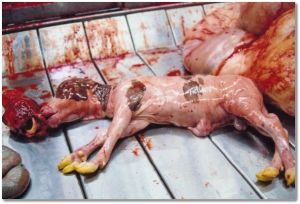
Oh yes! humans have rights and animals don’t, because … … because we human animals have just defined this fascist supremacy!
Animal Liberation Queensland VimeoEven as a vegan for many years, I had not heard of this horror until recently. That this is an accepted method of “animal husbandry” is wretched, that it is concealed as “animal husbandry” is vile.
It has been relentlessly and successfully proven that if a human can devise a form of torturous confinement, causing abject pain and maximum suffering, apathetically and indifferently, and then provide the most harrowing and terrifying death, it has been achieved on animals.
If you participate in animal exploitation in any form (consumption, products, entertainment, clothing, etc.), you contribute to this hell that humans inflict on sentient creatures – like humans, cats, and dogs – effortlessly, willingly, and without condemnation.
“Welfare” laws are 100% meaningless to the victims who suffer for them, there is no part of “welfare” that includes suffering and violence, which occurs in ALL animal exploitation; even the most “cared-for” animal is used and then killed. Using terms like “welfare” and “humane” and “husbandry” to define exploitation requiring bodily control, intrusion, violation, and violent death (yes, killing any unwilling being is inherently violent absent suffering, defense) means those human-manufactured, self-soothing terms are for HUMANS and not the victims of them. If you care, you don’t exploit. SL
Footage released in January shows filthy conditions, violent abuse by workers, untreated wounds, and one boar left to slowly die over several days.
Authorities have failed to prosecute and boars continue to suffer in this facility every day.
This is the reality for animals that live within this broken system, but thanks to you, more and more people are becoming aware and turning away from animal agriculture.
You’ve heard of sow stalls, but did you know about boar stalls?
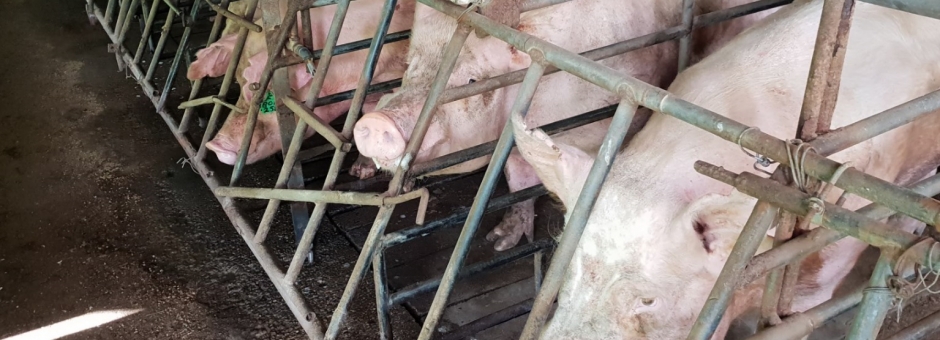
In an unseen facet of pig farming, boars are kept in small stalls all their lives, only being released for a brief time for semen collection a couple of times a week.
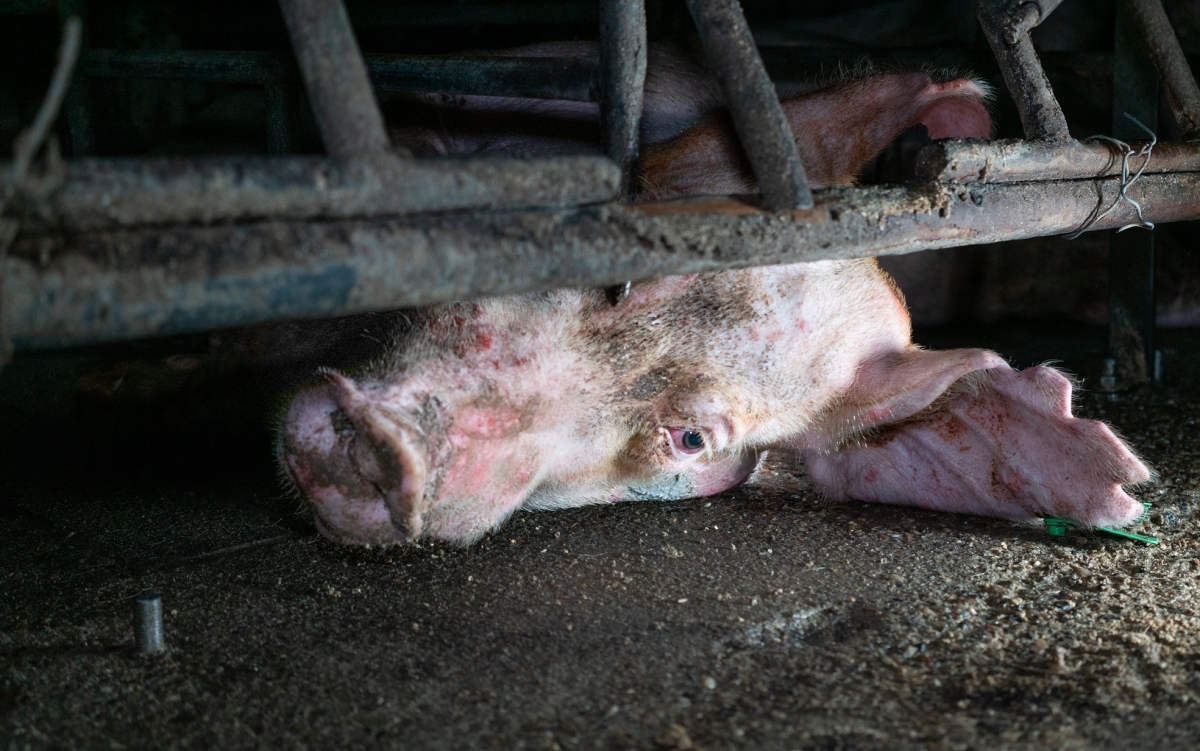
Semen collection farms are a relatively unknown facet of the industry. At this facility, at least 20 boars are kept in tiny stalls – most are equivalent to sow stalls – with no room to turn around, and barely enough room to even lie down. They have no enrichment, they are left with untreated injuries, fed only the minimum food required to keep them alive and “useful”, and are routinely abused. The only time the boars leave their tiny, filthy stall is for semen collection.
When we received the footage our immediate concern was around the strong possibility of another boar suffering a similar fate to Boe from untreated illness and dying a slow painful death. We immediately informed the authorities with a complaint to RSPCA Qld and passed on the video footage. RSPCA Qld acted quickly and arranged a team of inspectors and vets from both RSPCA Qld and Biosecurity Qld to conduct a surprise inspection.
We understand at least one boar was euthanised that day. After that, the rest of the investigation was handed over to Biosecurity Qld. In Queensland, a Memorandum of Understanding exists in which all farmed animal issues are referred to Biosecurity Qld, which is part of the Queensland Department of Agriculture.
On receiving no further updates from Biosecurity Qld, and realising authorities were not taking this seriously, we released the footage through two videos.
First, on 6 March, Animal Liberation Queensland & Animal Liberation (NSW) released Boe’s story. The public reacted and shared Boe’s story resulting in more than 630,000 views on Facebook.
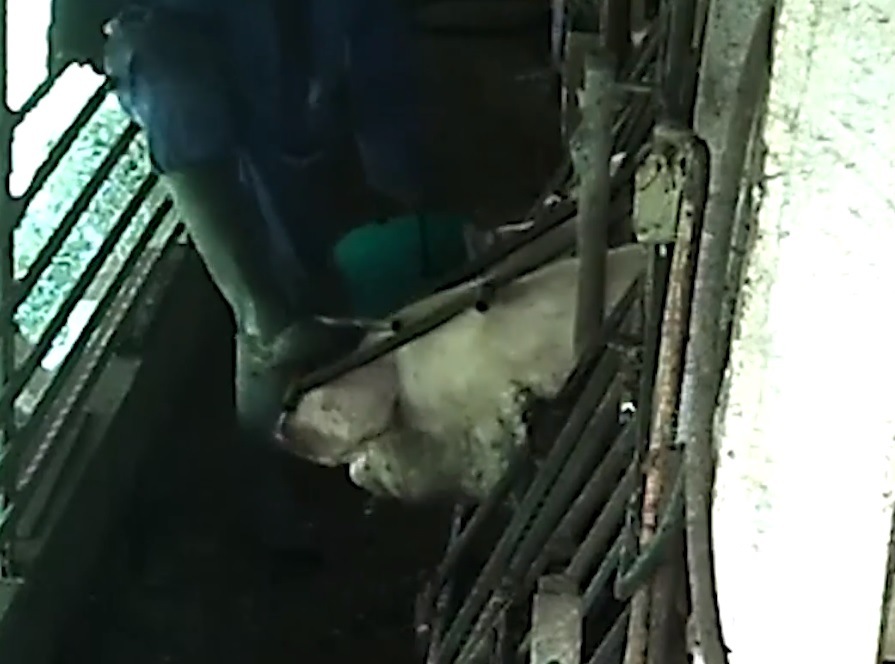
On 11 March we released the second video documenting further abuse and filthy conditions. Faeces and infestations were found throughout the facility. Video footage shows the worker kicking the boars, stomping and smashing metal bars against a boar’s head.
After numerous follow-ups with the Department, we learned that several “direction orders” were given to the owner to rectify issues they had found in their inspection. Biosecurity Queensland has confirmed that they have been back multiple times since the initial inspection and they are satisfied that all direction orders are being adhered to. In other words, it seems they will not be taking further action and have given this place the tick of approval. In practice, very little has changed for the boars that may spend the rest of their lives in these barren rusty metal cells. From the information we have, the direction orders related to the untreated wounds, and the maintenance or uncleanliness of the facility. There is nothing that will give any sense of relief to these boars and nothing that will stop others from meeting a similar fate to Boe.
Despite numerous requests for further information authorities would “not comment on the outcome of any investigations”. We can, unfortunately, conclude that no charges have been laid – despite numerous animal cruelty abuses outlined above that were documented by investigators, as well as issues during the inspection by authorities. If these boars were dogs, the owner and workers would now be facing court.
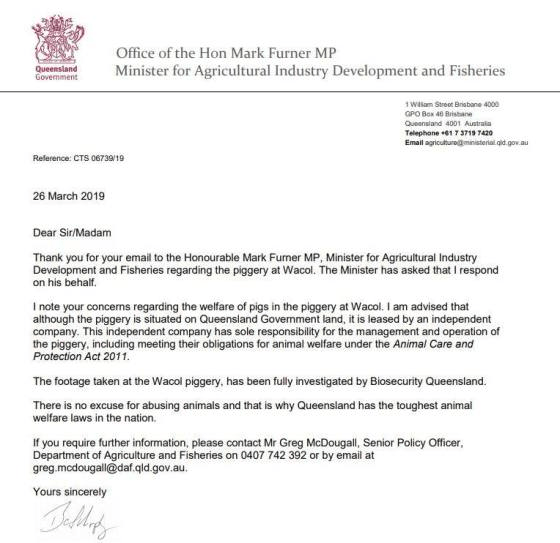
More than 3000 people sent emails of concern to the Minister for Agriculture. A couple of weeks later his office sent out a generic reply showing very little concern:.
Above: Minister’s office response to public concerns regarding lack of action taken by the Department.
Above: Injuries were left untreated.
We have also raised several conflicts of interests. Firstly, the land on which the Wacol pigs are incarcerated is leased from the Department of Agriculture – the very Department that is responsible for upholding animal welfare laws – is also taking money from this facility. The Minister failed to see any conflict here.
Secondly, this issue reminds us of the conflict of interest that exists for all animal agriculture. The Department of Agriculture in each state is responsible for growth and economic sustainability of the industry, but at the same time has the responsibility to enforce the Animal Care and Protection Act – and to police the very businesses it seeks to promote and grow. Both the Premier and Minister continue to ignore this very clear conflict of interest.
We are grateful to the investigators who took great risks to bring this cruelty to light. This is a thankless task, being confronted first hand with this cruelty. We greatly appreciate the thousands of you who complained to the Minister, made phone calls, and shared the video footage.
Sadly, this is the reality of millions of animals used and abused around the country every day. It is no wonder we see cruelty like this when the system is set up to fail these animals. As long as we have a society that supports, embraces and even celebrates animal agriculture, scenes like this will continue to be commonplace.
Know that this hasn’t all been for nothing. Hundreds of thousands of people have had their eyes opened to the reality of animal agriculture. For countless people, this was the final straw, and they have committed to going vegan. For others, this may be the start of their journey.
We can all help through our daily choices. By choosing vegan alternatives and never buying meat, dairy, eggs and other animal products, we take away the demand. Speak to your friends and family. Keep sharing footage and stories on social media. Keep writing and calling the Ministers, and speak to your local MP. Volunteer with or donate to animal advocacy groups.
Pressure on industry and government is growing every day, and every day the public is becoming more and more informed. Sadly, these industries of cruelty will not close down overnight, but with your help their days are numbered. We will keep fighting, and we will achieve animal liberation.
Take PETA’s Cruelty-Free Shopping Guide along with you next time you head to the store! The handy guide will help you find humane products at a glance. Order a FREE copyHERE
Searching for Cruelty-Free Cosmetics, Personal-Care Products, Vegan Products, or more? Click HERE to search.
Free PDF of Vegan & Cruelty-Free Products/Companies HERE
Want to do more than go vegan? Help others to do so! Click below for nominal, or no, fees to vegan literature that you can use to convince others that veganism is the only compassionate route to being an animal friend:
50 NGOs call on the European Commission to end the promotion of meat and dairy
19 September 2021
Eurogroup for Animals have signed a letter to the European Commission together with 50 NGOs calling for an end to the promotion of meat and dairy.
The EU promotion policy for agricultural products has previously funded campaigns that have aimed at increasing meat and dairy consumption with slogans such as “Milky is great” and “Pork lovers Europe”. Some campaigns have specifically targeted young people with the aim to reverse a declining trend in meat consumption among European youth.
The European Commission is currently reviewing the promotion policy, with “a view to enhancing its contribution to sustainable production and consumption, and in line with the shift to a more plant-based diet, with less red and processed meat and more fruit and vegetables”, as emphasised in both the Farm to Fork Strategy and Europe’s Beating Cancer Plan.
The letter points out that in the last four years the European Commission spent 32% of its €776.7 million budget for agrifood promotion on advertising campaigns for meat and dairy. The European Commission also spent 28% of the promotion budget on the promotion of mixed baskets of products, almost all of which included meat and dairy. This use of public money goes contrary to the established science about the negative impact on the environment and on public health of current diets that are heavy in animal protein.
The letter calls on the Commission to support the public interest to stop the promotion of meat and dairy and instead shift the promotion policy to promote healthy, sustainable plant-based food.
“Plant-based foods deserve wider promotion to benefit public health, the environment, and farmers. However, a shift towards a more plant-based diet can only be achieved if, in addition, the plant-based sector receives sufficient support to grow and to produce alternatives that can adequately mimic the texture, taste, and price of conventional meat and dairy products.”
European Commission to ban beef, soy and palm oil imports linked to deforestation
20 September 2021
The European Commission will propose in the next months a piece of legislation aiming at banning imports of certain products linked to deforestation. Eurogroup for Animals welcomes the initiative, but calls on the Commission to avoid any loopholes that would defeat the purpose of the legislation.
In a bid to minimise the risk of deforestation and forest degradation associated with products placed on the EU market, the European Commission will propose by December 2021 a piece of legislation that would encompass product-specific due diligence requirements, and a prohibition of placing deforestation-related commodities on the EU market. This legislation should complement other EU initiatives aiming at further embedding sustainability into corporate governance, such as the upcoming proposals on Due Diligence and non-financial reporting.
The scope will be limited to products with “the highest global contribution to deforestation” such as palm oil, wood, cocoa, coffee, beef and soy. The legislation would apply to all origins, “without geographical indication”, but it would create a system categorising countries into “low, standard and high risks of deforestation”, with simplified due diligence duties for low risk countries, and enhanced scrutiny for high risk ones.
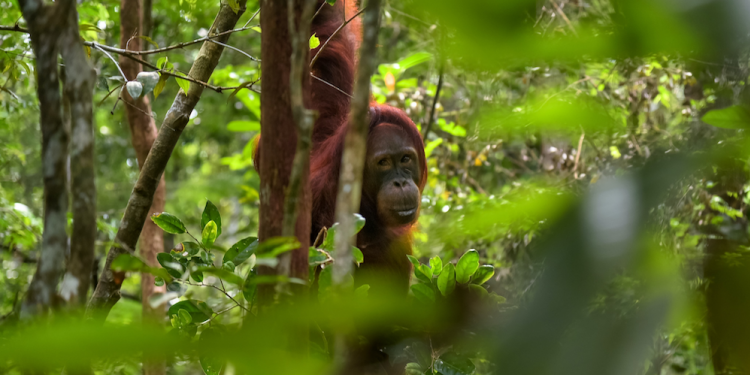
The proposal is interesting for animals in regions of the world where intensive animal agriculture or economic activities fuels deforestation. For instance, by banning imports of palm oil linked to deforestation, the habitats of wild animals such as orangutans and gibbons could be better preserved. Also, the welfare of farmed animals used in intensive productions could be improved, as intensive animal agriculture – which fuels deforestation as requiring crop feed – would be dissuaded. If Mercosur countries are categorised as “high risk countries” – two of the main products responsible for deforestation in Mercosur are beef and soy for animal feed – the legislation could possibly ban or restrict the imports of these products into the EU.
Eurogroup for Animals welcomes this initiative as producers intending to export to the EU would be incentivised to switch to more sustainable food production systems. However, the upcoming legislation must avoid loopholes that would defeat its purpose. For instance, the scope of the legislation needs to be improved as some products that are currently left out contribute to deforestation. Pig and poultry meat are for now excluded, but these animals are most often fed with soy, which largely contributes to deforestation. Avoiding this “distortion” is all the more important as some trade partners of the EU, such as Ukraine, exports significant quantities of poultry meat to the EU under the EU-Ukraine FTA. This means that Ukraine – biggest supplier of poultry meat of the EU – could feed the chicken from which the meat it exports derive with soy linked to deforestation that would be banned in the EU.
The geographical scope of the legislation must include other ecosystems in addition to forests, as the EU’s consumption of beef, soy and palm oil is linked to the destruction of other ecosystems such as grasslands, wetlands, and savannahs. The categorisation system of “low, standard and high risks of deforestation” could open the way for goods which have been produced on illegally deforested land, to be ‘green washed’ through a “low standard” country.
Considering that agriculture-driven deforestation is permanent (whereas lands that suffer from deforestation caused by fires may regenerate), there is urgency for the EU to uphold its sustainable agenda. The EU must adopt this legislation before the ratification of any FTA with Mercosur. Mercosur is already the largest supplier of beef to the EU, accounting for 73% of total EU beef imports. If the EU-Mercosur trade deal was implemented as it stands, imports of beef would increase between 30% and 64%. The Ambec report – the impact study commissioned by the French government – concluded that, as it stands, the EU-Mercosur agreement would generate an extra 25% of deforestation in the Amazon in the six years following its entry into force.
Hundreds of thousands of leaflets will never be able to develop as much force against the meat mafia as the actions of compassionate people who actively save these beautiful and characterful animals and only finally give them the opportunity to show who they are.
In the Romanian capital derby there was a special action over the weekend. The Dynamo Bucharest players ran onto the pitch with dogs in their arms.
To draw attention to animals without a home, the Romanian Football Association has come up with something very special.
At the derby of the two city rivals of the Romanian capital Bucharest, Dynamo and Steaua, the players of the former team showed a heart for animals.
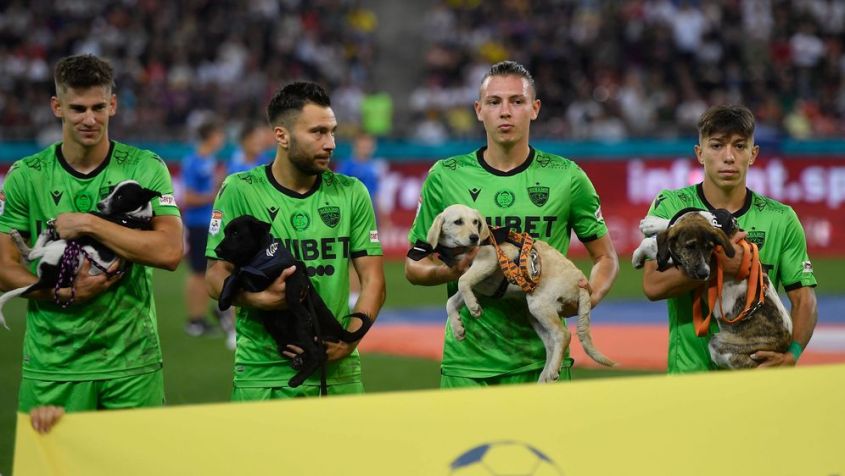
Four football players from Dynamo Bucharest before the game with their dogs from the shelter and from the street.
Before the match, they marched with dogs from the Romanian public shelter Branesti on the stadium lawn to draw attention to the suffering of the Romanian strays.
This campaign aims to encourage fans to adopt dogs from the often hopelessly overcrowded animal shelters.
Throughout the season, footballers will run into games with dogs from the shelter or from the street with the goal to find new owners for the four-legged friends.
Romania has had a significant problem with street dogs for many years, and stray dogs have a difficult time in Romania.
There are hardly any comprehensive, effective castration projects and unfortunately there are still killing stations.
The goal: respect and love for the dogs
Under the name “Fill the void in your life”, the beginning of the unique project was made last weekend in Bucharest. The dogs come from the local animal shelters or from the street and each have a small scarf with their name around their necks.
If viewers want to adopt one of the four-legged friends, they can easily get in touch with the initiators of the project.
The prerequisites have also been created within the stadium so that the dogs can attend the games without any major problems. All fireworks and pyrotechnics were banned.
At the weekend, the fans also adhered to these requirements.
A nice action that will definitely make one or the other dog’s life a lot nicer!
And I mean…When footballers walk into the stadium before the game, there is usually a familiar image: They almost always have small children on their hands who can come into contact with their idols and fulfill a childhood dream.
Now Romania gives us a new message: All animal lives matter!
We hope that their action has touched many people and will lead to the adoption of a stray dog from one of the animal shelters.
THANK YOU, DYNAMO !!!
A recent report by SMACC (Social Media Animal Cruelty Coalition) documents how animal cruelty is being promoted.
Videos on the social media platforms TikTok,YouTube and Facebook were analyzed for 13 months.
Perhaps the most amazing revelation is that the approximately 5,480 individual videos that were documented were viewed a total of 5,347,809,262 times at the time the report was written.
89.2% of them were hosted on Youtube because they are easier to find there.
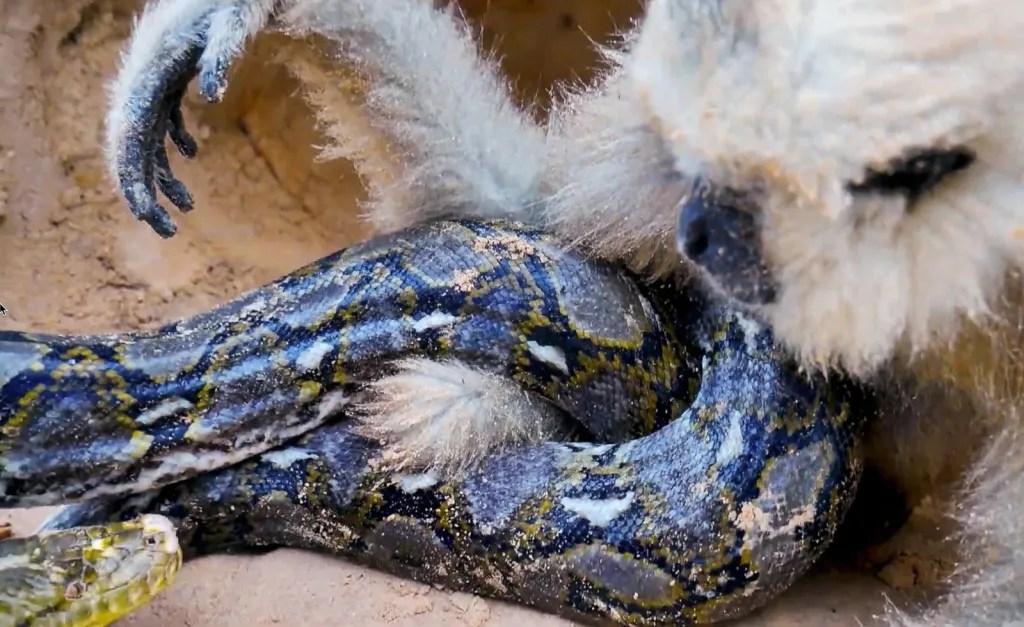
In one of the many staged animal rescue videos on YouTube, a dark tiger python wraps around a gibbon. The great ape is freed by a man who appears at the scene with a video camera, apparently “by chance”.
This staggering number is associated with extreme agony for the animals concerned – and the platforms that host such content have benefited by millions, according to the report.
The data clearly confirm that online content that is cruel to animals is a major global problem.
The five most commonly shown animal species were birds of various species, dogs and cats, wildlife, snakes, and primates.
Social Media Animal Cruelty Coalition (SMACC)
In 2020, founded the Asia for Animals (AfA) network – SMACC – to answer the hundreds of inquiries its member organizations have received.
The main SMACC organizations include: Action for Primates, AnimalsAsia Foundation, Humane Society International, PETA Asia and World Animal Protection.
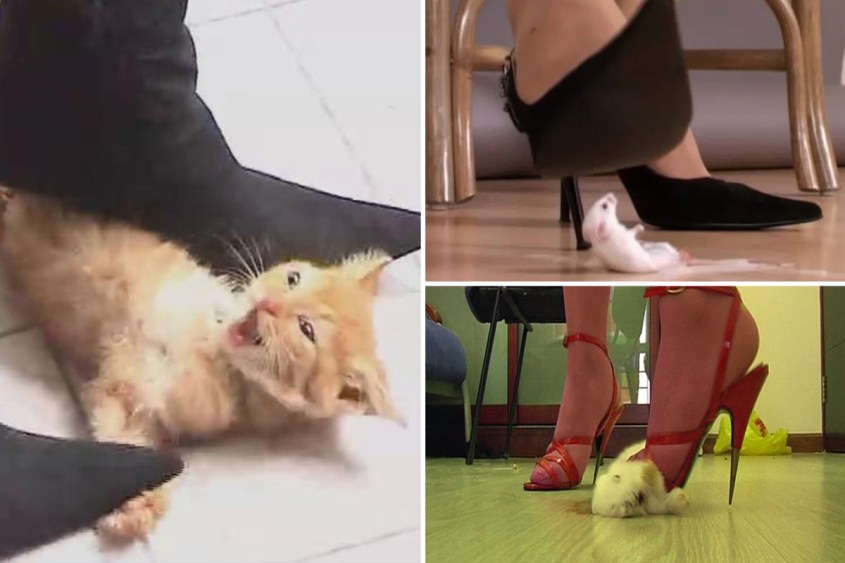
E-mails and phone calls described horrific animal cruelty to organizations, including the burial of live animals, the mistreatment of companion animals, the setting on fire and the recent fake rescue videos – all posted freely on social media.
According to the SMACC report, the videos found on social media platforms showed animals being drowned, broken limbs, and even how mothers were killed and their babies stolen from them.
The report states that “animals have become silent victims of the hunt for clicks and advertising dollars as videos promoting, encouraging, and benefiting from their abuse become rampant”.
Hunt
The hunting videos regularly feature foxes, hundreds of species of birds and wild boar, as well as animal fights.
Of the 5,480 videos that were recorded, 2,634 were assigned to the topic of “hunting”. These videos often show protracted deaths, extreme suffering, and both legal and illegal hunting methods used by the hunters.
The availability of thousands of hunting videos on social media platforms encourages this cruelty.
It is actively encouraged and normalized while the activity is being sold as “fun and exciting” and at an extreme cost to the wildlife.
The report quotes Nick Stewart, World Animal Protection’s Global Head of Wildlife Campaigns, as saying, “Wild animals are not props, toys, or entertainers; they are sentient beings with a right to life.”
Adam Parascandola of Humane Society International said, “The devastating data uncovered by this research only scratches the surface to reveal the shocking levels of animal cruelty on social media.”




 Oh yes! humans have rights and animals don’t, because … … because we human animals have just defined this fascist supremacy!





 Four football players from Dynamo Bucharest before the game with their dogs from the shelter and from the street.