3 pages in total Click on page numbers at end to read and see all.
Hi all; we have been getting some very positive news about wet markets through from Animal Equality. We have thrown everything into one post here – although you may read some things twice, this just because we have provided all the information from various mails we have had in.
The videos are worth a watch if you can stomach them. I will tidy this up later when there is time – things are arriving en masse now.
Regards Mark
————————————-
Hi Mark,
I have good news for you: We’re starting to see the first steps of progress in phasing out live animals at wet markets!
Here’s a quick reminder of the events leading up to this:
Animal Equality first exposed the reality of cruel and dangerous wet markets at the beginning of the COVID-19 pandemic in April 2020. These live animal markets were still relatively unknown to the general public at the time.
Our investigative team returned to these horrific places in May 2021 and discovered that nothing had changed despite claims of shutting down operations for safety. Wet markets were still a threat to human health and causing unimaginable suffering for animals.
Thanks to this investigation, we were able to show the brutality of these markets and launched an international campaign to demand their closure. The petition received overwhelming support, collecting nearly 600,000 signatures.
In April, the World Health Organization called for a ban on the sale of live wild mammals in food markets worldwide to prevent the emergence of new diseases.
And just a month ago, I delivered your signatures to world leaders at the United Nations asking for a ban on the sale of all live animals at wet markets.
Mark, now here’s the exciting update I have for you:
The Parliament of Singapore has spent a year reviewing legislation concerning the safety and welfare standards of animals sold for food in wet markets. As a result, the Singapore Food Agency (SFA) has confirmed a ban on the sale and slaughter of turtles and live frogs.
This is one of the biggest animal protections made in Singapore’s history.
Learn about the science of plant-based meat. Discover resources and research projects on the latest technological developments and key scientific questions.
Introduction to plant-based meat
What is plant-based meat?
GFI uses the term “plant-based” to refer to products made from plants that are alternatives to animal-based products. This includes plant-based meat, seafood, eggs, and dairy. This overview focuses primarily on the science of plant-based meat and seafood.
The concept of plant-based meat is not a modern development. The prevalence and variety of plant-based meat has steadily increased for centuries. However, many of the early plant-based meat products were designed with vegetarian consumers in mind. Early plant-based meats did not try to exactly replicate, or biomimic, conventional meat.
Recent concerns about sustainability, food security, and the environmental and public health impacts of industrial animal agriculture have spurred a sense of urgency to develop plant-based meats that appeal to mainstream consumers rather than niche markets. This has led to an explosion of innovation during the last decade. Today’s plant-based meat options appeal to the fast-growing segment of “flexitarian” consumers.
What is the market for plant-based meat?
Flexitarian consumers are looking for plant-based meat options that create the same sensory experience as animal-based meat. These consumers deliberately reduce their meat consumption but do not completely give up animal-based products. This decision to eat more plants is often due to concerns about health, the environment, or animal protection. It may also simply be a way of obtaining novelty and variety with flavorful and affordable meals. The rise in flexitarianism is creating considerable market growth for plant-based foods.
Despite the market growth in plant-based foods, plant-based meat is currently only about 1% of the US retail meat market. For plant-based meat to become a significant part of the global meat market in the coming decades, there remains tremendous need for additional R&D. This innovation and subsequent growth of the plant-based meat industry will only be realized through a concerted and collaborative effort to direct resources (financial, human, and technological) to this area.
At long last, we are able to share with you an Animal Aid investigation, which will be featured exclusively on BBC One’s Panorama tonight (Monday 19 July) at 8.30pm. You may have seen pre-broadcast coverage in newspapers and on the radio today.
Our world leading investigations team were able to film inside a UK abattoir that slaughters horses and ponies. Their cameras captured, in heart-breaking detail, the final moments of hundreds of these innocent animals, who, finding themselves unloved and unwanted, were shot in the head. We witnessed a wide variety of equines being killed in this place – from tiny ponies to Thoroughbred horses from the racing industry. The meat of these gentle animals is destined for human consumption.
We do not know the exact content of the programme, but we do know it will use some of our undercover footage and will reveal some shocking information about how many horses from the racing industry face slaughter in abattoirs.
2 Sign our petition to the government which calls for a limit on the numbers of horses being bred each year. Fewer horses produced means fewer horses having their lives taken from them in an abattoir.
3 Please keep an eye on our social media pages while the programme airs and help to amplify our message impact by sharing our posts and tweets
No ban on sale, sacrificing of animals on Eid-ul-Adha in JK, says Admin
Srinagar: Divisional Commissioner Kashmir P K Pole on Friday said that there is no ban on the sale and slaughter of sacrificial animals in the Valley as it’s a religious obligation done in memory of Prophet Ismail (AS).
The Divisional Commissioner said that the administration is providing full support to facilitate the import of sheep, goat, and poultry to Kashmir on the eve of Eid-ul-Adha.
“There is no ban on slaughter and sale of sacrificial animals. It’s a religious obligation done in memory of Prophet Ismail (AS) and we need to respect it,” Pole said. He said the administration facilitates entry of sacrificial animals at Lower Munda into Kashmir after proper testing etc. “We also test poultry birds for bird flu before allowing them to enter into the Valley,” Pole said.
He said that as far as bovine animals are concerned, there is already a ban on killing such animals. “It is not done in Kashmir and if it is done, action will be taken,” he said.
On the letter issued by the Director Planning Animal and Sheep Husbandry calling for the ‘ban on slaughtering of bovine and sacrificial animals’, the divisional commissioner said that letter is not above the rule position and the act is supreme.
“We need to see whether the letter has been issued keeping in view the legal aspect,” he said.
Interestingly, the letter had gone viral on social media evoking sharp criticism from the netizens and also from the Mutahida Majlis-e-Ulema (MMU), an amalgam of Kashmiri Ulemas. Many netizens had termed it as direct interference into religious affairs.
“Care must be taken before passing any information which involves religious aspects and as every religion should be honored and respected”, he added.
Director Animal, Sheep Husbandry department Kashmir Purnima Mittal said, first of all, she didn’t issue any order and it was just an advisory. “This is an advisory issued in response to the Animal Welfare Board of India. These are just norms for the animals for sacrificial animals,” she said.
“This is an advisory issued to prevent cruelty against the animals. This calls for banning the slaughter of animals that are three months old or in case the animal is pregnant.”
She said that there is no ban on sacrificing animals on “Bakra Eid” and the letter issued by the department only focuses on the norms to be followed while transporting animals meant for sacrifices on Eid eve. (KNO)
A comment left by one of our well known supporters:
Imagine violently killing animals as a “religious obligation” but denying those same beings religion. No god demands suffering to prove loyalty or as an entrance requisite to “heaven”. This is just human barbarity, psychopathy, and blood-lust violence disguised as “religious exercise” and accepted as such.
For sure, MY “religious obligation” is to protect and save animals, how dare they infringe on MY rights when MY rights require ZERO suffering, violence, and pain. These people are trash.
The wildlife trade could cause future disease outbreaks Credit: Adobe.
WAV Comment – we see and hear a lot about the causes; the real problem is that nobody has got the balls to take the case in hand and do something positive about it. Roll on more studies, inactive world governments; lots more deaths and ……………… ignorance of the causes !
Wildlife Trade Is ‘Key Risk Factor’ Behind Global Spread Of Disease, Study Finds
New research found that the wildlife trade is increasing the risk of another global pandemic
A new study looked at the wildlife trade’s impact on the transmission of viruses. Researchers warned that the wildlife trade could increase the risk of zoonotic outbreaks, including those with global ‘pandemic potential’.
A zoonosis is an infectious disease transmitted between animals and humans. According to the World Health Organization (WHO), some diseases can begin as a zoonosis but develop into human-only strains – one example is HIV.
The analysis, which was led by The Nature Conservancy, was published in the journal Current Biology. The Nature Conservancy teamed up with the Ashoka Trust for Research in Ecology and Environment (ATREE) in India to conduct the study.
Researchers studied 226 viruses known to cause zoonotic diseases across more than 800 mammal species. They categorized the animals into three groups: traded mammals, non-traded mammals, and domesticated mammals.Researchers found that one-quarter of mammal species in the wildlife trade host 75 percent of the known zoonotic viruses. Compared to domesticated and non-traded species, commonly traded mammals had a ‘much higher’ risk of transmission.
Preventing the next pandemic
Lead author Dr Shivaprakash Nagaraju is a Senior Scientist for The Nature Conservancy in India. He said: “From our findings, it is conceivable that wildlife trade (legal and illegal) is the key risk factor driving the global spread of zoonotic and emerging infectious diseases.”
The international wildlife trade leads to more than one billion direct and indirect interactions between wildlife, domesticated animals, and humans, he added.
Dr Nagaraju said he hopes the research will guide global health experts on where to ‘concentrate their efforts to prevent the next global pandemic’.
Dr Joe Kiesecker is the co-author of the study and a Lead Scientist for The Nature Conservancy. He said: “If we want to stop the next pandemic before it starts, our findings indicate that we should, among other measures, focus our efforts on keeping rodents, bats, primates, ungulates, and carnivores out of wildlife trade.”
Other pandemic concerns
Humans interfering with animals has sparked concerns about disease outbreak before.
A January poll found that roughly 85 percent of Brits support an ‘urgent’ ban on factoring farming, due to concerns about COVID-19. The following month, reports found that the H5N8 strain of bird flu had infected humans for the first time.
And in June, 67 infectious disease experts wrote a letter urging for the end of fur farming.
“The intensive breeding conditions typical on fur farms – animals unnaturally crowded together, poor hygiene, stress, injuries and low genetic diversity – are ideal for the creation and spread of novel pathogens,” the letter reads.
“To risk jeopardising our ability to control and end this or future global coronavirus pandemics, for the sake of fur fashion production, would seem imprudent.
“We therefore support the call by [Humane Society International] for a permanent global end to the breeding, keeping and killing of animals for the purposes of fur production, and the sale of fur.”
Boris Johnson Urged ‘To Lead World Leaders’ Towards Global Fur Farming Ban To Avoid Future Pandemics
67 infectious disease experts have written to the UK Prime Minister – highlighting how fur farms are ideal for the creation and spread of novel pathogens
UK Prime Minister Boris Johnson is being urged to lead world leaders towards a global ban on fur farming.
67 infectious disease experts have written to the politician ahead of the G7 summit.
The event brings together the heads of governments from a slew of wealthy democracies such as Canada and the US. It will be hosted in Cornwall, England, at the end of this week.
Global fur farming ban
The letter comes from virologists, epidemiologists, infectious disease specialists, veterinarians, and animal behaviorists from 16 countries. Moreover, it is coordinated by animal protection NGO Humane Society International (HSI).
“It’s clear fur farms have the potential to act as reservoirs of SARS-CoV-2…” reads the letter.
“The intensive breeding conditions typical on fur farms – animals unnaturally crowded together, poor hygiene, stress, injuries and low genetic diversity – are ideal for the creation and spread of novel pathogens.
“Severe animal welfare deficiencies are inherent to factory fur farming. The trade creates the potential for the many tens of millions of animals on fur farms to act as immediate, intermediate, or amplifier hosts for viral pathogens.
“To risk jeopardising our ability to control and end this or future global coronavirus pandemics, for the sake of fur fashion production, would seem imprudent. “We therefore support the call by HSI for a permanent global end to the breeding, keeping and killing of animals for the purposes of fur production, and the sale of fur.”
COVID-19 outbreaks
The letter follows more than 400 outbreaks of SARS-CoV-2 on mink farms across Europe, the USA, and Canada.
Some governments, such as the Netherlands and Hungary, have taken decisive action to stop mink fur farming in their jurisdictions.
Moreover, 14 countries globally have banned fur farming completely. However, species susceptible to COVID-19 are still being reared for their fur across the world.
‘A stark warning to governments’
Claire Bass is the executive director of HSI UK. In a statement sent to PBN, she said: “Virologists, veterinarians and disease experts from around the world have provided a stark warning to governments about the public health risks of exploiting wild animals in unsanitary, overcrowded and inhumane fur factory farms, simply for the sake of frivolous fashion.
“Not only is fur farming inherently cruel to animals. But, the potential for zoonotic disease spread, and for mink fur farms, in particular, to act as reservoirs for coronaviruses is another compelling reason for governments to shut down the fur industry for good.
“We can no longer ignore that fur farms make for a perfect petri dish for pandemics.
Bass then concluded: “As the first country in the world to ban fur farming two decades ago… The UK is in a unique position to urge world leaders to take decisive action with a global ban.”
On July 15th, the Puebla State Congress in Mexico approved an initiative tabled by local MPs with 34 votes in favor, 0 against and 2 abstentions that criminalize the operation of illegal slaughterhouses and the slaughter of animals without prior stunning represents.
This initiative comes after discussions that Animal Equality in Mexico participated in with various authorities in the Puebla government to reach a final consensus.
Aitor Garmendia / Tras los Muros-Mexico
What is the problem?
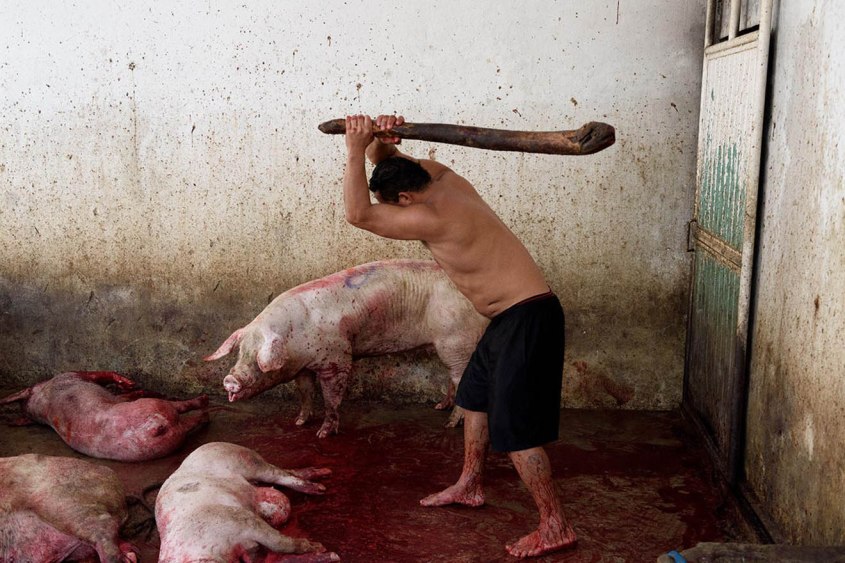
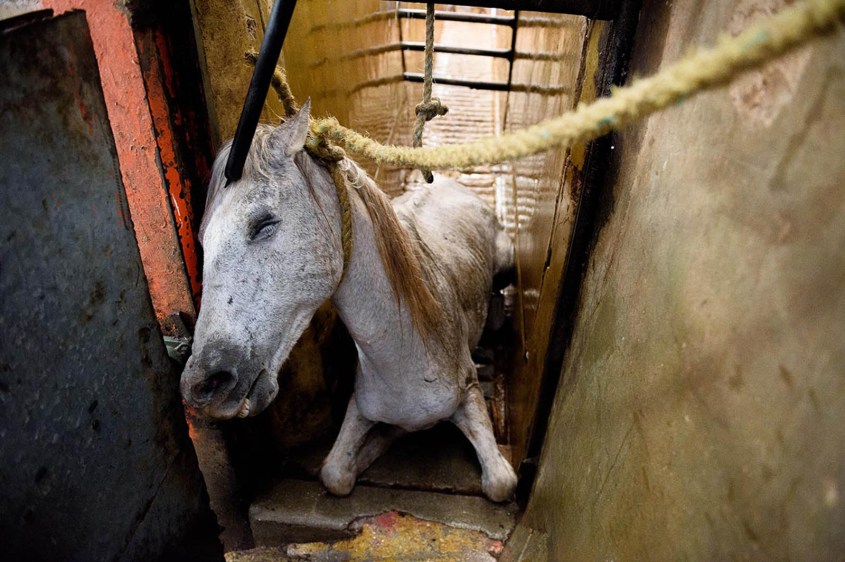
Secret slaughter harbors public health risks, contamination from poor waste management and, above all, great suffering for the animals.
In addition, it is not checked whether prohibited substances have been administered, such as growth promoters, which affect the health of animals and humans.
In addition, it does not comply with the official Mexican standard NOM-033-SAG / ZOO-2014 regarding methods of killing domestic and wild animals.
These places do not have the necessary infrastructure and tools to stun the animals before slaughter, causing them untold suffering.
Aitor Garmendia / Tras los Muros-Mexico
What does the reform say?
The reform adds an article to the chapter of the Puebla Criminal Code on crimes against animals as follows:
A prison sentence of one to four years and one thousand to two thousand times the daily rate is imposed on everyone who …
-has a room for unregulated slaughter, in addition to imposing the closure of the property whose purpose is slaughter.
– carries out the slaughter of animals for human consumption without prior stunning.
WAV Comment: Here in England; there has been no real summer – it has rained a lot for weeks; suddenly in the last few days it is clear sky and temperatures are at 31 degrees. Germany, Belgium and the Netherlands are having huge rainstorms, and over 150 people have been killed.
Mr EX President Trump was full of self gratification for pulling out of the Paris climate accord agreement. I remember watching all the ‘seals’ clapping him on the White House lawn when he announced. Fortunately President Biden has tons more sense and has re joined.
If anyone wants to send this to Trump, and Bolsonaro, then great. 2 fools who between them have contributed to major global environmental damage. Thank god that at least one of them is no longer in charge !
Above – Germany (BBC)
Amazon Rainforest Now Emits More CO2 Than It Absorbs For First Time
Animal agriculture has been linked to the worsening state of the Amazon rainforest
For the first time, the world’s largest rainforest is worsening the climate crisis, a new study has found. The Amazon rainforest’s ability to absorb emissions once slowed down climate change, but it now expels a billion tonnes of carbon dioxide every year.
Many of the emissions are caused by fires intentionally set to clear land for beef and soy production. A lot of the soy produced is fed back into the meat industry. In fact, according to WWF, nearly 80 percent of the world’s soybean crop is fed to livestock.
Rising temperatures and droughts are also contributing to increased emissions.
Brazil’s National Institute for Space Research led the study, which spanned over a nine-year period. Researchers launched around 600 flights over four main sites in the Brazilian Amazon. This allowed them to record carbon dioxide and carbon monoxide levels up to 4,500 meters above the forest.
They discovered that while the rainforest soaks up 0.5 billion tonnes of CO2 annually, it emits 1.5 billion. The remaining 1 billion tonnes left in the atmosphere is equal to the annual emissions of Japan – the fifth-largest polluter in the world.
Luciana Gatti, who led the research, said to The Guardian: “The first very bad news is that forest burning produces around three times more CO2 than the forest absorbs.
“The second bad news is that the places where deforestation is 30 percent or more show carbon emissions 10 times higher than where deforestation is lower than 20 percent.”
She added: “Imagine if we could prohibit fires in the Amazon – it could be a carbon sink. But we are doing the opposite – we are accelerating climate change.”
Do you remember that story we published four years ago?
It was about building a shark aquarium in southern Germany.
An investor wanted to build the biggest shark aquarium in Europe: “Shark City”.
Today we received very good news!!
The translation of the mail I received:
“Since this week it is certain that the “Shark City” shark aquarium will not be built. This saves countless sharks from capture and a painful life in captivity.
A group of investors originally wanted to build the large aquarium in Sinsheim in Baden-Württemberg (southern Germany). After massive protests by residents and animal and species protection organizations from all over Germany, the operators relocated the construction project to Pfungstadt in Hesse.
Even before the public found out about it, the city council in Pfungstadt voted to sell urban land to investors. But resistance was also very massive in Pfungstadt. Within a very short time, the local shark protectors managed to collect enough signatures for a referendum, which was rejected by the city council.
In 2019, the operators submitted a development plan. Then Shark City suddenly became quiet. In May of this year it became known that the property reservation had expired without the purchase contract being signed. The operators did not show up at a date agreed with the city. The company disappeared from the Internet.
This week the city council in Pfungstadt repealed all resolutions regarding the shark aquarium.
“animal public” has repeatedly intervened with the responsible politicians and the responsible authorities against the construction of the shark aquarium and supported the active citizens on site.
We are pleased that countless animals have been spared a short, dreary existence in captivity. This was only possible thanks to the cooperation of numerous organizations and active citizens, whom we would like to thank from the bottom of our hearts. Such successes give hope because they show that we can change a lot together.
Thank you very much for your compassion and support”
Animal Public
And I mean…When the famous German playwright and librettist Bertolt Brecht was asked what is the point of all the resistance against the Nazi regime at the time, the dead victims, the prisoners … he thought a little and said: “Without us, they would have had it much easier” . With us this is now a reality, the shark prison belongs to history!
What do we learn from it?
United and active, we can also achieve great things.
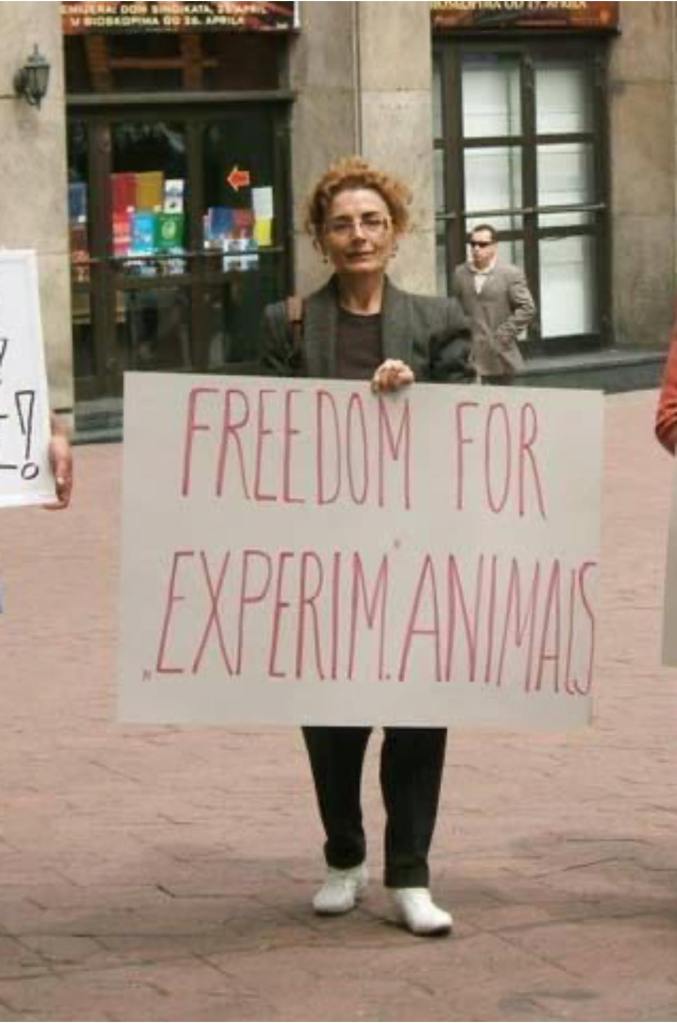
It’s been a year since the animal rights activist and our loyal friend Slavica Mazac-Bešlić passed away.
We have not forgotten them and we will always remember their tireless struggle for animal rights.
The fight continues, Slavica, but it is still very sad for us and the animals that you can no longer fight with us and for them, as you always wanted and have done.
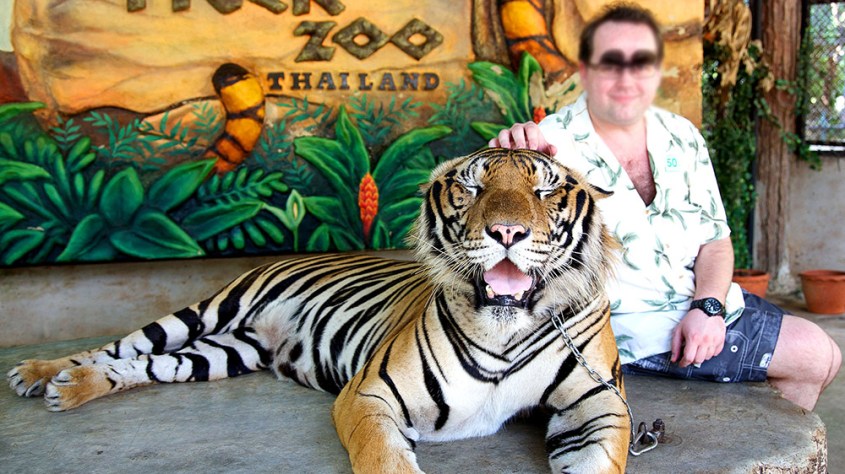
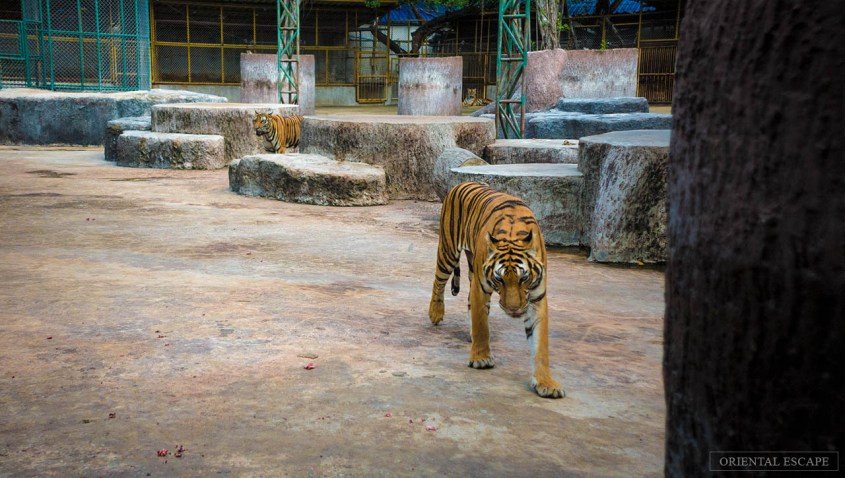
In Thailand, a well-known tourist attraction has to close after 24 years in the wake of the corona pandemic: The Sriracha Tiger Zoonear Pattaya is no longer able to maintain operations after being closed for months, the newspaper “Pattaya Mail”reported on Thursday citing the owner.
The approximately 5000 animals, including tigers, crocodiles, camels and elephants, are initially to be relocated to another area that belongs to the park.
The zoo was opened in 1997 by a former pig and crocodile breeder.
At times there were 1.5 million holidaymakers a year, mainly Chinese, Indians, Vietnamese, Indonesians and Russians.
Since the first Corona wave last year, management has tried everything to generate income, including selling “street food” and temporarily free entry for visitors.
Sriracha Tiger Zoo
But since foreign guests are still not allowed to come and the number of infections is now increasing, a closure is the only way, according to the operators.
The Sriracha Tiger Zoo is harshly criticized by experts and animal rights activists.
In 2004 the American NGO “Animal Welfare Institute” reported that the park’s tigers and elephants were being used in circus shows.
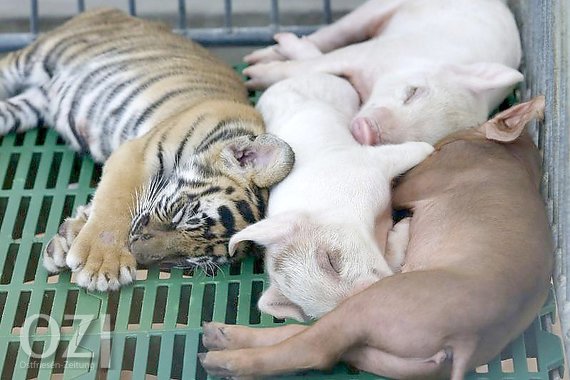
A baby tiger sleeps with piglets in the Sriracha Zoo, on a grid floor
A British organization criticized in 2016 that the big cats were in poor condition and that tiger babies were separated from their mothers only two to three weeks after birth.
And I mean…Wildlife tourism, worth up to $250 billion (USD) annually is a big business.
It is estimated that globally wildlife tourism attractions condemn around 550,000 wild animals to appalling, mostly unseen suffering.
Because the pain and distress is largely hidden, visitors are usually oblivious to the horrific abuse and conditions endured for tourist entertainment.
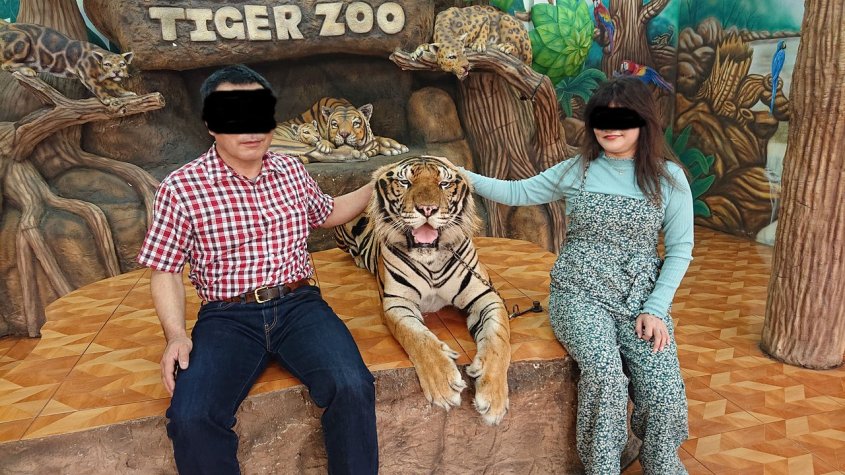
Captive tigers are particular victims of irresponsible tourism – their suffering fuelled by the demand for selfies and photo sharing on social media.
These majestic and endangered predators are bred, used and abused to create entertainment for tourists and boost the profits of wildlife attractions, travel companies and illegal traders.
Sriracha Tiger Zoo near Pattaya had reported the most tigers in their possession.
Here, visitors are encouraged to photograph a tiger in an ‘African’ landscape. The tiger is pushed and prodded with a bamboo stick wielded by a Tarzan-style trainer until the animal sits on a stool.
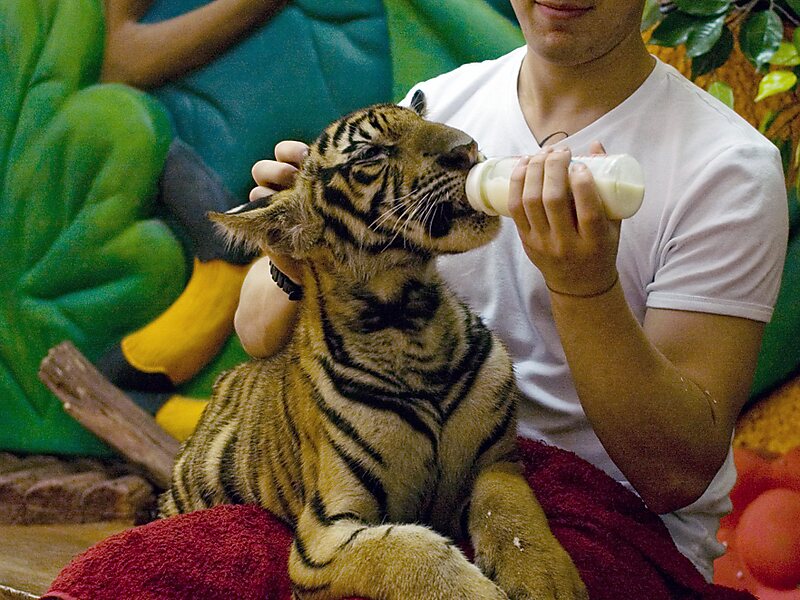
One attraction of the zoo that kids and their parents love is the “cub milk-feeding”.
In a big room, with several cages in a row containing one baby tiger each, visitors are encouraged to feed the animals through the wire-mesh with milk in feeding bottles.
A zoo attendant offers visitors milk in feeding bottles in exchange for a certain amount.
But loud cries of the baby tigers can be heard meters away from the room. When visitors start asking why, the attendant is quick to explain that the cubs are hungry and in need of feeding.
Visitors are then offered milk bottles to feed the cubs, but for a price.
All animal abuses have a price in the zoo.
Some suspect that the baby tigers are deliberately starved so they’ll always cry for milk.
Our message is simple: please do not support these activities.
Captured wild animals and other animals that are used for direct human-animal interaction for entertainment purposes suffer enormous agony in such businesses.
You make yourself an accomplice if you support them




 Aitor Garmendia / Tras los Muros-Mexico
 Aitor Garmendia / Tras los Muros-Mexico




 We have not forgotten them and we will always remember their tireless struggle for animal rights.