Fire at German Farm Likely Killed 55K Pigs

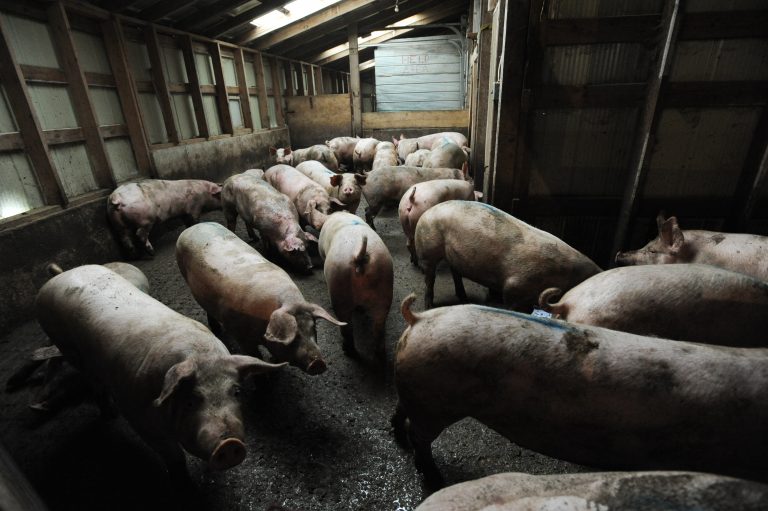
Pigs stand in front of a building after a fire broke out in a large pig farm in Alt Tellin, Germany, on Tuesday, March 30.

Pigs stand in front of a building after a fire broke out in a large pig farm in Alt Tellin, Germany, on Tuesday, March 30. Photo – Stefan Sauer/dpa via AP

Venus will probably have more on this from Germany later.  Probably the first time they have ever been outside and stood on grass !

Regards Mark

Fire at German Farm Likely Killed 55K Pigs

Some 7,000 sows and 50,000 piglets were listed as being at the facility at the time, and only about 1,300 animals were rescued.

Apr 1st, 2021

Associated Press

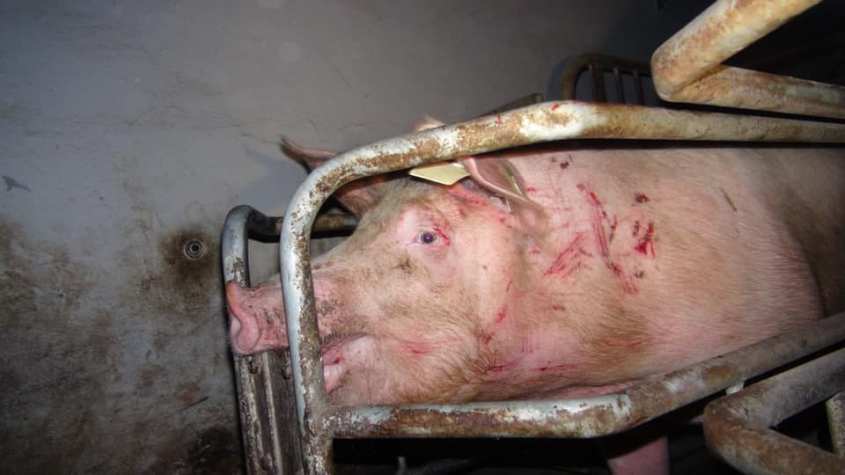
BERLIN (AP) — A fire at a pig-breeding facility in northeastern Germany is believed to have killed more than 55,000 animals, the operator said Thursday.

The fire broke out on Tuesday at the facility in Alt Tellin, in Germany’s northeastern corner. It spread quickly, in part through ventilation shafts, and destroyed the stalls where the animals were kept.

A spokesman for operator LFD Holding, Ralf Beke-Bramkamp, told German news agency dpa that over 55,000 animals died. Some 7,000 sows and 50,000 piglets were listed as being at the facility at the time, and only about 1,300 animals were rescued.

The cause of the blaze remains unclear. Police spokesman Andrej Krosse said it was an “incredibly difficult” investigation and a drone was being used to survey the devastated site.

The Alt Tellin facility was one of the biggest of its kind in Germany. Groups of demonstrators, carrying placards with slogans such as “Stop animal torture,” gathered at the scene on Wednesday.

Fire at German Farm Likely Killed 55K Pigs | Manufacturing Business Technology (mbtmag.com)

Murder is made everywhere

All life deserves respect, dignity, and compassion. All life.

These animals are not voluntary sacrifices. The sacrifice of their life is forced from them by force.

All of these animals feel and think. They feel fear and pain, joy and hope, lead a conscious life, and want to grow old with their feelings and thoughts.
Therefore they have a natural right to their life, to protection, to freedom.

The power of the fittest, but not morality, enables their death.
Murder is murder.

There is no murder made in China
made in India
made in Italy
or in Germany

Don’t take part in this murder.
You can do a lot for the animals if you don’t eat them.

regards and good night, Venus

Mass murder of turtledoves on the march in Italy

Conservationists across Europe are shocked by the Italian government’s plan to allow 7.5 million specimens of the endangered turtledove to be shot down this autumn.

The European Commission estimates that there are only between 2.9 and 5.6 million breeding pairs in the EU.

The shooting was decided at a meeting of the government with representatives of the regions, whose representatives, under pressure from the influential hunting lobby – above all the European hunting association FACE – almost without exception voted against a four-year closed season proposed by Rome.

Tragischer Unfall in Italien: Mann erschießt eigenen Vater bei Wildschwein-Jagd

Now each of the 500,000 Italian hunters should be allowed to kill up to 15 lovebirds in the coming hunting season!!

The Committee Against Bird Murder and its Italian partners are fighting against the hunting clearance and have received unexpected help: The anti-mafia hero Sergio De Caprio, legendary in Italy, who became famous as a police officer in 1993 after the arrest of mafia boss Totò Riina, also sits down in his Region of Calabria against the shooting plans.

EU Commission to finally enforce Europe-wide hunting bans for endangered species.

https://www.komitee.de/de/aktuelles/presse-meldungen/2021/italien-plant-abschuss-der-letzten-europaeischen-turteltauben

And I mean…The fauna and flora of Italy are extremely rich.
94,771 different animal species live on the boot south of the Alpine chain.

But Italy is also the country where, so say the animal welfare organizations, eagles and otters are still being shot, where a good thirteen regions abuse legal loopholes to permit the hunt for nationally protected species or to extend the hunting season.
Where the regional legislation in the matter of hunting is sometimes in stark contrast to the laws of the EU.

Where hundreds of volunteer game rangers try in vain to stop poaching, which is now threatening at least ten protected species with extinction.

Where you can shoot ducks from concrete bunkers.

Where every year thousands upon thousands of migratory birds are killed with the help of decoys and illegal electromagnetic decoys.

In hardly any other country in the EU is the overlap between licensed hunters and criminal poachers as great as in Italy. Almost three-quarters of all convicted poachers have a hunting license.

The turtle dove is classified by the International Union for the Conservation of Nature (IUCN) as a globally endangered species, the population of which in Europe has declined by around 40% in the last 16 years.

In some countries and regions, the loss is more than 90%, here the species is on the verge of disappearing.

The shooting of lovebirds is a sadist passion that has nothing to do with sustainable hunting but is rapidly accelerating the extinction of this species in Europe.
Nevertheless, the Italian hunting association and its European umbrella organization have pulled out all the stops to prevent the moratorium proposed by the government in Rome.

The EU bird protection directive gives the member states the possibility to release protected bird species for catching or shooting if it is a “tradition”, only “small amounts” are concerned, if there is “no other satisfactory solution” and if there is sufficient control the requirements are ensured.

The 7.5 million turtledoves are certainly a small amount, so the EU doesn’t have to worry about them !!!

My best regards to all, Venus

Ireland: Introducing ‘Ethical Farming Ireland’ – A Voice For The Animals. Check Them Out.

Hi everyone;

Like us at WAV, Ethical Farming Ireland is into live animal transport – live exports; in a big way.

Below at the end of this post is a link to their site, which features many interesting articles for you to have a look at, and see the reality of very young calves being exported live from Ireland – something we have been personally very involved with in the past. 

PMAF Inv 7
PMAF Inv 5

Check out all our investigation work at  About Us. | Serbian Animals Voice (SAV) – scroll down until you see the young calf pictures (as above); and you can read one of the investigation reports we produced (one of five) and which were presented to the EU in report form.

Here is the direct link to the aforementioned report if you wish to avoid visiting SAV; although we suggest a look as the site also covers many other campaign actions from the past:

Undercover investigation report link as presented to the EU (1 of 5 investigations):

Microsoft Word – JH.04.03.2010_REPORT on NON-COMPLIANCE with RESTING TIMES in relation to CONTROL POST at F-HEAUVILLE.doc (wordpress.com)

Here below is the EFI link:

Regards Mark

Ethical Farming Ireland

Ethical Farming Ireland

Ethical Farming Ireland – Campaigning for farm animals


USA: ‘Indigo’ – Joaquin Phoenix Speaks About ‘Los Angeles Animal Save’ To Help Rescue a Mother and Baby Cow From An L.A. slaughterhouse.

Thanks as always to Stacey at ‘Our Compass’ – Indigo | Our Compass (our-compass.org)

Regards Mark


“US Rejected”: Imagine having your entire life defined by how you will be used in death: the control, fear, and violence these gentle creatures experience at the hands of “humanity” is nothing short of depraved and an absolute, scathing indictment of human apathy disguised as normalized “humane” violence. SL

Source Nation EarthAnimal Save MovementVeg World Magazine

One day after his best actor Academy Award win last year, Joaquin Phoenix joined Los Angeles Animal Save to help rescue a mother and baby cow from an L.A. slaughterhouse. He named them “Liberty” and “Indigo” after his beloved sister and nephew. 

Today, L.A. Animal Save released a short documentary by Earthlings filmmaker Shaun Monson – INDIGO – in which Phoenix speaks frankly about the rescue, and visits the cows at their new sanctuary home in an emotional reunion. “We spend one day each year paying homage to our planet, Earth Day, but the other 364 days, we consume with impunity,” Phoenix said. “It’s undeniable the detrimental impact that animal agriculture has on the environment.

This simple act of rescuing Liberty and Indigo…in some ways, it’s just as simple as sparing the lives of these creatures. But it’s also an acknowledgment of not only the destruction they feel at our hands but the environment as a whole. By our actions, we either have the choice to continue to destroy other beings and the environment, or we begin the process of reversing the damage that we’ve done.” 

The film premiered online today (April 22) and is available above or at https://youtu.be/eJ9iQLfeGBk 

A Q&A with the filmmakers aired following the premiere can be viewed at https://youtu.be/rd7xpy_8UMc


Download Your FREE Vegan PDF HERE

Order a FREE vegan kit HERE

Dairy-Free Info HERE

Take the Dairy-Free Challenge HERE

Click HERE for more Dairy-Free

Fish alternatives can be found HERE

Learn about eggs HERE

Find bacon alternatives HERE and HERE

Take PETA’s Cruelty-Free Shopping Guide along with you next time you head to the store! The handy guide will help you find humane products at a glance. Order a FREE copy HERE

Searching for Cruelty-Free Cosmetics, Personal-Care Products, Vegan Products, or more?
Click HERE to search.

Free PDF of Vegan & Cruelty-Free Products/Companies HERE

Click HERE to find out How to Wear Vegan!

Want to do more than go vegan? Help others to do so! Click below for nominal, or no, fees to vegan literature that you can use to convince others that veganism is the only compassionate route to being an animal friend:

PETA HERE

Vegan Outreach HERE

Get your FREE Activist Kit from PETA, including stickers, leaflets, and guide HERE

Have questions? Click HERE

Stop the climate killer deal Mercosur

Germany, Brazil, and the Portuguese EU Council Presidency are pushing for the trade agreement to be concluded quickly.
We have to prevent that!
Greenpeace is working to ensure that the toxic deal does not materialize.

The trade agreement between the EU and the South American Mercosur countries Argentina, Brazil, Paraguay, and Uruguay is about to be concluded.

The Gran Chaco – stretches across the border region of Argentina, Paraguay, and Bolivia. Nowhere in the world is clearing for the cultivation of soy progressing faster than here for soy planting.

The deal aims to lower tariffs on agricultural products like beef. For these products, more and more rainforest is being destroyed in the Amazon region – often by slash and burn.

The huge biodiversity in the Amazon rainforest and the Pantanal is threatened: jaguars, sloths, and many other animal species are displaced or die in the fires.

Amazon: Jaguar

Customs duties on pesticides “made in Germany” should also be dropped.
This would deliver even more toxic chemicals to South America that cannot be used in the EU.
There they poison the soil and water and kill plants and animals – and also endanger the health of the people who are exposed to them.

Environmental protection also means wise trade policy !!

Humans destroy and poison important natural areas and CO2 stores.
Unique habitats such as the Amazon rainforest and the Pantanal are at risk, and reckless policies give land robbers additional encouragement.

As a result, more fires are burning in Brazil than there have been for years. The intensive industrial agriculture depends on the drip of pesticides, the massive use of these poisons leaves its mark on people and the environment.
We are destroying our best allies against the climate crisis – the last primeval forests on earth and poisoning the habitat for all living beings.

Amazonas-Brände vernichten den Lebensraum vieler Tier- und Pflanzenarten.Amazon

Consistent nature conservation and the expansion of protected areas are life insurance for people and animals. Because the well-being of humans is linked to the well-being of other living beings and entire ecosystems.

We have to see ourselves as part of nature instead of continuing to destroy it!

International trade must focus on people and nature – and not on corporate profits. If EU-Mercosur cuts tariffs on agricultural products such as beef and poultry as well as pesticides and cars, the agreement will further fuel the destruction of nature and the climate crisis.
That mustn’t happen! Greenpeace is therefore working to ensure that the deal does not come about.

Please help too and sign our petition!

https://act.greenpeace.de/eumercosur-ma

And I mean…The EU has been negotiating with Mercosur for twenty years, with no result. And now, with Bolsonaro of all people, everything suddenly happened very quickly. Chancellor Merkel in particular has pushed for this quick deal.

European cars, that is, industrial goods, against South American beef, poultry, and raw material

That is essentially what was agreed with the deal.
Business is business and the rules of capitalism do not include the protection of the environment, the climate, and human rights.

This leaves Bolsonaro’s devastating policies on the Mercosur deal with no consequences.
It’s fatal.
Europe must not look the other way when human rights, the environment, and the climate are trampled on. We have to pull the emergency brake and stop the conclusion of the EU-Mercosur agreement in this form.

We, therefore, urge the Federal Government and the EU Commission: No “keep it up” !!
Stop working on the current EU trade agreement with Mercosur.

Please sign and share the petition.

My best regards to all, Venus

for the day of the penguins

During our campaigns in the Southern Ocean, our crews often had nice encounters with penguins.
They are definitely one of our favorites among flightless birds.

But the idyllic images are often deceptive – unfortunately penguins don’t have it easy either: climate change, overfishing, and the destruction of their habitats are affecting penguin populations all over the world.

There are 18 species in the world and in the video you will meet some representatives who we have already run into during our missions.

(Text on the Video): there are 18 different species of penguins some are small and some are large
they cannot fly
but are very good swimmers
and very good at waddling
we fight to protect the penguins
and all marine life

 And I mean…Every year on April 25th is World Penguin Day.

It is therefore important to remember the day because it should draw attention to the fact that litter in the oceans and climate change are a threat to animals.
These sea birds are critically endangered.
Because the warming of the earth causes the sea ice to decline, the penguins find fewer and fewer krill, the small crustaceans that they mainly feed on.

Plastic garbage – the garbage from human animals – causes them – like all marine animals – great difficulties.

Humboldt penguins are among the most threatened species. Twice as many of them now live in zoos and animal parks as in the wild.

Humboldt penguins

By the way, not all penguins are the same.
Because of ice: not every penguin feels comfortable there, according to the WWF. Some species live in warmer regions, such as the little penguins in Australia.

penguins in Australia.

Penguins can withstand up to -70 degrees. Their water-repellent feathers and the layer of fat protect them from cooling down.

Penguins are considered monogamous and loyal.
We love these wonderful animals and want to continue fighting against the loss of their habitat.

My best regards to all, Venus

Interesting Article From idausa: What Is Zoochosis ? – Basically, Psychosis That Develops in Animals Held Captive in Zoos.

If you’ve ever been to a zoo and seen polar bears swimming in circles compulsively for hours, or seen tigers pacing back and forth endlessly, or elephants swaying back and forth rhythmically, all with a blank look in their eyes, you’ve witnessed an animal suffering from zoochosis. 

There are people who argue that animals are happy in zoos, or are at least content. Are they? Keep reading to learn about zoochosis and what it tells us about the degree to which captive animals suffer.

Read on to discover:

What Is Zoochosis?
What are the Signs of Zoochosis?
What Causes Zoochosis?
Is Zoochosis a Sign of Suffering?
Is Zoochosis a Disease?
How Many Animals Get Zoochosis?
If I Don’t See Signs of Zoochosis, Does That Mean Everything is OK?
How Can We Prevent Zoochosis?

What Is Zoochosis?

Zoochosis is a form of psychosis that develops in animals held captive in zoos. Most often, it manifests in what are called stereotypic behaviors, or stereotypies, which are often monotonous, obsessive, repetitive actions that serve no purpose. Stated plainly, zoochosis is mental anguish made visible by abnormal behavior, and it’s a common indicator of poor welfare.

Animals evolved in the wild, where they could roam freely, interact socially, problem solve, and in general live a rich sensory life. Captivity, whether in zoos, circuses, aquariums, or elsewhere, denies them all of this and more. As a result, animals suffer.

Crucially, stereotypical behaviors do not occur in the wild, but are exclusively seen in animals held in captivity.


What are the Signs of Zoochosis?

Thousands of different species are kept in zoos, and each one has specific physical and psychological needs that can never be met in captivity, even with the best husbandry practices. The most common stereotypies seen in captive animals can depend on species, and individuals, but often include:

  • Pacing 
  • Bar biting
  • Bobbing, weaving and swaying
  • Rocking
  • Self-mutilation
  • Over-grooming
  • Regurgitating and reingesting food
  • What Causes Zoochosis? 
  • In short, the answer is captivity. 
  • Animals in captivity are restricted in countless ways. They live lives of extreme sensory deprivation. We restrict what they can do and with whom they can socialize. We often separate them from their families and friends. We decide with whom they can mate, or deny them access to a mate entirely and artificially inseminate them using sexually abusive and invasive procedures. We limit their movements, their behaviors, their decision to have offspring, and their ability to fully realize their higher order needs, such as the desire to live autonomously, to make decisions, to do meaningful work. 
  • Research has found the effects of captivity so detrimental, it can actually cause physical changes to brain structures, which can alter health and behavior.
  • When animals are denied the ability to live sensory rich lives, and their experiences are limited to the dullest, most blank canvas, mental illness develops.

  • Is Zoochosis a Sign of Suffering?
  • Definitely. 
  • Again, stereotypies are a concerning sign of poor welfare that clearly show us animals’ stress and frustration over not being able to engage in instinctive behaviors. Some facilities have gone so far as to administer antidepressants and antipsychotics to a range of different kinds of animals, but that doesn’t solve the underlying cause of their chronic distress, which is confinement.
  • Don’t take our word for it,  look for evidence of this in nature. You won’t find it. As already stated, animals in the wild who are able to live full lives do not demonstrate stereotypical behaviors. Animals who live in captivity do.


Is Zoochosis a Disease?

Yes. 

According to Wikipedia, “A disease is a particular abnormal condition that negatively affects the structure or function of all or part of an organism, and that is not due to any immediate external injury.” This definition is inclusive of both bodily and mental disorders. 

That said, zoochosis is not a disease in the sense of an abnormal condition that stems from within, such as from one’s own body getting sick. Zoochosis is instead a disease that stems from outside forces, from the extreme sensory deprivation that zoos and other forms of captivity impose upon animals. 

Zoochosis is a mental disorder that manifests in abnormal, and often unhealthy, physical behaviors. It is largely, though not necessarily exclusively, caused by psychological factors induced by physical captivity and sensory deprivation. 

That said, many animals held captive in zoos are the product of breeding programs that result in inbreeding and loss of genetic diversity. So it is certainly possible that in some cases — though certainly not all — there is a biological component to zoochosis.


How Many Animals Get Zoochosis?

We don’t know.

As with all mental conditions, zoochosis is surely suffered to varying degrees by different individuals in different circumstances. In addition, zoochosis manifests in different ways across different individuals and different species. In some animals it may not be noticed by humans at all. So we cannot determine precisely how many animals in captivity suffer from severe mental illness.

There are 240 zoos in 13 countries accredited by the Association of Zoos and Aquariums, with 217 being in the U.S. alone. Collectively, they confine 800,000 animals from 6,000 different species, and that’s still only part of the picture globally, which doesn’t even account for roadside zoos, private possession, or other settings for captive animals, such as agriculture and research.

Accordingly, it is safe to assume that there are many millions, if not billions, of animals worldwide who are held in captivity and live lives of mental anguish. 


If I Don’t See Signs of Zoochosis, Does That Mean Everything is Okay?

No!

Perhaps you have known someone in your own life who is suffering inside but bottles up all their emotions. Research is clear that this happens in nonhuman animals, too. 

If someone looks sick in a way we recognize, we assume they are not well. But when we see an elephant or a bear in captivity swaying incessantly back and forth, most of us don’t understand how and why they are suffering.


How Can We Prevent Zoochosis?

Do not keep animals in captivity. It is as simple as that. 

If you have to keep the animal locked up to prevent them from escaping, that animal is held captive. 

With the exception of real sanctuaries accredited by the Global Federation of Animal Sanctuaries (GFAS), and cases of urgently needed medical care, it is a safe bet that captive animals everywhere are being held captive for the benefit of their human captors, not the animals themselves, and exceptionally rarely, “for the benefit of the species” at extreme cost to the individuals.

Animals, just like us human animals, want to be free. They do not want to live their lives behind bars any more than we do.


What you can do: 


Click here to donate:

Donation – ea (idausa.org)


Regards Mark