USA: Workers Pry Baby Monkeys Away From Mothers, Electroshock Monkey Penises in Depraved Lab.

Workers Pry Baby Monkeys Away From Mothers, Electroshock Monkey Penises in Depraved Lab

Posted by Dan on September 17, 2020 | Permalink
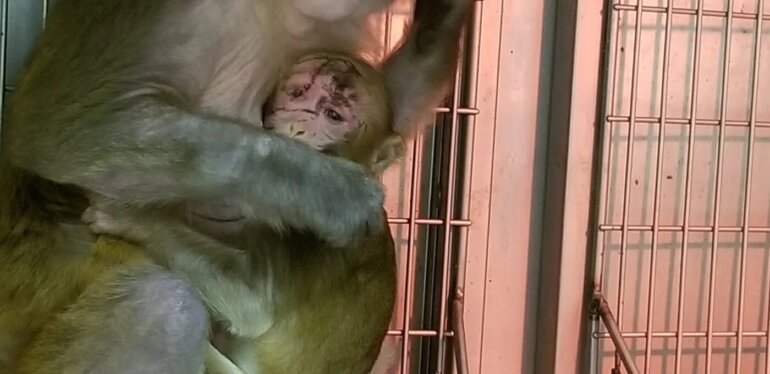
Image shows monkey at WNPRC

A six-month PETA US undercover investigation into the Wisconsin National Primate Research Center (WNPRC) – which keeps nearly 2,000 monkeys in barren steel cages and bleak, windowless rooms – found that highly intelligent animals were being neglected, driven mad by extreme long-term confinement, and attacked by their traumatised cagemates.

Severe Confinement, Constant Stress, and Mutilation

Monkeys at WNPRC spend every day and every night locked inside barren metal cages. They never feel the warmth of the sun on their backs or the earth beneath their feet. Stripped of their autonomy, they’re unable to make decisions regarding the most basic aspects of their lives. Constant, unremitting captivity causes these smart, sensitive animals extreme psychological distress, leading some to injure each other and themselves.

A baby monkey, named Cocoa by the PETA US investigator, was attacked by a severely stressed adult macaque, resulting in deep, painful cuts to her face.

Months later, her wounds still had not fully healed, and she clung to her mother in fear.

Incompatible animals were forced to live together in just a few square feet of space, and a monkey named Ellie lost part of her ear in a fight with a cagemate.

Amputations of parts of fingers, toes, and tails were a common result of the traumatic injuries sustained by monkeys in WNPRC’s care. A worker said that some of these highly intelligent animals were caged alone “because they’re a**holes ” who “beat the crap out of” each other – completely ignoring that the fights were a result of the monkeys’ unnatural, barren living conditions.

One frustrated monkey, known only as r12050, mutilated his own leg down to the muscle. With nothing to occupy his mind, he picked and scratched compulsively at the open wound.

“We’re not supposed to say they look depressed .”

Highly intelligent, social macaques – who, in their natural habitats, explore and roam vast grasslands and lush forests – paced, circled, and shrieked in the never-ending lockdown. One monkey, named Sainte, rocked continuously from side to side, all alone and miserable in a small cage.

When they weren’t being simply warehoused, animals were used in painful procedures and experiments.

Workers euphemistically referred to certain monkeys as “semen donors,” but they had certainly not volunteered for the painful process. Typically, the monkeys are fitted with metal collars, and workers use poles that fasten onto the collars to pull them out of their cages by the neck. The monkeys are then strapped into a restraint chair, and experimenters electroshock their penises until they ejaculate.

Many different types of experiments were being carried out at this facility. One experimenter bred monkeys infected with Zika and simian immunodeficiency virus, which is similar to HIV. Infant macaques were deprived of food overnight for “cognitive testing” and cried endlessly when separated from their companions. A supervisor said that experimenters attempted to infect marmosets—small, delicate monkeys—with COVID-19 but that “nothing happened.”

See the full PETA US investigation here.

Monkeys Are Used in Experiments in the UK, Too – Help Them

In 2019, 2,850 procedures using primates took place in the UK. It’s time to relegate such cruel experiments to the history books.

We must shift away from all procedures using animals.

Sign our petition to support PETA’s Research Modernisation Deal.

Netherlands: Listen ! – Dutch Animal NGOs Call on Parliament for Better Fish Protection.

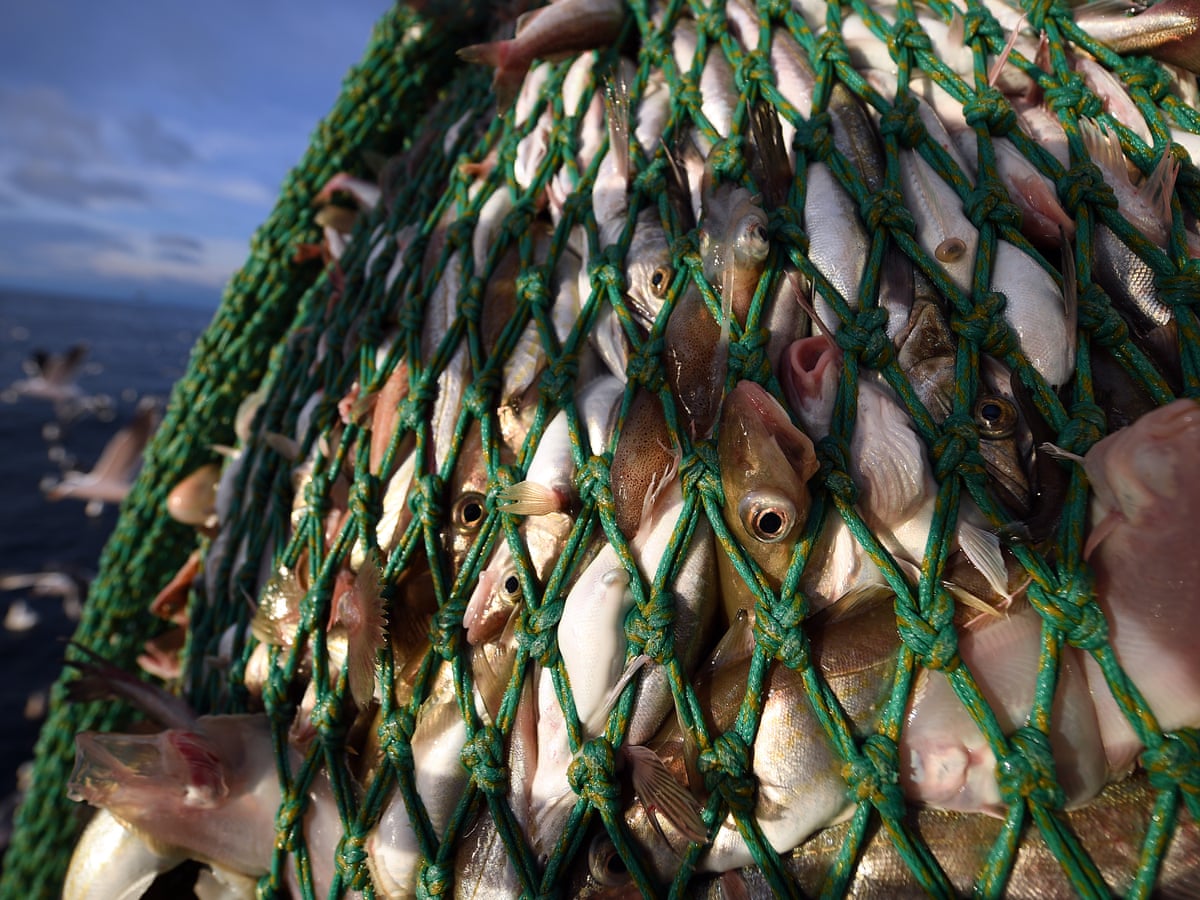
UK trawlers ignoring ban on discarding edible fish at sea | Fishing | The  Guardian

Photo – The Guardian, London.


CIWF LOGO
Dierenbescherming LOGO
Vissenbescherming LOGO

Listen ! – Dutch animal NGOs call on Parliament for better fish protection

The Netherlands must pay much more attention to the welfare of fish when caught and when killed say Dutch animal advocates.  

In a joint letter, Eurogroup for Animals’ members Dierenbescherming, Compassion in World Farming (CIWF) and Vissenbescherming, together with many other animal welfare organisations, call on Members of the Dutch House of Representatives to place fish welfare at the heart of fisheries policy.

Fish suffer en masse in capture and killing.

Animals are oppressed in the nets, injured and often endure long, painful agony. While the House of Representatives will meet on fisheries this week, fish welfare is not on the agenda.

In a joint letter, Dierenbescherming, Vissenbescherming, Compassion in World Farming (CIWF) and other NGOs are calling for more research into new methods of catching and killing fish, whereby the animals have as little stress and pain as possible. 

Currently there is only one ship in service that stuns plaice before they are killed.

The majority of Dutch citizens believe that the welfare of fish should be better protected and they deserve the same protection as other animals. However, it is currently impossible to buy fish in the supermarket, where the fish welfare is sufficiently guaranteed.

Dierenbescherming recently showed in a new study that some supermarkets do want improvement for the fish, but that the options are limited.

Also with fish with a quality mark, such as MSC and ASC, welfare is hardly taken into account and the animals suffer on a large scale which prompted CIWF to start an international campaign where they call on the biggest fish labels to put an end to fishing suffering.

The government must now also take responsibility and commit to better treatment of fish. Among other things, by giving fish welfare an important place in the fisheries policy and investing in improvements for the animals.

Read more at source

FOK!

Regards Mark

Denmark: The Killing Boxes Arrive to Murder at Least 2.5 MILLION Mink After Covid-19 was Reported on at Least 63 Danish Fur Farms. Other Farms to ‘Do It Themselves’ !

WAV Comment – “breeders who have non-infected animals on a farm within 8 kilometers (5 miles) of an infected farm must put them to sleep themselves”, said Flemming Kure Marker of the government agency.

So Danish authorities go from mass murderers to people who ‘put them to sleep’. Sounds so ok when said quickly. We are talking millions of deaths here – just so thhat ugly tarts can think they look better. Shame on the Danes for still doing the farming – shame on anyone who thinks they look better in a dead animal skin than the living animal themselves. Pathetic Denmark.

All data and photos from ‘Respect for Animals’ – Nottingham, England.

Slaughter on Denmark’s covid-hit fur farms

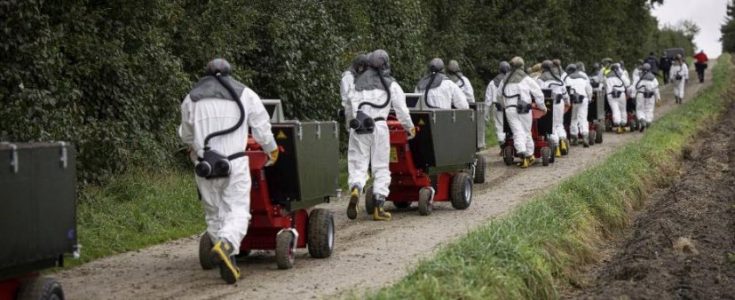
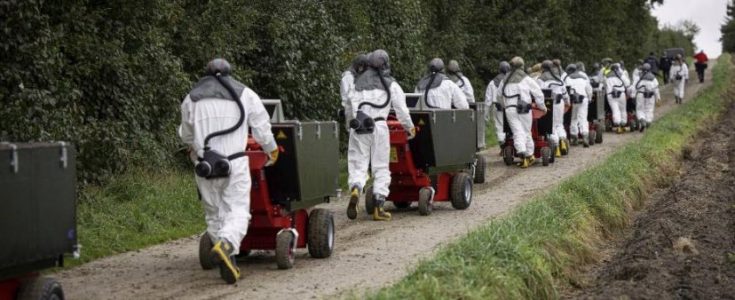
Photos depicting long lines of killing boxes being marched to fur farms have caused shock and anger in recent days. The devices are being used to gas mink after more coronavirus outbreaks on fur factory farms in Denmark.

Danish authorities have confirmed that veterinarians and farmers have begun slaughtering at least 2.5 million mink in northern Denmark after Covid-19 was reported on at least 63 farms.

Campaign Director of Respect for Animals, Mark Glover, said:

“This is shocking news and these images are greatly distressing. It should be clear to all that keeping animals in tiny, cramped, barren cages – and in appalling conditions- creates an environment for diseases to spread rapidly.

“I’ve seen many awful scenes on fur farms during my decades of campaigning, with terribly high levels of early mortality . Now we have major coronavirus outbreaks among factory farmed mink across Europe and in Utah, USA.

“Fur factory farming is a disaster for animal welfare. It must be banned.”

Full Coverage:

Photos depicting long lines of killing boxes being marched to fur farms have caused shock and anger around Europe.

The devices are being used to gas mink after more Covid outbreaks on fur factory farms in Denmark.

Danish veterinarians and farmers have begun slaughtering at least 2.5 million mink in northern Denmark, authorities have confirmed, after coronavirus was reported in at least 63 farms.

The Danish Veterinary and Food Administration is handling the culling of the infected animals while breeders who have non-infected animals on a farm within 8 kilometers (5 miles) of an infected farm must put them to sleep themselves, said Flemming Kure Marker of the government agency.

Campaign Director of Respect for Animals, Mark Glover, said: “This is shocking news and these images greatly distressing. It should be clear to all that keeping animals in tiny, cramped, barren cages – and in terrible conditions- creates an environment for diseases to spread rapidly.

“I’ve seen many awful scenes on fur farms during my decades of campaigning, with terribly high levels of early mortality . Now we have major coronavirus outbreaks among factory farmed mink across Europe and in Utah, USA.

“Fur factory farming is a disaster for animal welfare. It must be banned.”

Scientists are exploring how the mink got infected and the extent to which they spread it to people. Some may have received the virus from infected workers. Dutch authorities say some farm workers later caught the virus back from the animals.

In August, the Netherlands brought forward the mandatory end of mink farming by three years to 2021 amid a huge outbreak f coronavirus infections at fur farms.

Regards Mark


Russia: inspector saves three Beluga whales! a great act of humanity!

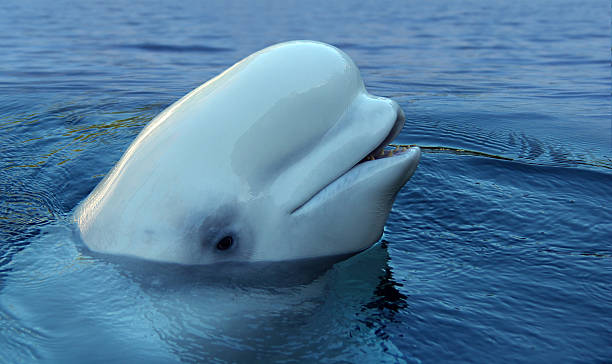
Three stranded Beluga whales saved in remote Russian Far East after a dramatic solo rescue operation by hero local inspector

An inspector from Russia’s Emergencies Ministry has been hailed as a hero, after he saved a family of three Beluga whales – two adults and a young calf – left stranded on a Far Eastern beach on Thursday when the tide went out.

Alexey Paramonov said that when he arrived at the scene he saw the animals about 1.5 kilometers from the coast. One of the adults was in a dangerous position, lying on its side, so he dug a hole under the beluga and turned it over to the correct position, while also trying to protect the family from predators.

In order to prevent dehydration, he watered their skin and eyes, and, with nighttime temperatures below freezing, Paramonov also swaddled the baby to keep it warm.

Beluga whale


The dramatic incident occurred in the Khabarovsk region, a vast territory that borders China by land and is close to Japan by sea, over 6,000 kilometers east of Moscow. A local resident told the Emergencies Ministry at about 4.30 pm local time that the animals were stuck at the mouth of the Uda river, which flows into the Sea of Okhotsk, near the village of Chumikan.

The settlement, home to about 1,000 people, is so remote that it has never been connected to the national road network. Thus, access is possible only by sea (which is frozen for close to half the year), helicopter, or small plane. It is 480 kilometers from the nearest train station and almost 700 kilometers away from the city of Khabarovsk.

Paramonov remained with the stricken creatures long after it got dark, mindful of the threat from other animals and poachers.

At about midnight, when the high tide arrived, the whales safely returned to sea on their own.

Last year, Paramonov also rescued three belugas.

Back then three adults found themselves stranded in shallow water and came under attack from crows and gulls before the hero inspector came to their rescue.

https://www.rt.com/russia/503626-russia-beluga-whales-stranded/


And we say...Yay !! Finally some good news instead of the constant horror reports we read every day about animal suffering, caused by direct animal abuse, or by those who do nothing against it.

The systematic indifference of the authorities to animal suffering leads us to regard an inspector as a hero, simply because he has conscientiously done his duty to the three animals.

And it is actually a hero who saves animals today.

But most of the officials who get paid for it don’t even give a shit when it comes to an animal’s life.

In the name of the animals, we say thank you to Inspector Paramonov!

My best regards to all, Venus


German Minister: on behalf of animal exploitation and they do the job well

In Baden-Württemberg, south Germany, a slaughterhouse had to close due to severe animal welfare deficiencies.

According to media reports, the Minister of Agriculture, Peter Hauk, intervened personally to suspend the fine against the operator.

A bitter article about this scandal from the SOKO animal welfare association
(for those who don’t remember: https://worldanimalsvoice.com/2020/10/08/germany-slaughterhouse-scandal-turns-into-a-political-thriller/)

“…. a pig breeding business that was reported months ago, and where nothing happened.

A slaughterhouse whose shortcomings were known for years and which was last personally protected by the Minister of Agriculture.

A slaughterhouse where the vets just watch how we do brutal force to the animals,
And: A Minister Hauk who does not see himself in any responsibility here.

Actually, he’s not far removed from tradition. Animal welfare – that has always been politically irrelevant. And the Ministry of Agriculture in particular is traditionally trying to make it easier for animal exploiters; animal welfare is systematically ignored and prevented.

The real scandal: people have become so accustomed to the fact that the interests of animals are trampled underfoot that even Minister Hauk creates the trick of not feeling responsible even in these entanglements.

Ministries of Agriculture and their associated ministers have consistently campaigned AGAINST animals.
They prevent the smallest concessions in animal welfare, enforce perpetual extension periods, and play into the hands of the animal exploitation industry.
These people act on behalf of animal exploitation and they do the job well”.


And I mean…The district office had levied a fine against the slaughterhouse (which was closed in March 2020), which Minister Hauk suspended shortly thereafter.
After SOKO’s undercover investigation, pigs were brutally beaten and kicked, electric shock devices were used and the animals were stunned in an unprofessional and incorrect manner. The public prosecutor’s office is informed and determined.

Nevertheless: three days ago, in front of the Agriculture Committee, where he had to give an account of this corrupt and illegal act, Hauk said: He was not aware of any animal welfare violations at the time!!!

Such system structures are not normal but can be described as psychopathic. Mentally, morally, socially healthy people with decency do not engage in such disgusting, exploitative business.

Nevertheless: this system is firmly established, it is an established ideology of violence, has the authority, and is supported by all-important social institutions.

Our parents, school, church, media, or other educational institutions persuade us that eating meat is normal, natural, and necessary.
So we go on with it from childhood; without us, the animal holocaust would not exist.
No meat consumption – no slaughterhouse

What exacerbates the whole matter is the fact that an animal is a “thing” by law, so cruelty to animals is often punished as property damage – if at all.

Black smokers’ lungs are depicted on cigarette packets; How about dead pork or beef in an animal transport or a cow with its throat cut on the meat packaging?

But the meat mafia would never allow that.
Everything indicates that the meat mafia is stronger than the tobacco mafia.

My best regards to all, Venus

The “Holocaust on your plate” campaign is lawful

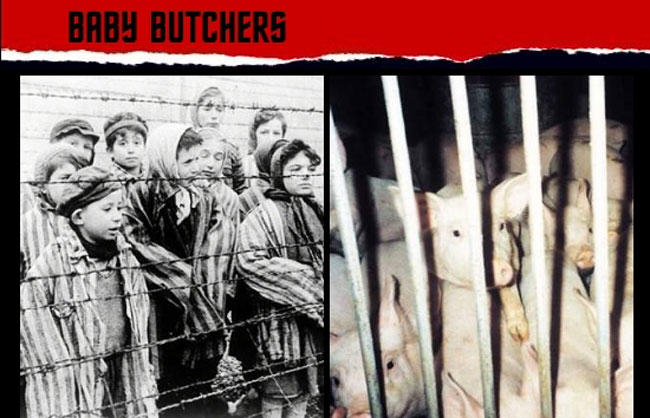
Gerlingen / Vienna – The controversially discussed “Holocaust on your plate” campaign by PETA-Deutschland e.V. is lawful – this has now been ruled by the Austrian Supreme Court in the last instance and all previous court decisions as unlawful.

The legal dispute between Jewish citizens and the animal rights organization is discussed on 19 pages and PETA-Germany eV is completely right: The striking juxtaposition of pictures from concentration camps showing emaciated people and of various animal species from the usual factory farming is legal and is under one to subsume of the highest democratic fundamental rights: Freedom of expression and freedom of the press.

In 2004, various plaintiffs brought about an injunction against certain pictures of the “Holocaust on Your Plate” exhibition.

“The shocking effect of the photomontages is largely dictated by the subject (the suffering of others brutally caused by humans).
The use of a drastic comparison serves a fundamentally permitted purpose, namely to attract attention to concern in a society flooded with advertising.
The animal welfare issue itself is – as stated – weighty, socio-politically controversial, and topical (cf. animal welfare legislation from the recent past). For the reasons given, excessive expression of opinion must be denied. ”(Ref. 6 Ob 321 / 04f, the judgment of October 12, 2006).

PETA attaches particular importance to the finding that the Supreme Court has also emphatically rejected the allegations of anti-Semitism alleged by the Jewish plaintiffs:

“The contempt of a race or a people, as relevant by the plaintiffs, is not brought about by the advertising campaign: (…) The statement only goes to the fact that Jews were treated like animals. In any case, the comparison does not lead to the conclusion (that it is a Nazi-like content) drawn by the plaintiffs for the relevant, intelligent average observer. “

“This is a good day for animals and the right to freedom of expression”, says Harald Ullmann, 2nd chairman of PETA-Deutschland eV.

Continue reading “The “Holocaust on your plate” campaign is lawful” →

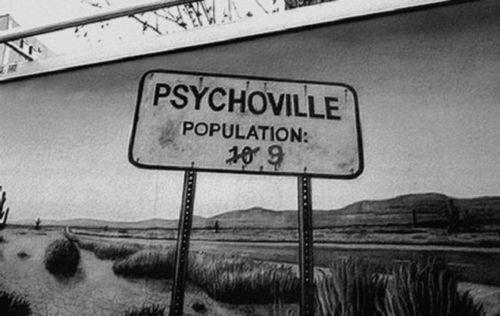
USA: 62 Bears Killed on 1st Day of Psychoville N.J. Bear Hunt; Opponents Plan New Lawsuit.

62 bears killed on 1st day of N.J. bear hunt; opponents plan new lawsuit

New Jersey’s controversial bear hunt opened 30 minutes before sunrise on Monday, with hunters heading into the woods on a dreary October day as the remnants of Hurricane Delta drenched the Garden State.

Those hunters killed 62 black bears, down from the 108 bears were killed on the first day of bear season last year.

Sussex County saw the most bears bagged on Monday, with 29. Elsewhere, 17 bears were killed in Morris County, 11 bears in Warren County, three bears in Passaic County, and one bear each in Bergen and Hunterdon counties.

Hunters killed 315 black bears in the state during the entire 2019 season. New Jersey’s highest bear hunt totals were recorded in the 2016 season, when hunters killed 636 of the animals.

The bear hunt is open for bowhunting only through Wednesday. Muzzleloaders will also be allowed Thursday through Saturday. A second segment of bear season, for firearms only, will open Dec. 7.

Though black bears are found throughout the state, the hunt is restricted to Sussex, Warren, Passaic, Morris, Bergen, Hunterdon, Somerset and Mercer counties. Bear hunting is prohibited on state lands thanks to an executive order issued by Gov. Phil Murphy in 2018.

The coronavirus has had one major impact on this year’s bear hunt: In an effort to promote social distancing, the state’s traditional weigh stations are not being used. Instead, successful hunters must call and report their kills to the state Division of Fish and Wildlife. A state biologist will then contact the hunter to legally check the bear and collect biological data.

New Jersey’s bear hunt was restarted in 2003 and being dormant for decades, following a crash in bear numbers in the 1970s. Advocates for the hunt say it is the most effective method of controlling the bear population and preventing threats to human safety and property.

A 2018 report from state wildlife officials warned that ending the bear hunt could cause New Jersey’s bear population to double by 2022.

Murphy, who campaigned on a promise to close bear season, announced a plan last week to stop any future bear hunts under his watch. That plan calls for an amendment to the state’s game code that removes the current bear management policy from the regulations.

The New Jersey Fish and Game Council, which has the final say on the state’s game code and has been Murphy’s biggest obstacle in cancelling the bear hunt, is scheduled to meet telephonically on Tuesday morning. Murphy’s proposed changes are on the agenda.

Opponents pledge to sue

While hunters spent the day in forests and fields, animal rights activists went online to voice their displeasure.

Raymond Lesniak, the former Democratic state senator from Union County, used a Zoom press conference to announce that a coalition of animal rights activists plans to sue the state over the statutory makeup of the state fish and game council.

The council currently consists of 11 members: Six sportsmen, recommended by the New Jersey State Federation of Sportsmen’s Clubs, three farmers recommended by the state agriculture convention, the chair of the state’s Endangered and Nongame Species Advisory Committee and one person with expertise in land management and soil conservation.

Brian Hackett, the state director of the Humane Society of the United States’s New Jersey branch, argued its unfair that a council with such a make-up gets to decide how wildlife is managed in the Garden State.

“Nobody is allowed on this fish and game council except for pro-hunting hunters, and pro-hunting farmers and some mysterious person who needs to know about soil,” Hackett said.

Lesniak echoed that sentiment, and said the council should include scientists, hikers, bird watchers and other people who use New Jersey’s outdoors for activities beyond hunting. He also argued the state’s bear population belongs to all residents, and should be protected by the public trust doctrine in the same way that access to waterways and beaches is protected.

Jeff Tittel, the director of the New Jersey Sierra Club, supported those points.

“It really has to be a council that manages public lands for the public benefit,” Tittel said.

The planned lawsuit, Lesniak said, is similar to Humane Society of the U.S. v. N.J. State Fish and Game Council, a 1976 case in which the Humane Society claimed the structure of the state fish and game council was unconstitutional.

That effort failed, with the state Supreme Court issuing a 6-1 ruling in favor of the state.

“The governmental interest in establishing regulations to ensure a plentiful supply of game animals for consumption and sport is suitably furthered by placing a degree of regulatory control in the hands of a Fish and Game Council composed of sportsmen, farmers, and commercial fishermen,” Associate Justice Robert Clifford wrote in the majority opinion. “Opening the Council’s membership to persons with differing philosophies might reflect the art of public relations, but it is not a constitutional necessity.”

Clifford’s decision acknowledges the council’s make-up is may be “less than ideal” to the general public, but left it to state lawmakers to handle any changes to who sits on the council.

Associate Justice Morris Pashman was the one dissenter in the 1976 case. He argued there was no good reason why membership to the fish and game council should be tied to sportsmen’s clubs and the agriculture convention.

“I especially cannot sanction this practice where its practical effect will deprive an organization, whose interests are intimately affected by the decisions of the Fish and Game Council, of any chance to achieve the representation which it needs to protect those interests,” Pashman wrote in his dissent, referring to groups like the Humane Society and the Sierra Club.

Lesniak said the planned lawsuit will rely on Pashman’s dissent, and “additional evidence” that was not presented in 1976.

“It’s an old case,” Lesniak said. “A lot of things that need to be presented to the court were not presented at that time.”

Lesniak said he expects the lawsuit to be filed early next year. Until then, he said he and his fellow activists are working to persuade Murphy to halt the bear hunt that is currently underway.

“We don’t have many options,” Lesniak acknowledged. He said that bear hunt opponents had urged Murphy to cancel this year’s hunt out of COVID-19 concerns — he noted a concern about hunters traveling to New Jersey from hotspot states — but the governor declined to do so.

Lesniak also called on hunters to just go home, and not participate in the bear hunt.

“Be content that you have made a positive contribution to the moral fabric of our society by not contributing to the slaughter of our bear population,” Lesniak said.

Regards Mark