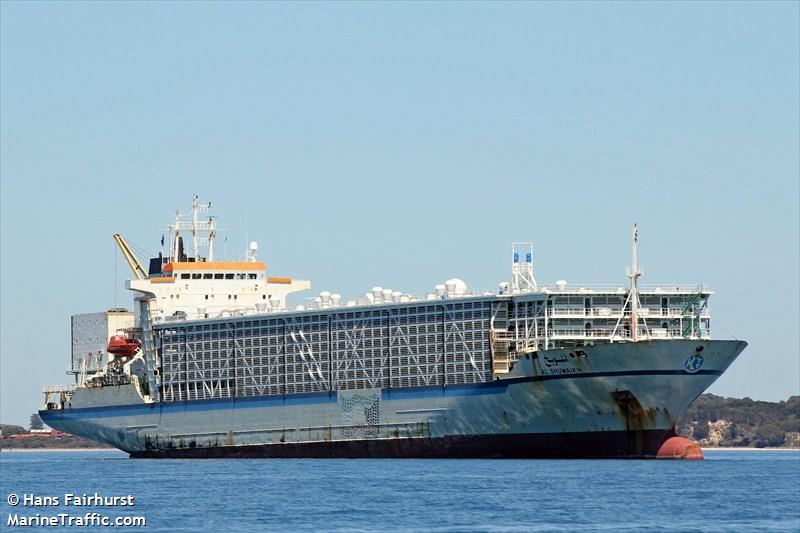
Update 24/7/19 – the Romanian sheep on the ‘Al Shuwaikh’
WAV have today (1120hrs GMT) written to all South East England Members of the European Parliament (MEP’s) asking why 70,000 Romanian sheep are allowed by the EU to be exported live to the Middle East, in conditions which are around 10 degrees hotter than the conditions in Europe, but for which France (another EU member state) has today stopped the transport of live animals !
We really welcome this announcement by the French, who take animal welfare during transport in high temperatures seriously. Pity the same cannot be said about other existing EU member states (Romania).
The EU is master at passing the buck back to individual member states saying that they should ensure enforcement of the rules. Obviously this does not work with Romania; so we now give our South East England MEP’s 48 hours to tell us why it is bad for some and yet ‘good’ for others. MEP’s are supposedly elected by the people to represent the people rather than just sit on the gravy train.
We want action now against Romania and EU Commissioners for allowing the Romanian exports to go ahead. If the EU Parliament can do nothing, then what the point of an EU Parliament representing ‘the people’.
Ref:
The French Minister for Agriculture and Food, Didier Guillaume, has announced on the France 2 TV show ‘4 Vérités’ a suspension on live animal transport because of the high temperatures.
The French Minister for Agriculture and Food, Didier Guillaume, has announced on the France 2 TV show ‘4 Vérités’ a suspension on live animal transport because of the high temperatures.
The restriction will start today and will prohibit certain transports of living animals between 1pm and 6pm from the French départements that are under orange/red alert for the heat.
“For animals crammed into trucks for transportation – often for several days or weeks – temperatures exceeding 30°C , let alone 40°C, cause heat stress which is hellish and can be deadly,” said Reineke Hameleers, director of Eurogroup for Animals. “With their suspension of some live transport, France is heading in the right direction. But we are still concerned that this order will have a limited impact on the welfare of animals.”
Unfortunately the scope of this order is quite limited. The restriction is not applicable to consignments destined to other EU and non-EU countries, and it does not affect sea transport. The role of the DDPP – the territorially competent administrative authority that oversees animal health and the protection of populations – is not sufficiently clarified, and there is a risk that approvals will continue to be granted despite the fact that trucks will go through the area categorized as orange/red. Also, the limited time of the suspension poses severe risks due to the fact that under such extreme weather conditions, temperatures can be higher than 30°C even before 1pm and after 6pm.
Eurogroup for Animals is working to have an EU ban of live transport during summer.
WAV Comment –
why are they not calling for a ban on live transport full stop ? – or certainly a maximum of 8hours as European citizens have been petitioning for ?
As with most EU issues, it (EU) does not really have a clue about enforcement of laws. So from this we assume that it is ok to transport 70,000 live sheep into the Red Sea area from Romania in temperatures of 40 degrees; but that you cannot transport them in France (quite rightly) above 30 degrees.
So are Romanian sheep different to sheep that are not allowed to travel in France ? – it would seem so, as Romanian sheep are going all the way to the Middle East in temperatures way exceeding 30 degrees – more like 40 according to the monitoring we have been doing about the Romanian consignment.
We hear big EU talk about taking action now against the Romanians – so lets see it !
Or is the EU only doing what it is really good at ? – being all talk and no action ?
The EU Commission is the police in the EU area, which means that, according to the will of Parliament, it should be allowed to impose fines on countries that do not comply with EU law. Transports to non-EU countries in breach of EU requirements must also be systematically prohibited.
Update: 24/7/19 0900hrs GMT.
The Al Shuwaikh is now in the Southern sector of the Red Sea,
Between Al Hudaydah in Yemen to the East, and Eritrea to the West.
Maybe it will get to the Arabian Sea today, but breath not being held …………..
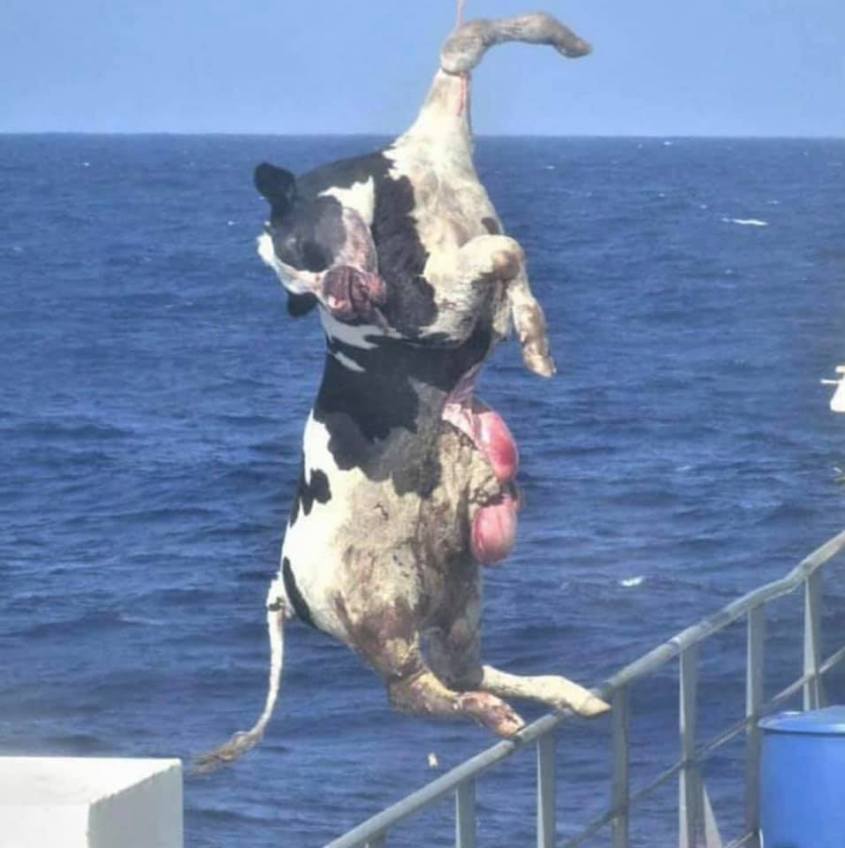
One of the three stranded cows in Tenerife, April 2019
They are terrible pictures dead cows or calves are washed ashore on the beaches!
as we see here in the video
Why are there bodies of dead cows and calves on beaches around the world? They were simply thrown overboard during an animal transport! How to throw leftovers from food, or garbage overboard!
After divers in the Mediterranean were suddenly surrounded by dead calves and cattle and published the video in the social networks, there are also criticisms in the United Arab Emirates about animal transports.
About 20,000 animals fit on such a ship and therefore they are carted together from all over Europe to be transported on these ships. Often, these animals travel for days by truck, then come on a ship, for example, are brought to Lebanon and transported from there again by truck to other countries.
My comment: In the paper, MEPs now demand that animals spend as little time as possible in the vans in the future. In the hot months and over 30 degrees certainly not.
In the paper we read, that unannounced controls and the use of modern tracking technologies must take place.
Accordingly, Member States that detect infringements should impose uniform sanctions across the EU, such as confiscating vehicles or, in the case of repeat offenders, depriving them of the right to transport.
The EU Commission is the police in the EU area, which means that, according to the will of Parliament, it should be allowed to impose fines on countries that do not comply with EU law. Transports to non-EU countries in breach of EU requirements must also be systematically prohibited.
This had independently practiced a small group of German veterinarians, acting under EU law, they have refused to approve shipments to non-EU countries. The German government, the strong lobby of the agrarian and transport mafia has condemned and banned this initiative.
We have not experienced effective protection especially in recent times. Both for the animals and for the law.
On the contrary !! Even commissioners resign themselves to the impudence and the authority corrupt ministers (see Romania) and instead of animal welfare on board and on the road, we experience officially even more animal exploitation, even more animal suffering, even more crimes against animality!
We must increase the pressure on the EU Commission and the Member States to do more to protect the animals transported.
We will fight against criminal transport gangs, and against the disregard of the laws of those, who paid by us to protect animals and laws.
The company — part of Sir Richard Branson’s Virgin Group — plans to initiate the changes as soon as possible, with a deadline of July 31st.
“We have now decided the time is right to discontinue offering attractions featuring close encounters with captive whales and dolphins,” said Joe Thompson, managing director of Virgin Holidays. “We will instead focus our efforts on encouraging customers to see these creatures in the wild. We will also continue our efforts to support the development of sanctuaries for whales and dolphins currently in captivity.”
Virgin Holidays has donated $100,000 to the National Aquarium in Baltimore for their project, which aims to relocate their captive dolphins to a purpose-built sanctuary, set to open in 2021.
“We want to actively support this direction by encouraging more responsible wild watching, which puts animal welfare at the heart of things, meaning our customers get to experience these amazing animals with peace of mind and future generations can enjoy these wonderful experiences too,” said Thompson.
Virgin joins many other travel providers around the world who refuse to support animal-related attractions, such as TripAdvisor and Thomas Cook.
Since 1977, 70 orcas have been born in captivity; 37 of them are now dead, and none have survived for longer than 30 years. The average lifespan of a wild orca is 50-80 years.
According to National Geographic, there are 58 orcas in captivity on the planet; a third of these are held in the United States. These incredible animals live in social groups and are exceptionally intelligent and complex individuals, who cannot thrive when taken from their natural environment.
“It’s basic biology,” says mammal scientist Naomi Rose from the Animal Welfare Institute. “A captive-born orca that has never lived in the ocean still has the same innate drives. If you have evolved to move great distances to look for food and mates then you are adapted to that type of movement, whether you’re a polar bear or an elephant or an orca. Not one marine mammal is adapted to thrive in the world we’ve made for them in a concrete box.”
We applaud Virgin Holidays for taking a stand against animal cruelty and putting their money where their mouth is by supporting humane alternatives to marine animal attractions.
World Animal Protection (WAP) has released a report documenting the heartbreaking suffering inflicted on big cats farmed throughout South Africa and Asia for the traditional Asian medicine industry.
“Trading Cruelty – how captive big cat farming fuels the traditional Asian medicine industry” describes how thousands of big cats are bred and killed every year only to be made into wines, capsules, gels, and balms — products that have never been proven to have any healing properties.
“Does the life of an animal mean nothing at all,” asks Dr. Jan Schmidt-Burbach, global wildlife advisor at WAP. “These big cats are exploited for greed and money – and for what? For medicine that’s never been proven to have any curative properties whatsoever. For that reason alone, it’s unacceptable. At each stage of their lives they suffer immensely – this makes it an absolute outrage.”
Lions are the main focus in South Africa, where cubs are either taken from their mothers in the wild or bred within special facilities. First, they are exploited at petting farms, then used for “walking with the lions” experiences, and eventually murdered at canned hunting game farms for a fee. Their body parts are used as trophies and shipped to Asia to be used in traditional medicines.
China has huge factory-style farms, where dozens of big cats are kept in tiny cells with only the basics to survive. Many discovered as part of WAP’s investigation were emaciated. Some facilities use their captives as entertainment, forcing them to perform in shows and charging visitors to have their photos taken with the miserable animals.
“Many of these animals will only ever see the world through metal bars, they will only ever feel hard concrete beneath their paws, and they will never get to experience their most basic predatory instinct – a hunt,” says Dr. Schmidt-Burbach. “Instead, they are taken away from their mothers as tiny cubs, forced to interact with people or perform tricks, to be then shot or slaughtered so that their bodies can be harvested for products.”
With so many big cats sourced from these horrific farms, you may assume that fewer animals are taken from the wild. This isn’t the reality. WAP discovered that nine out of ten people surveyed in Vietnam — and more than half of Chinese consumers — would rather consume products from animals taken from the wild than farmed. This shows that big cat farming is actually a driving force in the poaching of these magnificent endangered cats.
While the report documents enormous demand for big cat parts for traditional medicine, WAP also highlights some positive statistics. Their studies showed that 67 percent of Vietnamese residents would be willing to try herbal or synthetic alternatives to products sourced from big cats — if the products were reasonably priced.
The organization, along with myriad others around the world, continues to fight for the animals, with a focus on changing attitudes around the use of big cats in traditional Asian medicine.
“This should not be the life for these incredible animals – either in farms or entertainment venues,” states Dr. Schmidt-Burbach. “These animals are majestic apex predators – they are not playthings – nor are they medicine. Big cats are wild animals and they deserve a life worth living.”
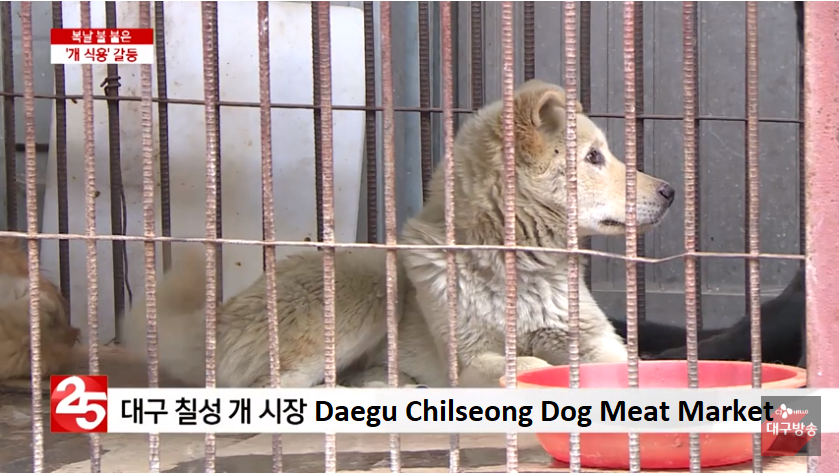
The city of Daegu will consider plans to close down dog slaughterhouses in the Chilseong Market by next year. These plans include solutions for the livelihood of the shop owners.
Daegu Mayor Kwon Young-Jin said on July 17, “The problem of dog meat consumption goes against current trends, and dog slaughterhouses located in the center of Daegu have negative effects on our emotions (sentiment).”
Mayor Kwon also stated, “If the dog slaughterhouses were to close down, there’s the livelihood issue for these businesses, so we will find various ways to help them which includes measures to support their livelihood.“
Daegu Chilseong Market had dog slaughterhouses even before the Chilseong Market became permanently established in the 1940s. There are now two dog slaughterhouses and 17 restaurants and dog soju places that sell dog meat in the Chilseong Market.
We received a report about a dog slaughterhouse and dog farm in Cheonan, a city about one and a half hours south of Seoul, at which the owner of the slaughterhouse killed the dogs in an especially brutal way. With one of the boknal days—the three hottest days of the year when dog meat consumption increases—a couple of days away on the 22nd, we went to investigate on the evening of the 20th.
What we encountered when we arrived was horrific even for experienced investigators.
There were broken cages with dogs tied with short leashes exposed to the elements—it’s monsoon season in South Korea, and there have been a couple of days of heavy rain. There were cages on the ground—they are usually raised off the ground—with dogs standing or lying in muddy puddles. In total there were about one hundred dogs on this farm.
However, that wasn’t the worst of it.
This dog farmer slaughtered dogs in a particularly brutal way; they were hung by the neck and blow-torched alive. The slaughtering was done outside in full view of any dogs unfortunate enough to be able to see the area in which it was done.
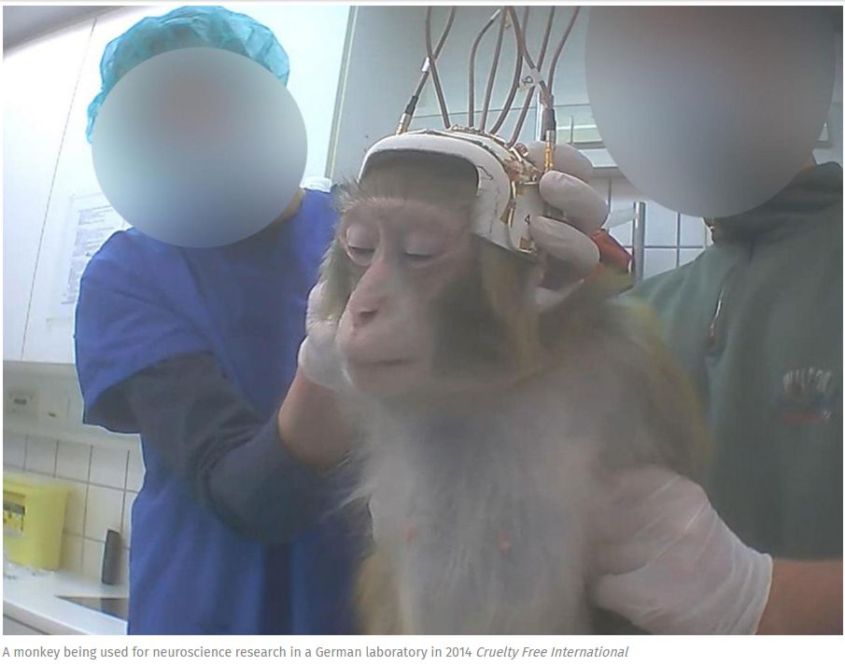
Ethics? The billion-dollar companies such as VW, BMW and Daimler are now because of the test series of monkeys in the criticism, but honestly, what has changed since the announcement of the exhaust gas scandal really?
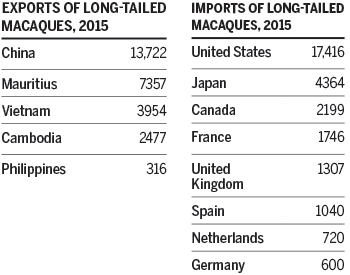
Mauritius is after China the number 2 country selling monkeys for animal testing.
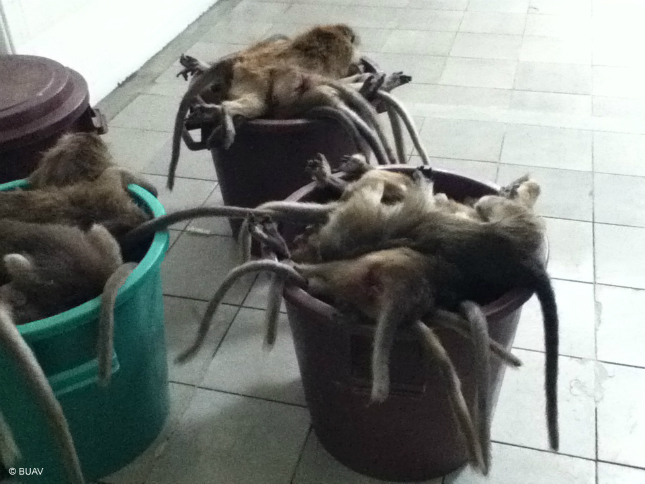
Tens of thousands of monkeys are kept in large farms across the island. The offspring of these wild-caught monkeys are then sent to labs around the world.
In 2016, the breeders exported 8245 animals to North America and Europe – nearly half of them to the United States (see table below).
6000 primatessuffer every year in research in Europewith the support of taxpayers!
Ethics play no role in the global economy today! This is shown by the 10 monkeys, who were sitting in an airtight gas chamber, inhaling the fumes from a VW Beetle, while “cartoons” were shown on a screen.
The car used in the experiment was equipped with illegal fraud software. As a result of the rapid increase in laboratory tests on live monkeys, Sir David Attenborough published an open letter in 2016 (see below).
Every year around 6000 primates suffer from research in Europe.The Patent Office in Munich even approved patents on great apes in 2012.
According to the Federal Ministry of Food and Agriculture, about 2.8 million animals were used for scientific purposes in 2014, including 4636 dogs and 997 cats. Large centers with laboratory laboratories are located in Munich, Berlin, Dusseldorf, Hanover, Heidelberg, Tübingen and Freiburg.
Instead of stopping the animal experiments, there is even a new initiative for animal experiments to be financed with taxpayers’ money.
The German Research Foundation(DFG) is an institution for the promotion of science and research in the Federal Republic of Germany.
In 2015, it had a subsidy budget of 2.84 billion euros. The DFG not only funds animal experiments but also supports the new campaign “Understanding Animal Experiments” (!!!).
How great the pressure from opponents of animal experiments is, shows the new campaign of the Alliance of Science Organizations. It is an association of science and research organizations in Germany. With a new initiative, science in Germany wants to inform comprehensively and transparently (!!!) about animal experiments in research. The Alliance of Science Organizations presented their joint project “Understanding Animal Experiments” on September 6, 2016 in Berlin.
It offers a variety of information material on an Internet platform and via social media, provides experts and allows interactive discussions. This campaign costs 250,000 euros annually and is initially limited to three years.The money comes from the five members of the Alliance, who work with animal experiments themselves. In addition, the German Research Foundation (DFG) finances a full-time position to update the contents of the site and to answer inquiries from the population.
The illegal trade in endangered animals for so-called research is a billion dollar business. Especially in China, the demand is increasing more and more. Also great apes find rapid sales there.
After a doctor pointed out to us in 2013 the monkeys in Mauritius and we made this public,the doctor was threatened and she had to stop her engagement against this massacre.She was even threatened with a career ban.We can see how big this criminal lobby is.
The monkeys are crammed into small wooden boxes and shipped as cargo in passenger aircraft. On long-haul flights, animals suffer from hunger, thirst, anxiety and stress. Animal rights activists have been protesting for years. Many airlines have already left the cruel transport business due to the worldwide protests.
Mauritius still supplies the primates for animal experiments.
What happens to monkeys from Mauritius in the animal experiment lab … can be seen in this video.
Sir David Attenborough is part of a group of leading scientists and animal welfare experts from around the world who have signed an open letter calling for an end to the use of primates for neuroscientific testing.
The letter, published in The Independent, calls for an end to support for certain neuroscientific experiments given the scale of the suffering inflicted on animals and the availability of human approaches.
“We, the undersigned, are concerned about the extent of the suffering that occurs in many neuroscience experiments on non-human primates, especially when it comes to fluid deprivation and movement restriction.
We believe there is now enough progress on human alternatives and are seriously wondering if further research of this kind is needed,” says the letter organized by animal rights organization Cruelty Free International.
The naturalist said that recent findings in understanding the ability of primates to suffer pain meant that science should no longer expose monkeys to painful or cruel experiments.
“Realizing that monkeys are, to a certain extent, similar to other primates, and that these animals suffer just as much as we suffer, has changed our attitude and should not be misused to our own benefit,” said Sir David Attenborough after he had signed the letter.
My comment: In Mauritius itself, there have been no animal experiments. But the government has now launched a law that will allow the establishment of animal testing laboratories.
Animal experimenters are to be lured into the country to be able to conduct research on monkeys directly on site.
A billion dollar business, a corrupt mafia that earns it and corrupt countries that support this business. From this recycling of violence and unscrupulousness lives the business of the laboratory mafia.
Long-tailed macaques are caught in the wild with traps and penned for mass-breeding in animal factories – a legalized crime. Animals for which there are no consumers, such as big males, are killed and disposed of like garbage.
The breeding establishment Noveprim in Mauritius belongs to 47% of the company Covance. The American company has contract laboratories around the world, including in Münster, Germany.
At Covance in Münster every year about 1,000-2,000 monkeys are killed in painful toxicity tests. The animals are pumped chemicals or drugs into the stomach with a tube or injected into the bloodstream. Eventually the animals are killed.
For many years, the Doctors against animal tests, have together with their European partners launched and supported various protest and letter campaigns from ECEAE (European Coalition to End Animal Experiments).
Target: Marilyn Hite Ross, State’s Attorney for Winnebago County, Illinois
Goal: Punish the two men who allegedly shot a dog multiple times, leading to the animal’s death.
An innocent dog was apparently shot multiple times in a shocking case of animal cruelty. The suspects in the case fled the scene and are still at large. Demand justice for this poor animal.
Rockford police are searching for two men in connection with the brutal slaying of an innocent dog. Per authorities, Kelvin Langston, 28, and Douglas Hollyfield, 26, entered a woman’s home and began shooting at the dog in her care. They took turns firing, the witness stated, and only targeted her friend’s animal. Sadly, the pup suffered serious injuries in the apparent attack and later died.
Langston and Hollyfield have been charged with aggravated cruelty to an animal, unlawful use of weapons by a felon, reckless discharge, and no FOID card. Both have warrants and bonds set at $150,000. Sign below to demand that these men are punished for their heartless crime, if convicted.
PETITION LETTER:
Dear State’s Attorney Ross,
A dog was apparently shot repeatedly by two men while being cared for by the owner’s friend. The poor animal later died due to the severity of the gunshot wounds. I demand that the people responsible be brought to justice.
They entered the woman’s home, the witness stated, and aimed their guns at her friend’s dog. They then reportedly took turns shooting the helpless animal, eventually inflicting fatal injuries. These men, identified by police as Kelvin Langston and Douglas Hollyfield, are accused felons and one is reportedly a gang member. Now, despite the continued efforts of the Rockford Police Department, they are on the loose and likely dangerous to other animals.
Those responsible for this innocent animal’s death must be found and brought to justice. Prosecute them and seek the maximum penalty to ensure the safety of all local animals.




 One of the three stranded cows in Tenerife, April 2019