Category: Environmental

Sweden: Big Disappointment in Sweden: the Board of Agriculture Decided Today to Lift the Mink Ban.

Big disappointment in Sweden: the Board of Agriculture decided today to lift the mink ban

10 November 2021

Djurens Rätt

At the end of this year, the temporary ban on breeding mink for fur production will expire and the Swedish Board of Agriculture has just announced that it will not be extended. The decision means that 2022 may mean that half a million minks will once again be staying in cramped grid cages, with risks to animal welfare and continued spread of infection. Animal Rights are deeply disappointed with the decision.

In January 2021, the positive news came that the mink farms would be closed again for 2021 to reduce the risks of spreading the coronavirus SARS-CoV-2. The breeding animals remained on the farms, almost as a promise to the companies that they would be allowed to start up again. It has now happened.

With today’s decision, the mink farms will be allowed to start their operations again on 9 November.

This is in contrast to Denmark, which recently decided that their ban on keeping minks will be extended for 2022. Other countries have also taken a different path than Sweden: the Netherlands imposed a permanent ban on fur farms following the pandemic, and during the week British Columbia in Canada decided on a plan to close down mink farms due to the spread of infection.

In order for the Swedish mink farms to be able to breed mink again, certain specific restrictions have instead been extended, such as a ban on the movement of live mink and isolation of the farms. But this is clearly not sufficient.

“I am deeply disappointed with today’s message. There are many reasons to stop mink farms from breeding minks in cramped lattice cages, the risk of infection spreading is just one of them. When the authorities made this decision today, they also took a stand for the mink industry to continue to conduct unethical activities in Sweden. I now urge politicians to take a new approach to the issue and introduce a permanent ban” says Camilla Bergvall, national chair of Animal Rights Sweden.

Minks have proven to be extra susceptible to the coronavirus, which also affects humans. The majority of Sweden’s approximately 28 mink farms have had outbreaks of infection, with consequences such as increased mortality and respiratory symptoms. Despite the breeding ban in 2021, the infection came on a farm during this summer.

Investigation in Sweden is ongoing

The Government has commissioned the Swedish Board of Agriculture and the Swedish Veterinary Institute to investigate the risks of the spread of infection between animals and humans in Sweden. That assignment will be presented in February 2022, and may involve other proposals for restrictions than the current announcement. However, there are few indications that a breeding ban will be introduced again. It will be up to politicians, especially in government, to implement other legislative proposals to protect minks from suffering and disease.

Animal Rights, with the support of at least 76% of the population, is not alone in proposing the decommissioning of mink farms for infection control and animal welfare reasons. Other examples are the Swedish Veterinary Association and several farmers.

Read more at source

Regards Mark

World leaders must address the impacts of animal farming on climate change.

World leaders must address the impacts of animal farming on climate change

8 November 2021

Eurogroup For Animals calls on world leaders to enhance pledges to reduce greenhouse gas emissions in order to better uphold the obligations derived from the Paris Agreement. Linking animal protection, trade policies and sustainable food systems would be a first step in the right direction.

Six years after the Paris Agreement, the 26th United Nations Climate Change Conference of the Parties (COP) is taking place in Glasgow. This conference is particularly important because it’s the first time the ‘ratchet mechanism’ foreseen in the Paris Agreement will be used

Indeed, each country is expected to submit enhanced “nationally determined contributions” (NDCs) every five years to ratchet up ambition to mitigate climate change.  However, despite the fact that the 2020 conference was postponed due to the pandemic, dozens of countries still have not updated their pledges to reduce their greenhouse gas (GHG) emissions by the time of the 2021 conference.

The implications are serious. A global temperature rise of 2°C above pre-industrial levels delivers the probability of dangerous climate change. Hence, GHG emissions need to be drastically reduced but countries continue to do “business as usual”. 

Livestock farming represents a significant share of the planet’s emissions that cannot be ignored as they account for approximately 18% of global GHG emissions, which is more than all transports combined. 

As outlined in the recent IPCC report, we have no time to lose in cutting methane emissions. Reducing livestock numbers could contribute significantly to meet the Paris target, while failing to reduce them will put most of the UN SDGs out of reach. 

World leaders need to explicitly recognise the intrinsic link between animal protection and the UN SDGs, and the importance of animal protection in putting the world on a sustainable path to 2030. Changing the food system and how we treat animals is a major opportunity for climate change mitigation. Political leaders and governments can, for example:

  • Redirect subsidies from industrial animal production, the main receiver today, to plant-based ones. 
  • Put the EAT-Lancet Planetary Health Diet at the basis for public procurement.
  • Invest in the development of plant-based proteins and cultivated meat.
  • Use the land differently, since deforestation is driven by animal feed production.


It is also high time to address the impact of trade on climate. Currently, trade agreements liberalise trade without any climate or animal welfare conditions. As a result, they fuel unsustainable production systems, harming people, animals and the planet. For instance, the EU-Mercosur trade deal, by granting significant market access to animal products, will fuel intensification of animal farming which highly contributes to deforestation, which in turn will contribute to climate change. In Brazil alone, over half of the country’s deforestation over the last twenty years came from the beef sector, mainly due to the conversion of forests into cattle pasture. 

Eurogroup for Animals’ contribution

To inform COP26 attendees about the environmental issues associated with animal-related sectors, as well as how improved animal welfare and transformed food systems can help build back better, Eurogroup for Animals have created a leaflet entitled “Protecting Animals to Protect the Planet”.

Download the leaflet

File

Protecting Animals to Protect the Planet

Regards Mark

New film shines light on the environmental impact of animal agriculture.

New film shines light on the environmental impact of animal agriculture

8 November 2021

Eating Our Way to Extinction is a new documentary exploring how our broken food system contributes to ecological collapse around the world. Narrated by Academy Award winner Kate Winslet, the film features undercover footage, shocking evidence from globally renowned figures and leading scientists, and firsthand accounts from Indigenous people directly affected by animal agriculture and climate change.

The film, Eating our Way to Extinction, spotlights the links between our food system and the unfolding ecological crisis – an important message as parties and world leaders gather at the 26th UN Climate Change Conference of the Parties (COP26). 

It calls for a switch to a plant-based diet due to unsustainable intensive livestock and fish farming that is leading to routine suffering, deforestation, ocean dead zones and species extinction.

At the COP26 climate summit this week, world leaders have pledged to end and reverse deforestation and lower global emissions of methane by 30 percent by 2030. The film explores both issues and finds that animal agriculture is the largest source of methane emissions and by far the greatest forest destroyer. 

Steep cuts to livestock production will greatly benefit the climate by slashing short-term emissions to give us the circuit-breaker desperately needed to stem global warming.

Eating our Way to Extinction trailer

To inform COP26 attendees about the environmental issues associated with animal-related sectors, as well as how improved animal welfare and transformed food systems can help build back better, Eurogroup for Animals have created a leaflet entitled “Protecting Animals to Protect the Planet”.

Download the leaflet

File

Protecting Animals to Protect the Planet

Regards Mark

UK: COP26 – There are more delegates at COP26 associated with the fossil fuel industry than from any single country

COP26: Fossil fuel industry has largest delegation at climate summit

There are more delegates at COP26 associated with the fossil fuel industry than from any single country, analysis shared with the BBC shows.

Campaigners led by Global Witness assessed the participant list published by the UN at the start of this meeting.

They found that 503 people with links to fossil fuel interests had been accredited for the climate summit.

These delegates are said to lobby for oil and gas industries, and campaigners say they should be banned.

“The fossil fuel industry has spent decades denying and delaying real action on the climate crisis, which is why this is such a huge problem,” says Murray Worthy from Global Witness.

“Their influence is one of the biggest reasons why 25 years of UN climate talks have not led to real cuts in global emissions.”

About 40,000 people are attending the COP. Brazil has the biggest official team of negotiators according to UN data, with 479 delegates.

So what counts as a fossil fuel lobbyist?

Global Witness, Corporate Accountability and others who have carried out the analysis define a fossil fuel lobbyist as someone who is part of a delegation of a trade association or is a member of a group that represents the interests of oil and gas companies.

Overall, they identified 503 people employed by or associated with these interests at the summit.

They also found that:

  • Fossil fuel lobbyists are members of 27 country delegations, including Canada and Russia
  • The fossil fuel lobby at COP is larger than the combined total of the eight delegations from the countries worst affected by climate change in the past 20 years
  • More than 100 fossil fuel companies are represented at COP, with 30 trade associations and membership organisations also present
  • Fossil fuel lobbyists dwarf the UNFCCC’s official indigenous constituency by about two to one

One of the biggest groups they identified was the International Emissions Trading Association (IETA) with 103 delegates in attendance, including three people from the oil and gas company BP.

According to Global Witness, IETA is backed by many major oil companies who promote offsetting and carbon trading as a way of allowing them to continue extracting oil and gas.

“This is an association that has an enormous number of fossil fuel company as its members. Its agenda is driven by fossil fuel companies and serves the interests of fossil fuel companies,” Mr Worthy said.

https://www.bbc.co.uk/news/science-environment-59199484

What else could we expect ?

Regards Mark

UK: Cop26 legitimacy questioned as groups excluded from crucial talks.

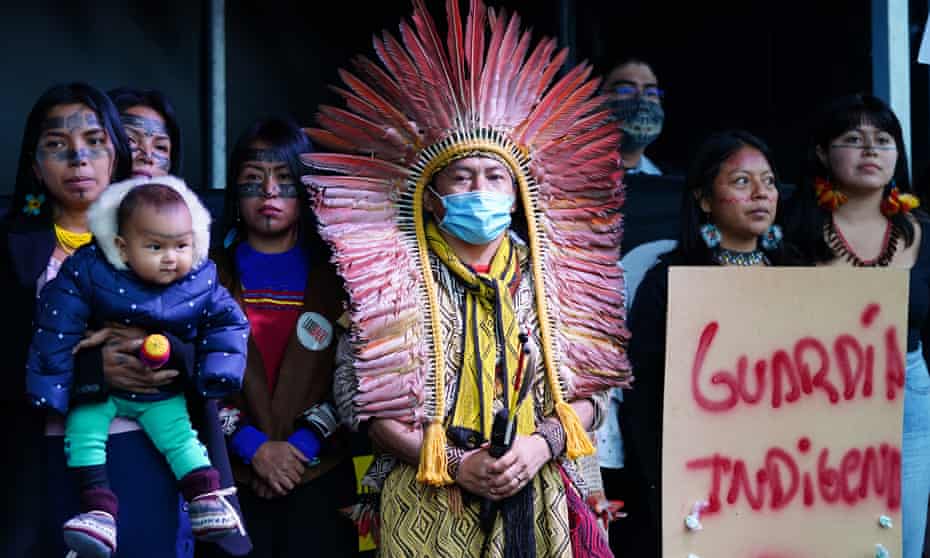
Members of indigenous groups from Brazil stand on the stage in George Square during the Cop26 summit in Glasgow.
Members of indigenous groups from Brazil stand on the stage in George Square during the Cop26 summit in Glasgow. Photograph: Jane Barlow/PA

https://www.theguardian.com/environment/2021/nov/08/cop26-legitimacy-questioned-as-groups-excluded-from-crucial-talks

Cop26 legitimacy questioned as groups excluded from crucial talks

Communities and groups say being shut out of key negotiations will have dire consequences for millions

The legitimacy of the Cop26 climate summit has been called into question by civil society participants who say restrictions on access to negotiations are unprecedented and unjust.

As the Glasgow summit enters its second week, observers representing hundreds of environmental, academic, climate justice, indigenous and women’s rights organisations warn that excluding them from negotiating areas and speaking to negotiators could have dire consequences for millions of people.

Observers act as informal watchdogs of the summit – the eyes and ears of the public during negotiations to ensure proceedings are transparent and reflect the concerns of communities and groups most likely to be affected by decisions.

But their ability to observe, interact and intervene in negotiations on carbon markets, loss and damage and climate financing has been obstructed during the first week, the Guardian has been told.

“Civil society voices are critical to the outcome of Cop, but we’ve not been able to do our jobs. If participation and inclusion are the measure of legitimacy, then we’re on very shaky grounds,” said Tasneem Essop, the executive director of Climate Action Network (CAN), which represents more than 1,500 organisations in over 130 countries.

CAN is one of two environmental “constituencies” – loose networks of NGOs including youth groups, trade unions, indigenous peoples, business, agriculture, and gender – recognised by the UNFCCC.

Gina Cortes, a member of the Women and Gender Constituency, representing women’s groups, said they also had to “call out the deep inequities and deep injustices of this Cop”.

“There are thousands of activists who should be here but who are missing and there is a shocking degree of closing space for civil society and frontline voices … it is offensive, unjust and unacceptable,” said Cortes.

In the run-up to Cop26, the UK government had boasted that Glasgow would be the most inclusive summit on record.

In reality, about two-thirds of civil society organisations who usually send delegates to Cop have not travelled to Glasgow due to “vaccine apartheid”, changing travel rules, extortionate travel costs and Britain’s hostile immigration system.

Observers say the situation was most critical during the two-day leaders’ summit at the start of last week, when they were limited to one or two tickets per constituency despite six negotiating rooms operating simultaneously. In addition, work stations, offices and restaurants were also cordoned off, preventing observers from having face-to-face contact with negotiators.

“The level of restrictions was unprecedented,” said Sebastian Duyck, from the Centre for International Environmental Law. “It’s alarming, because the relationships we build at the start of Cop are crucial to the work we do after … the limited participation absolutely undermines the credibility of Cop.”

Indigenous activists on tackling the climate crisis: ‘We have done more than any government’ – video

Access has improved since the ticketing system was lifted, with one observer per constituency now technically allowed in each meeting room – if there’s enough space according to social distancing rules. But their ability to participate meaningfully remains limited.

Observers are particularly concerned about negotiations over carbon trading protocols, as governments and corporations look for ways to achieve net zero commitments using offsets.

“There’s a real risk that decisions made in these rooms will impact human rights in the most dramatic fashion, like we saw happen under the carbon trading mechanism under Kyoto. If we get a bad rule, it’s almost impossible to fix afterwards. The scale of carbon markets means there’s a greater threat to communities,” said Duyck.

This is a huge worry for indigenous communities, who comprise 6% of the global population but protect 80% of the planet’s biodiversity. “Without our voices this risks the creation of rules that will continue to violate human, territorial and spiritual rights of Indigenous Peoples,” said Eriel Deranger, an observer for Indigenous Climate Action.

The UK government points to the unprecedented challenges posed by the pandemic, and says access has been boosted by the new online platform that has so far been used by 12,000 people.

But for some, trying to follow what’s going on virtually, technical glitches have made access a “logistical nightmare”, said Hellen Kaneni, regional Africa coordinator for the international nonprofit Corporate Accountability. “Cop has never been credible but this year it’s much worse, access has been limited in so many ways, it’s horrible.”

Kaneni’s colleague Aderonke Ige from Nigeria, who made it to Glasgow for her first Cop despite the Covid restrictions, said she felt “disappointed and unfulfilled” after failing to get online and being denied access to the meeting rooms and offices of the African group negotiators.

A spokesperson said: “The UK is committed to hosting an inclusive Cop. Ensuring that the voices of those most affected by climate change are heard is a priority for the Cop26 presidency, and if we are to deliver for our planet, we need all countries and civil society to continue demonstrating their ideas and ambition in Glasgow.”

The success of this Cop will be judged over years to come. But according to Nathan Thanki from Demand Climate Justice (the second environmental constituency), the summit’s legitimacy had been seriously undermined by restrictions in access and the way rich countries had used Cop26 to make headline-grabbing announcements outside the UNFCCC’s pledge and review framework.

“It’s impossible to monitor these announcements, which means there’s no accountability to civil society or other countries. That’s the sorry situation at this summit.”

Regards Mark

Scotland UK: We Sold Out of Every Vegan Bake ! – and Police Praise, 22 Only Arrested in March of Over 100,000 Campaigners.

Catch up with the latest Cop26 news here:

LATEST NEWS – UN Climate Change Conference (COP26) at the SEC – Glasgow 2021 (ukcop26.org)

Police praise good natured campaigners

COP26: Police praise ‘good natured’ marchers in Glasgow – BBC News

Police have praised the majority of “good natured” marchers who took part in one of Glasgow’s largest protests in memory.

About 100,000 took part in the procession from Kelvingrove Park to Glasgow Green on Saturday.

Officers made 22 arrests – one after a socialist group were contained and the rest after protesters chained themselves on a bridge.

Crowds swiftly dispersed after speeches concluded leaving little litter behind.

Police later told the BBC there were no major incidents following the event.

https://news.sky.com/story/cop26-tens-of-thousands-march-to-demand-climate-action-on-biggest-day-of-protests-at-climate-summit-12462301

https://www.theguardian.com/environment/2021/nov/07/counter-climate-summit-kicks-off-as-activists-lament-cop26-inaction

‘We sold out every vegan bake’

Arouge Salin
Arouge Salin served cakes and coffee to queues of shivering marchers on Saturday

Arouge Salin has worked at the Brave Bakers coffee shop on Saltmarket for around two months.

It was one of the few businesses in the area that had opted to stay open on Saturday – a move that paid off as tens of thousands of activists walked by.

The 25-year-old was one of three members of staff behind the counter delivering cinnamon twists and hot coffee to shivering customers who had been soaked in the rain.

“It started off quiet, but we had a queue outside the shop until the walk passed – it was non-stop from 15:30 until 18:00, and we normally shut at 17:30.

“We sold out of everything vegan – which never happens. The only thing we had left was our chicken and bacon bake which is usually the first thing to go.

“And we sold so many coffees that our machine jammed. I think people just wanted something warm.”

‘No problems’ with litter

Council crews and event organisers took part in the clean up operation on Sunday morning.

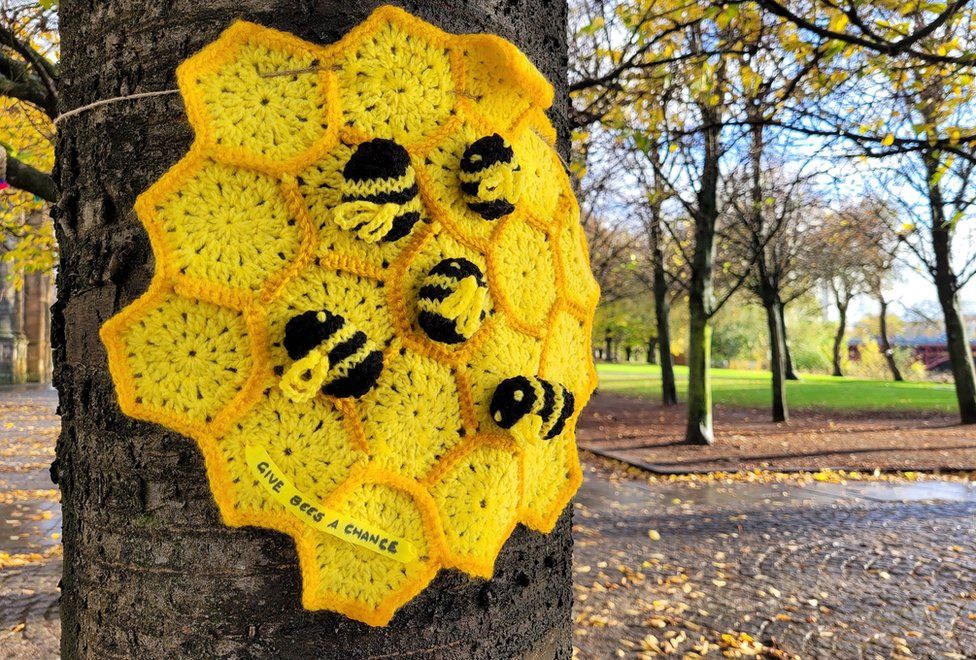
A yarn installation depicting flowers and bees at the entrance to Glasgow Green was removed by the council due to “high winds and wet weather”.

Glasgow Green

There was also a knitted sign which read “we’re watching you” – a phrase which has appeared on Extinction Rebellion campaign material.

A council spokeswoman said: “It is currently in storage for the owner to collect if they so wish.”

They added that overall, no problem areas had been identified and no “hotspots” were reported.

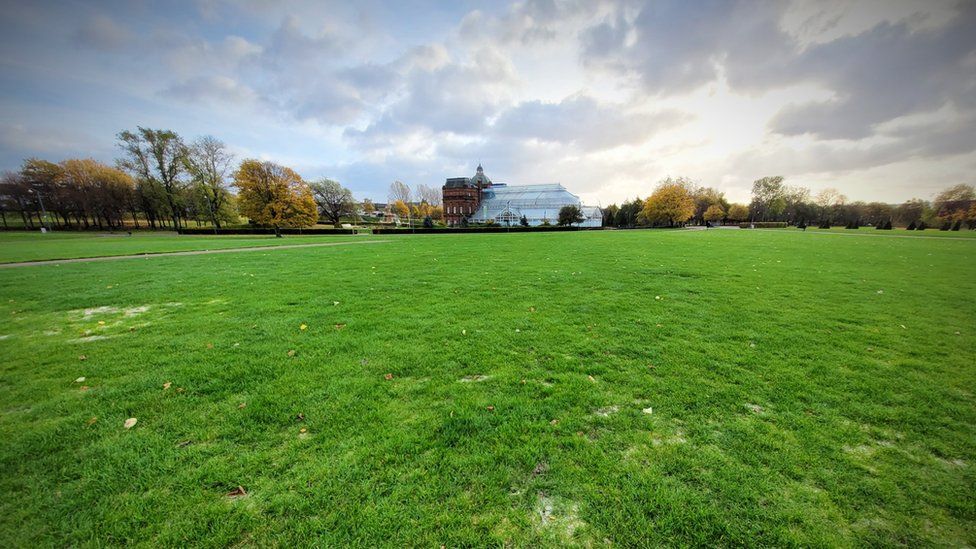
Glasgow Green

Glasgow Green on Sunday morning – a huge tribute to the respect of the environmental campaigners – others should take note of this !

Regards Mark

A Chance for European Citizens to End the Shark Fin Trade.

Note – this is FOR EU CITIZENS ONLY

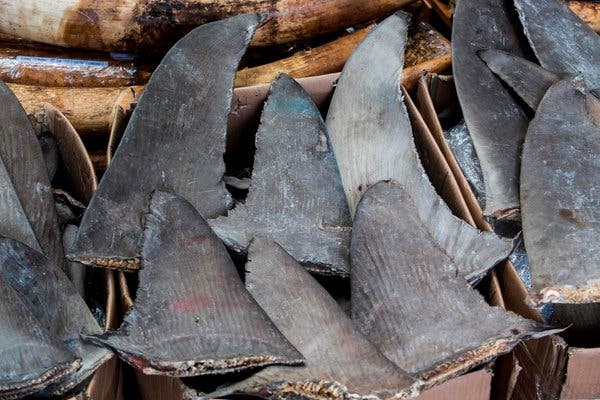
Every year, tens of millions of sharks end up in the fin trade.Credit…Isaac Lawrence/Agence France-Presse — Getty Images

A chance for European citizens to end the shark fin trade

4 November 2021

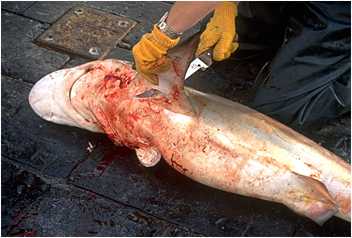
A group of citizens from across Europe have united and demand the end of the shark fin trade in the European Union (EU), so as to increase the protection of sharks. This trade relies on the cruel, unethical practice of cutting the fins off sharks and discarding the animal back into the ocean, oftentimes while it is still alive.

Every year, between 63 and 273 million sharks are killed, and many species are increasingly threatened worldwide. Europe is one of the major players in the global fin trade. Globally, sharks are targeted for their meat and liver oil, but the biggest threat remains shark finning. The steep erosion of shark populations across the globe has severe impacts, as many sharks are ‘apex predators’ and play an active role in maintaining healthy and productive marine ecosystems. Sharks commonly have their fins removed while alive on fishing boats, and are then left to asphyxiate or returned to die in the water.

The ‘Stop Finning — Stop the Trade’ European Citizens’ Initiative began collecting signatures on 1 February 2020. EU citizens have until 31 January 2022 to support the requested change by collecting one million votes to demand the end of shark fin trade in the European Union.

Specifically, EU citizens call to “end the trade of fins in the EU including the import, export and transit of fins other than if naturally attached to the animal’s body”. Should their endeavour succeed, the European Commission could then decide to propose a new regulation to achieve this goal.

Such a new regulation would go one big step further than the current EU legal framework, which aims to reduce the number of sharks fished by requiring — since 2013 and for all EU vessels — that fins remain attached to the carcass of the shark until unloading at port. However, fins can then be separated and traded locally or across the world. Soon after introduction of the regulation, fishing of sharks returned to previous levels. While a steep improvement from the EU’s former regulation, the current regulation still allows fins to be traded across Europe and EU fishers to feed Asia’s strong demand for shark fin soup.In June 2019, Canada became the first country of the G7 group to ban shark fin imports on its territory, and citizens around the world are increasingly requesting the end of such cruel and useless practices. Europe must follow suit.

European citizens have the power to demand that the EU’s decision makers enhance wildlife protection.At a time when the scientific community regularly rings the alarm bell regarding erosion of biodiversity erosion and the risks associated with climate change, we have no choice but to change our production and consumption patterns. It is high time to end the shark fin trade in Europe!

Sign the European Citizens’ Initiative here.

Read more at source

European Citizens’ Initiative: Stop Finning – Stop the trade

Regards Mark

On the Brink – Climate Change Famine: the Situation in Madagascar; and S(hell) CEO Gets a Totally Deserved Roasting From a Climate Activist.


Must watch:

On the brink – climate change famine:

This image has an empty alt attribute; its file name is images1.png

Personally, I (Mark) think the Shell CEO needs to be made to sit and watch all of the above videos; he caused it; the little children to suffer because of utter muck like him.

This person is crap; but as the activist shows in the following brilliant attack, she does not let him get away with talking crap, which he specialises in (see video below).

This image has an empty alt attribute; its file name is images1.png

Or to put it another way; big shit talk from the big Shell CEO:

UK; Twas The Night Before COP26 – British Comedian Joe Lycett Holds ‘Shell’ (Oil Giant) To Account For Their Green Sales Techniques. He Literally Talks Shit ! – World Animals Voice

For the innocents of Madagascar

Regards Mark

This image has an empty alt attribute; its file name is images1.png

Poland: Green REV Institute Urges Polish President to Introduce Carbon Pricing for Food.

Green REV Institute urges Polish President to introduce carbon pricing for food

4 November 2021

Green REV

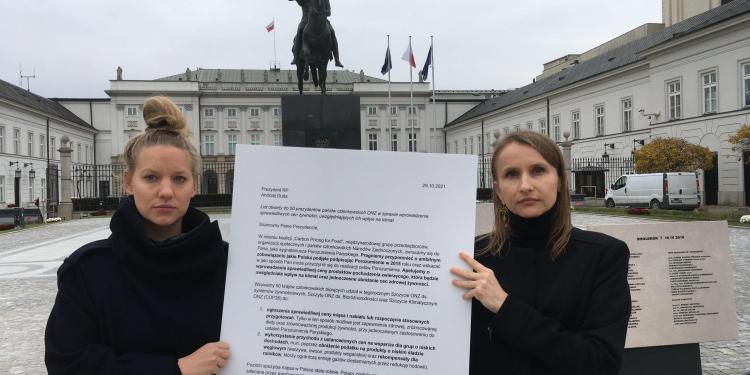
Just ahead of the UN Climate Summit (COP26), a press briefing was held at the Presidential Palace in Warsaw where Green Rev Institute and Democracy Action delivered an open letter to President Andrzej Duda from the international coalition “Carbon Pricing for Food”.

In the letter, numerous organisations from all over the world appeal to on the presidents of 50 UN member states to introduce fair prices for animal products (meat and dairy) that take into account the costs of their negative impact on the climate. 

Reducing industrial animal production, which accounts for over 14% of greenhouse gas emissions, is one way to meet the Paris Agreement goals, which Poland also ratified in 2015. 

At the same time, the organisations call for lower prices for plant products and compensation for farmers who turn to more sustainable plant-based food production.

Healthy food should be available here and now. That’s why we must stop subsidising animal production in our taxes: meat, dairy, eggs. Animal agriculture is responsible for nitrous oxide and methane emissions, for deforestation, for pollution and excessive use of water, for the decline in biodiversity and for lifestyle diseases (…) Therefore, together with NGOs and companies from all over the world, we turn to President Andrzej Duda to support the transformation of the food system and to support all actors in this process: farmers, consumers, decision-makers and politicians. It’s time for real leadership to change and fix the broken food system

Anna Spurek, COO of Green REV Institute

Read more at source

Read our report: The EU campaigns to promote meat, eggs and dairy

Regards Mark

EU Invests €2m to Develop Cultivated Beef for Commercial Markets.

Photo – Like Meat

EU invests €2m to develop cultivated beef for commercial markets

3 November 2021

News

Funding from a Covid recovery package that was set up by the European Commission, known as React-EU, has been granted to two Dutch food firms – Nutreco and Mosa Meat – attempting to lower the costs of growing meat in vitro.

The React-EU package (Recovery Assistance for Cohesion and the Territories of Europe) was first established in December 2020, setting aside €50.6bn in funding for countries to adopt a greener and more sustainable economic recovery in response to the Covid-19 pandemic.

The collaborative project “Feed for Meat” aims to address one of the the leading challenges in cultured meat development; affordability. The grant will fund research and development on lower-cost and sustainable nutrients for the base media in which the beef cells grow in order to make production more commercially viable for European markets.

According to an independent Life Cycle Analysis study, cultivated beef production is projected to reduce climate impact by 92%, air pollution by 93%, use 95% less land and 78% less water when compared to industrial beef production.

The project was ranked first place in this highly-competitive scheme, which received over 60 funding applications – yet another indicator that cellular agriculture has a critical role to play in helping the European Union meet the robust goals of the Farm to Fork strategy within the Green Deal.

Read more at source

Independent

Regards Mark