New outbreak of SARS-CoV-2 on Polish mink farms means 37,000 mink will be culled
According to official information from the General Veterinary Inspectorate, a new SARS-CoV-2 mink farm outbreak has been detected in Poland. This is the second outbreak of coronavirus detected on mink farms in Poland.
The outbreak was detected in two farms which hold a total of 8,000 breeding females and 29,000 young mink, both located at the same address in the Biała-Podlaska district.
The presence of the virus was discovered from the results of laboratory tests carried out at the State Veterinary Institute in Puławy. The samples were collected on June 16, as part of ongoing disease control procedures put in place after the dramatic outbreak of SARS-CoV-2 across European mink farms in 2020.
The inspectorate reported that “all control procedures foreseen in the event of SARS-CoV-2 in mink” had been implemented on the farms where the infection was identified.
The local veterinary inspector confirmed that all mink on these farms, a total of around 37,000 animals, will be culled.
Earlier this year Eurogroup for Animals and the Fur Free Alliance released a scientific statement on public health risks associated with SARS-CoV-2 and intensive mink production, signed by numerous scientists from the fields of virology, infectious diseases, clinical microbiology, veterinary medicine and environmental health.
Despite the mandatory SARS-CoV-2 screening of all European mink farms introduced by the European Commission, in addition to the introduction of more stringent disease prevention methods, this outbreak demonstrates that the risk of continued spread of the virus on fur farms is still extremely high.
We are calling on the European Commission to act immediately to suspend mink farming across the European Union to prevent the spread of SARS-CoV-2, to protect human and animal health.
Dutch court rules in favour of chicken welfare | Eurogroup for Animals
Andrew Skrowon
Dutch court rules in favour of chicken welfare
28 June 2021
Handling chickens by their legs, as prohibited in the Transport Regulation, will finally be enforced in the Netherlands. An example to follow for the rest of Europe.
Thanks to the case submitted by Wakker Dier on April 29, the Dutch Trade and Industry Appeals Tribunal ruled that it is not allowed to handle chickens by their legs on farm and when loading and unloading the animals, as stated in the Transport Regulation.
This cruel practice however, is the common one used across the EU, even if this type of handling was prohibited for the past 15 years. Alternative methods, such as the Swedish one introduced by Eyes on Animals, could provide for a more humane approach.
After the court case, the Dutch Agriculture Ministry supported the Wakker Dier position and, as a result of their enforcement request, three catching teams in the Netherlands were checked and fined (each 1,500 euro) for not complying with the Regulation.
The Dutch chicken sector is working hard on this issue: which catching method to use, how to instruct and train trapping teams, and what time frame they need to properly implement it.
This decision, while causing a commotion in the Dutch chicken sector, could have important downfalls in other countries too. Indeed, without a Court of Justice of the European Union’s (CJEU) ruling it is only relevant in the Netherlands but it could definitely start the same conversation in other EU countries.
The Dutch government indicated that it will possibly bring this matter up at the upcoming Agrifish meeting (28 and 29 of June).
The Transport Regulation is at the centre of the current revision of all animal welfare laws and we call on the Commission to maintain the ban on handling chickens by their legs and ensure proper enforcement.
With our No Animal Left Behind campaign we will make sure that chickens are properly protected and we hope that other Member States will take the Netherlands as an example to follow.
Council Conclusions on live transport by sea: unwelcome, unnecessary and unhelpful
28 June 2021
Press Release
Member States send all the wrong signals to the Commission, as EU citizens expect a ban on live exports and animals deserve better.
At the insistence of the Portuguese Presidency, Agriculture Ministers from across the EU today adopted formal Conclusions on animal welfare during sea transport to third countries, a formal expression of the opinion of all 27 Member States, but one that risks hindering progress.
Better rules for live sea transport won’t mitigate the serious risks associated with this outdated trade. Recent incidents as well as a recent new study by our member Animal Welfare Foundation (AWF) and Robin des Bois on EU- certified livestock carriers proved, once again, that live animal export is not a correct practice with regards to animals, humans and the environment.
While the fitness check process is still ongoing, today’s Conclusions also demonstrated added impetus for a new Transport Regulation. The Council still “invites the Commission to submit a proposal for a revised regulation on animal welfare during transport, if possible, sooner than indicated in the Farm to Fork Strategy”, which is more than welcome.
At the same time though, the Council stresses the need to prioritise short term improvements and monitoring, in order to improve the implementation of the current Regulation.
While Eurogroup for Animals welcomes short-term improvements to relieve the immense suffering of animals, it believes that the revision of the Transport regulation should introduce a much shorter maximum journey duration for animals as well as a ban on live exports. Such an approach would fit with the objectives of the EU’s Farm to Fork strategy to significantly shorten supply chains.
In this respect, we applaud the German, Dutch and Luxembourgish Ministers who presented a paper stating that these Conclusions can only be considered as short term measures, but want to see live exports ended through the forthcoming legislative revision.
As stated in the Conclusions, “animal welfare during transport is a priority at EU level and should be ensured at all levels and stages of the journey during the international long-distance transport of live animals including to third countries, while favouring, and supporting, as far as possible, the transport of genetic material and meat”.
We trust the European Commission will keep working on the revision of the Transport Regulation and towards phasing out live exports. The shift to meat and carcasses trade is the only way forward to protect animals, people and the environment. The Council Conclusions are simply unwelcome, unhelpful and unnecessary.
The first time that I meet Dulce Ramírez, I compliment her on her name – Dulce means ‘sweet’ in Spanish. “I am the opposite,” she says resolutely.
Those who know her agree. A colleague described her as “Persistent and tenaciously persuasive.” She’s also undeniably brave and focused. All valuable qualities when you are leading an animal rights organization in Mexico, a country where culture and national identity are so firmly rooted in food. In Mexico, food is about family, history and culture – and it is dominated by meat and cheese.
For Ramírez, it all started 13 years ago when she found a kitten on the patio behind her house. By caring for this kitten, “I began to understand the emotional world of animals, their needs, and their intelligence,” she explains. “I began to search for information and question more and more the relationship of subjugation we impose on other animals.” The more she learnt, the more it became clear to her that she wanted to advocate for animals.
Fast forward to June 2011, when the Spanish government arrested 12 animal rights activists linked to Igualdad Animal (Animal Equality) in Spain, labeling them ‘eco-terrorists’. Hearing this news, Ramírez contacted the founder and president of Igualdad Animal, Sharon Núñez, to express solidarity with the activists. The following year, the Mexico chapter of Igualdad Animal was founded, with Ramírez at the helm.
“The first thing we did was to show how Mexican industrial farming works.”
In the six years since, Igualdad Animal Mexico has achieved big things. Their first campaign brought animal groups in the state of Jalisco together to successfully end the use of animals in circuses. The organization has developed educational programs, petitioned for legislative changes, and conducted corporate outreach, encouraging companies to adopt policies that benefit animals, such as offering more plant-based options.
For the last two years, the organization has focused on improving the lives of farmed animals. As is the case in most countries, Mexico has virtually no legal protections for farmed animals. But while in some other regions the conversation about farm animal welfare is already well-established in the public discourse, that isn’t the case in Mexico. Given the victories coming for farm animals worldwide and the number of farmed raised and killed in Mexico each year, Ramírez believes this makes Mexico a prime target for bold campaigns and big changes. “For that reason, the first thing we did was to show how Mexican industrial farming works.”
At the foundation of this is investigative work, which Ramírez says is without doubt the most powerful ingredient for creating change. It is these investigations that, by documenting the lives of animals in factory farms, bring focus and strategy to the animal rights movement, she says. Without this footage, animal groups would struggle to develop hard-hitting public campaigns and educational resources telling the true stories of animals in animal use industries.
“I deeply admire women who have done investigations.”
Ramírez is one of only a few female investigators in the country. The work carries huge risks to personal safety, as well as the emotional toll of witnessing the intense suffering of animals.
“The challenge is always when, at the end of the day, you arrive home and the images come back into your head, you have the smell impregnated on your clothes and body, and it all takes you back.”
What inspires her to do this difficult work? “I deeply admire women who have done investigations, who take pictures of the most terrible situations and who transform it into struggle and activism to change the lives of the animals,” she says.
Igualdad Animal Mexico isn’t done setting precedents for the country.
New investigations are planned and the group’s corporate campaigns continue. Their current legislative push — ending the use of cages for laying hens — is in full swing. They also plan to launch LoveVeg, a public education platform focused on changing consumer habits, in Mexico.
Leading the way, and with so many hearts and minds to change, Ramírez knows she is exactly where she needs to be.
Press release from the “SOKO animal welfare organization”
In 2016 we uncovered the total failure of the Alb-Donau district in Baden-Württemberg, Germany. Only the use of “SOKO Tierschutz”caused the closure.
The veterinarian, who failed for years and simply didn’t want to notice anything about the drama, got away with it.
(The text in the video is described in the article)
His boss protects him and continues to lead the office.
What has changed? A new farm in a place nearby, Berghülen. Another pig farm is located here.
The last name is curiously the same. Horror reigns in the courtyard.
Severely mutilated pigs, lonely death without water and feed in the dirt.
Carcasses everywhere you look. Pigs eat one another.
The carcass bins fill up continuously.
Such horror and chaos develop over the years.
Has this neglected establishment been checked? We provoke it and inform the veterinary office.
Hidden cameras show what happens then. Shortly before the inspection, there is hectic cleaning.
A carcass is quickly removed.
Then the vets come. It is Dr. G. and his boss Dr. B. When checking, they overlook the pig, which is quickly hidden in the middle of a corridor.
One week after the inspection, SOKO activists discovered the rotting animal at the same location.
The carcass barrels, which were not even examined during the entire inspection, are filled with illegally killed pigs after the inspection. The keeper shot the animals in the head, but did not kill them with a throat cut as prescribed.
That means slow death with extreme pain from the head wound. The veterinary office does not notice anything.
Dying continues in the company.
Animals rot in the corridor and the bad head injuries over and over again.
The recordings in the video also show the brutal handling of the animals.
The farmer throws animals on the ground and carries pigs screaming in fear around his ears. “A terrible degree of brutality and one apparently feels so safe that decaying carcasses were simply left behind immediately after an inspection,” describes the SOKO animal welfare spokesman.
SOKO Tierschutz demands that the pig breeding facility be closed immediately and that there are finally severe consequences in the authorities. “This vet and his boss should be fired immediately and the farmers must be banned from keeping animals for life,” the SOKO spokesman demands.
Incapable veterinarians, an unscrupulous farmer and his wife and the people for whom this little pig child is only meat are responsible for this fate.
And I mean…How can you actually write something about it?
The horror piece begins with a farmer who shoots his animals on the head with one shot, and lets them perish in indescribable pain.
The fact that the conditions in the new facility worsened despite the intervention of the veterinary office and that there were new criminal offenses shows that the animal keepers do not have to fear the authority.
It stayed with the chaos of suffering and death. It even got worse.
This mixture of horror consists of farmer, office, politics and customer.
The first three go hand in hand in corruption and cruelty to animals, and have caused the worst animal welfare scandals for decades, especially in pig fattening.
And then there are the customers who keep eating pork because it tastes so good.
And best of all, cheap.
The meat in Germany is cheaper than anywhere else in Western Europe. You can safely double the price and it’s still cheaper than abroad. That’s why nobody in Germany goes hungry. Those who go hungry have very different problems than the reason they go hungry.
Nevertheless, there are some who claim that we have one of the best animal welfare laws here and that only German products are animal welfare … that is NOT true.
There are a number of countries with much stricter animal protection (by the way, Germany also works with animal tests in comparison with the EU with shameful protection).
It is nasty typical chauvinistic behavior and nasty complacency of the Germans always to be the best.
IT IS NOT TRUE !
WAV Comment: With a Prime Minister like Justin Trudeau (JT) attempting to be at the helm of Canada; is it any wonder that transport regulations have not changed for 40 years – just like ‘Mr no action’ and the mass seal clubbing that obviously has his support – otherwise, would he not have taken action by now ?
A very good article which probably reflects how many Canadians feel. and the National Animal Care Council – paid money to do what ? – does ‘animal care’ actually come into the equation ?
We totally unite with our campaigner friends at Toronto Pig Save, and all other campaigners across the beautiful country that is Canada – I (Mark) have visited and enjoyed many times. We wish them all well with their campaigns and the fight for justice for sentient beings. And we think things are bad in the EU ? – well they are, disgusting when it comes to live animal transport; but Canada really has to move into this day and age and not live 40 years ago, when the obvious putrid regulations were formed.
Live animal transport – archaic in Canada; disgusting in Europe; so about time politicians woke up, yawned, and then did something in the way of action !
Justin Trudeau; very much living in the past.
‘JT’ Living in the past – and JT stands for ……………………………. we suggest he listens to it sometime.
We’re outraged when dogs are kept in hot cars. Why not pigs in transport vehicles?
In Canada, there are no laws regarding temperatures above or below which farmed animals cannot be transported
A dog suffering in a hot car will typically cause people to react with immediate action and outrage. They break windows, call the police, and the atrocity might even be documented on the news or social media, leading to floods of angry comments and demands that owners be punished. Today the act of locking an animal inside a hot car is widely condemned, considered dangerous, deadly and morally repugnant.
But what if that animal is not a dog, but rather a pig? And what if it is not a car, but a large metal transport truck? What if it is not one, but dozens of pigs crammed together, panting and suffering, after traveling up to 36 hours in the sweltering summer heat?
How do we feel then?
Canada is known for having some of the worst animal transport standards in the Western world. (Dave Ritchie/CBC)
Pigs in distress
Last week, animal rights activists with Toronto Pig Save and The Light Movement shared footage and photos on social media allegedly recorded outside of a slaughterhouse in Burlington, Ont. The videos show pigs inside trucks breathing rapidly, some foaming at the mouth, some lying on their sides in obvious distress.
Environment Canada issued a heat warning for the region the day that footage was shot, with temperatures reaching 33 degrees Celsius in some areas.
But heat warnings don’t stop meat production.
In Canada, there are no laws regarding temperatures above or below which farmed animals cannot be transported.
Though the National Animal Care Council does have recommendations regarding transport of farmed animals in extreme weather, they are merely guidelines — not law — and are vaguely worded and rarely enforced.
This differs greatly from farmed animal transport standards in the European Union, which requires trucks be outfitted with forced ventilation systems that maintain a temperature range between five and 30 degrees Celsius, along with temperature-monitoring systems to alert drivers when limits are reached.
In Canada, where weather fluctuations are arguably more extreme, transport trucks typically employ simple open-air ventilation systems and are not required to have mechanical climate controls or monitoring.
There are also notable differences between Canadian regulations and those of other countries in terms of the lengths of time in which farmed animals can be in transport without food, water or rest.
In the EU, where advocates are currently fighting for even shorter times, cows can be transported for a maximum of 14 hours, pigs up to 24 hours and chickens for 12 hours. In the U.S., there is a law that limits all farmed animal transport to 28 hours.
In Canada, however, cows can be transported for up to 52 hours straight, and pigs and chickens for 40 hours.
That these animals are enroute to their death is no justification for causing them such prolonged suffering: suffering that in no way fits into our general cultural view that animals — all animals — in Canada are to be treated humanely.
Jenny McQueen, a member of Toronto Pig Save, filed a complaint to the Canadian Food Inspection Agency regarding what her group observed and recorded last week, but says she is not confident much will come of it. “I’m used to filing complaints and having no action taken,” she says.
That’s because even though what is seen in the footage could technically be considered against the law, lack of enforcement is also a major problem. “Technically there’s a strong case that the law prohibits it, but in practice it happens every day and the laws go unenforced,” says Anna Pippus, a Canadian animal rights lawyer with Animal Justice.
Outdated regulations
Canada is known for having some of the worst animal transport standards in the Western world, and despite years of protest from animal advocates, it appears legislators are in no rush to update the 40-year-old regulations in order to protect animals from extreme weather. This is in spite of a 2015 poll conducted by NRG Research Group, which showed eight out of 10 Canadians agreed that animal-transport regulations should be updated to reduce animal suffering, including protection from extreme weather.
That means that as the hot summer sun continues to bear down on Canada, farmed animals in hot metal trucks will continue to suffer, day after day.
Canadians do have some power to elicit change within this system of cruelty — apart from lobbying legislators — by simply not contributing to the demand for these products. We can opt instead for plant-based proteins and meat alternatives, access to which has never been easier as vegan restaurants boom across the country. Even Canada’s largest distributor of packaged meat, Maple Leaf Foods, plans to extend its product line to include plant-based protein products.
While the sight of a dog locked in a hot car is sure to elicit strong public reaction, so too should these images of pigs suffering inside transport trucks. Though the majority of us may not want to know how the sausage is made, as Einstein once said, “Think occasionally of the suffering of which you spare yourself the sight.” These animals and the systematic cruelty they endure deserve our attention, our outrage and our action.
WAV Comment: The only thing that is missing from this headline below is ‘… and a lot of bloody hard work by the people, for the people’
A major, major win for animals in the future.
‘Cruel’ Cages In Europe’s Animal Agriculture System To Be Banned
It took a 1.4 million strong petition and 170 NGOs to press politicians over three years, in what’s being described as the biggest push for animal welfare in European history
The European Commission has announced it will introduce legislation to ban the use of cages in the animal agriculture system by 2027.
Thanks to the calls of more than 1.4 million people, animals will no longer be confined to ‘cruel’ cages in the 27 member states within Europe.
Animal cages banned
The landmark decision comes after a collection of individuals pressed MEPs to increase welfare standards in collaboration with charity, Compassion in World Farming. This involved over 170 NGOs joining forces to make a stand.
They formed a proposal and took it to the EU Commission, which is the executive governing body responsible for legislation.The End the Cage Age European Citizens Initiative has spent three years working on a proposal to prohibit the cages.
It applies to chickens, pigs, cows, ducks, geese, among other farmed animals. Additionally, it will apply to all imported animal products too. Moreover, it’s thought to be the biggest push for animal welfare in European history: affecting over 300 million farmed animals.
The organization said: “Farmed animals have never had so many people standing up for them. From caged hens who long to stretch their wings to sows who want to mother their piglets unconfined, and rabbits who deserve the space to hop – each one of them now has a better chance in life, thanks to you.”
European Commission
The commission announced the news on Wednesday, June 30. From the end of this year, it will begin the legislative process.The Initiative confirmed it will ‘monitor’ this process to make sure the EC ‘sticks to its word’, however.
Moreover, the group said it will press each individual member state to embed the ban into each national law.
‘Cages are a desolate reflection on our society’, it added.
Animal agriculture in Europe
The European Parliament voted in favor of the ban earlier this month. 558 MEPs backed it whilst just 37 voted against, and 85 abstaining.
Whilst it banned battery cages for hens in 2012, the controversial practice of ‘furnishing’ cages were still legal.
Further victories for the EU this year included the landmark rejection of Amendment 171, also known as the dairy ban.
The ban sought to reject descriptive words for plant-based dairy products that were too similar to those used for dairy products: such as ‘vegan cheese’ or ‘yogurt-style’.
Because of your support, World Animal Protection recently rescued Cam, an illegally captive bear from a life of awful abuse and misery on a bear bile farm in Vietnam.
When Cam was found, he was being kept in a narrow, steel cage that didn’t allow him to turn around and was fed a poor diet that didn’t meet his nutritional needs.
Thankfully, Cam was found by staff and government officials who were visiting different bear farms to ensure all the bears in these facilities were tagged. His release was negotiated with local authorities and a plan executed to bring him to his forever home. He is now settling into his new surroundings and can live a life free of cruelty and suffering.
Rescues like this are possible because World Animal Protection has been working with other partnering NGO’s and the Vietnamese government, to end the cruel practice of bear bile farming and protect the small population of bears that remain in the wild.
Sincerely,
Liz Quick-Corral Interim Executive Director/Director of Development
The EU Commission wants to gradually end the caging of farm animals such as laying hens and pigs.
In response to a European citizens’ initiative, the authority announced a corresponding legislative proposal by 2023 on Wednesday.
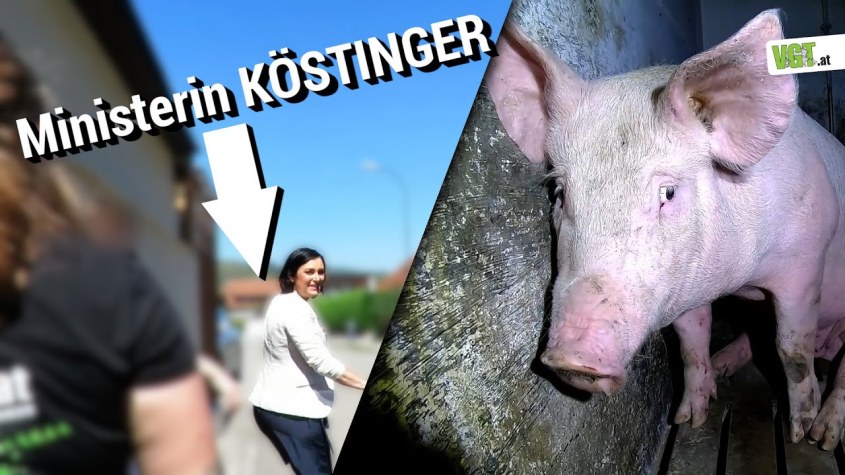
An ordinary pig farm: legalized torture of living beings …
This means that citizens’ requests could become a reality nine years after the initiative was launched.
Brussels now wants to first prepare an impact assessment by the end of 2022.
There should be a public consultation on this from the beginning of next year at the latest.
Brussels will “examine in particular whether the proposed legislation is realistic in 2027,” said the authority.
As EU Health Commissioner Stella Kyriakides said, the EU also wants to push for animal welfare standards to be anchored in trade agreements. This is also intended to prevent foreign producers from undermining these standards and thus unfairly competing with EU farmers after they have withdrawn from cage farming.
However, it is still unclear how long the possible transition phases will be.
Activists had collected nearly 1.4 million signatures with the “End the Cage Age” campaign by October last year.
In doing so, they received enough support within the framework of a European citizens’ initiative that the EU Commission had to deal with the matter.
Money for remodeling stables
The EU Commission announced that it would use the EU agricultural policy to help farmers abolish cage farming.
“The phasing out of cages will come at a cost for farmers,” said Kyriakides.
The Commission will not let them down, “but support them in all phases of the transition to better animal welfare and sustainable food systems”.
Funds from EU agricultural policy are to be used to support farmers in converting stables or purchasing new housing systems.
The consumer organization “Foodwatch” called the abolition of cages overdue and called for a faster process. “Every day on which we do not act is a day on which a million sows cannot look after their piglets and chickens and rabbits cannot move as they need”, explained Foodwatch representative Matthias Wolfschmidt.
The animal welfare organization “Four Paws” spoke of “a great victory for Europe’s livestock”.
However, as usual, the Commission can only submit proposals.The specific regulation must then be negotiated with the member states and the European Parliament.
A concrete draft is to be submitted in 2023 and then requires the approval of the EU Parliament and the EU Council
When it comes to cage management, there is likely to be strong resistance from some Member States,or at least calls for long transition periods.
And I mean…According to the citizens’ initiative, far more than 8.2 million animals still live in cages in Germany. This corresponds to a share of 14 percent of livestock in Germany.
This means that Germany is pretty well within the EU average.
Only in Austria (3 percent), Luxembourg (3) and Sweden (8) is the proportion lower. It looks worst in Portugal (89), Spain (89) and Malta (99). Across Europe, according to the initiative, more than 300 million animals are suffering in cages.
Image: SOKO Tierschutz
Copa-Cogeca welcomed the aid and accompanying measures proposed by Brussels for farmers.
The association emphasized that the ban proposed by the Commission could only be accepted if the proposal was based on clear economic principles.
In addition, an impact assessment must be available before the exit date is set. In other words, one can assume that farmers can in principle live with an end to cage management.
But they will be compensated dearly for the exit and will insist that the EU apply the same strict standards to imports.
We cannot speak of a victory before the end of cage husbandry comes as soon as possible, and also the end of the import of caged animal products.
We still have to watch closely what happens now so that the agricultural lobby does not overturn the project. Because they would have enough time for that, 6 years!
If you really want animals to be released from their cages, you have to stop eating their bodies and their products.
Here’s Why Millions of People Don’t Eat Lamb Anymore
We all know the children’s song “Mary Had a Little Lamb,” but did you ever seriously think about just how messed up eating lamb is? Let us fill you in.
The USDA reported that around 2.2 million lambs were killed for meat in 2015. Like cows, pigs, and chickens, lambs are raised in filthy factory farms, subjected to cruel mutilations, and horrifically slaughtered.
Lambs are usually “tail docked just a few weeks after birth. Farmers claim this is to reduce buildup of fecal matter around the animals’ backsides. But this cruel and painful mutilation is performed without anesthetics and often leads to infection, chronic pain, and rectal prolapse.
Typically slaughtered around six to eight months of age, lambs live a mere fraction of their natural lifespan. Mother sheep are deeply caring and form strong bonds with their babies. In fact, they can recognize their lambs who have wandered too far away by their calls. Sadly, this bond is broken at factory farms where lambs are ripped away from their mothers just a few days after birth.
Lambs are not only sweet and gentle but also highly intelligent. They are capable of problem solving and considered to have IQs that rival those of cows. They also have great memories. Lambs can remember at least 50 individual sheep for years! Through highly developed communication skills, lambs use various vocalizations to communicate different emotions. They can even display emotion through facial expressions.
How can anyone claim to love these gentle animals while still eating them?
People who are opposed to animal cruelty often cling to the idea that eating meat is necessary. But the science is clear: We’re more than capable of living happy, healthy lives without eating meat or other animal products.
It’s time to put our ethics on the table and stop eating lambs and all other animals. We can live our values of kindness by switching to a vegan diet.
Click here to order your FREE Vegetarian Starter Guide.