Category: Farm Animals

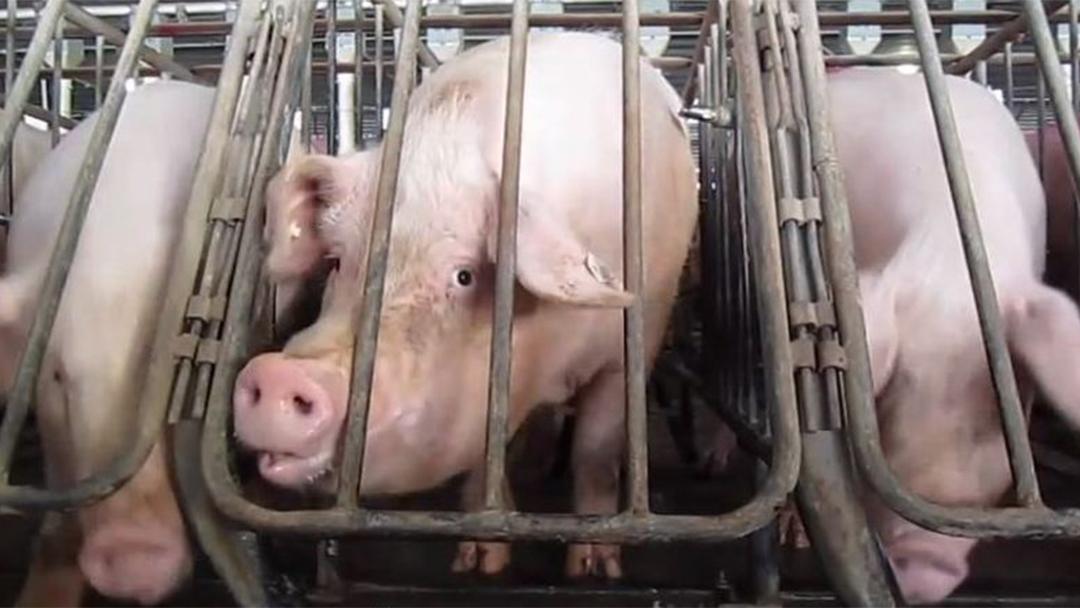
England: Supermarkets Suspend Farm Where Workers Kicked Pigs and Dying Animals Left to Rot Among Living.

WAV Comment:  Typical example of why the world is going meat free; people don’t want the abuses; so they vote with their food purchases – so much from supermarkets about ‘taking animal welfare seriously’. We say: Then get out there and make sure the abuses do NOT happen; typical supermarket yukspeak – simple solution.

If these hell holes for animals go bust – then fine by us.

Watch the video here:

Supermarkets suspend farm where workers kicked pigs and dying animals left to rot | The Independent

Supermarkets suspend farm where workers kicked pigs and dying animals left to rot among living

Exclusive: Morrisons admits scenes ‘appalling and shameful’ and joins Tesco, Asda and Sainsbury in dropping supplier

Four supermarkets have suspended a pig-farming company after The Independent showed them footage revealing horrific neglect and abuse, including dying pigs left among the living and workers kicking animals too crippled to stand.

Pigs even turned to cannibalism and sick animals were left without treatment to suffer in squalid conditions at Willerby Wold Piggeries in North Yorkshire.

Morrisons admitted the scenes were “appalling and shameful” and said it was urgently investigating.

Asda said its supplier had dropped the farm, and Tesco and Sainsbury, who said they bought meat from the company only occasionally, also said they were breaking off from it.

One vet said it was some of the worst footage she had ever seen, with workers displaying “a monstrous disregard” for the animals – but that it was not unique among UK pig farms.

Red Tractor, the scheme that says it certifies only meat from animals that have been well cared for, dropped the farm’s membership after The Independent revealed the footage, and the farm said it was working with “veterinary advisers to address concerns”.

Morrisons was at the centre of a campaign this week targeted at investors in the supermarket, over its animal welfare standards. Activists claimed the chain sells “Frankenchickens”, living lives of misery.

Undercover investigators who filmed inside Willerby Wold’s sheds 12 times earlier this year captured footage of pigs with bulging hernias, blood on their bodies or painful, infected wounds.

Many animals are seen in the videos covered in flies and others are left shaking from disease.

Some were so sick their intestines were outside their bodies, the footage shows, although The Independent is not publishing such scenes.

The footage was handed to the Surge animal rights group, which said it identified 15 potential breaches of animal welfare laws.

Dying and dead pigs were left among the living, all kept on filthy floors with excrement on, the witnesses said.

Some that were lame and too ill to get up were gnawed at by their pen mates out of frustration.

The footage shows one animal that cannot stand forced to drag itself along the ground when a worker kicked it.

Alice Brough, a former pig vet who used to carry out welfare checks for Red Tractor’s endorsement scheme, said: “This is among some of the most harrowing footage I have seen captured in the UK.

Continue reading on next page. Select page from 3 pages using numbers below.

England: EU Must Stop Paying For Adverts For Animal Products. CIWF London.

From Compassion In World Farming (CIWF), London:


EU must stop paying for ads for animal products | Compassion in World Farming (ciwf.eu)


The EU gives millions of euros each year for marketing campaigns with the purpose of increasing our consumption of animal products made in the EU.

This poor use of public funds unfortunately hampers efforts to reform our food systems and tackle issues related to environmental degradation, animal welfare and human health. We are calling on the European Commission to revise this absurd policy, in line with its recent plans to reform food production and beat cancer.

The EU is now in the process of revising its advertising scheme for European agricultural products. The current scheme funds marketing campaigns that present a false image of how animals are raised and may mislead consumers about the health and the environmental impacts of animal products.

In one notorious example, the ‘Beefetarian’ marketing campaign, the EU awarded €3.6m to ‘incite the consumers not to have a stereotyped idea about red meat and to enable them to be again confident about their consumption decision.’

The funding that the EU allocates for advertising animal products is simply not aligned with the latest ambitions of EU strategies to tackle issues such as unhealthy diets, poor animal welfare, climate change, pollution of air, land and water and the associated decimation of biodiversity.

In February this year, the Commission published a new plan to fight cancer, which includes a commitment to encourage a ‘shift to a more plant-based diet, with less red and processed meat and other foods linked to cancer risk and more fruit and vegetables.’

Earlier, in May 2020, the Commission released its new food policy vision – the ‘Farm to Fork’ strategy, which recognised that our ‘food consumption patterns are unsustainable’, and that the EU average consumption of whole-grain cereals, fruit and vegetables, legumes and nuts ‘is insufficient.’

The EU rears and slaughters 9 billion terrestrial animals each year.[1] Insufficient legal protection of their welfare condemns billions of these sentient beings to short and brutal lives on factory farms and to suffering at slaughter. In addition, over half a billion fish spend a life of misery in underwater factory farms in the EU. Cruel methods of capture and slaughter are commonly used for farmed and wild fish.

To protect our health and our one and only planet, scientists are recommending that Europeans reduce their consumption of red meat and poultry by two thirds.

EU-funded ads should no longer incite an increased consumption of animal products. Instead, they should support plant-rich foods and thus facilitate a transition to healthier and more environmentally friendly diets. Fewer animals raised for food also means that we can more easily transition away from intensive methods of production, which cause animals tremendous suffering.

[1] Estimates based on FAO data.

Regards Mark

waste

These puppies are the scraps of your #milk and are thrown away like garbage.
If you consume milk and dairy products then stop doing it, instead of playing the skit of those who suffer in front of these images, because you are the only real responsible for all this.

(Original text by Giustizia Animalista)

Scarti
Questi cuccioli sono gli scarti del tuo #latte e vengono gettati come spazzatura.
Se consumi latte e derivati allora smetti di farlo, anziché recitare la scenetta di chi soffre davanti a queste immagini, perché sei l’unico vero responsabile di tutto questo.

And we thought that the fascist right to annihilate the weakers is over. But obviously not!

My best regards to all, Venus

Plenary vote on an end to cage farming in the EU on June 10th

On June 10th, the European Parliament will vote on the European citizens’ initiative “End The Cage Age”.

Report: Animal Equality Germany

After the hearing in the European Parliament on April 15th, at which the European citizens’ initiative “End The Cage Age” had the opportunity to argue in front of the committees for a ban on cage management, it is now the turn of the European Parliament to get out of the cage and to debate the future of agriculture in the EU.

The MEPs will vote on whether cages for animals in agriculture should be banned in the EU in the future.

Hundreds of millions of animals are currently living a dreary existence in narrow, barren cages in the EU.

Sau mit Ferkeln im Kastenstand.
The plenary session and the subsequent vote are scheduled for June 10th.
Our aim is, of course, for Parliament to vote in favor of banning cages.
That is why we will again specifically urge the German members of the European Parliament, who have not yet expressed their support for the campaign, to vote for an end to cage management until the plenary session.

Please support us on Twitter by retweeting our tweets or posting your own tweets – today through Wednesday, at 12:00 p.m. and 5:00 p.m.!

But there is also a petition from the “Albert Schweitzer Foundation”.
It goes to German MPs, but anyone can sign it.

Schwein in Kastenstand.

Animal Equality Germany

And I mean…We are asking for a ban on the use of cages in animal farming.

In detail, we are asking for legislation prohibiting the use of:
• cages for laying hens, pullets, broiler breeders, layer breeders, quail, ducks and geese;
• farrowing crates for sows;
• sow stalls for sows, where not already prohibited
• individual calf pens, where not already prohibited

Even single boxes for calves should no longer be allowed in the EU.

The first stape is done, because…

….in April there was a sign of hope from Brussels for an end to cage farming; it was an overwhelming approval from the MEPs who spoke out in favor of abolishing cage farming in the EU and called on the EU executive to quickly submit a proposal for it.

The Commission has to officially respond to the ECI within the next three months.

We know from the past how closely the EU Commission supports industrial animal husbandry.
We have made the experience that the EU has totally failed in animal transport.
That is why we always must have a plan B when we negotiate with the EU Commission.
Because unfortunately she has the last word in this debate.

My best regards to all, Venus

UK: New Animal Welfare Bill Launched With Positives For Animals. What Leaving the EU Can Do.

New Animal Welfare Bill launched to protect pets, livestock and wild animals – Defra in the media (blog.gov.uk)

New Animal Welfare Bill launched to protect pets, livestock and wild animals

There is positive coverage today following the launch of our Animal Welfare (Kept Animals) Bill to improve welfare standards across Great Britain. The story was covered by the MirrorEvening Standard and Daily Express. The UK’s Chief Veterinary Officer Christine Middlemiss was also interviewed by the Daily Mail about our new measures to tackle puppy smuggling.

The UK has long history of leading the way on animal welfare and now that we have left the EU, the Government is committed to improving our already world-leading standards by delivering a series of ambitious reforms, outlined in the Action Plan for Animal Welfare.

The Bill will raise animal welfare standards in five key areas:

  • Puppy smuggling: The Government will introduce new powers to tackle the unethical trade of puppy smuggling by reducing the number of pets (dogs, cats and ferrets) that can travel under pet travel rules. It will also include powers for the Government to bring in further restrictions on the movement of pets on welfare grounds, for example by increasing the minimum age of imported puppies and restricting the import of pregnant dogs and dogs with mutilations such as cropped ears and tails.
  • Live exports: Live animals can endure excessively long journeys during export, causing distress and injury. EU rules prevented any changes to these journeys, but the UK Government is now free to pursue plans which would see a ban on the export of live animals for slaughter and fattening. We will become the first European country to end this practice.
  • Banning keeping primates as pets: Primates are highly intelligent animals with complex needs and require specialist care. The Government will deliver on its manifesto commitment to introduce a ban on keeping them as pets, ensuring that all primates being kept privately in England are being kept at zoo-level standards and that those unable to meet the standards are phased out.
  • Livestock worrying: The Bill will give new powers to the police to provide greater protection to livestock from dangerous and out of control dogs. The Bill will also extend this protection to other species such as llamas, ostriches and game birds.
  • Zoos: The Zoo Licensing Act will be amended to improve zoo regulations and ensure that zoos are doing more to contribute to conservation.

Environment Secretary George Eustice said:

The Kept Animals Bill will bring in some of the world’s highest and strongest protections for pets, livestock and kept wild animals.

As an independent nation outside the EU we are now able to go further than ever on animal welfare by banning the export of live animal exports for slaughter and fattening, prohibiting keeping primates as pets and bringing in new powers to tackle puppy smuggling.

This builds on the launch of our Action Plan for Animal Welfare and Animal Sentience Bill last month as part of our work to build on our status as a world leader on animal welfare.

The Bill is the second piece of legislation introduced in the last month aimed at driving better standards of animal welfare, after the Government’s decision to formally recognise animals as sentient beings in domestic law through the Animal Welfare (Sentience) Bill. The Government will also announce a series of further reforms this year related to microchipping, pet theft, farm animal welfare and tackling wildlife crime.

Follow Defra on Twitter, and sign up for email alerts here.

Regards Mark

Happy Animals Make for Tastier Meat—or at Least We Like to Think They Do

Light In A Dark Forest – Animal Photojournalism – Exposing The Reality The Business Does Not Want You To nSee.

Hidden book Jo-Anne McArthur listing image

Above – Award-winning photographer, journalist and campaigner Jo-Anne McArthur – author of Hidden: Animals In The Anthropocene (Image credit: © Animal Equality)

WAV Comment: 

Every photographer, professional, amateur, or simply casual, hopes that maybe one day, one of their images will have that ‘something extra’ that makes it so special in different ways for so many people to view with awe or amazement.  As a youngster, I can remember one such image from the Viet Nam war showing a little girl who’s village had just been bombed with napalm.  Decades on, this image is one of those which captured my sesnse into the reality of war and what it does to people – do you remember it ?

Or, as an activist, one of my all time favourite photos (below); Watson and Hunter on the ice; stoopping the seal hunter ship from continuing with its disgusting business. 

Or the very recent article by Venus, showing the suffering calves in Austria – Calf fattening in Austria: Animal suffering and fraud – World Animals Voice  – different images which all show the viewer the reality of the issue; often in the case of animal abuses, which are so different to the yukspeak the industry pumps us with; now we see the ‘reality’, as opposed to the spin and ‘happy cow’ images churned out by the trade and industry.

Thanks to those involved with Animal Photojournalism, the tightened lid of the abuse and suffering of so many animals is now being unscrewed and the contents of reality are being exposed to the world.  We thank all animal Animal Photojournalists in so many locations for making our work easier, by supporting what we say and have always said with the images.  Now, the abusers can run but they cannot hide – their cruelty is being exposed every minute of every day, and long may ‘normal’ people continue to be shown the real side of their dinner; or their clothes, or how their handbags are produced.

The lid has been taken off and the world is being educated for the better.

Regards Mark

One of my photos which hopefully puts the hunters claim of a ‘quick kill bite on the back of the neck’ into the disgusting reality it really is – fox hunting does not know the term ‘quick kill’:

New book Hidden shows why animal photojournalism really matters right now | Digital Camera World

New book Hidden shows why animal photojournalism really matters right now

By Graeme Green April 15, 2021

This emerging genre focuses on humankind’s relationship with nature – and these images are not for the faint-hearted

“Animal Photojournalism is extremely urgent and relevant to the issues of today,” says Jo-Anne McArthur, an award-winning Canadian photographer, journalist and campaigner. 

She has coined the term Animal Photojournalism (APJ) for an emerging genre of photography that focuses on people’s relationship with nature and highlights the suffering of billions of animals on the planet from human activities, including factory farms, breeding facilities and animal experimentation. 

The abuse of nature isn’t just bad for animals; it’s impacting all of our lives, from climate change to the global pandemic (said to have come from bats or pangolins in China’s wildlife markets). McArthur is also the author of Hidden: Animals In The Anthropocene and the founder of We Animals Media. 

We sat down with her to discuss animal photojournalism, and why it is so important. 

How do you define Animal Photojournalism? 

I call it an emerging genre, coming out of a number of different kinds of photography. Wildlife photography became a lot more about conservation photography, but conservation photography still excludes a number of animals, namely domestic animal and the billions of animals in labs and factory farms. 

Because these animals are sentient and relevant, Animal Photojournalism likes to include all of them. That’s why we call them the ‘hidden’ animals, – they’re hidden from the public conscience, hidden from the media. We’re trying to bring those animals and stories forward.

It’s also a mix of a bit of conflict photography and street photography.

Animal issues are affecting everyone on the planet. Do you see APJ as a growing area?  

Yes, that’s why I wanted Animal Photojournalism to mean something in its own right. Journalism is usually newsy and timely. I wanted to define it as its own thing and as something that overlaps with other current important issues. 

For example, factory farming contributes to climate change, it overlaps with labour rights, it overlaps with human health issues and with the pandemic right now, which is caused by our animal use. That’s all part of the definition. 

Who would you flag as great examples of animal photojournalists? 

There’s a Spanish photographer who goes by the pseudonym Aitor Garmendia. He’s won a number of awards and won in the World Press Photo awards this year in the Environment category for his investigations of pig farms. 

And there’s a Polish photographer, who also uses a pseudonym, Andrew Skowron. These guys are absolutely relentless and tireless in their work. They produce a lot of investigative work that’s been used by NGOs globally.

Many photos by you and other animal photojournalists are disturbing to look at and many people will want to turn away. How challenging is it as an area to work in?

Yes, we’re not producing images for people’s walls. They sometimes end up on walls at exhibits on the topic. 

But these images are largely for campaigners. They’re for the education of the general masses. We want them to end up in major media outlets. 

That’s our piece of the puzzle, when it comes to changing things for animals. Journalists are out there to show the public what’s happening behind closed doors. We often provide material evidence for NGOs to show the public.

These photos need to communicate a story or a message and need to be visually striking. What is your creative approach and how do you balance those elements? 

We can talk about an individual image or a narrative. Photojournalists are working on both. We want a storyline. We want to show the big picture. 

What’s really interesting about animal industries is that these animals are being farmed in the billions every day. We can go into a hen farm or a boiler chicken farm, and we might meet 900,000 birds in all the barns. It’s absolutely insane. So we want to show scale, whether that’s with a drone or with the wild angle. 

But then we also want to show the individuals who make up those millions. As with war photography, we can relate much better when we make eye contact with an individual, seeing their suffering up-close through the lens. 

A lot of my most relatable images have been ones where I’m actually up-close with an animal, with a wide angle, so I’m showing the individual looking at me, but also showing the context and situation this animal is in. 

Is this photography that’s all about having an impact?

I wish I could hold up an image of animal torture to people and have them say, “Oh my God, I’m never doing that again.” 

But people don’t do that. People are defensive and very attached to the way we do things. I understand that. 

That’s why it’s important to have context and narrative, working with NGOs, giving solutions… It’s not just about the field work.

‘Hope In A Dark Forest’, your photo of an Eastern grey kangaroo and infant in Australia’s forest fires, won the Man & Nature category in Wildlife Photographer of the Year 2020. Was that a difficult photo to get? 

I knew that photo was going to be a killer picture before I shot it. It’s in an eucalyptus plantation, so everything was in rows. 

Through the diagonal rows I could see that the kangaroo was there, and I started walking towards the angle I wanted. 

I wanted to shoot straight down through the plantation. I could see the colours and the quality of the light, her fur, and I was thinking “Oh no, oh no”, in case she moved. I got to where I needed to be and she stayed there and just watched me. I took a picture but I knew the picture I wanted was if I was more eye-to-eye, so I crouched down. I had time to get a few photos, then she bounced off. 

It was one of those moments when you want to put that image on your hard drive and in the cloud and back it up a few times because you know you captured a poignant moment. 

Sure enough, other people agreed. That photo is quite well-known now. It has been used and printed the world over. 

Hidden: Animals In The Anthropocene is on sale now

Featuring images by 40 animal photojournalists and a foreword by Joaquin Phoenix, Hidden: Animals In The Anthropocene by Jo-Anne McArthur, is on sale now and is published by We Animals Media.

For more about Jo-Anne’s work, click here

Jo-Anne also co-founded Unbound, a multimedia documentary project highlighting women in conservation. 


Calf fattening in Austria: Animal suffering and fraud

Milk calves stand on fully slatted floors with excrement – the company advertises with “species-appropriate” husbandry!

The slatted floor is littered with feces, the animals are completely covered with excrement.

The new insights into a large company in Upper Austria show the real picture behind the scenes of the advertising phrases.
According to their own statements, around 700 animals live in the calf fattening area.
All live on fully slatted floors in bays with no outlet to the outside.

The scandal: the floor is completely covered with feces and smeared with feces.
Many animals have their fur covered with shit.

The shit is all over the body. Calf diarrhea sticks the animals’ fur.

Feces and diseases

Light-colored diarrhea sticks to the flank of a calf, in other places it covers the floor. The calves have to lie down on this completely filthy slatted floor to ruminate and sleep.
In many bays there are no dry and clean lying areas at all.

Some calves also appear to have skin diseases and bald spots on their bodies.
The coughing of several calves can be heard over and over again in video recordings (see below) – life on and in their own feces attacks the calves’ respiratory tract and lungs.

Continue reading “Calf fattening in Austria: Animal suffering and fraud”

Spanien: They kill six wolves and obtain 60,000 euros pretending damage by the animal

A publication of the Fund for the Protection of Wild Animals (Fapas) uncovered a group of farmers who falsified the damage of the wolf in western Asturias.
The news collected by the entity on its website prompted an investigation by the Seprona de Vegadeo, attached to the Oviedo Command.

Tipo de lazo usado en Asturias

The operation took place under the orders of the Castropol Court of First Instance and Instruction, it took place for almost two years and culminated in the arrest of six Asturian farmers, accused of collecting more than 60,000 euros of public funds from the Asturian administration.

Likewise, it was shown that they had killed six wolves that were part of a pack shared between Asturias and Galicia.

In November 2020, a veterinarian from Asturias denounced in the Castropol court irregular practices of farmers who reported alleged attacks suffered by horses and whose cause, they pointed out, was the wolf.

However, the investigation showed that they were false and that the complainants had a very specific modus operandi: they separated the foals from their mothers and then abandoned them in the mountains, getting the canids to attack them and thus collect a subsidy that could reach 900 euros for each one.
This means a profit of between 600 and 700 per animal, since the price of it is between 150 and 300 euros.

From Fapas they assure that some of the animals left in the forest were bought in Galicia, as they are the cheapest specimens.

The Asturian veterinarian also denounced that the farmers fed the wolves so that they could approach the herds. This prompted the court to open an investigation by Seprona.

The proceeding of the defendants in the framework of this operation, baptized as White Fang, was to attract wolves to the area where the foals were located by means of feedlot.

In total, more than 170 horses were killed and linked to the cause between 2019 and 2020. In some cases, farmers falsified the documentation to collect a double subsidy, feigning the death of the same animal twice in six months.

Continue reading “Spanien: They kill six wolves and obtain 60,000 euros pretending damage by the animal”

Mothers Against Dairy – Human Mums Who Could Never Part With Their Infants – Unlike The Bovines Forced To By The Dairy Business.

mark 3

This is a 3 page article – please click on page numbers at the end of post to select page – thank you.

Mother 1

As someone who researches the dairy industry regularly, I have observed over the last few years a distressing surge in pro-dairy messaging from an increasingly visible and vocal sector of animal agriculture: female dairy farmers, many of whom are also mothers. It is painful and disturbing, to say the least, to read these mothers righteously defending the reproductive subjugation of other mothers, and the destruction of other mothering relationships for profit. But I believe this growing trend is no coincidence; rather, in a climate of increased criticism of dairy farming practices, it represents a strategic industry shift to put more female faces on dairy farming, and to reframe this mother-exploiting industry as a maternal, nurturing one.

Fortunately, I am also frequently privy to comments and messages from mothers relating how the process of becoming a mother led them to see the dairy industry for what it truly is: an assault on motherhood and bodily sovereignty. The poignant insights these mothers relate articulate a uniquely powerful perspective that I believe deserves a larger audience. For this reason, I founded Mothers Against Dairy , a year-round campaign devoted to showcasing the stories of vegan mothers for whom motherhood influenced their decision to reject dairy and go vegan, as well as reflections from mothers who were already vegan before becoming a parent, but whose mothering relationship deeply reinforced for them the injustice of dairy farming.

In the nearly two years that have passed since first posting a call for statements, I have received hundreds of inspiring reflections from vegan mothers around the world. New stories are shared each month on our Facebook and Instagram accounts, which have a combined following of more than 30,000 readers. Submissions to be featured at Mothers Against Dairy are accepted on an ongoing basis and can be uploaded to our website or emailed to info@milkhurts.org.  To keep up with new statements and other news about the campaign, follow our Facebook, Instagram, and our new Twitter account, and sign up at our website to be notified each time a new story is published.

Below are 10 heartfelt reflections that first launched the Mothers Against Dairy campaign on Mother’s Day of 2016.

WAV Comment – we are not publishing all the experiences here – please click on the link given to view them all.

Mothers Against Dairy: Why Moms Worldwide Are Saying NO (freefromharm.org)

Netherlands: Floating cow stall in Rotterdam

Report from “German Animal Welfare Office”, June 2, 2021

The first floating cowshed was built in the Netherlands. In the middle of the largest deep-sea port in Europe, Rotterdam, almost 40 cows are kept on the two-story building.
Animals keep falling into the water.
We are demanding the closure and have contacted the German embassy in the Netherlands.

Floating Farm – Unique in the world

The operator of the floating cowshed boasts that only two employees are needed to operate the barn, because robots are used to milk and clear the cowshed automatically.
The feed reaches the animals from the lower floor via conveyor belts.
Everything would run independently.
Floating farms are the future of agriculture.

On the company’s website, the animals are advertised with short transport routes, beautiful pictures and great views.
A cow has a completely different eyesight than we humans and perceives the water more as a black hole and thus as a threat.

It’s all about profit

We reject the entire project and don’t see the future in it.
It makes no difference to the cows whether they are exploited in a barn on land or in water.
In addition, it is all about profit here too.

In the “showcase project”, for example, the calves are torn away from their mothers after birth and when the milk yields of the cows they go to the slaughterhouse.
Of course, there is nothing about that on the PR website.

Nor is it mentioned that probably the main reason for this globally unique project is that you can only build a stable in the Netherlands if you own land yourself.
In addition, there is a limitation of fattening houses compared to the number of inhabitants.
This also means that more and more Dutch fattening operators are coming to Germany and building stables.

Again and again criticism

We have made and published drone recordings of the floating stall.
It is the first time that such images have been created.
With the pictures we want to show how absurd this project is.
Nobody needs a floating barn, especially not the animals.


There is always criticism.
So the Dutch party Partij voor de Dieren (PvdD), which also campaigns for animal rights, is trying to get a majority in the city council to close the farm, unfortunately unsuccessfully so far.
But now the situation could change.

Cows fall into the water

This is the second time that a cow has fallen into the water.
The animal, which weighs 600-800 kilograms, had to stay in the cold water for several hours until it was finally rescued by the fire brigade.
The first incident occurred in December 2020, and even then it was difficult to rescue.
In both cases a door or barrier was left open. The operator has repeatedly violated his duty of care here, it is a miracle that both cows survived.

This is how you can help the animals

The German Animal Welfare Office is now hoping for help from the German Embassy in the Netherlands.
“We wrote to the embassy and asked them to ensure that the barn was closed,” said Jan Peifer, chairman of the board of the German Animal Welfare Office.
The animal rights activists also call for a boycott of dairy products from the floating stall.
Nothing should be bought from the “Floating Farm” brand.

“We recommend a plant-based way of life anyway, because this way all animals on land and water can be helped,” concludes Jan Peifer.

https://www.tierschutzbuero.de/floating-farm/

And I mean… Instead of thinking about how we can feed the world without animal suffering and without the destruction of the environment, there are other ways of breeding even more animals and now even on the water.

The little Netherlands, by the way, is the second largest agricultural exporter in the world!
From 2018 to 2020 alone, exports rose from 90 billion to 104 billion euros.

So there is definitely no need for more cattle breeding, whether on the mainland or in the water.
It is not the case that agriculture today is primarily used to feed the local population.
It is an industry that mainly produces for EXPORT.

Seldom has a bad business in animals been sold so professionally as in this case.
But that’s not enough – this is also celebrated by all media as an innovation and funding is demanded, maybe soon the lobby group of the EU will step in with subsidies in the project.
Because the businessmen of the floating farm are planning to build a floating chicken coop with around 6000 hens for the next year.

The last thing we need is more factory farming.
What we urgently need is to reduce the growth of human animals.

My best regards to all, Venus