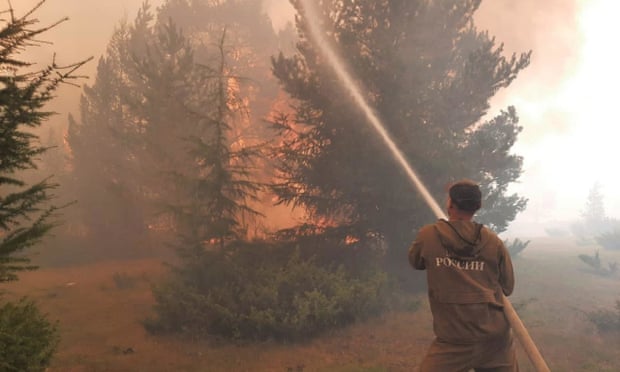
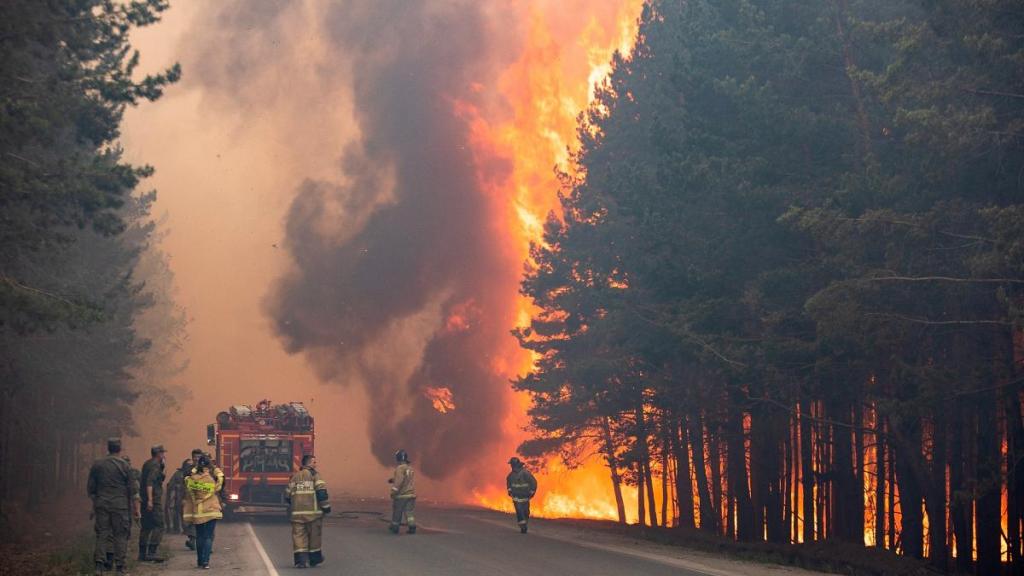
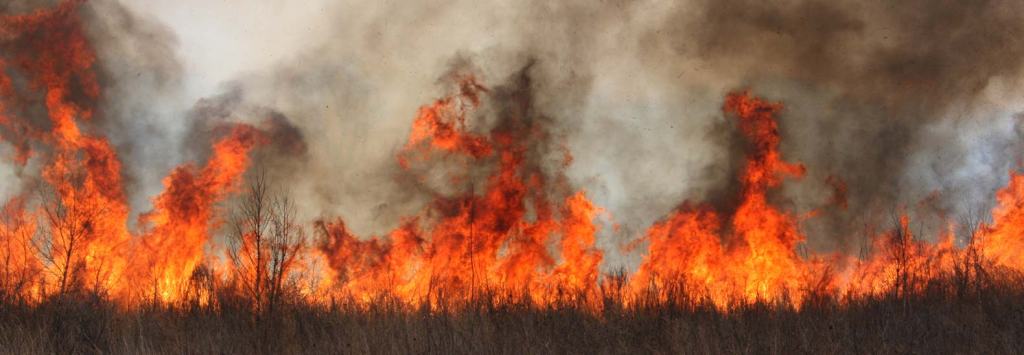
A firefighter trying to extinguish wildfire in the republic of Yakutia, Russia, in August 2021. Photograph: Emercom Of Russia Handout/EPA
Russia forest fire damage worst since records began, says Greenpeace
Analysis shows over 18.16m hectares were destroyed in 2021, an absolute record since satellite monitoring beganRussia has endured its worst forest fire season in the country’s modern history, according to recent data from the Russian Forestry Agency analysed by Greenpeace.
Fires have destroyed more than 18.16m hectares of Russian forest in 2021, setting an absolute record since the country began monitoring forest fires using satellites in 2001. The previous record was set in 2012, when fires covered 18.11m hectares of forest.
The record was surpassed late last week after a long fire season that has also produced unprecedented levels of global wildfire emissions and upturned daily life for hundreds of thousands of people living in Siberia and elsewhere in central Russia.
“For the past several years, when the area of the fires has surpassed 15m hectares, it has become, in all likelihood, the new normal in the conditions of the new climate reality,” Greenpeace Russia wrote.
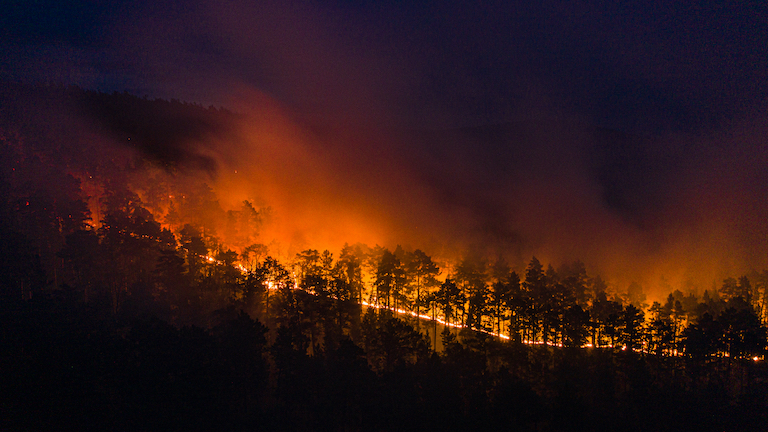
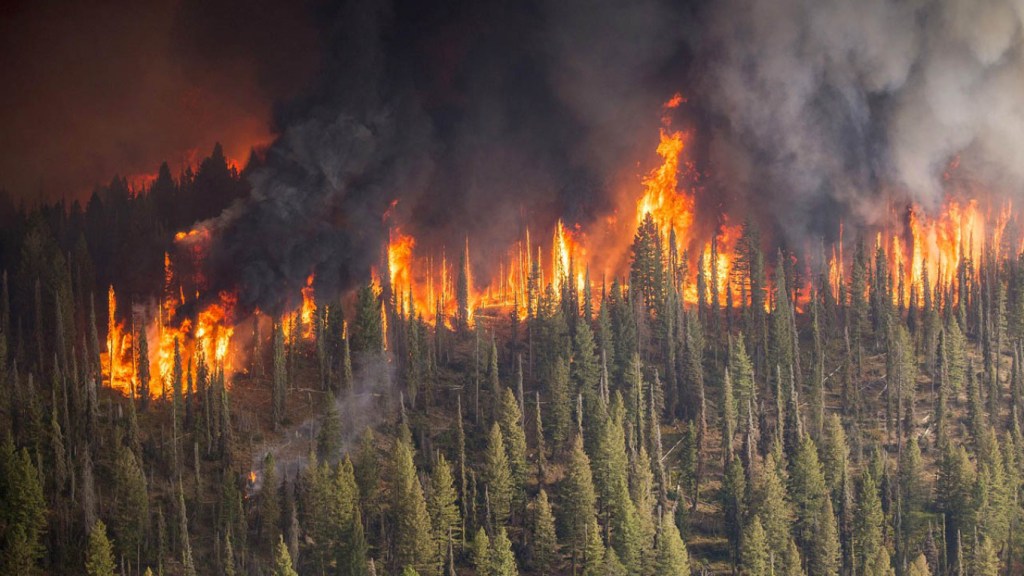
Those fires have primarily affected communities in Siberia, where dry, hot summers have turned the vast taiga forests into a tinderbox. In Yakutia, a northern Siberian region that has been particularly hard-hit, smog covered the capital city, Yakutsk, for weeks, and villagers have had to come together in last-ditch efforts to save their homes.
“Emergency workers have come and villagers are also fighting the fires but they can’t put them out, they can’t stop them,” Varvara, a 63-year-old from the remote village of Teryut, said by telephone in July. “Everything is on fire.”
The statistics do not record other types of fires taking place outside Russia’s forests. “If we counted all the fires – grass, reed, tundra, where there is no forest fund – then we would see an even higher number,” wrote Grigory Kuksin, the head of Greenpeace Russia’s firefighting project. The total area could be as high as 30m hectares, he said, an area the size of Italy or Poland.
Burning forests in Russia helped produced some of the worst global emissions in recent months. The Copernicus Atmosphere Monitoring Service of the EU found that burning forests released 1.3 gigatonnes of carbon dioxide last month, the highest since the organisation began measurements in 2003.
The taiga forests of Siberia pumped 970 megatonnes of carbon dioxide into the atmosphere between June and August – more than all the forests in the rest of the world put together. The fires in Yakutia played an important role in that, as the fire season lengthens and pushes farther north, amid unusually high temperatures and lower than normal soil moisture.
According to Greenpeace Russia, the fires in Yakutia are continuing, including north of the Arctic Circle. “That is not characteristic for this time of year,” Kuksin wrote.
Grassfires are also ongoing mainly in Russia’s southern regions of Rostov, Volgograd, Astrakhan and Orenburg, Greenpeace said. Climate change will also make it more difficult for emergency workers to manage Russia’s regular peat fires, which have enveloped Moscow and other cities in noxious smog in past years.
Sustainable Food Systems: the intersection of trade and animal welfare
21 September 2021
News
Ahead of the 2021 UN Food Systems Summit Eurogroup for Animals and The Good Lobby organised a high level event to discuss the intersection of animal welfare and trade in international policymaking
The COVID-19 crisis has reminded the world of the limits of unconditional trade liberalisation, which tends to favour corporate interests while ignoring the effects of the intensification of animal agriculture on the planet and on the animals. This has contributed to the three key challenges the planet is currently facing: zoonoses, antimicrobial resistance, and the overall climate and biodiversity crisis.
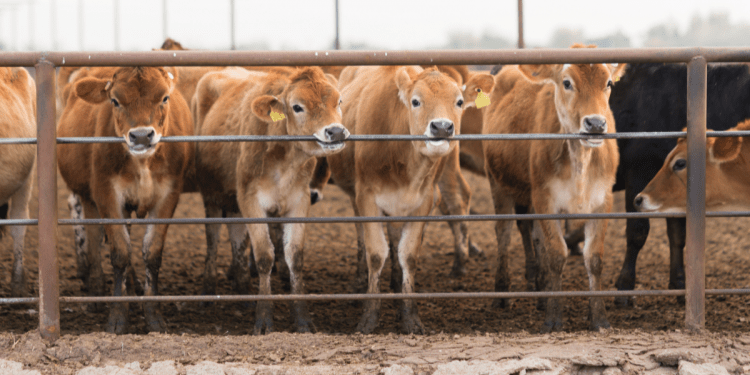
At the moment, international trade and economic policies are fuelling rather than countering the expansion and negative impacts of intensive livestock farming by prioritising profits and free trade above all. For example, the trade deal between the EU and Ukraine has led to a surge in cheap chicken meat imports, and the ones planned with Australia and Mercosur countries are expected to also fuel beef production – mostly on feedlots – according to the EU’s own analysis.
Indeed, there seems to be a disconnection between the conversations on the much needed transformation of our food systems and the international trade agenda.
Both panels investigated the best ways to ensure that trade agreements and international trade rules not only avoid negative impacts on animal welfare, but also intrinsically contribute to a global transition towards a more ethical and sustainable way of producing.
The first panel focused on how bilateral trade agreements can help to promote higher animal welfare and thus to move towards sustainable food systems.
“We want to step up cooperation [under EU Trade Agreements] and make a big difference,” said Claire Bury, Deputy Director-General for Food Sustainability at DG SANTE. She also underlined the importance of developing work programmes for the animal welfare cooperation with each partner country, “so we have concrete plans about what to do with the country. It’s not a talking shop, it’s about making a change”, Bury added.
Recognising animal welfare has never been as high on the agenda, Pascal Durand MEP called for products derived from animal exploitation – as well as biodiversity and human exploitation – not to be allowed on the EU market.
The EU is not the only place where trade policy is at the centre of important debates. Chris Sherwood, CEO of the RSPCA, portrayed the tensions reflected by the current UK debate on trade policy. “There are real tensions at the heart of the UK government – between ensuring high standards locally, and wanting to have a Global Britain negotiating trade deals all around the world”.
EU trade policy is also monitored by non-EU Civil Society Organisations. “We need to bring [higher animal welfare and sustainability-related] standards within the [EU-Mercosur] agreement to push up Mercosur standards”, said Maureen Santos, Project Officer at FASE.
The second panel’s focus was on multilateral issues and how animal welfare can be addressed at WTO level and throughout the value chain.
“There is an increasing interest for animal welfare within our members”, said Jean-Marie Paugam, deputy Director-General at the World Trade Organisation. “The debate can be open, and the WTO is open to support a trade policy enhancing animal welfare”, he added.
“It is possible to build up a progressive interpretation of [WTO] rules. That would be a huge evolution about how article XX [and its exceptions to trade liberalisation] was being read in comparison to what it was when WTO was created”, said Ignacio Garcia Bercero, Director General for Trade at DG TRADE. “If we are going to [restrict trade based on animal welfare], we will need to have solid, strong evidence to show it is grounded in widely perceived ethical concerns, not tainted by economic considerations”, he added.
Dr Laura Nielsen also mentioned the role that tiered labelling, intertwined with tariff reductions, could play in incentivising businesses all around the world.
A key part of the solution to ensure that trade contributes to a transition towards more sustainable food systems is thus to better address the impact of trade policy on animal welfare.
Asked about his expectations from the UN Food Systems Summit, Pascal Durand concluded that “we must understand that our current production methods are not sustainable for humans nor for animals, and that we must improve the life of all living beings. Once this is understood, policies will follow.”
Now more than ever, we must seize the opportunity the UN Food Systems Summit presents to leverage the emerging global awareness that the health and wellbeing of humans are inseparable from those of animals and the planet. In doing so, we must break down silos to go beyond the traditional animal welfare and sustainability narratives and rethink trade policy, at both bilateral and multilateral levels.
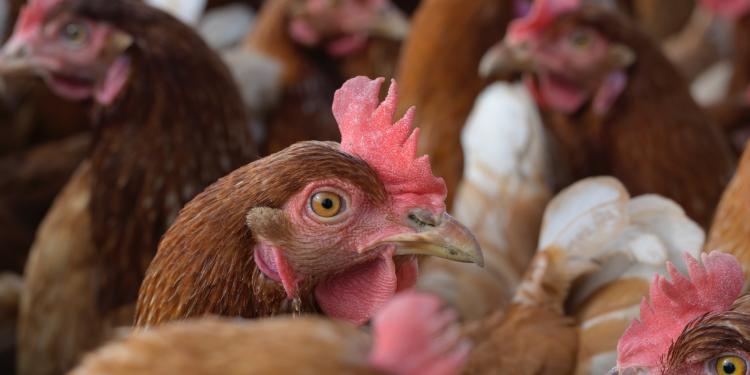
New research from the University of Copenhagen shows that 85 percent of laying hens in Danish production have fractures of the sternum due to the intensive breeding of smaller hens which lay many large eggs. Animal Protection Denmark is taking action.
Laying hens have reached their limit, and it is unacceptable to have a production that causes such extensive and serious damage to animals. This is the main message from Animal Protection Denmark and the National Organic Association, who have joined forces to invite the industry to find common ground on a solution. The meeting will be held on 1 November, and the entire industry has been invited together with Minister of Food, Agriculture and Fisheries, Rasmus Prehn to participate in the presentations and debates, as well as suggestions for future solutions.
We are, of course, appalled by the study’s documentation of how widespread fractures of the sternum in laying hens are. It is completely and utterly unacceptable that this is the rule rather than the exception for hens in all branches of egg production. We are furthermore painfully aware that this also applies to the hens that we normally recommend, namely organic eggs and eggs under our brand “Recommended by Animal Protection”. That is why we have immediately taken up our producers, who are even taking it very seriously and in fact are already now initiating measures that can hopefully remedy the problems in the short term, while we work on the sustainable solutions in the slightly longer term.
Britta Riis, Director of Animal Protection Denmark, Britta Riis.
So, a climate conference which debates the issues of global warming. Vegan eating can reduce Carbon emissions by up to 73%; so we are more than angered to find that at this present time, there is not even a plant based option for food being delivered at the conference ! – Read more:
We know and understand how the mafia does everything to protect its business; but here we are talking about a global conference and the amount of emissions that animal farming is responsible for – because it is the second-biggest source of damaging global emissions.
If you cannot get the UN to get a grip on these facts, and then do something about it, then where are we going ?
In recent months we have witnessed environmental devastation on (literally) a global basis – wildfires, floods, temperature extremes etc; and yet the light does still not appear to be in the ‘on’ position when it comes to conference debates in the name of ‘UN actions’.
Maybe the UN is happy to protect the meat industry at the cost of everything else, who knows ? – but not currently having even plat based food at the conference just sums it all up really.
Maybe it would be better to call the conference ‘COP OUT 21’.; as that may be a more descriptive term.
Regards Mark
Jo Lumley
Stephen Fry
Moby, Joaquin Phoenix and Billie Eilish urge world leaders at climate talks to curb animal farming
Exclusive: Joanna Lumley and Alesha Dixon also among 18 stars warning world will fail to limit disastrous temperature rises without radical changes
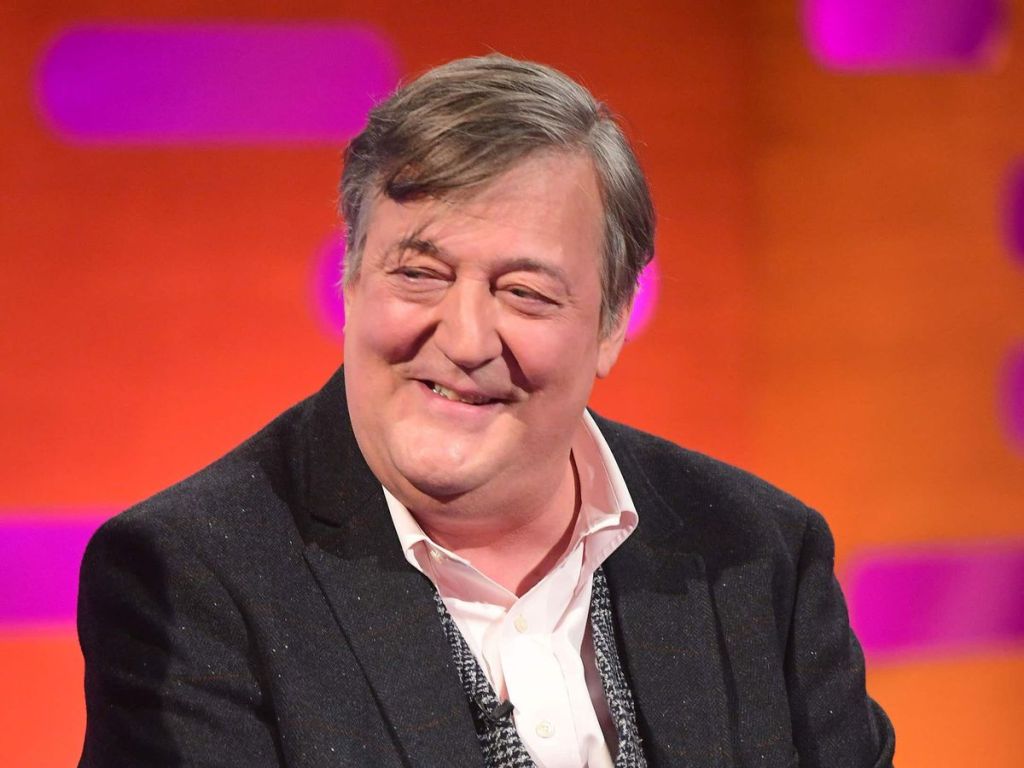
A host of stars including Billie Eilish, Moby, Joaquin Phoenix and Stephen Fry are urging the government to get world leaders to debate animal agriculture at the upcoming climate crisis summit because of the environmental damage it causes.
Eighteen celebrities have written to MP Alok Sharma, president of the Cop26 conference, asking him and other delegates to “formally and publicly recognise the role of animal agriculture as one of the largest contributors to climate change”.
Other stars signing the letter are: Ricky Gervais, Joanna Lumley, Deborah Meaden, Harry Potter star Evanna Lynch, singer Leona Lewis, Chris Packham, actors Alicia Silverstone, Alan Cumming and Daisy Ridley, singer-songwriter Alesha Dixon, model Lily Cole, singers Finneas O’Connell and James McVey, and reality TV star Lucy Watson.
They argue that animal farming should be on the Cop26 agenda because it is the second-biggest source of damaging emissions, after burning fossil fuels for electricity and heat.
The UN’s Food and Agriculture Organisation says global livestock accounts for 14.5 per cent of carbon dioxide emissions, but other research has concluded it is nearer to 16.5 per cent.
This is similar to levels produced by all the world’s transportation combined – and the proportion is forecast to rise.
The celebrities – all on plant-based diets – warn that without large-scale change to animal farming systems, the world will fail to keep rising temperatures to 2C, as agreed.
The letter, coordinated by Humane Society International/UK and seen by The Independent, reads: “With animal agriculture being such a major source of greenhouse gas emissions, it is impossible to meet goals set out in the Paris Agreement without making changes to our global food system.
“Even if all other major sources of emissions were reformed, we will still fall short.
“Addressing these urgent areas in the Cop26 meeting would help propel governments around the world to take action and would provide world leaders with another high-impact option to add to their toolbox for tackling climate change.
“We call on the UNFCCC [United Nations Framework Convention on Climate Change] to formally and publicly recognise the role of animal agriculture as one of the largest contributors of climate change and to open a greater space for dialogue.”
They want Mr Sharma to put three proposals to the summit: shifting subsidies away from animal agriculture to more sustainable agriculture; offering incentives to develop alternatives to animal agriculture and changing government procurement priorities in the public sector.
Moby said: “The science is clear and overwhelming that adopting a more plant-based diet is one of the most impactful actions we can take to avert catastrophic climate change.
“So if we want to protect our planet, we must include intensive animal agriculture in climate change mitigation strategies. Cop26 is one of our last vital chances to reform our global food systems.”
At least 88 billion land animals are bred and slaughtered for food globally each year, taking up nearly 80 per cent of global agricultural land, yet producing less than a fifth of the world’s calories.
Animal agriculture is also a major driver of deforestation, species extinction, land degradation, pollution and exhaustion of water resources because of the vast tracts of land used to grow the crops to feed them on, a system long criticised by experts as highly inefficient.
A series of reports have concluded meat consumption must be reduced to curb CO2 emissions.
World-leading scientists on the IPBES (Intergovernmental Science-Policy Platform on Biodiversity and Ecosystem Services) even floated the idea of a meat tax.
A 2019 study showed that by 2030, the livestock sector is projected to account for almost half of the world’s emissions budget for 1.5C without radical change.
The campaign for Cop26 has been dubbed The Cow in the Room, a play on the phrase “elephant in the room” because HSI claims the conference is ignoring the second-biggest factor in the climate crisis.
Producing meat, milk and eggs also requires huge amounts of water – up to three times as much as producing cereals, one study found.
The Independent has asked the UNFCCC for their response to the letter’s demands.
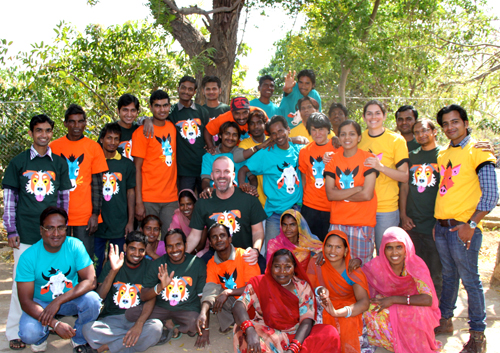
The expression “rain or shine” gets a whole new meaning in the intense weather of Rajasthan. We’re experiencing a late monsoon, and we want to take a moment to thank our incredibly cheerful, often drenched, staff. Our kennels and animal treatment areas are protected, but because we have nearly year-round sun and extreme heat most areas are outside and do get muddy when it rains. The smiling faces we see, with rain sometimes soaking right through their rain gear, not only boosts the spirits of the other staff, but it affects the animals too with the loving encouragement they need. Thank you for appreciating our tenderhearted and stalwart crew.
Elvis’s sadness lifted as he healed,and then he started singing!
Precious Elvis, a teenaged puppy, screamed in pain when his rescuers tried to lift him.
His feet had been run over by a vehicle, andone paw was crushed. His toes were splayed and swollen to twice their normal size. Standing was too excruciating to bear. Had he been an older dog with more brittle bones, Elvis might have been facing an amputation, but since puppy’s bones heal much faster than adults we decided it was worth trying to save his legs. We treated his wounds and wrapped his intensely painful feet in thick bandages, which we changed every day. The little guy was one of the most careful young patients we’ve ever had. He seemed determined to cause no fuss. But he was so inward we wondered if he was depressed. Then, when he’d progressed a bit on his healing journey, well, this boy burst out in song.
A wild piglet was seriously hurt with multiple puncture wounds from an animal attack. Even hours after her wounds were cleaned and bandaged, this young sweetheart trembled with fear. She would need incredible bravery, but snuggled deep into her blanket for the feeling of the comfort she had known sleeping with her siblings against her mother’s big body. Now she was all alone. Though she ate well, she was facing a long recovery, and she may have been significantly depressed. But someone very special was waiting for her, though none of us would have guessed.
Just one week after her admission, we rescued another little piglet with similar puncture wounds–a little boy piglet full of his own noisy squeals and twirls. As we treated his wound, we told him he was in for a beautiful surprise. As soon as we had secured his bandages, we delighted in introducing him to his new friend. Though they were a few weeks different in age, pigs are such social and emotional beings that no questions were asked! They bonded within minutes. We felt we could see their healing accelerate from the sheer joy in each other’s comfort and…play! Meet Luke and Leia, tumble-bunnies in action.
Mauled by a leopard,but Beesie’s love of life won!
We can only imagine that the leopard was interrupted, though no one saw the attack–maybe Beesie fought back too hard.
He was in utter shock for hours after the attack to his throat and chest. Residents from a nearby village hurried him to our hospital. Saving his life seemed an almost impossible task. But his strength was phenomenal, and the jaws of the leopard had closed on him just millimeters short of killing him. His astonished eyes stayed wide as adrenalin ran through his body long after arriving in our hospital.
A great amount of flesh had been simply taken, and there was insufficient skin remaining to stitch closed the wounds. We kept them clean and snuggly bandaged, and changed them every day for 2 months. To our amazement, this dignified boy completely healed. Meet Beesie today!
This sweet little baby was injured so seriously she couldn’t move or even really cry out in pain. Her mother and siblings seemed to sense something was wrong, and when our rescuers arrived, they were completely cooperative as they reached down and lifted up the limp little bundle.
When we cleaned her wound and bandaged her up, she started feeling much better and we were delighted to find she had a good appetite and was “all heart” when it came to healing. Within just 10 days her strength was completely restored and she could be reunited with her family again. We were so delighted by her great recovery.
Greenhouse gases released by New Zealand’s 6 million-cow dairy industry have hit an all-time high. Agriculture made up more than half of the country’s total industry and household emissions. The increase continued a longer-term rise in emissions from New Zealand agriculture, up 5.5% in the past decade.
Emissions from cows on New Zealand dairy farms reach record levels
This article is more than 1 month old
Calls for further regulation after latest data after latest data from Stats NZ shows greenhouse gas emissions rose another 3% in 2019
Greenhouse gases released by New Zealand’s dairy industry have hit an all-time high, according to the latest data.
Data from Stats NZ, just released for the years 2007-2019, showed dairy emissions rose 3.18% in 2019, to a total of 17,719 kilotonnes of carbon dioxide equivalent that year. That rise helped drive an overall increase across the agricultural sector, which released almost 42,000 kilotonnes that year.
Agriculture made up more than half of the total industry and household emissions measured by Stats NZ, with most of that split between dairy, sheep and beef farming. The increase continued a longer-term rise in emissions from New Zealand agriculture, where emissions were up 5.5% in the past decade.
The emissions created by the digestive systems of New Zealand’s 6.3m cows are among New Zealand’s biggest environmental problems. Agriculture is one of the country’s biggest producers of the greenhouse gases that cause global heating and the climate crisis.
Greenpeace spokesperson Steve Abel said it was “no surprise that when you let corporations and industries regulate themselves, they basically maintain the status quo of their pollution profile”.
“You have to step in and regulate and legislate to lower greenhouse gas emissions,” he said.
The president of Federated Farmers, Andrew Hoggard, said: “Food isn’t a nice-to-have, it’s a must-have, and New Zealand farmers are amongst the best in the world at producing food in a very low footprint.”
“For New Zealand to go off on some virtue signalling crusade to shut down its agricultural sector, just to say ‘Hey, we’ve reduced a heap of emissions’ hasn’t solved anything,” he added.
The sector is hopeful that new scientific developments, such as methane inhibitors, breeding, and using different forms of feed would continue to reduce methane emissions, Hoggard said.
In 2019, New Zealand passed multipartisan climate legislation setting a net zero by 2050 target for CO2 emissions, and set up the Climate Change Commission to map out a pathway there. The government is legally bound to formulate a policy response to the commission’s report, which was released in June – but has not outlined what those policy steps will be. The commission’s report found that some of the work to reduce methane emissions could be done through improved farm practices and breeding animals that produced less gas – but it would also require a drop in the number of total herd numbers by 10%-15%.
Hoggard also said methane emissions were down from 2006 – although data shows methane emissions spiked particularly high that year. Methane emissions since 2008 have been trending mostly up.
Abel said Thursday’s data release should be considered a conservative estimate, because it did not include emissions from transport, coal used to dehydrate milk powder, or the emissions of palm kernel imported for food.
“All of the promises of the dairy industry that it will self regulate and take charge of the problem are clearly not working, and that is borne out by the actual emissions data,” Abel said.
“We need farming, but farming needs to stop being this industrial polluter – it needs to move to making the land healthy, keeping our rivers healthy, keeping our fresh water healthy and not driving extreme weather events through climate change.”
WAV Comment – I am old enough to remember the terrible situation of BSE in the 1980’s; which was largely due to cows being fed the ground up remains of other cows – or giving meat to animals that should feed on grass. Watch the video for detail; which shines a bright light on the modern day farming practices.
Regards Mark
The video explains it better:
Brazil has confirmed two cases of BSE, or mad cow disease, and has suspended beef exports to China. Ireland, a smaller beef supplier to China, reported a case of mad cow disease in May last year, but has not yet been able to resume exports.
However, the Brazilian ban is not expected to last for long, with Brazil accounting for 40% of China’s beef imports.
A number of meat processors in Brazil have been found to have bought cattle from ranches that exploit ‘slave labour’, according to international media reports.
How the cruel death of a little stray dog led to riots in 1900s Britain
Novelist campaigns for statue of terrier experimented on by scientists to regain its place in a London park
An animal in peril can inflame British public opinion like nothing else. Nearly 120 years ago, the fate of one small brown dog caused rioting in the streets of London, to say nothing of the protest marches to Trafalgar Square and questions asked in parliament.
Now the astonishing, little-known story – involving anti-vivisectionist campaigners, an eminent doctor, a legal battle and a controversial memorial statue in a park – is the subject of a new book and of a fresh campaign to honour the lowly terrier at the heart of it all.
An “affair” that made headlines and provoked disorder, but has since been forgotten, the Brown Dog story is a tale that has “obsessed” the imagination of first-time novelist Paula S Owen ever since she heard it.
“The book and the campaign really are a dream come true for me after all this time,” Owen said this weekend before the publication of Little Brown Dog, her fictionalised account of historic events. “I’ve been obsessed with this story for so long, it’s fantastic to know it has been told.”
The extraordinary row began with the public vivisection of a stray dog carried out in 1903 by Dr William Bayliss, a renowned physiologist who was also instrumental in the discovery of hormones. Operating alongside his brother-in-law, Professor Ernest Starling, Bayliss demonstrated the procedure to medical students at University College London, including a duo of undercover Swedish feminists and animal rights campaigners, Leisa Schartau and Louise Lind-af-Hageby. The operation, the women declared in their diary, was cruel and unnecessary, and the dog, which had been previously experimented on, had not been properly anaesthetised.
Months later, the campaigners recruited the help of a barrister Stephen Coleridge, a descendant of the Romantic poet Samuel Taylor Coleridge and secretary of the National Anti-Vivisection Society. He spoke out in public against Bayliss, prompting, first, an action for slander, and then one for libel, once the accusations of cruelty had been repeated in print.
The case quickly became a cause célèbre, discussed across the country, and when Coleridge eventually lost the case, Britain’s animal lovers were enraged. A fundraising drive resulted in the erection of a statue in Latchmere recreation ground in Battersea, south London, to commemorate the life of the stray dog. But, as Owen explains in a note at the end of her novel, in the 1900s the nation was not prepared to let a deceased dog lie.
The issue, she recounts, “became a lightning rod for continuing disturbances, riots, and rallies across London.
[The statue] was subjected to repeated attacks by outraged medical students. And was defended by the equally outraged working-class locals of Battersea, plus a cast list of feminists, suffragists and suffragettes, trade unionists, radical liberals and anarchists. The situation became a national talking point and was debated in parliament. The statue was protected, at great expense, day and night, by the police.”
Eventually the council acted, taking down the statue covertly at night. It has never been seen since.
In 1985, a bronze statue by Nicola Hicks, which commemorates the dog and the lost memorial, was unveiled in nearby Battersea Park. But on Sunday Owen is to visit the spot in Latchmere recreation ground where the original statue once stood to launch her campaign for a new monument to the terrier. She will put up a carefully re-created lightweight model.
“It’s incredible that the team who helped me have made something so realistic and 3D from a grainy old picture,” she said.
Owen, who is Welsh but lives in south London, has worked as a climate change campaigner and environmentalist. Her factual book about the Brent Spar controversy of 1995, when Greenpeace fought Shell’s plan to sink a decommissioned North Sea oil storage and loading platform in the Atlantic, is being adapted for a television series. And she sees a clear link between the animal protection story at the heart of her novel and her environmental work.
“This isn’t simply the tragic tale of one stray dog, appallingly treated and abused in a less enlightened age,” she has written. “Nor is the hysteria, violence and bewildering behaviour directed at a lump of stone and metal – so feared by authorities it drove them to steal and destroy it – the main focus of the novel.
“It’s more complicated than that. The whole sorry episode is an echo, a mirror, reflecting the endless injustices and evil carried out by humans on other species throughout history.”
Her novel is being published by Honno Press, a supporter of Welsh women’s writing for 35 years, and Owen said it keeps very close to the facts. “I have stayed true to events but I have changed the key characters a little. My surgeon is Bayling and my heroines are now British ≠ one upper class and one a working-class young woman from Wales.”
On Wednesday, when Owen launches her book and the new statue campaign, it will be the 115th anniversary of the day the original Brown Dog statue was unveiled to gathered celebrities, including Irish playwright George Bernard Shaw.
In the spirit of the words of Lena, Owen’s fictional heroine, who argues “our humanity is defined by how we treat, respect and nurture other species, not just our own kind”, the author now says she hopes her book will ask: “Can we say, hand on heart, we are any more ‘humane’ today than we were one hundred years ago?” This article was amended on 16 September 2021 to include reference to the 1985 memorial by Nicola Hicks that stands in Battersea Park.
Animal Liberation Queensland VimeoEven as a vegan for many years, I had not heard of this horror until recently. That this is an accepted method of “animal husbandry” is wretched, that it is concealed as “animal husbandry” is vile.
It has been relentlessly and successfully proven that if a human can devise a form of torturous confinement, causing abject pain and maximum suffering, apathetically and indifferently, and then provide the most harrowing and terrifying death, it has been achieved on animals.
If you participate in animal exploitation in any form (consumption, products, entertainment, clothing, etc.), you contribute to this hell that humans inflict on sentient creatures – like humans, cats, and dogs – effortlessly, willingly, and without condemnation.
“Welfare” laws are 100% meaningless to the victims who suffer for them, there is no part of “welfare” that includes suffering and violence, which occurs in ALL animal exploitation; even the most “cared-for” animal is used and then killed. Using terms like “welfare” and “humane” and “husbandry” to define exploitation requiring bodily control, intrusion, violation, and violent death (yes, killing any unwilling being is inherently violent absent suffering, defense) means those human-manufactured, self-soothing terms are for HUMANS and not the victims of them. If you care, you don’t exploit. SL
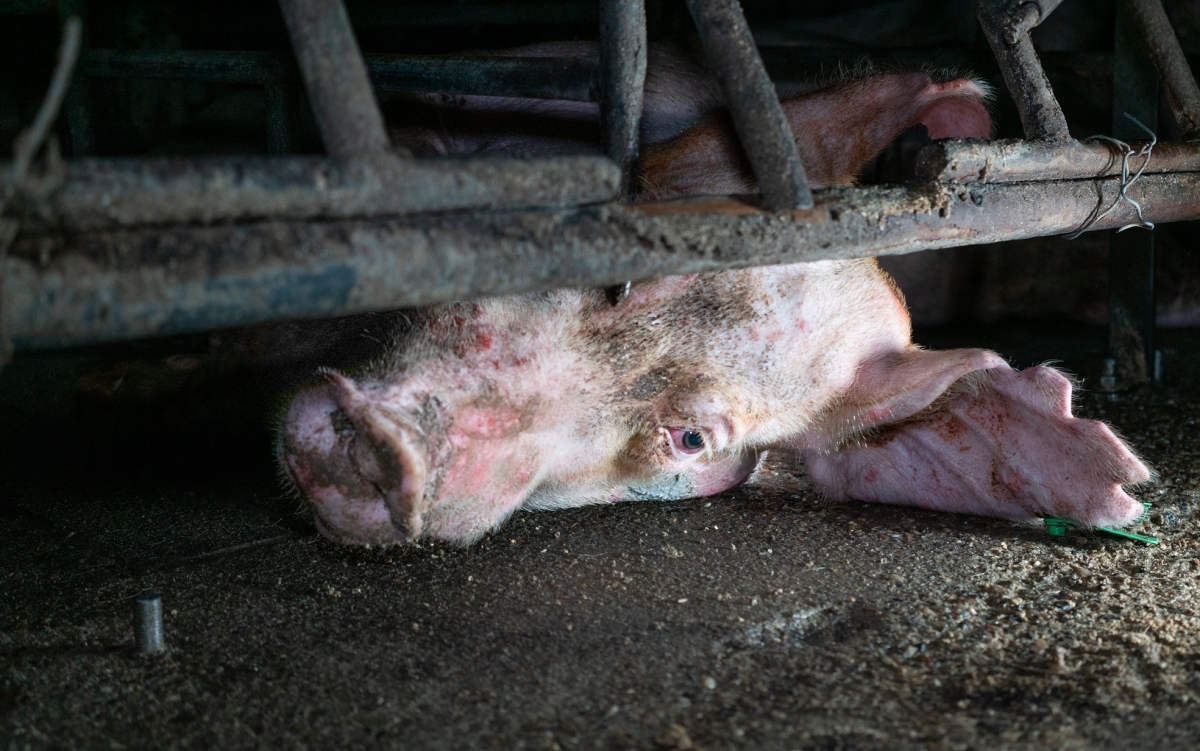
Footage released in January shows filthy conditions, violent abuse by workers, untreated wounds, and one boar left to slowly die over several days.
Authorities have failed to prosecute and boars continue to suffer in this facility every day.
This is the reality for animals that live within this broken system, but thanks to you, more and more people are becoming aware and turning away from animal agriculture.
You’ve heard of sow stalls, but did you know about boar stalls?
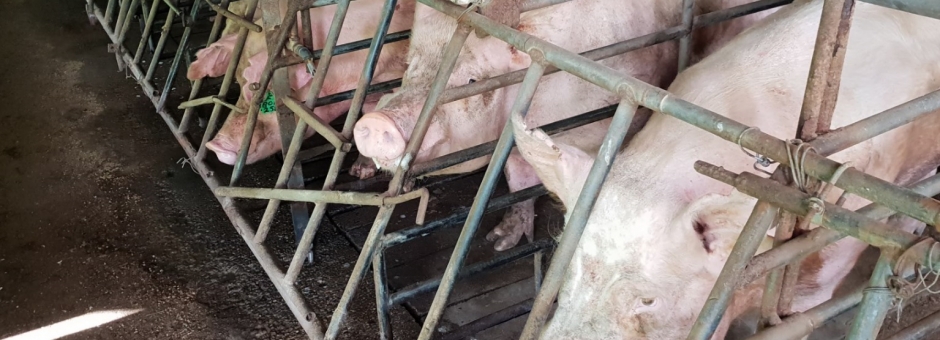
In an unseen facet of pig farming, boars are kept in small stalls all their lives, only being released for a brief time for semen collection a couple of times a week.
Semen collection farms are a relatively unknown facet of the industry. At this facility, at least 20 boars are kept in tiny stalls – most are equivalent to sow stalls – with no room to turn around, and barely enough room to even lie down. They have no enrichment, they are left with untreated injuries, fed only the minimum food required to keep them alive and “useful”, and are routinely abused. The only time the boars leave their tiny, filthy stall is for semen collection.
When we received the footage our immediate concern was around the strong possibility of another boar suffering a similar fate to Boe from untreated illness and dying a slow painful death. We immediately informed the authorities with a complaint to RSPCA Qld and passed on the video footage. RSPCA Qld acted quickly and arranged a team of inspectors and vets from both RSPCA Qld and Biosecurity Qld to conduct a surprise inspection.
We understand at least one boar was euthanised that day. After that, the rest of the investigation was handed over to Biosecurity Qld. In Queensland, a Memorandum of Understanding exists in which all farmed animal issues are referred to Biosecurity Qld, which is part of the Queensland Department of Agriculture.
On receiving no further updates from Biosecurity Qld, and realising authorities were not taking this seriously, we released the footage through two videos.
First, on 6 March, Animal Liberation Queensland & Animal Liberation (NSW) released Boe’s story. The public reacted and shared Boe’s story resulting in more than 630,000 views on Facebook.
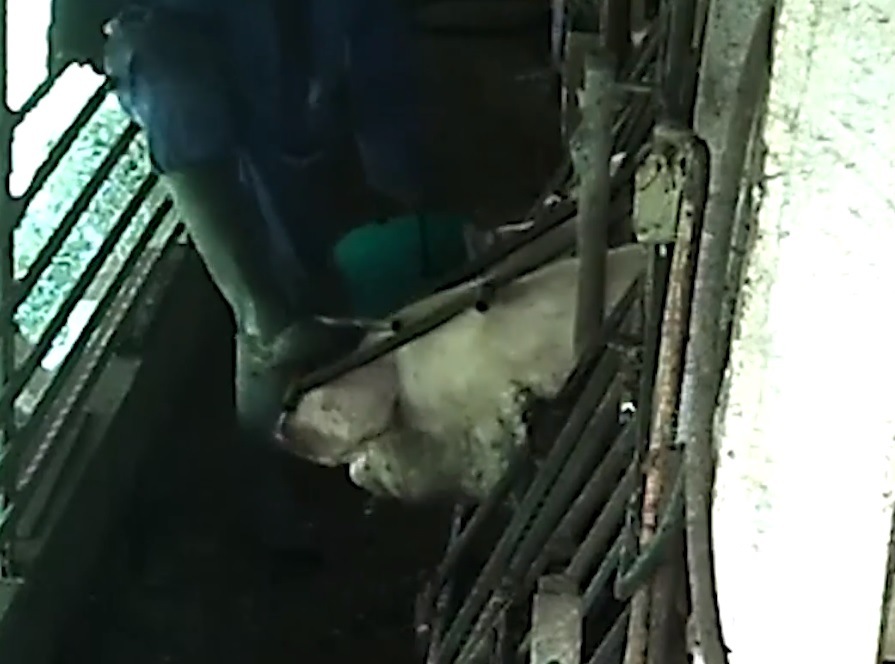
On 11 March we released the second video documenting further abuse and filthy conditions. Faeces and infestations were found throughout the facility. Video footage shows the worker kicking the boars, stomping and smashing metal bars against a boar’s head.
After numerous follow-ups with the Department, we learned that several “direction orders” were given to the owner to rectify issues they had found in their inspection. Biosecurity Queensland has confirmed that they have been back multiple times since the initial inspection and they are satisfied that all direction orders are being adhered to. In other words, it seems they will not be taking further action and have given this place the tick of approval. In practice, very little has changed for the boars that may spend the rest of their lives in these barren rusty metal cells. From the information we have, the direction orders related to the untreated wounds, and the maintenance or uncleanliness of the facility. There is nothing that will give any sense of relief to these boars and nothing that will stop others from meeting a similar fate to Boe.
Despite numerous requests for further information authorities would “not comment on the outcome of any investigations”. We can, unfortunately, conclude that no charges have been laid – despite numerous animal cruelty abuses outlined above that were documented by investigators, as well as issues during the inspection by authorities. If these boars were dogs, the owner and workers would now be facing court.
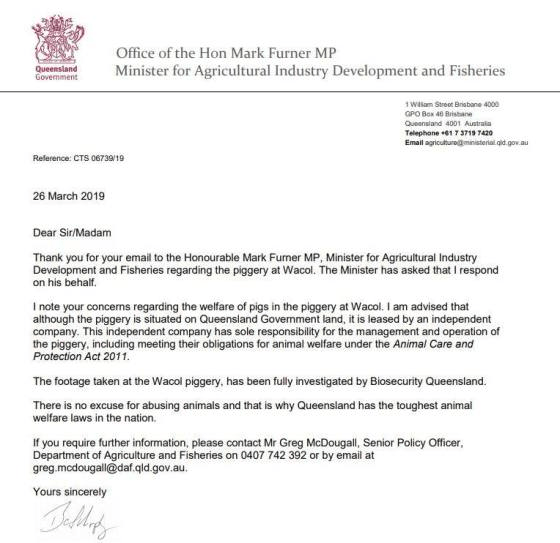
More than 3000 people sent emails of concern to the Minister for Agriculture. A couple of weeks later his office sent out a generic reply showing very little concern:.
Above: Minister’s office response to public concerns regarding lack of action taken by the Department.
Above: Injuries were left untreated.
We have also raised several conflicts of interests. Firstly, the land on which the Wacol pigs are incarcerated is leased from the Department of Agriculture – the very Department that is responsible for upholding animal welfare laws – is also taking money from this facility. The Minister failed to see any conflict here.
Secondly, this issue reminds us of the conflict of interest that exists for all animal agriculture. The Department of Agriculture in each state is responsible for growth and economic sustainability of the industry, but at the same time has the responsibility to enforce the Animal Care and Protection Act – and to police the very businesses it seeks to promote and grow. Both the Premier and Minister continue to ignore this very clear conflict of interest.
We are grateful to the investigators who took great risks to bring this cruelty to light. This is a thankless task, being confronted first hand with this cruelty. We greatly appreciate the thousands of you who complained to the Minister, made phone calls, and shared the video footage.
Sadly, this is the reality of millions of animals used and abused around the country every day. It is no wonder we see cruelty like this when the system is set up to fail these animals. As long as we have a society that supports, embraces and even celebrates animal agriculture, scenes like this will continue to be commonplace.
Know that this hasn’t all been for nothing. Hundreds of thousands of people have had their eyes opened to the reality of animal agriculture. For countless people, this was the final straw, and they have committed to going vegan. For others, this may be the start of their journey.
We can all help through our daily choices. By choosing vegan alternatives and never buying meat, dairy, eggs and other animal products, we take away the demand. Speak to your friends and family. Keep sharing footage and stories on social media. Keep writing and calling the Ministers, and speak to your local MP. Volunteer with or donate to animal advocacy groups.
Pressure on industry and government is growing every day, and every day the public is becoming more and more informed. Sadly, these industries of cruelty will not close down overnight, but with your help their days are numbered. We will keep fighting, and we will achieve animal liberation.
Take PETA’s Cruelty-Free Shopping Guide along with you next time you head to the store! The handy guide will help you find humane products at a glance. Order a FREE copyHERE
Searching for Cruelty-Free Cosmetics, Personal-Care Products, Vegan Products, or more? Click HERE to search.
Free PDF of Vegan & Cruelty-Free Products/Companies HERE
Want to do more than go vegan? Help others to do so! Click below for nominal, or no, fees to vegan literature that you can use to convince others that veganism is the only compassionate route to being an animal friend:
50 NGOs call on the European Commission to end the promotion of meat and dairy
19 September 2021
Eurogroup for Animals have signed a letter to the European Commission together with 50 NGOs calling for an end to the promotion of meat and dairy.
The EU promotion policy for agricultural products has previously funded campaigns that have aimed at increasing meat and dairy consumption with slogans such as “Milky is great” and “Pork lovers Europe”. Some campaigns have specifically targeted young people with the aim to reverse a declining trend in meat consumption among European youth.
The European Commission is currently reviewing the promotion policy, with “a view to enhancing its contribution to sustainable production and consumption, and in line with the shift to a more plant-based diet, with less red and processed meat and more fruit and vegetables”, as emphasised in both the Farm to Fork Strategy and Europe’s Beating Cancer Plan.
The letter points out that in the last four years the European Commission spent 32% of its €776.7 million budget for agrifood promotion on advertising campaigns for meat and dairy. The European Commission also spent 28% of the promotion budget on the promotion of mixed baskets of products, almost all of which included meat and dairy. This use of public money goes contrary to the established science about the negative impact on the environment and on public health of current diets that are heavy in animal protein.
The letter calls on the Commission to support the public interest to stop the promotion of meat and dairy and instead shift the promotion policy to promote healthy, sustainable plant-based food.
“Plant-based foods deserve wider promotion to benefit public health, the environment, and farmers. However, a shift towards a more plant-based diet can only be achieved if, in addition, the plant-based sector receives sufficient support to grow and to produce alternatives that can adequately mimic the texture, taste, and price of conventional meat and dairy products.”