This version is a must watch and especially should be viewed by politicians and those in power who CAN make the changes; so if you can pass it on to any in your ‘patch’ then all the better.
It is the full 1 hour version as per the original programme.
Please watch; get angry; get annoyed. Upset, whatever; rage and repent over what is shown, but please take the message on board – the planet needs you and all others to give a shit.
Pass the video (or link) on to whoever you consider it worthwhile.
The Chamber of Deputies in the Czech Parliament votes for a ban on dressage and a ban on the appearance of wild animals in circuses.
The house has just passed the end of wild animal abuse in circuses!
The ban has yet to be voted on in the House of Representatives and signed by the President, but the hardest part has already been done.
We congratulate the animal rights organization Svoboda zvířat on this success, which PETA is promoting as part of the Year of Change 2019/20. their project dealt explicitly with the ban on wild animals. ❤
PETA Germany
And I mean…Yes, such news brings joy to our everyday life.
In the meantime, 26 EU countries have already banned or at least restricted the keeping of wild animals in traveling circuses.
We in Germany are still begging for a wild animal-free circus. Without success!
You can’t say we didn’t care, no! On the contrary – for many, many years now, numerous animal welfare organizations, private individuals, and political parties in Germany have been campaigning for such a ban to be passed here in Germany too.
But despite the long struggle, the demos, petitions … Germany obviously finds cruelty to animals in the circus as a sign of civilization.
Market access for Taiwanese duck eggs spells disaster for animal welfare
14 September 2020
In December 2018, Taiwan’s Food and Drug Administration asked the European Commission to be allowed to export Taiwanese processed egg products, including duck egg products, to the EU. The application is still pending, but with the sector witnessing a move towards battery cages, Taiwanese NGOs are campaigning to raise awareness on what would be a serious step back, not only for animal welfare but also for public health.
The situation emphasises the urgent need for more stringent market access provisions in the EU, not only to prevent EU progress on animal welfare being undermined by imported products, but also to better promote higher animal welfare in third countries.
Under existing legislation, the EU does not impose any animal welfare criteria to imported eggs and egg products. While the EU has banned the use of battery cages for laying hens for more than a decade, this method of production can still be used by producers exporting to the European market, and by EU producers of other kinds of eggs.
The case of Taiwan’s duck eggs is interesting as this is an industry that used to rely almost entirely on cage-free systems. Unfortunately, the sector has not been spared by the trend of intensification and an increasing number of water-loving ducks in Taiwan – around 20% of the 2.16 million laying ducks – are now kept in tiny barren cages, away from the water which is so essential to maintain their health, regulate their body temperature, and keep their plumage in good conditions.
Investigations in Taiwan have revealed ducks with wounded feet caused by the dry conditions and rusty wire floors, and animals exhibiting abnormal stereotypic behaviors resulting from life in a cage. According to the Environmental and Animal Society of Taiwan (EAST), who launched a domestic campaign on this issue, the mortality rate of ducks kept in conventional cages is two to five times higher than that of ducks kept in cage-free systems equipped with water troughs and nesting boxes, illustrating the inadequacy of cage systems.
Such intensification has also an impact on public health. The recent COVID-19 pandemic, while having emerged from wildlife, has put the spotlight on zoonosis and on the risks related to intensive farming. Intensively farmed poultry are most notable for Highly Pathogenic Avian Influenza (HPAI), the recurrence of which is due to interaction between animals with a compromised immune system and wild animals potentially carrying low pathogenic viruses.
Over the past decade, Taiwan has faced many occurrences of HPAI, and has previously been unable to timely report the outbreaks and to address them transparently. It is often argued by the poultry sector that avian influenza is mainly spread by wild birds. However, the viruses carried by wild birds are usually of low pathogenicity and it is only when these viruses reach overcrowded sheds that they can evolve into a more dangerous form of avian influenza (1).
Humans can be contaminated by zoonotic influenza, whether they originate from birds or pigs. The previous pandemic, the H1N1 outbreak in Mexico, killed between 151,00 and 575,000 people worldwide, 80% of which were under 65 year old. It is thus important to favour systems that will be more resilient to such diseases, and the European Commission should consider this aspect when assessing Taiwan’s bid to export duck egg products into the EU.
A record-breaking 1.5 million EU citizens have called for a ban on cages in the EU, demonstrating the strength of public opinion on this issue.
As the EU considers moves to strengthen domestic regulations, it should not repeat past mistakes by leaving the door open to low-welfare imports. Any ban on cages should thus become a requirement for those exporting to the EU, including Taiwanese duck egg producers.
With the review of animal welfare legislation foreseen in the EU Farm-to-Fork strategy, the external dimension of our rules cannot remain overlooked. As the European Commission concluded itself, imposing EU standards to imported goods (as with the slaughter regulation) is the EU’s best tool to promote higher welfare abroad.
(1) Nickbakhsh, S. et al., 2016, Modelling the impact of co-circulating low pathogenic avian influenza viruses on epidemics of highly pathogenic avian influenza in poultry, Epidemics, 17:27-34
WAV Comment: Well done them – very effective. Fish too need a voice !
Activists protest against intensive fish farming conditions in Italy
17 September 2020
Essere Animali
On board of a motorised boat, activists from our Italian member Essere Animali reached a fish farm in the province of La Spezia, Italy. Arriving near the cages in the sea where hundreds of thousands of fish are confined, they unrolled a banner to protest against the poor living conditions of these animals, destined for the large-scale distribution market.
“Caged in the open sea – “FishToo need to be protected” reads the thirty square meter banner captured by the drone that the activists used for the shooting. The fish farm where the protest took place, is specialised in the breeding of sea bass and sea bream, and has about thirty cages located along the coast of the Ligurian province. The fish spend around 16 to 22 months for the fattening process in these cramped cages in the sea until they reach the commercial weight of 300 to 500g.
https://www.youtube.com/embed/fxwEqRVg3bg?autoplay=0&start=0&rel=0&enablejsapi=1&origin=https%3A%2F%2Fwww.eurogroupforanimals.org “Crammed into cages, tanks, or ponds, these animals live in conditions that do not allow them to express their natural behaviour. Their life is of deprivation, spent in unhealthy environments with very high densities where they are often fed with antibiotics to contain the inevitable spread of viruses and bacteria”, says Brenda Ferretti, Outreach Manager of Essere Animali. “Furthermore, compared to terrestrial animals, fish raised for food spend much more time on the farm, and at the time of the killing, they are victims of atrocious suffering. But fish are also sentient beings, capable of feeling fear and pain, and therefore worthy of being defended and protected”.
Essere Animali underlines the urgent need for a change in the critical conditions which fish are enduring in the aquaculture industry, the food sector with the highest growth rate in recent decades. According to the new FAO report “The State of World Fisheries and Aquaculture” (SOFIA), aquaculture production now represents 52% of fish destined for human consumption. This means that half of the fish that reaches consumers’ tables comes from fish farms, where the predominant production model is industrial and intensive.
“Although fish are the animals raised in the greatest number in the food industry, they are also the least protected by national and EU legislation. This, combined with harmful breeding practices, such as the absence of effective stunning procedures which could reduce their suffering at the time of slaughter, pushes up to stand up for the protection of these animals”, continues Brenda Ferretti.
In this problematic context, the role of large-scale distribution is decisive. In fact, according to the Italian Institute of Services for the Agricultural Food Market (ISMEA), about 80% of purchases of fresh fish and processed fish products in Italy take place in modern distribution outlets. With its purchasing power, large-scale distribution can encourage farming practices that are more respectful of the life of the fish raised in their fish supply chains, binding its suppliers to adhere to stricter production standards. As part of their campaign #AncheiPesci (“#FishToo”), Essere Animali is, therefore, collecting signatures for a petition calling for better welfare conditions for farmed fish.
“Crammed into cages, tanks, or ponds, these animals live in conditions that do not allow them to express their natural behaviour. Their life is of deprivation, spent in unhealthy environments with very high densities where they are often fed with antibiotics to contain the inevitable spread of viruses and bacteria”, says Brenda Ferretti, Outreach Manager of Essere Animali. “Furthermore, compared to terrestrial animals, fish raised for food spend much more time on the farm, and at the time of the killing, they are victims of atrocious suffering. But fish are also sentient beings, capable of feeling fear and pain, and therefore worthy of being defended and protected”.
Essere Animali underlines the urgent need for a change in the critical conditions which fish are enduring in the aquaculture industry, the food sector with the highest growth rate in recent decades. According to the new FAO report “The State of World Fisheries and Aquaculture” (SOFIA), aquaculture production now represents 52% of fish destined for human consumption. This means that half of the fish that reaches consumers’ tables comes from fish farms, where the predominant production model is industrial and intensive.
“Although fish are the animals raised in the greatest number in the food industry, they are also the least protected by national and EU legislation. This, combined with harmful breeding practices, such as the absence of effective stunning procedures which could reduce their suffering at the time of slaughter, pushes up to stand up for the protection of these animals”, continues Brenda Ferretti.
In this problematic context, the role of large-scale distribution is decisive. In fact, according to the Italian Institute of Services for the Agricultural Food Market (ISMEA), about 80% of purchases of fresh fish and processed fish products in Italy take place in modern distribution outlets. With its purchasing power, large-scale distribution can encourage farming practices that are more respectful of the life of the fish raised in their fish supply chains, binding its suppliers to adhere to stricter production standards. As part of their campaign #AncheiPesci (“#FishToo”), Essere Animali is, therefore, collecting signatures for a petition calling for better welfare conditions for farmed fish.
The advert shows a couple ‘making the connection’ (Photo: Supplied to Plant Based News)
A pro-vegan T.V ad – Israel’s first – has reached 35 percent of the nation, after being broadcast during one of the country’s most popular T.V shows – and has earned positive feedback with viewers branding it ‘effective’.
The 60-second advert, created by international non-profit Vegan Friendly, shows a couple shopping in a supermarket. When they ask for ‘extra fresh’ meat, they are handed a living lamb. The commercial ends with the message ‘make the connection’.
Millions of viewers
The advert was initially broadcast during the current season finale of Survivor Israel: this season has the highest ratings in the show’s history, and so the spot was chosen to ensure as many people as possible would see the commercial.
According to Vegan Friendly, a massive 35 percent of the country’s population – some 3 million people – watched the ad.
The organization’s founder and CEO Omri Paz told Plant Based News: “After so many years seeing commercials of animal products, it is exciting to see for a change a vegan commercial that talks about compassion for animals on the most popular show in the country.”
Positive feedback
The advert is now also available to watch on YouTube, where it has garnered praise. One viewer wrote: “Yes! Who could ever hurt that sweet innocent lamb! Not me! Not anyone who could see it and hold it. Make the connection! Go vegan!”
Another was inspired to share their transition to veganism, writing: “This is excellent. My own story is that I worked in a meat dept. for three years prior to ‘making the connection’. There was no slaughtering there. I never would have been able to do that, but still, I was one step more involved than just buying and consuming animal foods. I think my soul is quite curious and wanted to see what this experience was like while it still could. I came out of ignorance and switched to veganism just four months after quitting the job.”
One simply said: “This is spot on! Way to go veganism, people are so blind to make a connection to life! Definitely, this will make everyone rethink.”
I have campaigned for, and spoken in defence of, all the worlds animals exported live for over 30 years. Part of my campaign ‘patch’ was at Dover in Kent, which is my personal home county.
Until recently; the Dover Member of Parliament (MP) was one named Charlie Eliphicke. Over many years of campaigning against live exports (from Dover); protestors were constantly informed that ‘Charlie’ was against the trade and fully supported them. Never once was he observed at the docks supporting the protests, or supporting written documentation (evidence) being presented to either the EU or ‘his’ Political Party, the Conservatives.
Yesterday, 15th September 2020, Charlie Elphicke was sentenced to 2 years in prison for ‘sexual assaults on women’. The Judge at the case, one Mrs Justice Whipple; told Elphicke he was a “sexual predator who used his success and respectability as a cover”.
It is not for me to stand here and put Charlie Elphicke down; I have better things to do; nor do I in the least support his alleged actions against women in any way – quite the opposite; but what (allegedly) happened in his case is an issue that I don’t want to get involved with. The abuse of females is wrong – simple as that; whatever guise it takes.
For me, personally and more importantly, is the fact that CE was sentenced to 2 years for the ‘assault on women’. That to me this is disgusting enough, but with all that has happened here I consider the envelope should be pushed a little wider.
‘An assault on women’.
From of many searches today, I find that under ‘the system’, ‘A woman’ is identified as an adult femalehuman.
Fine; no problems there, but then what about all the other ‘women’; females of this planet ?
There are ‘women Bovines’; and they are called Cows once they have had offspring. A heifer is a female (cow) that has not yet had any young. A cow is a mature female bovine that has had at least one calf.
There are ‘women Porcines’, Female pigs, called sows, give birth to offspring twice a year to a litter of around 12 young. The baby pigs are called piglets. Prior to having any young, the female pig is usually known as a ‘gilt’. At birth, piglets weigh around 2.5 lbs. Wild pigs can give birth to six for 14 piglets at a time.
For ‘women’ sheep, or ‘Ovines’, an adult female is referred to as a ewe. She gives birth to lambs.
For ‘women Hens’, younger females are known as pullets, although in the egg-laying industry, a pullet becomes a hen when she begins to lay eggs.
The female / male list of animal types is endless. If you’d like to find out the correct male and female names for these animals and many more, then check the list below
‘Women’ animals are abused by respective ‘Human’ industries that farm them continually. Most humans; those of the non animal advocate kind; accept this as part of the system. I ask the question; why can a male human abuse females and get sent to prison for 2 years; and yet tens of thousands / millions of ‘women’ animals’ suffer much greater abuses, and yet their perpetrators appear to get away with the abuses all the time because they are accepted by most in human society as being the ‘norm’.
Until society realises that ‘women’ animals are sentient beings; just like the human version, and accept that they also love and cherish their offspring (given a chance), and allowed to be mere mothers for more than just a few hours; then human society will make little progress. The human abusers will remain as the abusers and the women animals that suffer as a result will continue to suffer for all mankind.
2 years for fondling a human woman.
Continual Insemination of a ‘woman cow’ – Using the flexibility of your wrist, twist and bend the cervix until you feel the second ring slide over the gun tip. Push the plunger slowly so that drops of semen fall directly into the uterine body. When the insemination gun is more than 1” through the cervix, all the semen will be deposited in only one horn. Animals – thus ACCEPTED.
Seems that some abuse is not accepted in the human world; you can go to jail for it; and yet the daily animal abuse is accepted in the human world everywhere without question.
The question is – Why ?
Regards Mark
Learn more about more ‘female mums’ – the stray dogs and cats of Serbia – from our other site; ‘Serbian Animals Voice’ (SAV):
A small sample of the welcome the fishermen gave us a few days ago in Brittany.
As part of OPERATION DOLPHIN BYCATCH, we are currently on the move off the coast of Brittany to uncover dolphins being caught in fishing nets.
After we documented on August 30th how five dolphins were killed in one day in the nets of a single fishing boat, fishermen pursued, threatened, surrounded, pelted us, and tried everything possible to hinder our work.
But we don’t let ourselves be scared off, we don’t let ourselves be discouraged and we don’t let ourselves be intimidated … especially not by an ass demonstration!!
Every year 10,000 dolphins die off the French coast from fishing nets.
We’ll keep patrolling and uncovering these deaths until something changes.
The European Union has already asked France to ban fishing methods that are responsible for the unnecessary death of thousands of dolphins.
And I mean…
...”The European Union has already asked France to ban fishing methods that are responsible for the unnecessary death of thousands of dolphins”.
If a court requires a rapist not to rape any more women, can the judiciary assume that the perpetrator has been punished enough?
Is this a sufficiently effective punishment for the perpetrator, so that will keep him from future rape?
Govt agrees to change law to help protect over 35,000 endangered species
“The changes will be made by amending the Trade in Endangered Species Act 1989 to ban the domestic sale of elephant ivory in New Zealand with some exemptions, and to improve the regulatory system at the border,” said Eugenie Sage.
The Government has agreed to change the law to help protect more than 35,000 internationally endangered species where unsustainable trade threatens their survival in the wild, Minister of Conservation Eugenie Sage announced today.
“The changes will be made by amending the Trade in Endangered Species Act 1989 to ban the domestic sale of elephant ivory in New Zealand with some exemptions, and to improve the regulatory system at the border,” said Eugenie Sage.
“This is a big step forward in strengthening the management of international trade in endangered, threatened and exploited species. The Cabinet decisions follow the release of a discussion document in September 2019 and public submissions.
“Currently there are no restrictions on domestic trade in elephant ivory in New Zealand. This is out of step with many countries such as the United States, United Kingdom, France, Taiwan and China which have already banned domestic trade in elephant ivory.”
“I am pleased to announce the proposal to ban the domestic sale of any items made with ivory from elephants killed after 1975, which is when elephants began to be protected from international trade under the Convention on International Trade in Endangered Species (CITES).
The import and export of all elephant ivory is also proposed to be banned, with narrow exemptions to ensure elephant ivory items can still be traded by museums, for DNA testing and testing to determine age, and that antique musical instruments with correct permits can still be carried across the border.
“The New Zealand market in ivory is small, but banning the sale of post-Convention elephant ivory in New Zealand will send a message that New Zealand does not want to receive elephant ivory that may have been poached or illegally traded,” said Eugenie Sage.
Other planned changes to the TIES Act focus on improving the way the Act is implemented to ensure the regulatory system at the border efficiently and effectively manages international wildlife trade and stops illegal trade.
“Proposed changes to the TIES Act will ensure that New Zealand can continue to protect significant plants and wildlife from around the world to the highest standard.”
Regulate the domestic sale of elephant ivory, with elephant ivory from elephants killed before 1975 exempt;
place further restrictions at the border on importing and exporting elephant ivory;
update the definition of personal and household effects to ensure it functions as intended by not allowing items for commercial sale to qualify as personal or household effects;
include a regulation-making power enabling species-specific exemptions from permitting for personal and household effects;
enable a process to return seized items to individuals where there are permit irregularities in certain limited circumstances; allow cost recovery for services provided to commercial traders; and
allow DOC to consider cases where there have been irregularities with permits issued by Management Authorities in other countries. There will be a process with strict conditions to consider errors, and decide whether to accept replacement or retrospective permits.
The Trade in Endangered Species Act 1989 will need to be amended to implement the changes. An amendment Bill will be drafted incorporating the proposed changes. It is planned for introduction to the next Parliament after the election to be referred to Select Committee after its first reading.
(With Inputs from New Zealand Government Press Release)
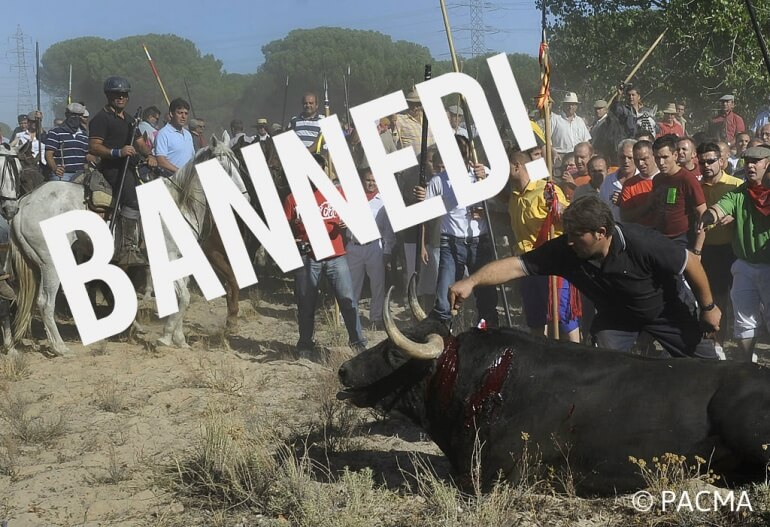
A study concludes that pressure on networks led to the prohibition of Toro de la Vega.
Eduardo Galeano once said, “Many small people, in small places, by doing small things, can change the world.”
The activists created against this barbarian fiesta in Tordesillas (Valladolid) an emotional stigma for the followers of this celebration, constructing them as psychopaths, sadists, or beasts.
And won! After many years of fighting, they won!
It is said that the press is the fourth power.
Perhaps everyone who fights against the lies of the press, the animal rights activists, the protesters, the defenders of animals, is the fifth power.
All these forces have abolished el Toro de la Vega!
WAV Comment: Special thanks must go to the Northern Ireland Fire and Rescue Service (NIFRS) who battled the flames for hours, unsuccessfuly, to save lives.