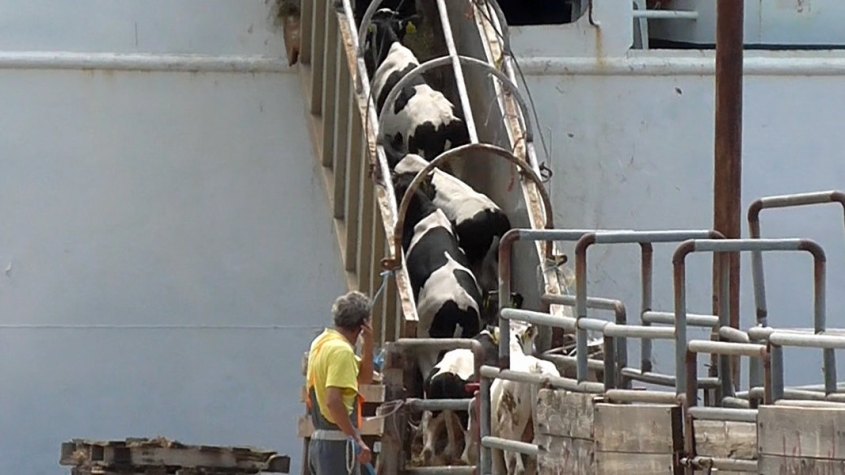

All photos – Eyes on Animals, Welfarm Foundation and Animals Welfare Foundation.

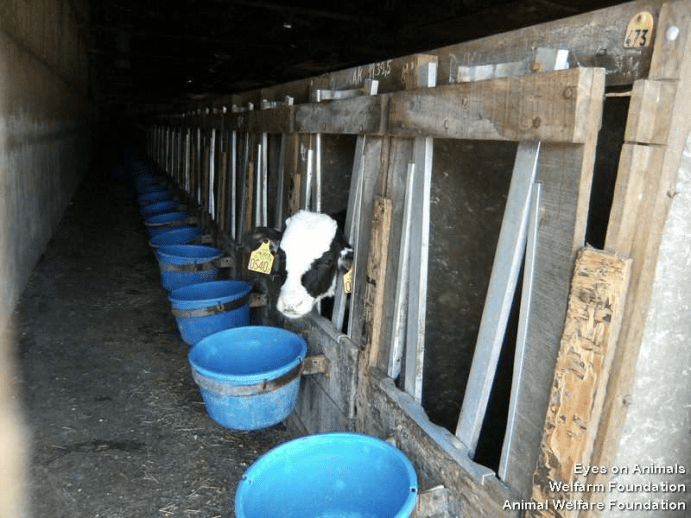
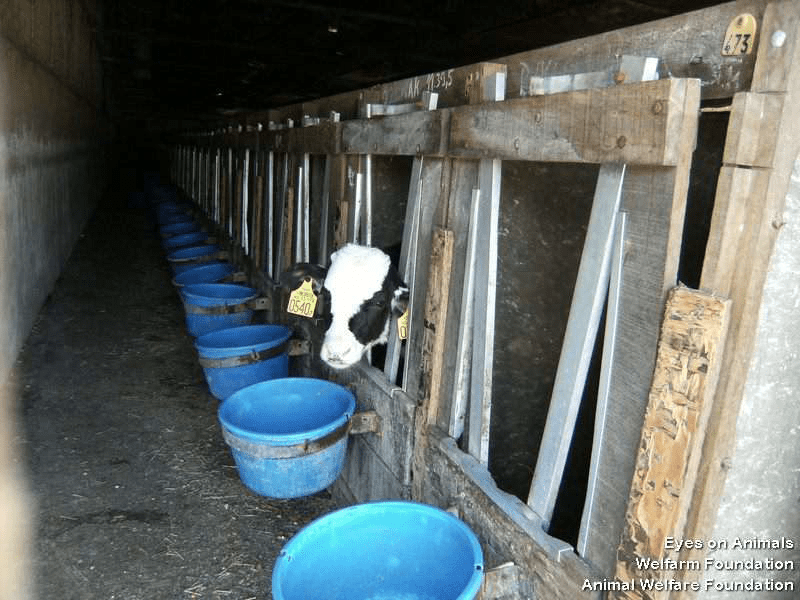
Above – Calves being kept in illegal crate systems in Hungary – 6 years after EU legislation change !
This post is in addition to that recently regarding Scottish calves being exported from the port of Ramsgate, Kent, England; to the EU for further fattening / slaughter.
See our post and video footage of the calves at https://worldanimalsvoice.com/2018/11/27/england-dutchman-onderwater-exports-scottish-calves-from-ramsgate-plus-more-info/
This above, and the following, show that the EU policy on animal welfare is in a complete mess.
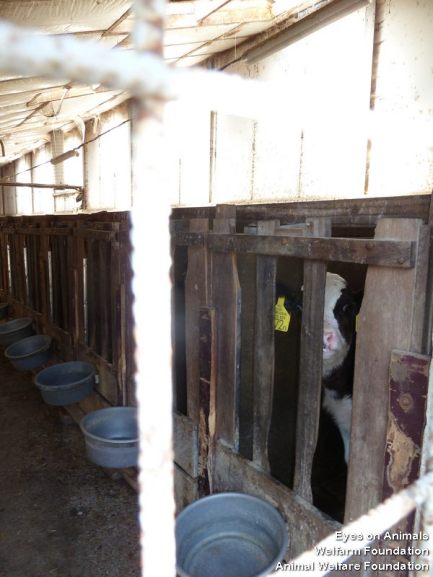
A calf peers out from a Hungarian illegal crate system
For this post we are going back to 2012 as yet another example of the complete disregard the EU has for its own legislation. This time we relate to:
Official Journal of the European Union –
COUNCIL DIRECTIVE 2008/119/EC
of 18 December 2008
laying down minimum standards for the protection of calves
We need to start by saying that during 2012, Croatia was NOT a member state of the EU. It only became a member state on 1st July 2013. This is important as it has bearing on the information we are supplying here.
Our concerns deal specifically with regard the 20th – 21st March 2012 inspections of Hungarian assembly stations designated to dispatch animals to Turkey; investigations as undertaken by investigator friends from ‘Eyes on Animals’ ,‘Animal Welfare Foundation’ and ‘Welfarm’.
Our primary concern at the time related to the inspections undertaken by the above organisations at a facility known as ‘Agracoop Kft’ farm and export station, Nagykapornak, Hungary – the owner one Kiss Arped.
At the entrance to this specific facility there is a sign clearly indicating that they (‘Agracoop Kft’) have received some 615,000 Euros from the EU in the form of subsidies to ‘modernise their facility’.
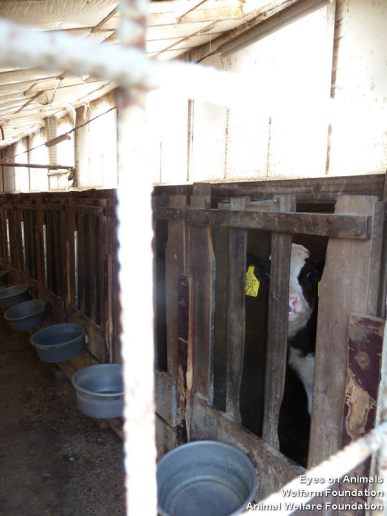
Whilst at the time (2012) welfare organisations appreciated that this facility was further sub-divided into four main animal rearing areas, it became clear after reviewing evidence provided by the investigating organisations, that one building still in current use at the time (2012), retained the old, and (EU) illegal, veal crate system made out of wood, with slatted floors and solid wooden dividers.
At the time, Mark (WAV) wrote on behalf of another welfare organisation to Dr. Endre Kardevan; Chief Veterinary Officer (CVO)Hungary (EU), to ask the following:
Why is this type of illegal animal housing system (banned in 2006 across the entire EU) still being used within Hungary ?, in particular when there is official national veterinarian surveillance at these approved dispatching facilities ? The (EU) illegal operation of still using banned veal crates at the ‘Agracoop Kft’ in Hungary is obviously known to official veterinarians who visit the site; so why does ‘Agracoop Kft’ continue to be allowed to operate such illegal practices ? EU rules do not permit it; so why does it happen ?
Although as the CVO for Hungary should have known, it was also pointed out in the letter that:
With solid wooden dividers on the crates observed by investigators at ‘Agracoop Kft’, the calves held within these are thus unable to either see or touch each other. We would like to inform you that this type of crate system has been illegal within all existing EU member states since 2006. As the Chief Veterinary Officer within Hungary, we trust and would very much hope that you are up to date with EU regulations and are fully aware of the illegality of these crates since 2006.
The question was asked that:
Why, as the Hungarian Chief Veterinary Officer, do you continue to allow systems such as these crates to be used by ‘Agracoop Kft’ ? – your actions are illegal under existing EU legislation. The calves held in these illegal crates were, on the day of inspection, seen to have ‘Hungarian’ (HU) ear tags – with Hungary being an EU member state and nation which should have been compliant in 2006 along with all other EU member states in banning this type of crate system. As a British NGO, we have special concerns relating to British animals (calves) identified with ‘UK’ ear tags, and which were observed at the ‘Agracoop Kft’ during the inspections in March.
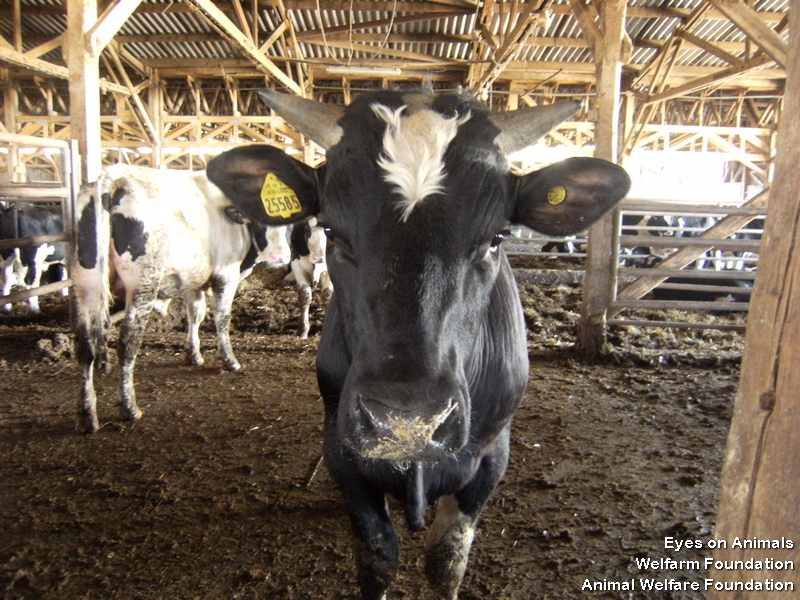
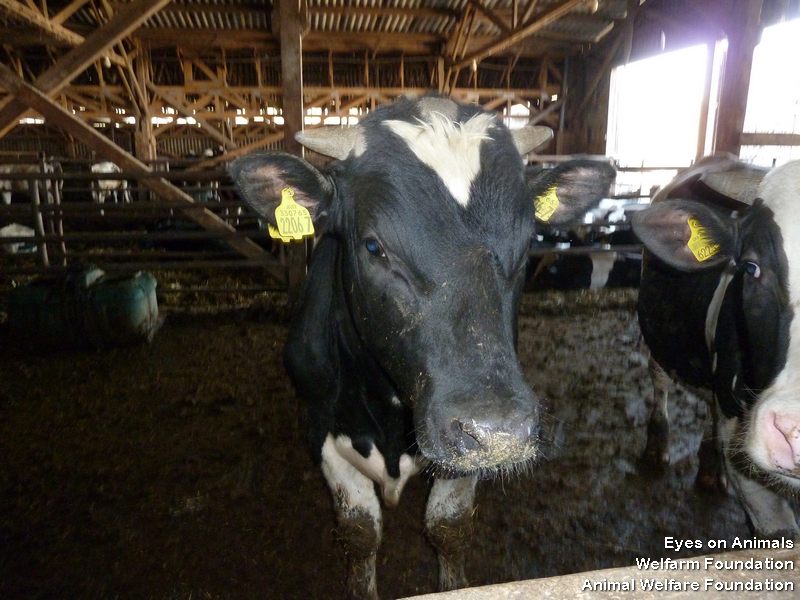
Above – UK ear tags on British calves at the Hungarian facility
Although Hungarian calves were identified by their ear tags in the illegal crate systems during the inspections; British calves were also at the facility; we had strong concerns that the British calves would also end up in the same illegal crates. We could tell that the calves were from the UK as this could be identified fromtheir er tags.
So, we asked the Hungarian CVO a question about this situation:
As illegal veal crates are still being used at the ‘Agracoop Kft’ facility, please inform us if
British calves are ever located into these same crates – ie. are you as the Hungarian Chief Veterinary Officer breaking EU law by authorising British animals going into a now (EU) illegal system ?
Regardless of the ‘nationality’ / national origin of the calves observed at the ‘Agracoop Kft’ facility, we stress that these animals are now being confined in systems which were banned across the entire EU back in 2006; six years ago !
We ended our questions regarding the EU subsidies and the continued use of Hungarian illegal crates:
Why is such a large company such as Agrarcoop Kft, which is provided with such large EU subsidies (615,000 Euros), if they are not even respecting the basic EU norms and regulations regarding the housing of calves ?
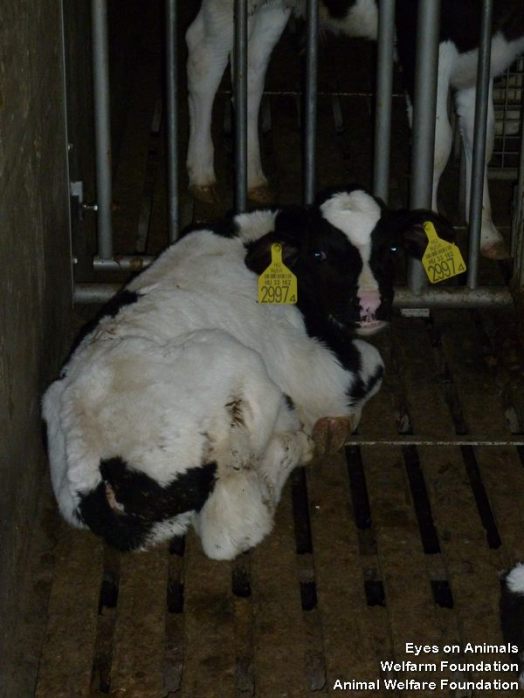
A calf lies on an illegal slatted floor
EU AnimalWelfare Violations
With regards to the young calves being observed and kept in tiny wooden crates with solid walls, preventing them from seeing each other or touching each other, we outline the following EU violations were observed during the visit of March 2012.
EU law on calves is contained in Council Directive 2008/119/EC laying down minimum standards for the protection of calves (the Calves Directive) which consolidates earlier legislation adopted in 1991 and 1997.
The EU’s prohibition of the veal crate is firmly based on scientific research. The Scientific Veterinary Committee’s (SVC) 1995 report is highly critical of the veal crate. The fact that a young animal needs proper exercise is recognised by the SVC which states that exercise is necessary for normal bone and muscle development. The SVC added that “If calves cannot move their limbs sufficiently they are likely to be severely distressed” and that after six months in an individual pen many calves have severe locomotor problems.
The EU is rather clever in the way the system works. Basically it says that enforcement of legislation is down to governments of individual member states. So in this case, it should be the Hungarian authorities who ensure that the crate system is not in force. As they have not done this, we would argue that the evidence should go back to the EU Commission and that they should follow up with their own investigations and possible prosecutions if necessary.
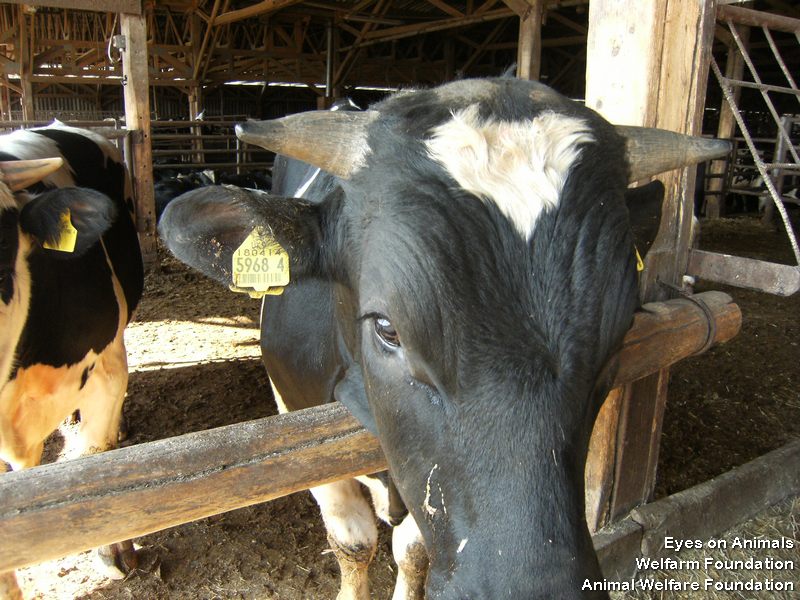
Hungary – A UK Calf with UK ear tag
Slaughter in Croatia
As we said before, please remember that at the time of the investigation; 2012; Croatia was NOT a member state of the EU.
We continued in our letter to the Hungarian CVO:
We also understand from investigators that calves, including those with ‘UK’ ear tags, continue to be further fattened at the ‘Agracoop Kft’ prior to going for slaughter in other parts of Europe; which we understand to be primarily Germany and Croatia.
Whilst declaring that Germany is an existing member state of the European Union, and as such should adequately meet EU standards for animals at slaughter, we would like to point out to you that Croatia is currently not a member state of the EU.
Question –
What guarantees can you, as the Chief Veterinary Officer of Hungary, provide to us that ‘UK’ ear tagged animals (calves) are being slaughtered to the highest of standards (certainly compliant with existing EU standards, nothing less) within Croatia ?
We request that you provide us with full evidence of EU slaughterhouse standard compliance within Croatia, including the names of facilities within Croatia which undertake the slaughter of British calves carrying ‘UK’ ear tags which have been re-exported from Hungary.
Although the Hungarian CVO did respond to our letter; we found very little which actually addressed our concerns. Nothing in the way of a reply was given regarding assurances that animals were slaughtered to EU standards in Croatia. You can read the (Google) translation below and make up your own mind if the responses are adequate.
Translation
Dear Addresses!
Referring to the letter “Investigating collecting stations transporting animals from Hungary to Turkey” I will be informed of the following on the basis of the on-the-spot official controls.
According to the objection to the collection site, the incoming animals do not spend 6 hours on the site before delivery, so the collection plant may not be the starting point for the purposes of Regulation (EC) No 1/2005. During the on-site official inspection for the purpose of the objection, the owner of the site said that the animal protectors had ca. They spent 1 to 2 hours at the plant. None of the staff members of the site told anyone how long the animals would be staying at the collecting station before their departure. However, in their summary, the animals are resting for 3-4 hours.
The set-aside time was randomly checked by the authority for a consignment consisting of 4 different animals. Comparing the GPS data of the delivery and delivery vehicles, it was found that the animals stayed at the collecting station for 9.5 hours.
I would point out that the proposal to prevent the bulls from rolling on each other in practice can not be realized in view of the fact that food-producing animals can not come into contact with this non-authorized substance which affects the organoleptic properties of meat or may appear as a residuum of health risk. Therefore it is strictly forbidden to use animals with diesel oil.
Collector of Agrár-coop Kft
The Eyes on Animals, the Animal Welfare Foundation and the Welfarm Foundation staffed their report on the visit of the Agrár-coop Kft. In their collections. They complained about the conditions of the calf, the stalls in the stables and the duration of animal transport.
The visit was not pre-arranged, a manager and an interpreter were not present. At the time of their arrival, plant closures were temporarily unavailable due to manure transfer, so animal protectors could be accessed without authorization and prior health checks, and the entire animal farm outside the separate collection center.
The local competent authority, in conjunction with epidemiological surveillance, held animal protection inspections at the collecting station and livestock farm, the experiences of which were as follows.
Questions related to veterinary care have been raised in the case of veterinary surgeons. The battery is contracted with a supplying (operator) veterinarian who performs his veterinary duties as recorded in the medication and treatment log. The employees of the plant responded to these questions either incorrectly or spoke to a worker who did not know the difference between the duties of the official and the veterinarian, nor In one of the previously unused baskets, the sidewalls of the individual cages are really compact, so the stall does not meet the requirements of 32/1999. (III.31.) FVM Decree. On the basis of the on-site inspection, a plan of action was prepared for the transformation of the sidewalls, which the local competent authority imposes in the form of a decision. With regard to the other objections to calf stalks, it was found on the spot that in a boxing (size 4m x 2.5m) five individuals were placed in a boxing bracket during a grouping, the individual space being 2nm. Each faucet of the group holding is equipped with a mouthpiece water pipe. Milk calves that do not drink from a bucket have a unique rubber. There is no calf less than two weeks old in the farm, according to the manager’s statement they do not accept such an animal. The above-mentioned legislation is mandatory for them. No bedding is used between two and eight weeks old, the technology works with a paddle pad. They use deep-tissue technology in the stables of the adult animals, wearing fresh straw on the litter every two days. The objection to transport was raised by the employee’s oral communication. Turkish exports can be carried out under very strict conditions. According to the data of the shipments surveyed on a GPS basis, contrary to the established procedural rules, this can not be supported by the assumption in the announcement that “it may take up to 12 hours until it collects adult slaughter bees and then goes straight to Turkey”.
The objection to transport was raised by the employee’s oral communication. Turkish exports can be carried out under very strict conditions. According to the data of the shipments surveyed on a GPS basis, contrary to the established procedural rules, this can not be supported by the assumption in the announcement that “it may take up to 12 hours until it collects adult slaughter bees and then goes straight to Turkey”.
The provisions of Article 2 (r) of Regulation (EC) No 1/2005 are also complied with for shipments from Agro-Coop Kft.: “The starting point may be the collection center if the distance between the first loading point and the collection station is 100 km, shall not be exceeded or the animals shall be placed in a suitable litter for at least six hours prior to departure from the assembly center, preferably not bound and pickled

Tisztelt Címzettek!
Hivatkozva a „Magyarországról Törökországba élő állatokat szállító gyűjtőállomások vizsgálata” tárgyú levélre az alábbiakról tájékoztatom a helyszíni hatósági ellenőrzések eredménye alapján.
Fekete Sándor bugyi-ürbőpusztai gyűjtőtelepe
A gyűjtőtelepre vonatkozó kifogás szerint a beérkező állatok szállítás előtt nem töltenek el 6 órát a telepen, így a gyűjtőtelep az 1/2005/EK rendelet értelmében kiindulási helyként nem szerepelhet. A kifogás kivizsgálása céljából végzett helyszíni hatósági ellenőrzés során a telep tulajdonosa elmondta, hogy az állatvédők kb. 1-2 órát töltöttek a telepen. A telep dolgozói részéről nem nyilatkozott senki, hogy az állatok mennyi ideig tartózkodnak indulás előtt a gyűjtőállomáson, ennek ellenére összefoglalójukban az áll, hogy az állatokat 3-4 óráig pihentetik.
A pihentetési időt szúrópróbaszerűen vizsgálta a hatóság egy olyan szállítmány esetén, mely 4 különböző helyről származó állatokból állt. A be- és kiszállító járművek GPS adatait összevetve megállapítást nyert, hogy az állatok 9,5 órát tartózkodtak a gyűjtőállomáson.
Megjegyzem, hogy a bikák egymásra történő felugrálása megelőzésére tett javaslatuk a gyakorlatban nem valósítható meg tekintettel arra, hogy élelmiszertermelő állatokkal nem kerülhet kapcsolatba erre a célra nem engedélyezett anyag, ami a hús érzékszervi tulajdonságait befolyásolja, illetve egészségügyi kockázatot jelentő maradékanyagként megjelenhet benne. Ezért az állatok dízelolajjal történő bekenése szigorúan tilos.
Agrár-coop Kft. gyűjtőtelepe
Az Eyes on Animals, az Animal Welfare Foundation és a Welfarm Alapítvány munkatársai az Agrár-coop Kft. gyűjtőtelepén tett látogatásuk alapján összeállított bejelentésükben a borjútartás körülményeit, a növendék állatok istállóiban az almolást és az állatszállítások időtartamát kifogásolták.
A teleplátogatás nem volt előre egyeztetve, ügyvezető és tolmács nem volt jelen. A telepi zártság érkezésük idején trágyakihordás miatt átmenetileg nem valósult meg, így fordulhatott elő, hogy az állatvédők engedély és előzetes egészségügyi ellenőrzés nélkül bejutottak, és az elkülönített gyűjtőistállón kívül az egész állattartó telepet bejárták.
A helyi illetékes hatóság járványügyi ellenőrzéssel összekapcsolva állatvédelmi ellenőrzést tartott a gyűjtőállomáson-állattartó telepen, melynek tapasztalatai a következők voltak.
A betegistálló kapcsán az állatorvosi ellátásra vonatkozóan merültek fel kérdések az állatvédőkben. A telep szerződésben áll egy ellátó (kezelő) állatorvossal, aki a gyógyszer- és kezelési naplóban rögzítettek szerint elvégzi állatorvosi feladatait. A telepi dolgozó e kérdésekre adott válaszait vagy tévesen fordították, vagy olyan dolgozóval beszéltek, aki nem tudta, hogy mi a különbség a hatósági és az ellátó állatorvos feladatai között, illetve arról sem tudott, hogy ki az ellátó állatorvosuk.
Az egyik – korábban nem használt – borjúistállóban az egyedi ketrecek oldalfalai valóban tömörek, így az istálló nem felel meg a 32/1999. (III. 31.) FVM rendelet előírásainak. A helyszíni szemle alapján az oldalfalak átalakításáról intézkedési terv született, melynek megvalósítását a helyi illetékes hatóság határozat formájában elrendeli.
A borjúistállókra érkezett többi kifogással kapcsolatban a helyszíni ellenőrzésen megállapítást nyert, hogy a csoportos tartástechnológiájú borjútartás során egy bokszban (melynek mérete 4m x 2,5m) öt egyedet helyeznek el, az egyedi férőhely így 2nm. A csoportos tartás minden fakkjához szopókás végű vízvezeték van bevezetve. Azoknak a tejes borjaknak, melyek vödörből nem isznak, egyedi cumi áll rendelkezésre.
A telepen nincsen kéthetesnél fiatalabb borjú, az ügyvezető nyilatkozata szerint nem is fogadnak ilyen korú állatot. Az almolást ezek számára írja elő kötelezően a fent említett jogszabály. Kettő- és nyolchetes kor között nem használnak alomanyagot, a technológia rácspadozattal működik.
A növendék állatok istállóiban mélyalmos technológiát alkalmaznak, kétnaponként hordanak az alomra friss szalmát.
A szállításra vonatkozó kifogást a telepi dolgozó szóbeli tájékoztatása nyomán emelték. A török export nagyon szigorú feltételek teljesülése mellett valósulhat meg. Az erre kidolgozott eljárásrenddel ellentétes, kifejezetten valószerűtlen és az eddig más eljárásokban GPS alapon megvizsgált szállítások adatai alapján sem alátámasztható a bejelentésben szereplő feltevés, miszerint „esetenként akár 12 óráig is eltarthat, amíg összegyűjtik a felnőtt vágóbikákat, majd egyből Törökország felé veszik az irányt”.
Az Agrár-Coop Kft. gyűjtőállomásáról indított szállítmányok esetén is betartásra kerül az 1/2005/EK rendelet 2. cikk r) pontja szerinti rendelkezés: „kiindulási hely lehet a gyűjtőállomás, ha az első berakodási hely és a gyűjtőállomás között megtett távolság a 100km-t nem haladja meg vagy az állatokat a gyűjtőállomásról való indulást megelőzően legalább hat órán át megfelelő alomban helyezik el, lehetőleg nincsenek megkötve és megitatják őket”.
Üdvözlettel:
Dr. Schmidt Anikó
állatvédelmi referens
Nemzeti Élelmiszerlánc-biztonsági Hivatal
Állategészségügyi és Állatvédelmi Igazgatóság
National Food Chain Safety Office
Animal Health and Animal Welfare Directorate
1024 Budapest, Keleti Károly u. 2






 y to finally End the Cage Age.