Korean Dogs Newsletter 14th April 2020.
News and actions; including:
Please sign the important petition at:

Korean Dogs Newsletter 14th April 2020.
News and actions; including:
Please sign the important petition at:

WAV Comment.
It started off as a simple idea one day – to be a voice for the strays of Serbia. Since its foundation in 2005 to try and help the street dogs and cats of Serbia; our sister organisation, ‘Serbian Animals Voice’ (SAV) campaigned for a better deal for strays.
As you can see in the link above – ‘about Serbian animals’, we worked with Serbian activists to get the government to change their attitude and policy of dealing with strays; enforcing the laws of Serbia which actually protect animals (see more via the link).
Unlike the Turkish government approach, which the Serbian government should follow finally and learn from, we have always found the Serbian government, municipalities and authorities to be the most primitive, ignorant and pig headed ‘legislators’ that you could ever wish to meet. They are ignorant; simple as that, listen to nothing which is presented to them, and continue to live in a policy for strays which belongs in the 1700’s, not the 21st Century.
We have gained a lot of very good, compassionate and very hard working campaigner friends in Serbia since our foundation; even today, they must never give up their fight, and we hope that the model of Turkey will eventually lead to Serbian authorities realising their many faults, and instead working to protect the animals rather than killing them.
We very much suggest that both articles below are read in the order that they are presented; but we draw especially to the second article from the ‘New York Times’ and the very positive approach that now is the norm within Turkish government when it comes to helping and protecting stray animals.
As we say and have shown so much on SAV, the Serbian government and its authorities are still living in the dark ages when it comes to their approach to animal welfare. All we can say to out Serbian activist friends is that Turkey’s approach must be used as a very positive signal; so much has changed there in very few years.
Most of all; continue to fight the fight; you know that you are correct in everything that you do – it is the government and authorities who are blind to the modern world, not you.
We have also a SAV Facebook page which allows activists to connect with each other; and just like Turkey, also allows dogs and cats to be found forever homes with people all over the world.
You can visit SAV Facebook by clicking on the following link:
https://www.facebook.com/groups/SerbianAnimalsVoice/
The most successful campaigns are usually the very ones which take many years, or decades, to win. Serbian activists, YOU WILL WIN. The government is wrong and they have known it for decades; show them the situation in Turkey now – something which everyone must learn from.
With respect to all the Serbian activists in their fight for what is right !
Regards Mark.

As the people of Turkey stay at home to contain the spread of Covid-19, the government is tackling the question of who will feed the country’s hundreds of thousands of stray animals.
The interior ministry has decided that the job falls to local councils nationwide, and has ordered them ‘to “bring food and water to animal shelters, parks, gardens, and other areas where animals are found”.
The ministry insists that “all necessary measures must be taken to ensure stray animals don’t go hungry”, adding that the animals’ shelters and dens should also be disinfected.
Activists, volunteers and residents usually feed Turkey’s army of strays, but self-isolation and restrictions on movement have hit animal welfare hard.
While councils sometimes provide services for street animals, it is unusual for the central government to order such a move.
In Turkey’s largest city Istanbul, which has the most confirmed Covid-19 cases, there are some 162,970 stray cats and 128,900 dogs, according to the city’s 2018 figures.
Turkish social-media users have largely praised the move, with many thanking Interior Minister Suleyman Soylu.
The official Twitter account of Istanbul’s Bayrampasa district has shared photos of stray animals being fed on 5 April.
”We are with our true friends, with whom we share life…” the district said.
An animal welfare foundation in the Black Sea region has called on people over 65 who have been banned from going outside to get in touch with their district governor to help feed the animals.
Turkey has so far refrained from imposing a nationwide lockdown, and instead urges the public to stay at home.
Justice Minister Abdulhamit Gul tweeted a photo of himself stroking a dog and saying ”we should not abandon our animal friends during these tough days”.
But not everyone appreciates the tweet, with one user telling the minister to “let the animals be… and think instead of the prisoners, because coronavirus does not distinguish between inmates“.
This is a reference to an draft law to release 90,000 prisoners on a temporary basis because of the Covid-19 outbreak.
The bill, which is due for debate in parliament this week, faces criticism for excluding political prisoners, including dozens of jailed journalists.
https://www.bbc.co.uk/news/blogs-news-from-elsewhere-52199691
Oct. 2, 2019
https://www.nytimes.com/2019/10/02/opinion/turkey-stray-dogs.html
After 15 years of legislative changes, local initiatives and grass-roots activism, life has become more humane for animals that roam city streets.
ISTANBUL — Pinar Satioglu, 48, a dentist from the Anatolian part of Istanbul, leaves her clinic duties behind every Friday, as she has done for the past 20 years. Instead of treating dental patients, she spends her day at the Kadikoy Municipality’s Center for Street Dog Rehabilitation, feeding, walking and giving care to about 400 rescued dogs.
In Istanbul alone, a megacity of 15 million people, there are thought to be 130,000 dogs and 125,000 cats roaming free. These animals in all of Turkey’s urban centers now get services from local governments: shelter, regular feeding, sterilization and medical checks by trained veterinarians.
It wasn’t always that way. “Municipalities around Turkey poisoned hundreds of dogs in the late ’90s and early 2000s,” Dr. Satioglu said. “This poison is not only the most painful and inhumane way to kill the dogs, but it was also a public health hazard. It enters the soil, the water and gets in contact with children playing in the streets.” On one summer day in 1998, she saw a pile of bodies — perhaps 60 dogs. They had been poisoned with citrinin. She and fellow animal lovers staged a demonstration that day to protest the mass killings of street dogs.
Street animals, particularly dogs, are often a part of the urban landscape in developing countries. This endangers human health. They bite, and their feces on the street may be a serious hazard, containing microorganisms that not only are pathogenic to humans, but in some cases are also resistant to antibiotics. The most serious consequence is rabies. According to the World Health Organization, more than three billion people, about half of the world’s population, live in countries and territories where dog rabies exists. The virus takes 55,000 lives each year in Africa and Asia alone.
While some developing countries like Uruguay eliminated rabies in 1983, in Turkey it still remains a public health concern, according to the Turkish Ministry of Health. Research shows that dog destruction isn’t effective in eliminating rabies. Rahul Sehgal, a co-director of companion animals and engagement at Humane Society International, describes killing stray dogs as an “endless process” because of the sheer numbers. The dog populations are large, and access to the more dangerous dogs can be a problem, because they’re not always the ones closest to humans.
Culling is also a counterproductive approach, Mr. Sehgal said. He believes inhumane killings and cruelty toward dogs might accelerate the aggressive behavior in them, enabling a vicious cycle of conflict between human and dog populations in urban areas. “When you kill these dogs, you are killing the dogs closest to humans that are not necessarily even dangerous,” he said.
Nevertheless, street dogs in 80 developing countries where rabies is a risk are still killed in excruciating ways, like the ones Satioglu saw in 1998.
Murat Cirak, the lead veterinarian at the Kadikoy Center, has spent his career treating Istanbul’s street dogs. He confirmed the atrocities that Dr. Satioglu saw in 1998. “Municipalities had teams to exterminate dogs,” he said.
Things changed because the killings of dogs finally provoked demonstrations and public pressure, assisted by the rise of access to the internet, in the late 1990s and early 2000s. Asli Varlier, a street animal welfare activist, recalled 2004 as a year in which the awareness and anger started to peak. “Once those awful photos of the killed dogs started to be widely shared on the internet, there was an increasing public pressure for a law to protect the animals,” she said. “Many important columnists, artists or musicians started to talk about the abuse street animals suffered.”
Organizing online and using her background in event management, Ms. Varlier and some fellow activists — among them pop singers and prominent journalists — staged big public events and concerts for the benefit of the street animals, and in June 2004, the Turkish government passed a law requiring local governments to rehabilitate street animals rather than kill them. It requires the animals to be sterilized, vaccinated and taken back to the place where they were found.
Today, municipalities around the country have teams that scan the districts to look for animals in need of neutering. Once they catch, neuter and vaccinate them (they tranquilize them using a blowpipe and treat them for any potential medical complications, it sometimes takes 10 days for the animals to recover from these operations. Before the animal welfare teams return the dogs to the places where they were found, they plant a yellow digital chip on the animals’ ears, which gives them an identity number for tracking. These chips are also visual signs to the public, as well as the municipality workers, that a particular animal is tracked electronically and its medical data is accessible.
The dogs that end up in municipal shelters or rehabilitation centers like the one in Kadikoy tend to be animals with special needs or abandoned pets unaccustomed to street life. In Turkey’s cities, which have grown rapidly since the 1980s, owning dogs — especially poodles, Dalmatians and Labradors — is considered a status symbol. But in areas where most people live in apartments, it’s not uncommon for pet owners to be overwhelmed by the responsibility and abandon their dogs in the streets.
Having worked in different areas of Istanbul since the 1990s, Dr. Cirak of the Kadikoy center has seen the law lead to significant change. “We figured out most things by trial and error,” he said, “but now we have a good idea about what works for both animals and humans.”
These days, the municipalities around Turkey tap into government funds dedicated to street animal welfare, which they use to feed, sterilize and shelter animals in need, as well as provide regular medical care.
Dr. Cirak and his colleagues in Kadikoy neuter or treat about 50 dogs every day. Between 2004 and 2018, about 1.2 million street animals were neutered and 1.5 million vaccinated across the country. “The extermination teams are now the welfare teams that look after the dogs,” Dr. Cirak said. “This alone tells how much the mentality shifted.”
Dr. Cirak said social media have played a big role. He runs a Facebook group of over 10,000 people to support street animals in Kadikoy, his home district. Group members help his teams identify, catch and treat the animals in need. They also help many dogs find permanent homes: Dr. Cirak said that about 40 percent of the dogs in the center get adopted to be guard dogs in farms and factories, or by families. Many of these adoptions start on social media when he shares a picture of a dog in need of a home.
Social media has also spread memes celebrating Turkey’s new fondness for street animals. A critically acclaimed documentary, “Kedi,” which means “Cat” in Turkish, explored the history of Istanbul’s feline residents and their importance in urban culture — making the city’s cats world famous. Videos went viral around the globe of an imam petting cats in a mosque, a tram stopping to wait for a stray cat to finish drinking water from the ground and a shopping mall letting dogs sleep inside, wrapped in blankets, during a snowstorm. There are even statues of street animals in some cities.
Ahmet Kemal Senpolat, a lawyer who is president of the Animal Rights Federation, said that Turkey still has much still to do to protect street animals — that the laws have significant loopholes. Cruelty, he said, is usually not punished adequately, if at all. If a municipality team commits inhumane acts toward animals, it will probably be ignored, he added. He said such dangers to the animals are often found in municipalities not following the proper procedures, rather than being isolated cases caused by individuals.
“Some municipalities dump hundreds of dogs to forests to get rid of them,” he said. In the process, these dogs become wilder and more aggressive, posing a greater risk to the nearest communities. Dogs abandoned in the wild are also more likely to carry rabies because they are less likely to be neutered, vaccinated and controlled.
Furthermore, not all municipalities in Turkey have the same resources or levels of compassion toward animals, Mr. Senpolat said. And even if their intentions are the best, their methods might be inefficient. “They have big budgets now, but they don’t always manage it well,” he said. “Sometimes they waste millions.”
Nevertheless, Mr. Senpolat also acknowledged progress. “Fifteen years ago, we wouldn’t even be having these conversations,” he said.
The love of street animals has become so much a part of the national psyche that it even brings people together in a politically polarized country. On March 31, Turkey held elections for new leaders in 81 provinces and 957 towns. Ahead of these elections, Mr. Senpolat created a manifesto titled “I promise.” It was a plea to protect and improve the lives of animals, particularly street animals.
HAYTAP, Mr. Senpolat’s organization, brought together leaders from all major political parties, asking them to sign the document. Much to his surprise, there was no resistance. No matter what their politics or worldview, all of them vowed to create a better future for animals.
“The issue became so popular, now politicians cannot afford to alienate animal lovers any more,” he said. “Normally, they never agree on anything else, but they were all on the same page about the street animals. This must be a historic moment.”
Didem Tali is a freelance multimedia journalist based in Turkey.

Draft policy released by agriculture ministry cites concern over animal welfare and prevention of disease transmission as factors behind move
The Chinese government has signalled an end to the human consumption of dogs, with the agriculture ministry today releasing a draft policy that would forbid canine meat.
Citing the “progress of human civilisation” as well as growing public concern over animal welfare and prevention of disease transmission from animals to humans, China’s Ministry of Agricultural and Rural Affairs singled out canines as forbidden in a draft “white list” of animals allowed to be raised for meat.
The ministry called dogs a “special companion animal” and one not internationally recognised as livestock.
The city of Shenzhen recently approved the first ever mainland China ban on consumption of dog and cat meat, a move that has given hope to animal welfare groups worldwide that other parts of the country could soon follow suit. The new draft policy has provided even more.
“The signal is the first ever from a ministry that dogs are not food animals,” Paul Littlefair, international head of the Royal Society for the Prevention of Cruelty to Animals told the Guardian. “[This] leaves the door open for local governments to follow Shenzhen’s lead.”
While not officially a ban on the consumption of dog meat, the draft policy from the agriculture ministry could be a “game changer moment for animal welfare in China”, Wendy Higgins of Humane Society International (HSI) told the Guardian.
“That signals a major shift, recognising that most people in China don’t eat dogs and cats and want an end to the theft of their companion animals for a meat trade that only a small percentage of the population indulge in,” Higgins said.
HSI estimates that between 10 and 20 million dogs are killed in China for their meat annually, while Animals Asia puts the figure for cats at around 4 million per year.
Most of these are stolen animals and not raised in captive breeding facilities, Higgins said.
“Not only does it cause enormous animal suffering, but it is also almost entirely fuelled by crime and, perhaps most significantly right now, poses an undeniable
The temporary wildlife trade ban was imposed from late January in response to the Covid-19 outbreak, largely thought to have originated in the formal or illicit wildlife supply chain.
But campaigners hope the government will go still further. Peter Li, China Policy Specialist with HSI, told the Guardian: “Listing wild animals, including foxes and raccoon dogs, as ‘special livestock’ is concerning. Rebranding wildlife as livestock doesn’t alter the fact that there are insurmountable challenges to keeping these species in farm environments, their welfare needs simply can’t be met. In addition, there’s clear evidence that some of these species can act as intermediate hosts of viruses, such as Covid-19, which is why we’re urging China and all governments to stop trading in wildlife.”

WAV Comment – What a Hero !!
Please click on the following link to see photos of this amazing young man.
For those who think that only human beings happen to face the difficulties and hardships of a distressing time like such, this veterinary student from Mumbai will help you shift your focus to just how bad animals have it.
COVID-19 has also had an equally scarring impact on the lives of stray animals across the nation and unfortunately like us they don’t have a voice. In a bid to help the suffering of these animals, Sagun Bhatjiwale is feeding these animals along with the help of some other good samaritans like himself.
Sagun is a part of he Nature’s Ally Foundation: an NGO dedicated to the welfare of birds, animals and trees, and his good deeds got him noticed on Instagram by account ‘nobordersshop’. The account shared his story, where he talks about how disheartening it is for him to see animals in such anguish
“My heart reaches out to the stray animals of the city, who face the scarcity of food and lack of water on a daily basis, struggling with extreme starvation and dehydration, as human activity has decreased to an unprecedented level.”
Sagun Bhatjiwale
Sagun also spoke about how people were also constrained to step out and help due to the restrictions of the lockdown.
“The shutting down of restaurants and eateries has completely stopped the usual leftovers that are discarded in garbage bins. I could not bear to see the stray animals suffer, so I decided to do something about it. I reached out for help, but no one was ready to risk coming out during the lockdown. I managed to convince a college canteen to help me cook the rice meal for the strays every morning.”
He organised for the food supplies from his own savings, but the bigger obstacle was to find transport to carry the food, however with the help of a local animal lover, Rakesh Gupta, Shagun managed to help feed over 100 dogs every day.
“I could not drive myself and I do not have a car of my own. Luckily a local animal lover, Rakesh Gupta, agreed to drive me. We would get up at 4 am, cook and pick up the rice meal from the canteen and start the no hunger drive. I served some food in plastic bowls and offered it to the strays, making sure to pick up the bowls after they were done. I encountered some pregnant dogs, some lactating mothers with their pups, and many old infirm and/or emaciated ones, who could not scout for food themselves. I used to feed 100-150 dogs per day. It was very heartening to see them eat hungrily.”
Sagun Bhatjiwale
To see hungry animals finally eat in peace was the motivating factor for Shagun to do this almost every morning ever since the lockdown, despite being stopped by police officers.
“I spent 6-7 hours every morning doing this. I was stopped multiple times by policemen who questioned why I am out on the streets during the lockdown, but they allowed me to continue feeding the stray animals”
Sagun Bhatjiwale
He requested for people to come forward and help him feed those who don’t have both the means or the ability to express it’s dearth.
“I want to encourage others to participate and feed the strays in your locality, keep a bowl of water outside and regularly refill it.
Sagun Bhatjiwale
Sagun’s efforts are truly heartwarming and praiseworthy!

To be a stray means to be alone.
In the cold, heat, without food, without a warm home … alone against everyone.
Being a stray means facing death every day, who often has the face of a human animal that hits you, chases you away, throws stones at you or the wheels of a car that intentionally wants to drive over you …
Being a stray means sharing life in a hell shelter with thousands of others who, like you, fight for food every day and sleep in their shit.
Human indifference and harshness have made them refugees in our society.
They didn’t fall from the sky, they also had a home at some point, they had people and they loved them, but the human animals took the right to take them to the streets because they were no longer new or beautiful. Just like they do with old shoes.
They gave love, solidarity and loyalty to their people and wanted to be with them forever.
They got hate, contempt, ingratitude for it.
And today they are “this from the street”, the garbage.
And still waiting every day for a miracle, for a home, for a normal life with love and care.
ADOPT a stray, save a life, make reality the impossible dream of an animal being for a warm home and a warm heart.
He will be thankful and loyal to you forever,and you will have a friend for life!
My best regards to all, Venus

They own nothing but their lives
and humans take them away.
They are not from the street
they are on the street
because of selfish, irresponsible and heartless humans.
Don’t buy animals
they are not toys to use and throw away, they are family,
for the whole life.
Not betrayals.

18 March 2020

As the coronavirus COVID-19 continues to cause global chaos, sickness and fatalities, and Indonesia reports its first human infections, international and Indonesian celebrities join forces with campaigners from the Dog Meat Free Indonesia coalition to call on the Indonesian government to take action to close its cruel and filthy live animal markets to safeguard human and animal health and welfare.
18th March, Jakarta: Celebrities Ricky Gervais and Peter Egan have joined the Dog Meat Free Indonesia (DMFI) coalition in their calls on President Joko Widodo (Jokowi) to take action to close the country’s macabre live animal markets amidst the growing global health crisis.
Whilst the virus is now known to have originated from the Huanan Seafood Wholesale Market in Wuhan, China, where a huge variety of wildlife species were being sold alongside dogs and other domesticated animals destined for human consumption, campaigners warn that these types of gruesome markets are still rife in many parts of the region, including Indonesia.

The DMFI’s latest campaign supported by international and Indonesian celebrity ambassadors is committed to raising public and political awareness of the unsanitary conditions in these markets, that, together with the contamination risks of having so many animal species caged and killed alongside one another, present the perfect breeding ground for new and deadly diseases. The World Health Organization (WHO) states that 70 per cent of global disease-causing pathogens discovered in the past 50 years came from animals, and COVID-19 is no different.
In the video released by the DMFI coalition today, actor and comedian Ricky Gervais warns, “It’s not the first time a terrible disease has started because of people eating things they shouldn’t. I mean this one comes from eating pangolins. Pangolins! Stop eating everything that moves! It’s going to kill us all!.”
Campaigners warned President Jokowi in an open letter in January of the grave dangers of the country’s live animal markets and unregulated trade in wildlife, and called for “preventative and proactive measures to make sure Indonesia is not the next point of origin of a deadly virus.” The authorities in Indonesia are finally starting to feel the pressure after announcing the country’s first cases of the deadly disease on the 2nd March, with the numbers of infections on the archipelago steadily rising in the world’s fourth most populous country, and with the French Prime Minister calling it the “biggest health crisis in a century”.

Other countries affected by the deadly outbreak have already started to adopt landmark measures to tackle the source of the virus. Following a temporary ban in January, on the 24th February, China approved a landmark proposal which prohibits “the illegal wildlife trade, abolishes the bad habit of overconsumption of wildlife, and effectively protects the lives and health of the people”; and on the 26th February, China’s fifth largest city, Shenzhen, proposed legislation with the additional measure of a city-wide ban on the consumption of dogs and cats, to reflect the special relationship between people and domesticated companion animals, which it has called the “consensus of all human civilisation”. On the 9th March, the Prime Minister Nguyen Xuan Phuc of Vietnam ordered the Ministry of Agriculture and Rural Development to submit a directive for a ban on wildlife trade and consumption by the 1st of April. The DMFI campaigners hope that Indonesia will follow their example.
“The coronavirus outbreak has not only exposed the huge public health risks associated with live animal markets, it has also shone the global spotlight on the horrors of these animal markets and trades. Finally, governments are realising that they cannot keep these cruel and unregulated trades and practices alive and also keep their citizens safe, and we urge Indonesia to take similar urgent actions. Populations of protected species of wildlife are being decimated, companion animals are being stolen, and every month, tens of thousands of animals are illegally transported into, and slaughtered in, densely populated cities to supply the demand for dog, cat and “exotic” meat,” explains Lola Webber, co-founder of Change For Animals Foundation and co-ordinator for the Dog Meat Free Indonesia coalition.
On December 27, 2018, the text for a new animal protection law was passed in Russia. In 2010 the lower house of the Russian parliament received the draft law for the first time.

The Animal Welfare Act has been fully applicable since January 2020. This Animal Welfare Act forms the basis for implementing further improvements in the protection of animals in Russia.
For the welfare of animals, the Animal Welfare Act sets limits and guidelines for the coexistence of humans and animals.
Animals with owners, homeless animals and animals in captivity are affected by the law.
As a result, every individual, animal shelter and facilities such as zoos or circuses are obliged to adhere to certain standards when dealing with animals.
These 5 points from Russia’s Animal Welfare Act should be known:
1. Animals as living beings that experience emotions and suffering
The law names animals as living beings that experience emotions and suffering and turns away from the definition of “animals as possessions”.
Legal recognition is an important success for animals and forms a legal basis to fundamentally question the common way people deal with animals.

2. Castration programs and catch-and-release procedures for dealing with homeless animals.
When dealing with homeless animals – for example if they are to be caught – they should always work together with an animal shelter and the animals should be housed there.
If a human companion can be identified for the animal, it is brought back there. Simply abandoning an animal rather than moving it to a new owner or shelter is prohibited.

Once at the shelter, homeless animals are to be vaccinated and sterilized or castrated. The use of pain relievers is also legally required for such interventions.
They also get a brand that cannot be removed. After veterinary care, the animals return to their usual environment, i.e. to the place where they were found.
The capturing and resetting of the animals should be filmed and open to the public.
Homeless animals should remain in the shelter until the previous human companions are found, a new home is found, or the animals succumb to their age.

Killing homeless animals is prohibited.
If euthanasia is necessary, this may only be carried out by appropriate specialist staff.
3. Cruelty to animals
The law formulates an extensive definition of cruelty to animals, which includes torture through physical violence, hunger or thirst.
To better protect animals, the law also prohibits:
-Abuse animals as bait for another animal
-To promote any form of cruelty to animals
-To let animals fight against each other on purpose
This gives competent authorities an important basis for consistently preventing and punishing cruelty to animals.
More needs to be done for animals in the entertainment industry, since the license introduced for zoos, circuses, aquariums or similar establishments merely sets guidelines for the exploitation of animals instead of abolishing them.

Animals continue to be forced to behave unnaturally in these facilities for questionable cultural or entertainment purposes. Animals are not there to entertain people, which is why PETA Germany works every day to ensure that animals are not misused and tortured to entertain people.
4. Wild animals as animal roommates
The Animal Welfare Act prohibits the acquisition and keeping of wild animals as roommates in Russia. Wild animals are no longer allowed to be kept in private apartments, houses, gardens or in bars and restaurants.
Unfortunately, this regulation only applies to the purchase of animals after the Animal Welfare Act comes into force. Wild animals that already live with humans are not affected by the law.
They will probably not be able to live in a species-appropriate way.

5. Dealing with offenders
Cruelty to animals must always be taken seriously and punished. If people torture animals by inflicting them psychological or physical injuries, or even killing them, these actions must have corresponding legal consequences.
The Animal Welfare Act provides for various penalties for these cases. For example, a fine of up to 80,000 rubles (about EUR 1086.00) or up to six months in the amount of the monthly salary of the offender. If minors are present during the crime, a fine of up to 300,000 rubles (around EUR 4072.50) or up to five years in prison can be imposed.
Animal welfare laws have the potential to bring about significant changes in how humans treat animals.
The more specifically the legal texts name criminal behavior, the less excuses there are for criminals.
Although the Russian law now recognizes animals as living beings that experience emotions and suffering, there is no consistent implementation.
Facilities such as aquariums, dolphinariums, circuses and zoos that imprison animals for entertainment purposes may continue to do so.

The condition is a valid license. It is now up to the responsible authorities and institutions to enforce the guidelines of the new law in an animal-friendly and consistent manner so that the text of the law not only reads well, but also means noticeable changes for the animals.
My comment: If we take into account that Russia is not an EU country, we have to praise the legislator.
But that’s only one dimension of the law.
The other is its practical application.
The German animal protection law is also very good on paper.
For example, the first section says:
§ 1 “Nobody may cause pain, suffering or harm to an animal without a reasonable reason.”
This also means “useful” animals.
But every day we experience conditions in factory farming as if we had no animal protection law.
An animal protection law is as good as its consistent application in practice.
We hope for Russia.
That the police, authorities, veterinarians and, last but not least, the court remain consistent and true to their progressive animal welfare laws.
My best regards to all, Venus

Officials in Shenzen, China have finally moved to end the deadly cat and dog meat trade amid fears of devastating illnesses like coronavirus.
Add your voice to help save cats and dogs by urging officials to pass the proposed ban immediately.
This bill would protect wild animals, too, by outlawing consumption and sale of turtles, frogs, snakes, pangolins, and more.
These poor creatures await their deaths in small, cramped cages. Dogs and cats may be beaten, sliced and even burned alive.
This must end, and the ban in Shenzen could create a ripple effect throughout China and the rest of the world, and finally stop the cruelty.
PETITION TARGET: Chinese Ambassador to the U.S. Cui Tiankai
Officials in Shenzhen, China recently moved to ban the horrifying dog and cat meat trade amid growing concerns that eating infected meat can transmit coronavirus and other diseases. Add your voice to show your support for this proposal, and urge officials to stop all dog and cat slaughter as soon as possible.
If enacted, the law, which coincides with a larger national movement to permanently end China’s wild animal trade, would ban consumption of all animals not on a “white list.” In addition to dogs and cats, the legislation would outlaw eating snakes, turtles and frogs, which are popular in southern China.
Now a global health emergency, coronavirus has killed over 2,700 people. The only way to prevent future outbreaks is to abolish the dangerous and largely unregulated wild animal trade, according to conservationists.
It is imperative for local administrations to step up and implement their own legislation moving to abolish the cruel dog and cat meat trade. Animals’ lives and our health depend on it.
Sign this petition urging Cui Tiankai, the Chinese Ambassador to the U.S., to support the proposed dog and cat meat ban in Shenzhen, as well as other city and provincial governments attempting to adopt similar policies.
A cat and a pit bull make friends and flee from an evil dog owner. The Pixar film “Kitbull” is cute, dramatic – and unfortunately realistic.
“Kitbull” is not only incredibly cute and dramatic – but unfortunately also quite realistic. 💔
Actually, filmmaker Rosana Sullivan wanted to tell the story of an unusual friendship. She herself is rather shy, much like the little cat who in “Kitbull” first looks at a large pit bull fearfully, then even scratches out of sheer panic – and finally makes friends with him.
The message is clear: it is worth looking beyond apparent differences, because even a grim-looking dog is actually a playful and friendly animal.
In the end, “Kitbull” shows something else: The kitten encourages the pit bull to flee together from its owner, who chains the dog outside and injures him badly.
Unfortunately, this tethering is a reality, especially in the USA, and in Germany, too, certain dog breeds, in particular, are often kept by people who see them as a fighting tool rather than a living being – which is why we have been requesting a dog license for a long time.
The family that ultimately adopted the dog and cat in film would probably get it easily, because they approach the animals gently and treat them with love.
A happy ending that reminds us that keeping animals is a responsible task – and that you should never buy an animal because there are enough that are eagerly awaiting adoption.
https://www.petazwei.de/kitbull
And I mean…You can do that when you find an abandoned animal: adopt! thousands of them want nothing more than a house, a little food and love; thausands abandoned animals are waiting in sad shelters for someone to change their miserable lives.

An adoption is a hard blow to the irresponsibility and ignorance of the assholes, they put animals on the street like they do with their garbage bags every day.
We correct the misery that others have created.
Because animals only have us!
My best regards to all, Venus

WAV Comment – an interesting article which really should be read in full.
You can do that via this link:
Quote from Daily Mail:
“Chinese firm encourages people to EAT DOGS to show ‘cultural confidence’ as it boycotts drafted law that bars pet meat from the dinner plate in the wake of coronavirus outbreak
A company specialising in making dog meat dishes has claimed that eating dogs is a way for Chinese people to show their ‘cultural confidence’.
Fankuai Dog Meat from eastern China made the statement in a blog post while protesting against a proposed law which bans people from consuming pets in the wake of the coronavirus outbreak.
The brand claims that lawmakers in the city of Shenzhen drafted the proposal to appease the West”.
Yulin – the 2020 Lychee and Dog Meat Festival is scheduled to begin on Sunday 21 June and ends on Tuesday 30 June.
In 2019 over 1.5 million people signed a petition calling for China to ban the Yulin dog meat ‘festival’. It was delivered to the Chinese Embassy in London by Dame Judi Dench.
Read our link here from that time:
Guess what; the Chinese authorities ignored the petition; as they have ignored everything about improving the situation for animals in China to date.
Well now the ignorance of the Chinese government is biting back at them big time.
Their actions have spread virus across the world, and suddenly now, much too late in the midst of the crisis; they turn turtle and attempt to introduce legislation involving animals.
Take this simple fact on board – China – Too Little, Too Late. Now the price of your ignorance is being paid.
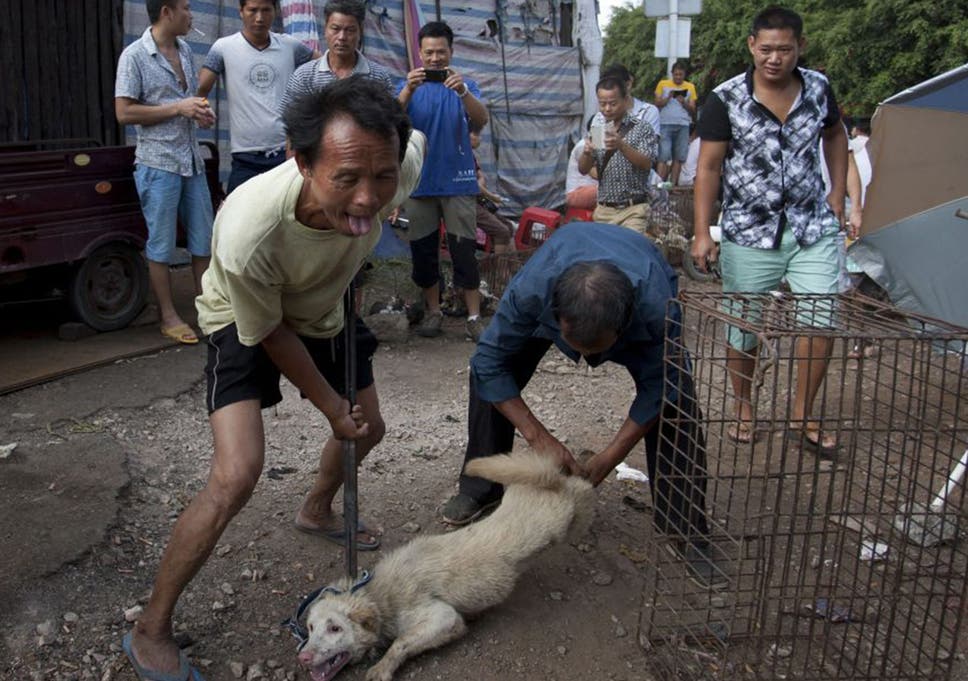
Look at the following pictures – a bloke smokes a cigarette whilst preparing ‘food’ (dog) for others to eat !!
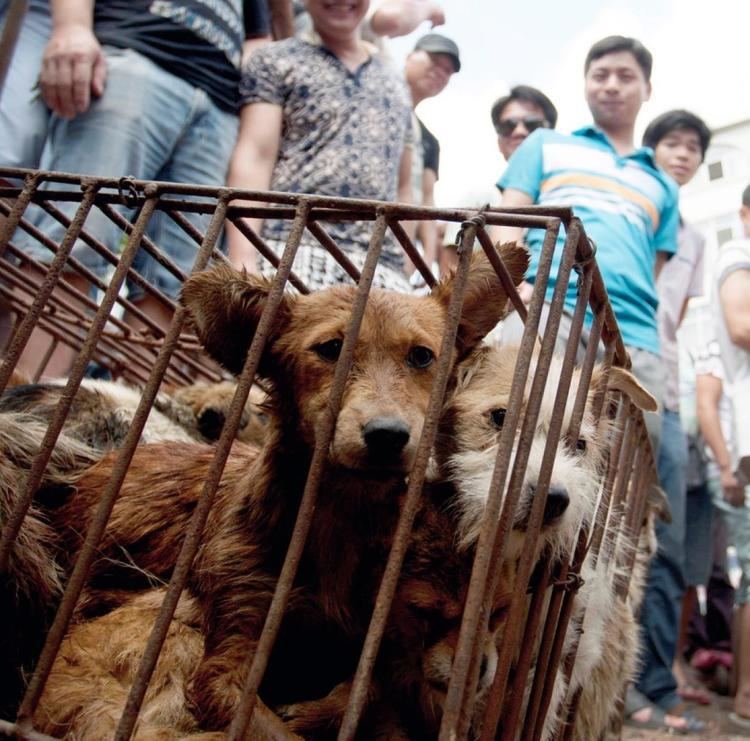
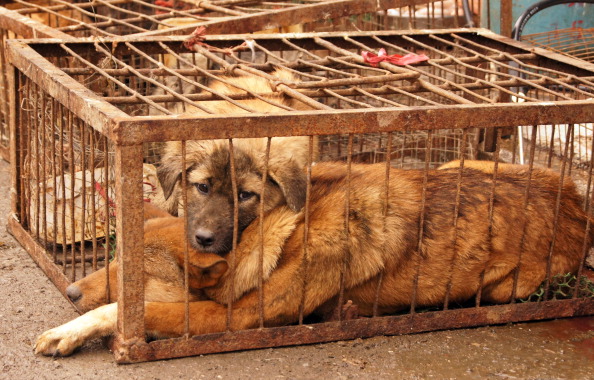
If the Chinese government have any sense; then can we expect the Yulin Dog Meat ‘festival’ to be banned from now on – remember all the scenes ?; we do; pitiful animals being kept in the most horrendous conditions.
Those same animals then being slaughtered in barbaric ways; blowtorch etc; by street vendors standing there proudly smoking old fags in utterly un hygienic conditions – just like the wet markets we have seen photos of since the spread of Coronavirus.
Do these people ever make any links ? – you have to ask.
Other Yulin links from our site – you only have to lok at the photographs and the conditions in which animals are kept, slaughtered, and consumed to see that this place is a hotbed for the spread of virus and disease.:
https://worldanimalsvoice.com/2019/06/03/yulin-a-city-in-blood-orgies/
https://worldanimalsvoice.com/2019/05/08/china-yulin-is-coming-take-action-now/
https://worldanimalsvoice.com/2019/06/22/yulin-is-eyerywhere/