Category: Vivisection

Cleveland Clinic Labor: a gang of Frankensteins

Animals were injected with toxins that damaged their bodies, cut open with minimal pain relief, deliberately bred so that their internal organs would protrude outside their bodies, and kept in severely crowded cages.

A worker even described preventable animal deaths there as “acceptable-ish.”

american-flag-120402148
All this took place in the laboratories of one of the best-known and largest taxpayer-funded research facilities in the country.
PETA has conducted a six-month undercover investigation into the laboratories of the Cleveland Clinic, which, in 2019 alone, received more than $100 million in taxpayer money through the National Institutes of Health (NIH).


Skulls Cut Open

Experimenters at the Cleveland Clinic call it a “cranial window.” Less euphemistically, it’s a hole in a mouse’s skull exposing the brain and covered by a pane of glass.

cleveland clinic 1
Experimenters cut into the head, drill into the skull to expose the brain, and use suction to remove portions of it, exposing the hippocampus. A glass coverslip is placed over the exposed portion of the brain, and a stainless steel “head cap” is glued onto the mouse’s skull.

The mouse receives pain relief only on the day of the surgery and the next day.

These painful, invasive experiments are ostensibly carried out to monitor what happens to “the brain condition.” However, the “structure, function, and behavior” of the mouse brain has little relevance to the human brain.

Animals with their insides hanging out

Experimenters at the Cleveland Clinic deliberately breed mice who are prone to pelvic organ prolapse—in which the uterus, bladder, or rectal tissue falls out of place and even protrudes outside the body.

One mouse, named Daisy by PETA’s investigator, had a bloody rectal prolapse—a very painful condition in which part of the rectum protrudes from the anus.

She had to drag her protruding rectal tissue through her bedding for at least 10 weeks, and she walked with her back legs unnaturally spread, appearing not to want to put pressure on her lower abdomen.

cleveland 2 pg
Daisy and other mice, some of whom had “enormous” prolapses, according to the experimenter’s aide, were bred repeatedly and denied pain relief.

Asked about giving Daisy something to make her more comfortable, the aide replied, “No, there’s nothing.”!

She added that when mice like Daisy “just linger” and stop breeding, after a year of such misery, only then would they be gassed to death—which was ultimately Daisy’s fate.

Another mouse, named Lily, walked slowly and leaned forward with her legs spread widely apart because of her painful, untreated condition. Imagine a dog or cat being treated this way. But of course, mice suffer just as much as they do—the extent of their pain isn’t proportional to their diminutive size.

Paralyzed mice drag themselves along to eat

Experimenters injected mice with a chemical that caused an inflammatory disease of the central nervous system, which left them struggling to walk and dragging their hind legs.

Apparently, this is done to “model” multiple sclerosis—even though what happens in mice bears little resemblance to what happens in humans with the disease. The mice’s painful condition was expected, so, according to one worker, their agony went unreported to veterinary staff unless their paralysis also affected their front legs or they developed a skin condition such as urine scalding caused by the inability to move their back end.
PETA’s investigator saw that some mice suffering in this experiment lost strength in their lower limbs and could not walk at all. They had no choice but to try to crawl and drag themselves along in order to reach their food.
Experimenters cut into their backs and separated their muscles from their vertebrae so they could take images of their spinal cords.

Kill them because they’re ugly’
Mice used in a kidney disease experiment developed raw, red, massive skin growths and lesions. One mouse scratched continuously at a growth that covered nearly half her face and kept pushing at her eye.

When veterinary technicians told the experimenter that these mice were in pain, the experimenter apparently replied that they wanted to “kill” the mice “just because they’re ugly.”
One mouse had a sore stretching across his entire back, about 3 inches long. His hair was gone, and his skin was red. Another mouse had a thumb-size sore on her lower back covered by a thick scab. Yet another mouse had a 2-inch-long sore on his right side.

A veterinary technician said that these mice were “scratching and biting the crap out of” the lesions, as mice used in the experiment “always” did.
But PETA’s investigator never saw these mice receive any treatment or relief for their wounds, such as anti-itch ointment or painkillers.

Animals driven mad by extreme crowding

Mice at the Cleveland Clinic were crammed into shoebox-size cages—up to five adult mice apiece or two adults with a litter of babies. Those housed alone in a cage fared no better—instead of companionship, they were given little more than a single paper towel.

cleveland 3 pg

Staff often failed to remove litters or additional adults from cages before new litters were born. This led to trampling and even cannibalizing of the babies by their severely stressed parents in the intolerably unnatural conditions.
A veterinary technician at the Cleveland Clinic said that “in the grand scheme of things,” such deaths were “acceptable-ish.”

cleveland 4
Other mice were simply left somewhere and forgotten.
Three mice were abandoned with no food or water in a cardboard bucket for hours.

When no experimenter’s group took responsibility for them, a supervisor said that “it isn’t like they would get in trouble for it” anyway.

Six more mice were found abandoned in another bucket. Two were found in a cage bound for the garbage. One experimenter’s aide left a mouse gasping and laboring to breathe for more than an hour before she was finally euthanized.

Pigs used as living, Breathing practice dummies

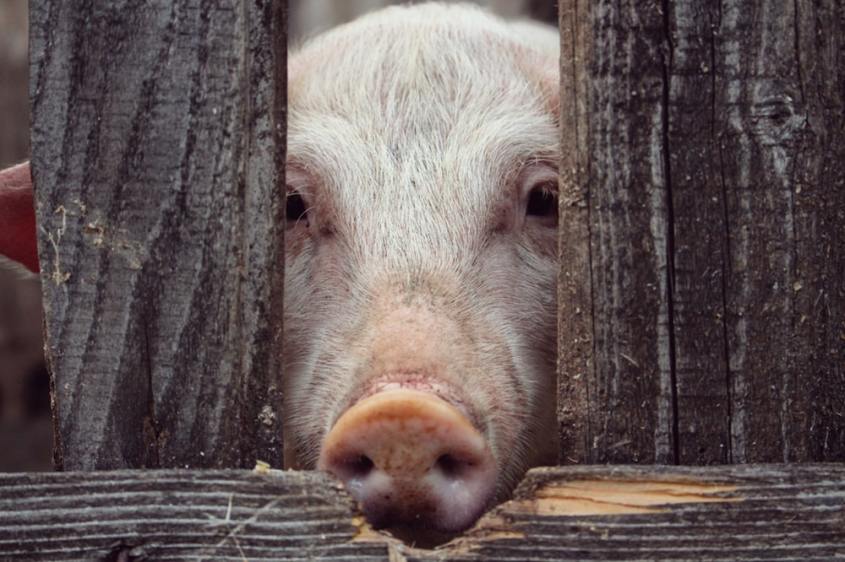
Other species at the Cleveland Clinic also suffered. Social, playful pigs were kept alone in barren pens. A worker said that some were used as “practice for new doctors,” while others were subjected to experimental rectal surgery.

You Can Help these Animals!

PETA has submitted these findings to NIH and has requested an investigation. Please join PETA in calling on NIH to stop funding cruel experiments at the Cleveland Clinic, beginning with the Frankensteinian cranial window experiments.

https://investigations.peta.org/cleveland-clinic-animal-experiments

(The petition is also in the link. Sign and share)


My comment: The neurosurgeon and brain researcher Professor Robert Joseph White from Cleveland, Ohio, was a recognized surgical technician in the 1980s and spent decades in this horror laboratory dealing with the problem of head transplantation.
White beheaded rhesus monkeys and put his head on another monkey’s.

The inverted heads remained functional on a foreign body for a maximum of seven days: they could see, hear, feel and, as far as possible.

White said he would not hesitate to transplant human heads: “The technical problem has been solved,” he said at the time.
“It would be even easier for humans than for the much smaller rhesus monkey. We don’t have to wait 200 years, we can do it right away.”

This “science”, which White tried to practice, already meant fidgeting and desecrating the primates, consuming them by the dozen, leaving them paralyzed, vegetating them for a few days and then moving them towards the garbage like a broken toy throw.

The most heinous and frightening thing of all about this research practice was the indifference with which such (practically) illegal crimes against animals were committed.
Obviously, and after today’s undercover investigation, not much has changed in Cleveland Clinic Labors.

I can only say one thing: The human experiments in the concentration camps during the Nazi era should also serve non-profit medical purposes.

My best regards to all, Venus
Canada: ALF brings red message to laboratory

ALF stop exploiting animals pg

BY MATT CARTY
Global News- Canada
[Press Office note: No claim for this action has been received by the Press Office as of this posting.]

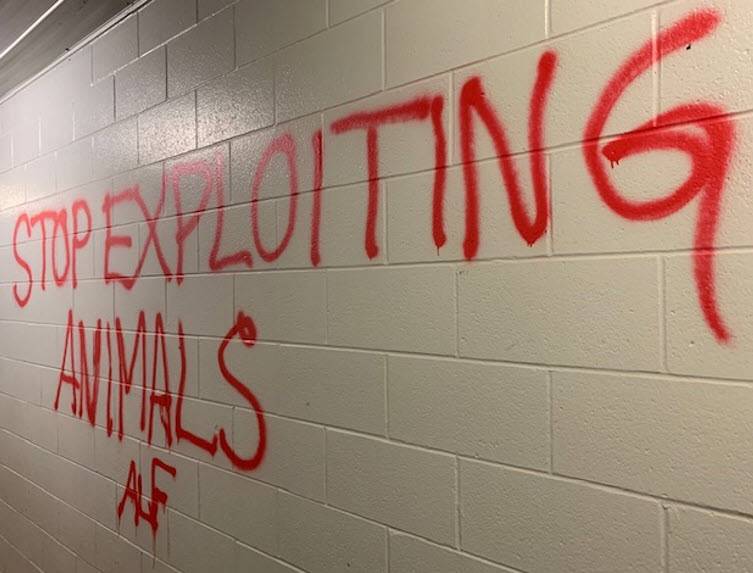
Wellington County OPP say vandals broke into the University of Guelph’s swine research site in Puslinch, spraying paint onto walls and equipment with animal rights messages.

Officers were called to the facility on Arkell Road on Tuesday morning to find walls and a tractor spray-painted. Red spray paint reading “stop exploiting animals” in capital letters was scrawled on an interior wall.

OPP believe that someone entered the facility between 3 p.m. Monday and 6:30 a.m. Tuesday and wrote messages that “consisted of profanity and slogans in support of animal rights.”

A vehicle captured on surveillance is described as a metallic blue four-door Ford Focus from either 2008 or 2009.

https://animalliberationpressoffice.org/NAALPO/2020/05/06/university-of-guelph-research-site-vandalized-with-animal-rights-graffiti-2/


And I mean…No slogan, no graffiti from the ALF can be as brutal as animal testing.

As soon as you write the truth on the wall of a horror laboratory, that’s vandalism.
When animals are tortured, massacred or cruelly killed in laboratories, the perpetrators speak of freedom of research.

The freedom of research stops when others have to suffer.

On behalf of the animals, thank you ALF!

Best regards to all, Venus

Germany: wasted money and animal suffering in laboratories

Germany has released an unscheduled 305 million euros for research funding for the new corona virus. While part of the funding is spent on animal testing, it is not clear whether and to what extent the development and application of modern animal testing-free in vitro methods such as human organoids are being funded.

tierversuch-ratte-d-27459718
The nationwide association Doctors Against Animal Experiments asked about the distribution of the funds and received only unsatisfactory answers. The association criticizes the lack of transparency and the flow of public funds in expensive and lengthy animal experiments as ethically and economically irresponsible for humans and animals.

Tierversuche-Mauese-Ratten-USA

The Federal Ministry of Education and Research (BMBF) has announced that, in view of the current COVID-19 emergency situation, it will provide additional funding both for research into the SARS-CoV-2 virus and for the development and testing of medicines and vaccines .

corona Impfung peg

The corona virus cannot infect the usual “laboratory animals”, nor can it cause a severe course of disease in other animal species as in humans. Nevertheless, there is strong evidence that a large part of this special funding is used in animal experiments.

mäuser aufs geldn

The international vaccine initiative CEPI (Coalition for Epidemic Preparedness Innovations) provides a large portion of this special funding, namely EUR 145 million.

CEPI is a public-private partnership that works with government sponsors as well as private foundations and companies. It coordinates and supports a wide range of projects for the development of various vaccines and vaccine technologies.

At the request of doctors against animal testing, CEPI was unable to provide any information about the proportion of the COVID-19 funding used for animal testing or for animal testing-free procedures. Since animal testing is generally much more expensive than the human-relevant in-vitro methods, it can be assumed that a lot of money will be invested in animal testing.

The strategic COVID-19 plan, which was developed by the international funding network GLOPID-R (Global Research Collaboration for Infectious Disease Preparedness), of which the German Ministry of Education and Economy is a sponsoring member, together with the World Health Organization, is also unsettling.

In this plan, various animal experiments, especially those with mice and monkeys, are provided and described as milestones that should be encouraged and supported.

Affenversuche

The German Ministry of Education and Economy supports projects from basic research with a total of up to 10 million euros – in addition to the 145 million for CEPI.

The following are listed as funding points for financing:
– Research into the genesis of the virus and its transmission between animals and humans
– Approaches to testing the transferability of existing animal models to CoV-2 and ”
-Development of new clinically relevant animal models and human cell models “(for example, lung infection model).
All three points are based on animal experiments.

In contrast to this, the human-based animal-free methods with the exception of the briefly mentioned “human cell models” are not listed as funding points.

corona

We asked the German Ministry of Education and Economy what the distribution of these special funds between projects with and without animal experiments looks like, but our request has not yet been answered. This is an indication that more funding can be invested in carrying out cruel and fruitless animal experiments with a wide variety of animal species than in the development of in-vitro high-tech technologies with human tissue.

Labor maus mit Tumor
The German Ministry of Education and Economy is investing 150 million in the establishment of a scientific network from German university clinics.

Although the focus should be on clinical work with patients, there are indications in the report that this money is partly also attributed to preclinical research, including animal experiments.

Ärzte gegen Tierversuche e.V.


My comment: CEPI was founded in 2017 by several governmental and non-governmental donors in response to the 2014 Ebola crisis.
The German Ministry of Education and Research (BMBF) supports CEPI for up to 90 million euros for five years.
Other supporters so far have been Norway, Japan, Great Britain, Canada, Belgium and Australia, the Bill and Melinda Gates Foundation and the Wellcome Trust (!!!)

With a bit of bad luck, a (compulsory) vaccination that is already being planned will not save us from the swamp.
This could be because we will be suffering from the next patented virus in about 18 months, when the Bill-Gates vaccine is available, so that we can no longer get out of this quarantine spiral.

But “good propaganda” protects us fairly reliably from “unhealthy information”, and all Corona stressed citizens can hardly wait for a vaccine, which is reliably tested on animals.

The rescue comes from a substance that has been tested just on these animals that are not infected by the virus.
Dead safe vaccination!

So the question remains whether there can be such a thing as learning resistance in medicine?

Yes, this question does indeed arise. And we can assume that it is so.
Or worse: the mafia-like structures from the laboratory – pharmaceutical industry inclusive – are highly motivated to make money again.

It is again about billions, with the suffering and senseless massacre of sentient beings.
This is how the laboratory mafia has always worked; now  it’s “business with the fear”.

My best regards to all, Venus

UK: World Day for Laboratory Animals – Urge the UK Government to Commit to Ending All Experiments on Animals – Petition.

UK flagge aquarelljpg


Hi Mark,

Unable to hold a real protest because of restrictions on social gatherings, PETA is staging a march by an army of adorable animal figurines against a backdrop of the Houses of Parliament today to mark World Day for Animals in Laboratories.

Our tiny protesters are calling on the government to commit to ending all animal experiments and redirecting resources towards superior, non-animal methods – such as sophisticated tests using human cells and tissues and advanced computer-modelling techniques – which would benefit humans and animals alike.


petition keyboard


Will you join us by adding your name to PETA’s petition?

https://secure.peta.org.uk/page/26847/petition/1?utm_source=PETA%20UK::E-Mail&utm_medium=Alert&utm_campaign=0420::viv::PETA%20UK::E-Mail::WDAIL::::aa%20em&ea.url.id=4686377&forwarded=true


European Union Directive 2010/63/EU on the protection of animals used for scientific purposes is clear – the EU’s ultimate objective is to replace all experiments on animals. Shamefully, Britain has yet to commit to this important goal in its own national legislation – and as the end of the Brexit transition period fast approaches, the UK government is running out of time.

Over 90 per cent of drug trials in humans fail, even though the drugs have already passed experiments on animals. The problem is that the differences between species are so vast that results in animals are, at best, a very poor approximation of what will happen in humans or, at worst, dangerously misleading. A paradigm shift away from all studies using animals is needed. The government must create a clear strategy and timeline for replacing animals used in experiments. With greater investment in animal-free science and bold policy initiatives, far more promising cures and treatments for humans as well as more effective and reliable methods for toxicity assessment can be developed.

Finally – and crucially – committing to this goal would also help put an end to the almost unimaginable suffering of millions of animals.

It’s time for the UK to commit to completely replacing all experiments on animals.

Please sign our petition to the Home Office; Department of Business, Energy and Industrial Strategy; and Department of Health and Social Care.

Urge the Government to Commit to Ending All Experiments on Animals


To: Home Office; Department of Business, Energy and Industrial Strategy; and Department of Health and Social Care

Please commit to the EU’s final goal of fully replacing the use of animals in scientific procedures to ensure that the UK is not left behind – in either animal-welfare standards or scientific innovation – in the wake of Brexit. Although EU Directive 2010/63/EU (the Directive) has been transposed into the Animals (Scientific Procedures) Act 1986, the UK has not formally adopted the EU’s ultimate goal of replacing the use of animals in scientific procedures, as reflected in Recital 10 of the Directive. We, the undersigned, respectfully request that the government take this official step immediately, establishing a clear policy within a legislative framework, mandating an end to experimentation on animals, and providing a clear strategy and timeline for achieving this goal. Redirecting funding away from unreliable and unethical tests on animals and instead investing in superior, non-animal methods will benefit humans, animals, and the future of science in the UK.

Yours sincerely,

Thank you for helping animals in laboratories.

Julia B
PETA UK


World Day for Laboratory Animals. Cannoli.

Canpeta


Cannoli, a sweet and healthy golden retriever, should be enjoying comfort and safety with a loving family right now.

Instead, he’s languishing in a laboratory cage—even though Texas A&M University (TAMU) has temporarily closed because of the COVID-19 pandemic and sent students home to their families.

After a determined PETA campaign led TAMU to announce last year that it had stopped breeding dogs to be tormented in painful, pointless canine muscular dystrophy (MD) experiments, Cannoli was made available for adoption. But now he’s been taken off the list and transferred to another laboratory, where his suffering will continue.

Experimenters have been confining dogs with debilitating canine MD to barren cages and tormenting them in painful tests for more than three decades—which hasn’t yielded a single treatment that reverses symptoms of MD in humans.

Crude, cruel tests on animals waste lives and resources when researchers should be focusing on actually helping humans, and now, even the most stubborn companies, institutions, and government agencies are finally changing their tune. For example, the National Institutes of Health has taken a potential COVID-19 vaccine straight to human trials—without waiting for a lengthy animal-testing phase, paving the way for cruelty-free research in the future.

PETA is leading the charge to spare dogs horrible lives in laboratories and breeding mills, end crude “fright” experiments on monkeys, stop the terrifying forced swim test on mice, and promote the development and use of animal-friendly, human-relevant testing methods and technology.

When we started our campaign against canine MD experiments, TAMU experimenters had nearly 100 dogs in their clutches and were intentionally breeding them to develop symptoms of the disease. Today, after our determined online activism, our demonstrations, our lawsuits, the help of MD patients and 500 physicians, and more, the school has ended its breeding program, and fewer than 30 dogs are still suffering there. We’re making huge progress—but we must keep pushing to cross the finish line, because TAMU is still treating Cannoli and dozens of others like disposable lab equipment rather than the sensitive individuals they are. Animals deserve better.

Donation Link – https://support.peta.org/page/18069/donate/1?utm_source=PETA::E-Mail&utm_medium=Appeal&utm_campaign=0420::viv::PETA::E-Mail::ActDR::MiniVVM::ap1&supporter.appealCode=H20DEBXXXXA&ver=2&ea.url.id=451879&forwarded=true

Animal experiments: a criminal idiocy

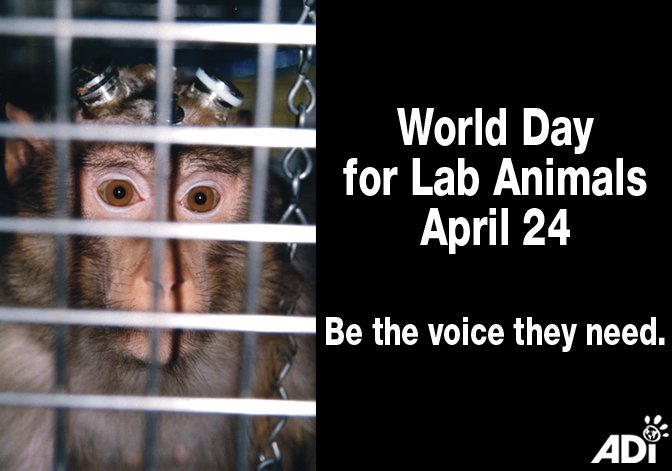
on the day of the laboratory animals, April 24, 2020

We will not be silenced. We will not stop fighting for the animals 💚

affen mutter mit Abtreibungo

His mother was poisoned with chemicals while she was pregnant.
Then he was cut out of the mother to investigate how these chemicals affect the unborn baby.
With what right does man take such cruelty towards his fellow creatures.

STOP ANIMAL TESTING IMMEDIATELY AND FOREVER!


My best regards to all, Venus
England: Friday, 24/4/20 will be the World Day for Laboratory Animals.

About WDLA | World Day For Laboratory Animals

World Lab Animals Day || April 24,2017 | Tufing.com

This Friday, 24/4/20 will be the World Day for Laboratory Animals.

We will be covering it more on the day, but please prepare for this and give a few minutes thought for all the animals in Labs, and suffering, worldwide.

I have never said before, but I have suffered Multiple Sclerosis (MS) for the past 20 years.  People who know me know about my situation; otherwise it is MS and me !

Despite desperately wanting a cure for my condition and to get back to ‘normal’, whatever that is; do I want ‘normal’ ? – probably not; I am an MS sufferer who would NEVER wish ANY animal to suffer in the labs to improve my condition

I can deal with my illness in many ways; and a Vegan diet is just one of them.  Veganism gives me tons of energy; so much so that I trashed all the neurologist ‘medicines; prescribed for me years and years ago.  Now they were something that really did make me ill; not help my situation or help m with getting improvements.

I can survive as a long term MS sufferer with a very physical daily life without pumping my body full of false; no good lab created medication.  I dont want to see animals suffer in labs under my name, and so I will always speak out against animal testing whenever the chance arises.

So stop the animal testing and instead put finances and investment into cruelty free research and testing that will be of a real benefit to sufferers; but will exclude animal suffering.

Open the labs and set them all free.  It is not medical research; it is animal abuse – simple as that; and I will never support the use of animals in medical research.

Fact – animals do NOT suffer from MS; so why artificially create it in them and then try to find a cure ?  – animals are not the same as us humans and thus should not be used as testing models.  There are enough good people with illness who would be more than willing to take part in any clinical trials.  As with Coronavirus now; suddenly the animal testing is being largely removed and virus infected people are being used directly as test volunteers for a vaccine.  What does this show and tell us ?; that human people could and should be used to find cures for illness that affects the human species.  Kick animal testing out !

I have MS, but MS does not have me !

Regards Mark


World Day for Animals in Laboratories 2020 | Veggies

World Day for Laboratory Animals (Laboratory Animals Protection ...

Gina Mutta on Twitter: "Today, 24th April, is World Day for ...

Britches and their rescue

britchesjpg

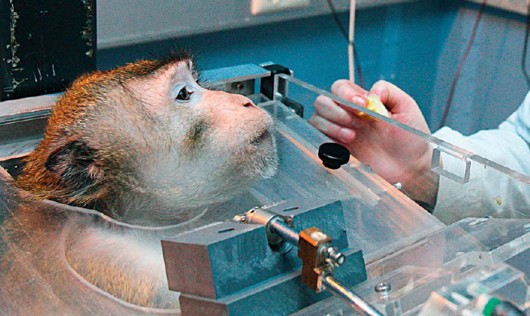
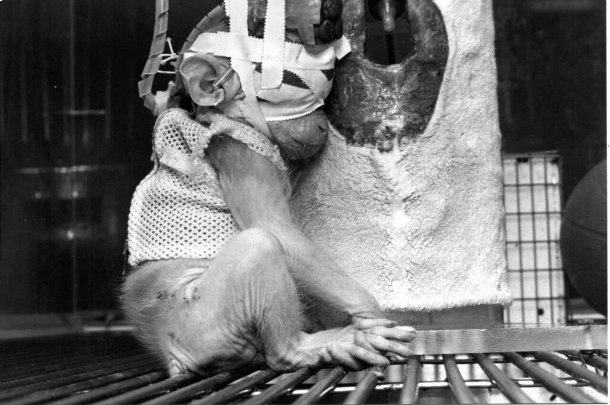
Born at the University of California, Riverside in March 1985. He was removed from his mother at birth and had his eyelids sewn shut as part of a three-year maternal and sensory-deprivation study involving 24 infant monkeys.

Britches was removed from the laboratory when he was five weeks old during a raid on April 20, 1985 by the Animal Liberation Front (ALF).

britches01

The ALF made a videotape of their raid and of Britches’ condition when they found him.

The Consequences of Britches Animal Liberation

When PETA released the photos, videos and documents provided by the animal liberationists, there was an enormous public outcry.
Eight out of a further 17 planned animal studies were discontinued; the facility also prohibited the practice of sewing monkey babies’ eyes shut. An instructor quit his job and has not mistreated animals since then.

The National Institutes of Health (NIH) conducted an eight-month study of the animal care program in the university’s laboratories and concluded that it was “appropriate” animal care and that no corrective action was required.
There were no consequences for the responsibles.

But this action led others to follow suit: In 1985, A.L.F activists broke into a laboratory at the University of California in Riversde and freed 260 laboratory animals.
Britches became the symbol of this campaign.

Last but not least, there are open animal liberation grades, such as the liberation of beagle dogs from the breeding facility in Green Hill in Italy in 2012 and the liberation of over 300 animals from the Instituto Royal in Brazil in October 2013, which led to the shooting of the labo a month later.

It is very difficult to break through the fronts of the laboratory mafia.
Some activists made it, ALF made history and we are grateful to them for all the animals they liberated.

ALF Türkeypg

My best regards to all, Venus

Breaking! Animal Welfare Coalition Calls On World Health Organization To Focus On Testing On Humans Not Animals For COVID-19 Remedies.


Breaking! Animal Welfare Coalition Calls On World Health Organization To Focus On Testing On Humans Not Animals For COVID-19 Remedies


https://worldanimalnews.com/breaking-animal-welfare-coalitions-call-on-world-health-organization-to-focus-on-testing-on-humans-not-animals-for-covid-19-remedies/


In a joint statement released today by Cruelty Free InternationalCruelty Free EuropeEurogroup for Animals, and People for the Ethical Treatment of Animals Foundation (PETA), the animal protection organizations stress that it is essential that authorities, under the leadership of the World Health Organization (WHO), work together with a focus on humane, human-relevant research.

While everyone wants a safe and effective vaccine and other medicines for COVID-19 produced as quickly as possible, it should not be at the expense and undue suffering of thousands of innocent animals such as: monkeys, dogs, cats, ferrets, and mice.

Sadly, animal experimentation remains one of the approaches used in this research which adds to the unfathomable suffering caused by the COVID-19 pandemic. This, despite animal testing and experimentation being cruel and unreliable with a history of failure in the development of drugs used for humans.

“The impact of the COVID-19 pandemic will have a long-lasting effect on our societies and our work, and this change of paradigm should also be reflected in the way we carry out research, there is an urgent need to focus on advanced scientific techniques that are more representative of what actually happens in the human body, than old ways including the use of animals,” Reineke Hameleers, CEO of Eurogroup for Animals said in a statement. “It is crucial that the WHO and other authorities acknowledge that many animals are suffering as well, and that they help to focus the research efforts of governments, researchers, clinicians, and companies towards more humane and human-relevant approaches.”

As huge numbers of animals and billions of dollars, pounds, and euros are being directed towards trying to solve the problem, it is vital that the scientific and technical merits and ethical aspects of proposed research are robustly assessed in each and every case.

Countries and institutions must also try to coordinate their research, sharing data to prevent any duplication of effort or repeated testing on animals.

That is, until the ineffective and unnecessary testing and experimentations on animals stops completely. As many lives as possible must be spared from this pandemic, including animals.

The urgent need is for more resources to be directed towards studying the virus in humans to increase our understanding of the disease, treat patients, and limit the spread of the virus altogether.

You can help all animals and our planet by choosing compassion on your plate and in your glass. #GoVeg

Help us continue to bring you the latest breaking animal news from around the world and consider making a Donation Here!

https://www.paypal.com/donate/?token=Kb0ECpsdekh7rfb0sQnj2tn9oubs1b-Y25zA-33nruXGEe20s17FrvDwTFrfg-81pQsMqm&country.x=US&locale.x=US


England: Torture pigs and fight viruses!

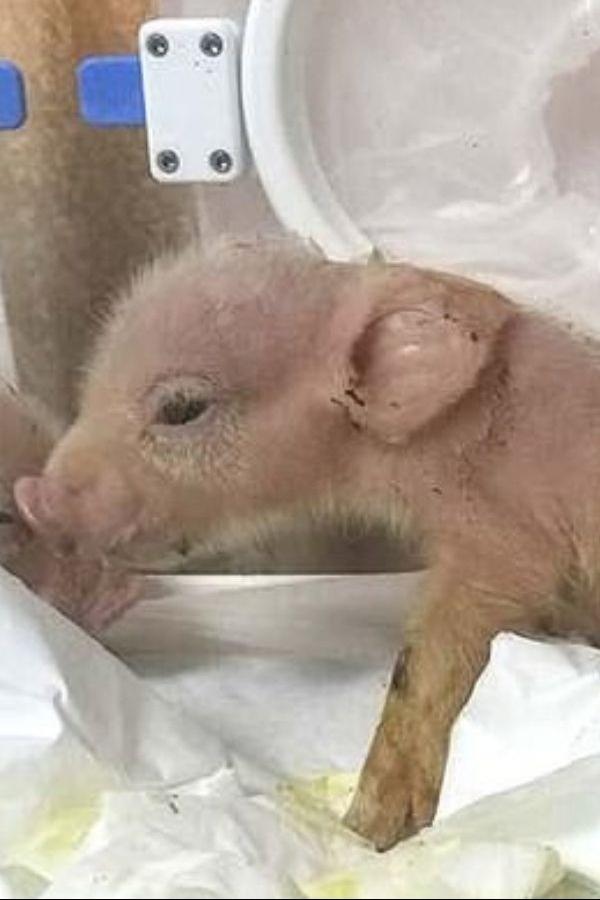
Researchers from England used pigs to test vaccines against the novel corona virus. To do this, they take advantage of the similarity of the immune and respiratory systems of pigs and humans.

UK flagge aquarelljpg

Scientists from England now want to use pigs to fight the new SARS-CoV-2 coronavirus. In collaboration with researchers from Oxford University and Public Health England, a team of scientists from the Pirbright Institute will begin testing new vaccines for their ability to raise protective antibodies against SARS-CoV-2.
Among other things, the chimpanzee adenovirus vaccine vector that was used to produce vaccines against Ebola, the Middle East respiratory syndrome and the flu is tested.

schweinchenjpg

The vaccine candidates developed will contain the spike protein of SARS-CoV-2. This is the protein against which protective antibodies are formed in infected people. To do this, the researchers measure the amount of antibodies produced after injecting vaccine candidates into pigs.

Pig and human respiratory system and immune system very similar (!!!)

They take advantage of the fact that pig and human immune systems have significant similarities. It can be assumed that a good response to a vaccine candidate in pigs is also promising in humans.
At the same time, the scientists will also test the safety of the new vaccines and check whether there are any adverse side effects in the pigs. If this attempt is successful, the next step could be to investigate the possible vaccine in humans.

schwein anatomiejpg

The scientists from Pirbright are already using pigs for research on influenza viruses. Pigs have so far been used as large animal models because they have a very similar respiratory system to that of humans. In addition, they inherently become infected with influenza viruses and form antibodies with properties similar to those of humans.
Pigs are therefore a suitable model for carrying out research for the novel corona virus.

schwein hinter gardinepg

The vaccine vector used cannot cause infection

“The vector vaccine developed at Oxford is used in this SARS-CoV-2 vaccine research because it can produce a strong immune response at a low dose,” explains Bryan Charleston, director of the Pirbright Institute.

“The vaccine vector is not replicable, which means that it cannot cause infection in an individual. This makes its application safer for people with underlying health conditions such as diabetes.

This approach has been applied to other vaccines and we hope that this research will enable the vaccine to advance to the next phase of human testing. ”

https://www.agrarheute.com/tier/schwein/coronavirus-impfstoff-schweinen-getestet-566899


And I mean…We are very lucky again!
With a success rate of 5% (which generally affects all results from animal experiments on humans), we will control the healing process of the corona as slowly as that of the Spanish flu.
100 years ago, it took a year; today if we test on pigs it will probably take even longer.

The human being is the only animal that does not learn from its mistakes.

My best regards to all, Venus