Category: Farm Animals

Mosa Meat Cultivates Beef Without Fetal Bovine Serum (FBS).

21 January 2022

Fetal bovine serum (FBS) is commonly used in cultivated meat production as a supplement for cell feed due to its richness in nutrients and growth factors. But reliance on FBS, taken from the fetuses of pregnant cows during slaughter, is not an ethically viable option for a product positioned as the “environmentally friendly alternative to conventional meat”.

In a new paper published in the journal Nature Food, leading cultivated meat brand Mosa Meat reveals how they managed to replace FBS and achieve muscle differentiation without genetically modifying the cells in any way. 

This is really a milestone for us and for the cultivated meat field, because there’s no method out there that describes the differentiation of primary satellite cells if you don’t want to use FBS or genetically modify your cells.”

Dr. Joshua Flack, Mosa Meat scientist

The document includes descriptions of the processes and ingredients of the differentiation medium that worked well for Mosa Meat. The muscle cells that differentiate into fibres are responsible for the structure and chewing of the meat, and it is in the muscle fibres that the protein and rich colour of the meat are produced. 

To learn more, read the full article.

Read more at source

Mosa Meat

Regards Mark

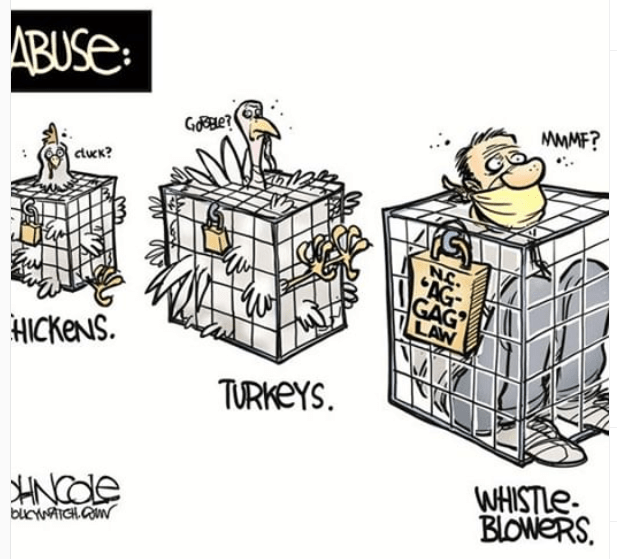
New South Wales wants to criminalize undercover activists

Laws criminalising the use of secretly recorded vision of animal cruelty and abuse are posing “too great a burden on speech”, animal rights activists have told the high court.

The Farm Transparency Project, an Australian animal advocacy group, launched a case earlier this year arguing New South Wales laws restricting the use of covert footage were an unfair burden on freedom of political communication.

The state’s Surveillance Devices Act criminalises the use of footage or audio that was obtained using a listening device or hidden camera, but, unlike other states, gives no public-interest exemption.

Those investigations have revealed countless atrocities in Victoria alone that would otherwise still be an industry secret:

• Live-baiting in the greyhound racing industry
• The maceration (blending) of live male chicks in the egg industry, because they won’t ever be able to lay eggs
• The slaughter of five-day-old male calves in the dairy industry because they won’t ever be able to produce milk, and female calves who are in excess of the farm’s needs
• The use of excruciating carbon dioxide gas chambers in all major pig slaughterhouses, previously touted by the industry as ‘humane’, and also for the killing of ‘unviable’ chicks in the broiler (meat) chicken industry, and ‘spent’ hens in the egg industry whose egg-laying has slowed
• Repeated failure of stunning methods at numerous slaughterhouses
• The routine killing of newborn male goats by the notorious ‘Gippy Goat’ farmer, as they are unable to produce milk and therefore useless to the goat dairy industry
• The routine ‘disbudding’ of newborn female goats at Meredith Dairy, using hot irons to painfully burn off the young goats’ budding horns
• Dogs confined, exploited and abused in puppy mills
• Routine mutilation of young animals without anaesthetic
• … and much more.

Continue reading “New South Wales wants to criminalize undercover activists”

Why Do You Support An Industry That Normalizes Infant Dead Piles? — by Stacey.

With thanks to Stacey as always – Stacey | Our Compass (our-compass.org)

Regards Mark

Why do you support an industry that normalizes infant dead piles? by Stacey

Source Mercy For Animals Drone Investigations , Mark Devries

The above is globally standardized animal “production”, greater than 90% of all animals exploited for food in the world are commodified in industrialized manners: animals minimized to numbers and weights, their suffering mocked by nonvegans: you know what happens to them yet you continue supporting the system that requires their pain, violation, and violent death.

And if you are one of ten who does buy expensive animal body parts from a “small, local farm”, you’re not killing animals for the animals, you’re consuming animal products but want to limit your exposure to e coli or listeria while still participating in animal exploitation that fuels animal exploitation. You cannot separate yourself from animal suffering just because you feel better about your OWN body requiring the unwilling, terrorized destruction of others’.

I know what you’re doing. You cannot rest comfortably in your willful ignorance causing others’ suffering, you just lie about it and use deceit, manipulation, and words meant to promote artificial ethics, but causing harm is inherently unethical, regardless of your fictionalized narrative: actions matter more than words, your apathetic and cruel behaviour betray your disingenuous greeting card platitudes and reveal your true intentions. You may hate vegans, but animals have done nothing to deserve your indifference. SRL

Download Your FREE Vegan PDF HERE

Order a FREE vegan kit HERE

Dairy-Free Info HERE

Take the Dairy-Free Challenge HERE

Click HERE for more Dairy-Free

Fish alternatives can be found HERE

Learn about eggs HERE

Find bacon alternatives HERE and HERE

Take PETA’s Cruelty-Free Shopping Guide along with you next time you head to the store! The handy guide will help you find humane products at a glance. Order a FREE copy HERE

Searching for Cruelty-Free Cosmetics, Personal-Care Products, Vegan Products, or more?
Click HERE to search.

Free PDF of Vegan & Cruelty-Free Products/Companies HERE

Click HERE to find out How to Wear Vegan!

Want to do more than go vegan? Help others to do so! Click below for nominal, or no, fees to vegan literature that you can use to convince others that veganism is the only compassionate route to being an animal friend:

PETA HERE

Vegan Outreach HERE

Get your FREE Activist Kit from PETA, including stickers, leaflets, and guide HERE

Have questions? Click HERE

Spanish company wants to breed octopuses in aquaculture

From 2023, 3000 tons of octopus meat could be produced annually on the Canary Island of Gran Canaria.
Science and animal welfare protest. Because octopuses are highly intelligent and sensitive
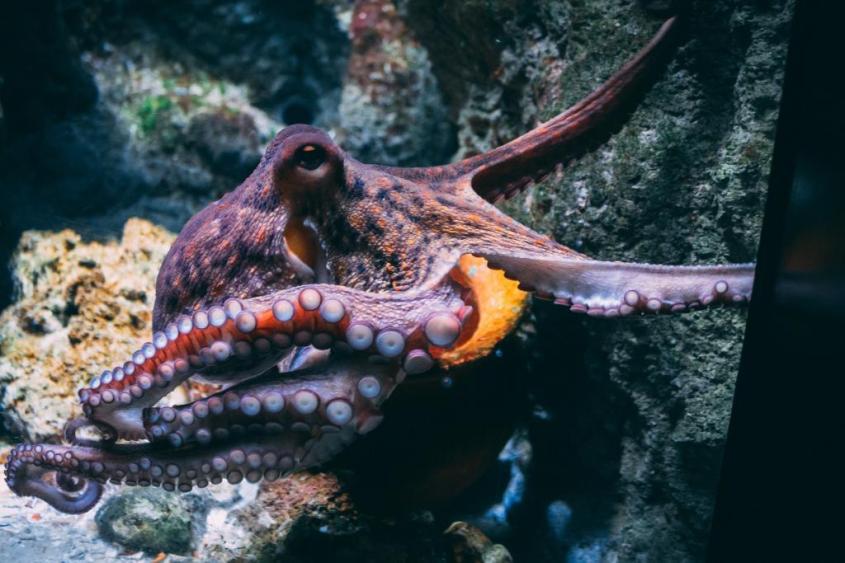
Octopuses are amazing creatures.
With their eight arms and sac-like body, they appear alien – and yet they are more similar to us humans than most vertebrates: they have an excellent memory, they plan, deceive, play.
They manage to open child-resistant screw caps.
They even have distinct personalities, being shy, curious, or reckless.
They have likes or dislikes of their own kind as well as people.
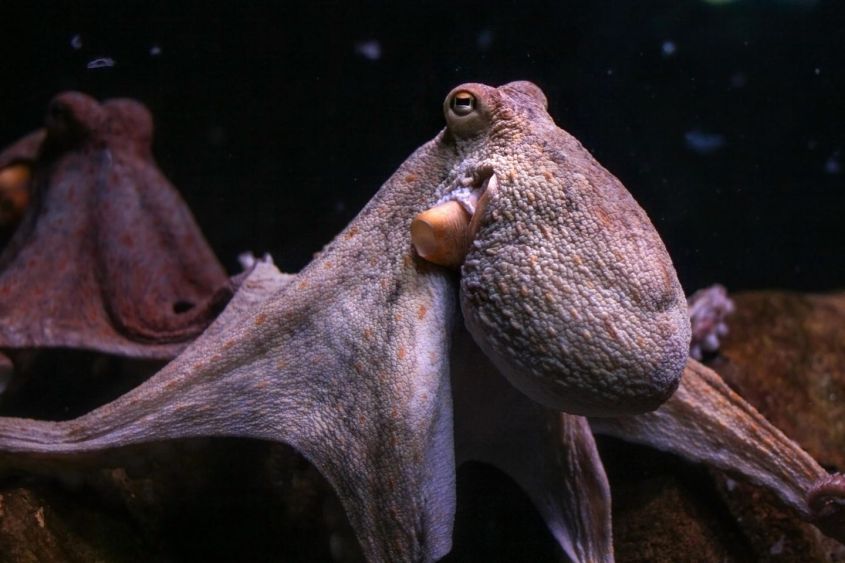
And something else makes octopuses special: they are difficult to reproduce in captivity. But that’s exactly what a Spanish company has managed to do.

According to the Nueva Pescanova Group, octopuses could be bred for several generations in their own aquaculture for the first time.
In the summer of 2022, the first animals should come onto the market.

President of the Las Palmas Port Authority port Luis Ibarra said “it was the biggest private Investment in the history of the port which will create 450 jobs and make the Las Palmas Harbour-La Luz- the world`s biggest exporter of octopus”

From 2023, 3,000 tons of octopus meat (!!) are to be produced annually on the Spanish Canary Island of Gran Canaria, for example for popular dishes such as “Pulpo a la Gallega”.
The company is investing around 65 million euros in the project. The targeted main customer countries are Spain, Italy, Greece and Japan.
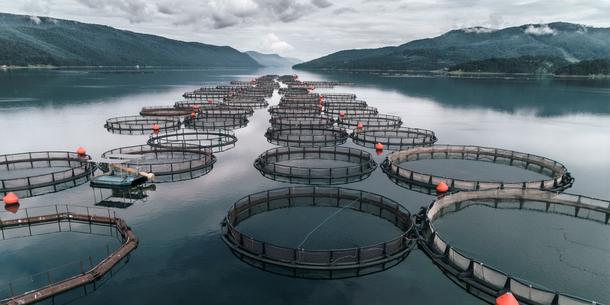
Does aquaculture relieve the marine ecosystems?

It is estimated that around 350,000 tons of octopus are caught and processed worldwide every year – about ten times as much as in 1950.
The Nueva Pescanova Group argues that the number of wild catches can be reduced by around ten percent with production in aquaculture.
Whether the pressure on wild populations caused by factory farming will actually decrease is anything but clear.

Biologists and animal rights activists warn – on the contrary – that aquaculture is increasing the pressure on marine ecosystems. Because many edible fish are – like octopuses – carnivores.
Already today, around a third of the global catches are fed to animals, around half of them in aquaculture.
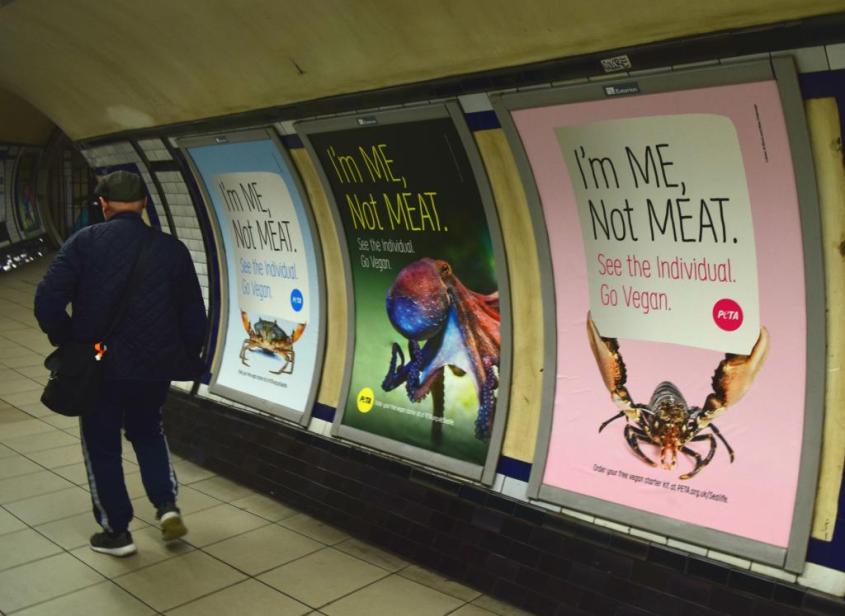
According to critics, it is also certain that octopuses cannot be kept anywhere near species-appropriate in aquaculture.
Unlike fish, the intelligent octopuses in their water tanks would be aware of their hopeless situation.
And they are loners.

It seems unlikely that this elementary need of the animals is taken into account in mass aquaculture.
Especially since there are hardly any legal regulations for keeping them: Most national and EU keeping requirements relate to vertebrates.

Housing conditions and method of killing: unknown

It is also to be feared that speed is more important than avoiding stress and pain when slaughtering on assembly lines.
When asked by the British BBC, the company declined to comment on the husbandry of the octopuses, the origin of the food or the killing method.

As early as 2019, scientists had declared that breeding octopuses in captivity for food purposes was a “terrible idea”.
And not only from an environmental point of view, but also from a moral point of view.

The company is yet to reveal exactly what the octopus tanks look like, what “toys” they claim to use for stimulation and what source of food they will rely on
On paper, however, the claims are noble.
According to the authors, keeping octopuses in aquaculture with high animal welfare standards is “impossible”.

The clever cephalopods already enjoy better legal protection in the United Kingdom than in Spain.
Experts there had viewed more than 300 scientific studies – and had come to the conclusion that octopuses were “sentient beings”.
There is “strong scientific evidence” that animals can feel joy, but also pain, stress and despair.
The scientific assessment led to the inclusion of the animals in the Animal Welfare Bill.

https://www.geo.de/natur/tierwelt/unternehmen-will-kraken-in-aquakulturen-zuechten-31494072.html

And I mean…In a year when many countries have passed laws protecting species they believe are sentient beings, the news that the world’s first octopus farm has opened in the Canary Islands have understandably been met with shock, disgust and outrage around the world for every compassionate and civilized human being.

For the thousands of these animals will be bred and imprisoned in cruel, prison-like conditions.
Just like any animal in factory farming.

Known as the “Einsteins of the sea”, octopuses have large, complex brains.
In fact, they have nine: one central brain between the eyes and separate mini-brains at the base of each tentacle – meaning that each arm, quite literally, has a mind of its own.
They can navigate their way through mazes and remember the solutions.

They are solitary, territorial animals, as curious as humans, and cramming them into barren communal tanks or netted pools, with little or no stimulation – as is common of all factory farm systems – would condemn them to a miserable existence.
All agree that octopuses would suffer dreadfully in such conditions.

To make matters worse, there is currently no legislation in Spain, or elsewhere, to protect octopus welfare on farms or during their slaughter.

In reality, the farm – close to Las Palmas in Gran Canaria – means countless animals will spend their lives vulnerable to pain and suffering, and endure agonising deaths.

The solution, of course, is to stop eating octopuses – and, indeed, all animals.
Even if they’re not farmed, octopuses captured for food still suffer: they are often speared or burned with caustic chemicals to force them out of specialised traps.
Many are snared in massive, indiscriminate trawl nets.
On deck, if they’re not left to suffocate in agony, they’re clubbed, stabbed, or butchered alive.
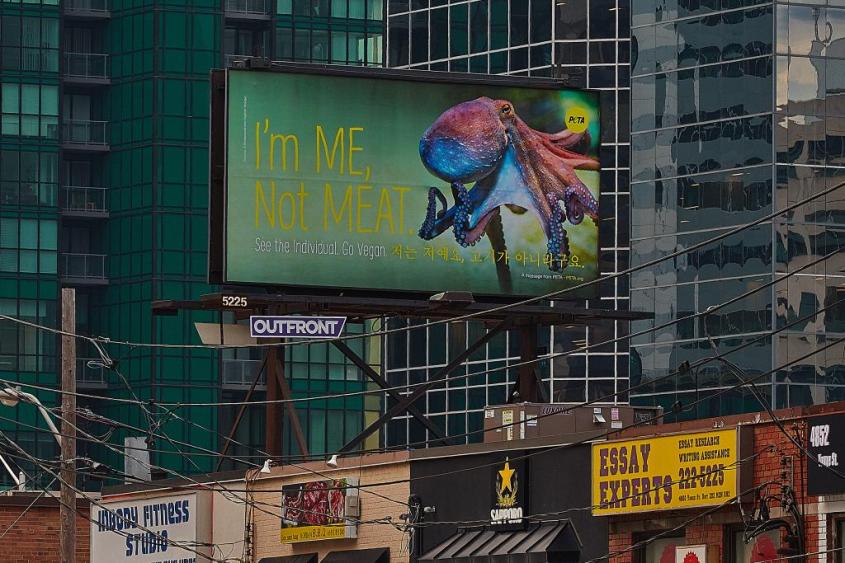
To allow the world’s very first octopus factory farm to open, when we know and understand the impact it would have on these intelligent, feeling beings, would be a monstrous act and a shame on the Canary Islands government.

We must act quickly to prevent this farm from being built.
As soon as we have a petition about this, we will inform you further.

—Updated—Petition: https://www.peta.de/aktiv/krakenfarm-gran-canaria-petition/

My best regards to all, Venus

Scotland: Butchers Encourages Shoppers To ‘End The Violence’ Against Plants By Eating Meat.

The sign takes aim at vegetarians, joking that they “kill’ plants. Credit: Jakub Dragon / Facebook

A butchers in the UK has caused a stir online after stating that vegetarians kill thousands of “innocent plants”

Amarketing strategy implemented by a butchers shop in Edinburgh in the UK has raised eyebrows, with some branding it as “ignorant.”

W.M Christie, a family butchers established in 1889, placed a chalkboard sign in its store in Bruntsfield that took aim at vegetarians. 

“Everyday thousands of innocent plants are killed by vegetarians,” the sign read. “Help end the violence. Eat meat.”

An amused shopper posted a photo of the sign online, causing a stir among animal rights advocates. 

“Jeez, the ignorance is astonishing. Plants are not sentient and exist in synergy with humans and animals as a food source,” Kevin Thomson commented, per Edinburgh Live

“You just can’t say I murdered a carrot. People will cling to all sorts of nonsense to justify murdering animals… animals that have exactly the same fundamental wishes as us – to be happy, safe, and free from suffering.”

Other social media users pointed out that animals bred for human consumption also require the “killing” of crops. 

In fact, only around half (55 percent) of the world’s crop calories feed people directly. And for some crops, a vast majority is fed to livestock, not people. For instance, 77 percent of the world’s soy is fed to livestock. 

Furthermore, calorically speaking, the system could be considered inefficient, given that it takes 100 calories of grain to produce just 12 calories of chicken. The conversion is even more dire for other animal-based foods; 100 calories of crops produce just three calories of beef. 

‘A simple joke’

Willie Christie, who runs the butchers alongside his brother, defended the advertisement. “As it’s Veganuary, isn’t it fitting it could be Meatanuary too? It wasn’t malicious in any way, just a simple joke and banter,” he said to Edinburgh Live.

“People have taken it wrongly. we are surrounded with people telling us to go vegan and vegetarian, yet my business is a butchers. We sell meat and I’m promoting my business.

“Everyone is entitled to their own opinion and I respect that, I’m just expressing mine. And it seems to have worked, given the attention my butchers has now received.”

Pro-meat campaigning

W.M Christie isn’t the only meat-centered company poking fun at the Veganuary campaign – the month-long pledge to go vegan for January. 

This month, a coalition of animal agriculturalists are pushing their own take on Veganuary. The Regenuary campaign encourages shoppers to seek out meat and dairy produced by regenerative farming methods.

The campaign notes that vegans and vegetarians can still participate by being more mindful about where their food is sourced. However, the Ethical Butcher website notes that Regenuary was launched as “a response to Veganuary,” and was borne out of “frustration” at the “misleading messages around veganism and its effect on the environment.”

Tangentially, in November, an anti-vegan lifestyle brand launched to allow meat-eaters to declare they are “proud to not be a vegan.”

The company sells tongue-in-cheek merchandise, such as mugs with the statement: “Doubled my meat intake to cancel out someone who turned vegan.”

“We’re here to stand up for the vast majority of people who eat meat,” the brand, called Not Vegan Friendly, says on its website.

“If you’ll excuse the pun, but a lot of people are fed up with vegans ramming their beliefs down our throats so it’s time to speak out in favour of our different and perfectly valid choice to eat meat.”Butchers Encourages Shoppers To ‘End The Violence’ Against Plants By Eating Meat

Regards Mark

Butchers Encourages Shoppers To ‘End The Violence’ Against Plants By Eating Meat – Plant Based News

Sanderson Farms- a nightmare scenario for chickens.

Following our lawsuit in 2020, Sanderson Farms scrubbed its false and misleading advertising and labels.
But the underlying problems remain — terrible suffering for over 1 million animals who they kill every day.

Now the company is set to merge with Wayne Farms, another chicken flesh-selling company with its own history of animal abuse.
We must speak up now!

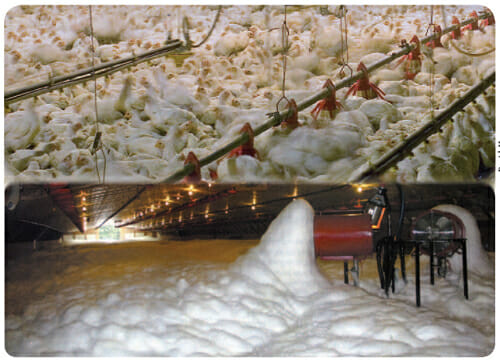
Chickens in Sanderson’s industrial plants are held captive in filthy, overcrowded, inhumane conditions.

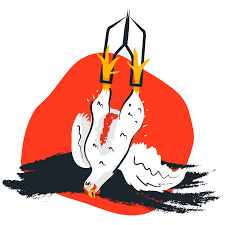
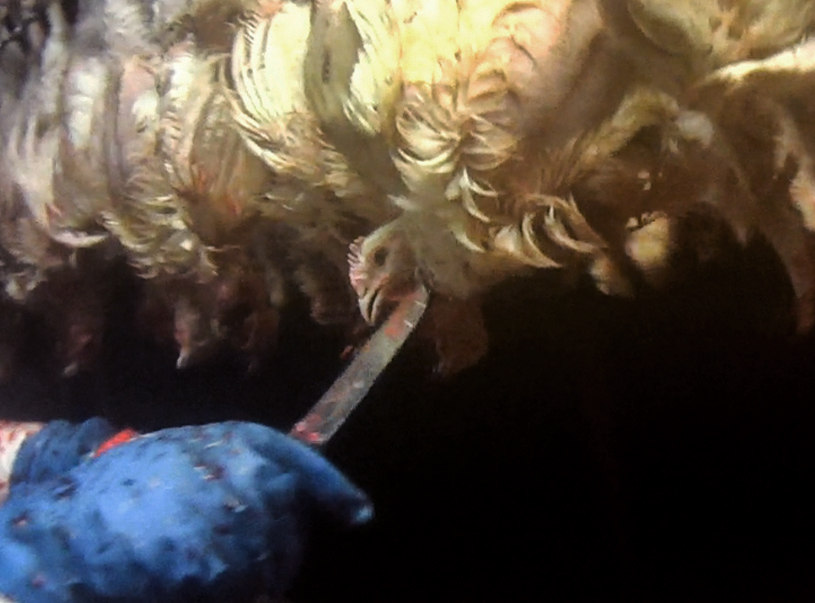
When slaughter time comes, the industry standard is that they are violently hung upside down in metal shackles;
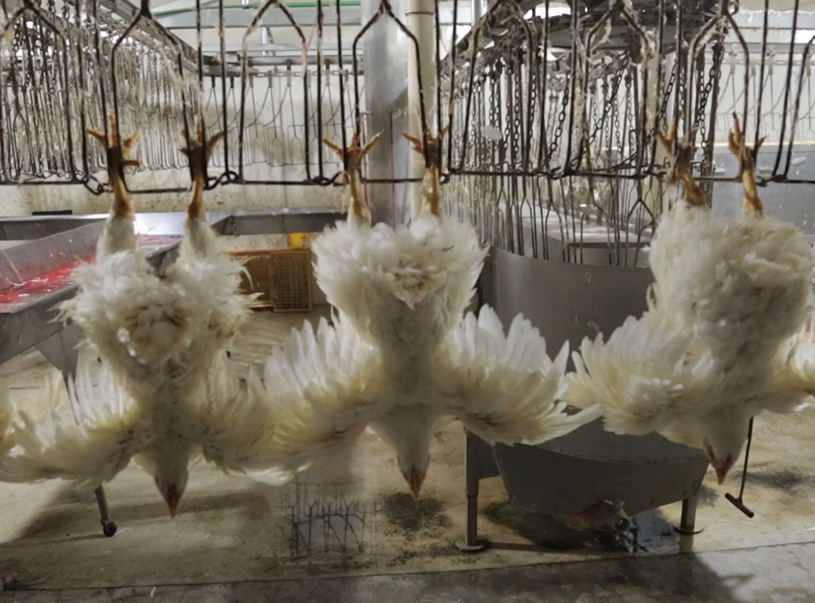
dunked in a tank of electrified water (which often fails to render them unconscious); have their throats cut (this step too is performed at a breakneck pace and the birds often survive it);

lastly, they are dunked in boiling water to defeather them.
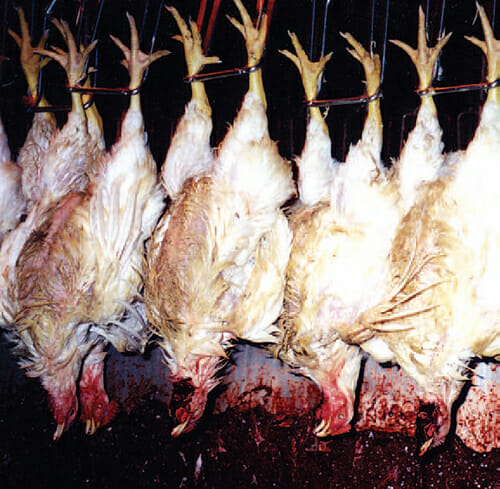
https://fb.watch/aBxnDxKtx3/

Tragically, over 500,000 birds reach the water alive each year and are drowned in boiling water while still conscious.
According to a former slaughterhouse worker, when chickens are scalded alive, they “flop, scream, kick, and their eyeballs pop out of their heads.
They often come out of the other end with broken bones and disfigured and missing body parts because they’ve struggled so much in the tank.”

As if that weren’t enough, chicks who hatch later than expected have been documented being born alone in barren plastic creates, gasping for air and the warmth and comfort of their absent mother.
The corpses of dying and dead chicks end up scattered around, including near the living. The final stage of the process for unwanted chicks is the metal macerator, which grinds them up.
Truly it is a nightmare scenario.

Enough is enough. Chickens are sentient creatures, capable of feeling love and happiness, as well as suffering and feeling fear and terror.
It is inexcusable to treat them as if they are inert matter, as is currently being done by Sanderson Farms and Wayne Farms.

Two petitions, Please take aktion: https://www.idausa.org/campaign/farmed-animal/latest-news/sanderson-farms-animal-welfare/

https://actnow.thehumaneleague.org/live-shackle-slaughter/

And I mean…There were more than half a million chickens drowned alive in scalding water tanks last year, according to the USDA.
That’s 1,400 birds boiled alive each and every day right on US soil!!
Why don’t more people know about this?

Sanderson Farms and other meat industry giants in the US like National Chicken Council, Tyson Foods, Foster Farms, Koch Foods, who are collectively responsible for slaughtering 70-80% of birds each year—need to end this animal cruelty now and have to understand that consumers demand real changes for chickens.

It’s time for these corporations to transition away from the cruel, outdated practices of factory farming, adopt much stronger animal welfare policies, and ultimately focus their energy on expanding their plant-based alternatives in order to improve the treatment of animals and workers suffering within their supply chains.

These meat industry giants have a unique power—and responsibility—to make these changes that will impact billions of animals every year. By phasing out live-shackle slaughter in their supply chains, countless chickens will be spared from one of the greatest causes of suffering in slaughterhouses today.
Because even one bird boiled alive is too many.

For too long, the meat industry has put profits before people and animals, with devastating consequences.

But now, pressure is mounting, more than 180 major food companies have already adopted the Better Chicken Commitment.

With these two petitions we refuse to support, with our taxes, an industry that is unable to find humane and effective solutions, an industry that persists in its mistakes, without respect for animal welfare or long-term human health.
We demand that governments – national, European and international – take their responsibilities and stop perpetuating this dangerously failing system.
Please sign and share

My best regards to all, Venus

Italy: So Probably ‘Ag Gag’ Does Exist In the EU ? – Essere Animali (Italian Animal Welfare Org.) Forced to Censor Videos of Investigations of Two Grana Padano Dairy Farms.

Photo – Essere Animali

WAV Comment – So Ag Gag DOES exist in the EU !

We know our investigations are troublesome, affecting the interests of powerful food groups, and we are aware of the legal risks we run. However, the need to improve living conditions for animals in factory farms drives us to carry out these investigations, and this is our primary goal. Attempts to intimidate us will not stop our work.

Simone Montuschi, President of Essere Animali

Well said Simone – we are fully behind you and your excellent work as animal defenders at Essere Animali.  What a pity that the court did not pay more attention to stopping the abuses rather than trying to Ag Gag EA.  Maybe then we would see some progress rather than the cover ups that they are trying to hide.

It would appear that despite the obvious abuses filmed by EA, the ‘bigger boys’ are now using a form of ag gag as their defence in order to cover up the exposed abuses. Money matters to the abusers more than anything ! – especially in the arena of animal welfare

EA you have our full support;

Mark.

13 January 2022

Essere Animali

Following the release of two investigations of two different dairy farms where Grana Padano is produced, the Consortium that protects the most consumed PDO cheese in the world has filed a civil lawsuit against Essere Animali and filed charges against their legal representative and some other members of the organisation.

As a result of the civil proceedings instigated by the Consortium, albeit in the interlocutory stage, the Court of Brescia ordered the removal of all the online videos related to the undercover investigations.

Additionally, the court prohibited the disclosure of any other footage or content from the investigations that involve Grana Padano. The only exception is the right to mention that the two farms involved are part of the Consortium.

Essere Animali appealed the Court decision, asking them to reconsider the order of removal and to allow the videos to remain online. The Consortium for the Protection of Grana Padano has also pressed charges against several members of Essere Animali, for different crimes including defamation and receiving stolen goods.

We know our investigations are troublesome, affecting the interests of powerful food groups, and we are aware of the legal risks we run. However, the need to improve living conditions for animals in factory farms drives us to carry out these investigations, and this is our primary goal. Attempts to intimidate us will not stop our work.

Simone Montuschi, President of Essere Animali

What happened

Following the dissemination of the first investigation, released on 13 July 2021, the Consortium for the Protection of Grana Padano replied with a video in which it distanced itself from episodes of animal abuse by referring to “isolated cases”. Subsequently, the Consortium proposed a meeting at their headquarters, during which Essere Animali were asked to remove the references to the Grana Padano trademark from the video, without making any concrete proposals regarding the requests of Essere Animali and Eurogroup for Animals’ Member Organisations.

Following the release of the second investigation on 29 September 2021, the police and official veterinarians intervened and found several animals in poor conditions. The farm, on which violations of regulations had previously been found, was sanctioned almost 10,000 euros, and was requested to adjust practices in accordance with regulations.

While the court of Brescia acknowledges that the investigations contain truthful footage, it accepted the request to blackout the investigative videos because they claimed the videos conveyed the message that “the entire production of the Grana Padano brand cheese takes place in violent ways and in the conditions reported“. 

Essere Animali maintains the right to criticise and strive for the abolishment of legal and common practices such as the separation of the newborn calf from the mother and subsequent isolation, which cause stress and suffering to the animals.

File

Press release – Essere Animali forced to black out videos of investigations of two Grana Padano dairy farms.pdf239.08 KB

Belgium: Record Number of MEPs Demand An EU Commissioner For Animal Welfare.

10 January 2022

GAIA

Press Release

This is the most-signed thematic oral question tabled by members of the European Parliament (MEPs) in this term and beyond. The Conference of Presidents is now called to decide on its scheduling in a plenary meeting for the Commission to answer within the next three months, and on its transformation into a resolution.

Over 150 MEPs and more than 140,000 citizens recently expressed their support to the #EUforAnimals campaign, promoted by over forty animal protection organisations across the EU, which demands that more relevance is given to animal welfare by making this responsibility explicit in the name of the relevant Directorate-General and the job title of the competent EU Commissioner. In the present context, the Commissioner’s responsibility would become for “Health, Food Safety and Animal Welfare”.

Today MEPs have made history again by putting together – in impressive numbers – the foundations for a European Union that cares more consistently and constantly for animal welfare, as its citizens are demanding, by establishing an EU Commissioner explicitly in charge of Animal Welfare. The EU institutions should not miss this opportunity to ensure that their efforts will not be thwarted by a different attitude in future EU Commissions.

Michel Vandenbosch, President, GAIA

We thank enormously Mr Fuglsang and the other MEPs who tabled the oral question, which represents a milestone in the work for animal welfare in the EU. The acceptance of this proposal by the European Commission would be a natural complement to its present efforts, and we would be delighted to see Ms Kyriakides become the first EU Commissioner for Animal Welfare.

Reineke Hameleers, CEO, Eurogroup for Animals

A survey conducted in June by Ipsos shows that 70% of Europeans think there should be an EU Commissioner for Animal Welfare. While animal welfare is very close to the heart of European citizens, who constantly support initiatives aimed to improve the way animals are treated, the attention it has received within Brussels has fluctuated depending on the priorities of the Commission in office at the time.

We are fortunate to have a committed Commission at present, which has initiated a review of the existing legislation relating to animal welfare and has repeatedly announced its intention to prepare ambitious improvements for the years to come. However, previous Commissions’ actions on this front had been nearly absent, and this could be again the case when the next Commission starts operating in late 2024.

A new period of inaction on animal welfare should and can be prevented, and the way forward is clear: an EU Commissioner explicitly in charge of it.

ENDS

Notes

Text of the oral question:

Art 13 TFEU recognises animals as sentient beings. European citizens care about animals as testified by the Eurobarometer responses and would like to see their welfare improved through clear legislation, effective policies and the commitment of adequate resources. 

EU legislation on animal welfare has been elaborated since 1974, but the approach of the EU institutions has been inconsistent, contributing to the problem of poor enforcement on various fronts. 

The Commissioner responsible for animal welfare should receive more influence and powers in the EU institutions on this topic whose importance has been clearly acknowledged by this Commission. 

Over 125,000 EU citizens and over 120 MEPs from all political groups have already joined the #EUforAnimals campaign to demand that more relevance is given to animal welfare by making this responsibility explicit in the name of the relevant Directorate-General and the job title of the competent EU Commissioner. 

Presently, the Commissioner’s responsibility would become for “Health, Food Safety and Animal Welfare”, thus greatly supporting both legislative progress and proper enforcement. 

This would be a significant political decision leading to more accountability of the EU institutions for animal welfare and would therefore increase the consistency, effectiveness and impact of policy making in this field. 

One of the immediate effects of this proposal would be to establish a specific Directorate on animal welfare within DG SANTE, thus adequately recognising its specific relevance. 

  • Is the Commission planning to respond positively to this proposal? 
  • If so, what procedures aimed to implement it have been activated?

The oral question was promoted by Niels Fuglsang MEP (S&D, DK), with the co-promotion of MEPs Sylwia Spurek (Greens/EFA, PL), Petras Auštrevičius (Renew, LT), Manuel Bompard (GUE/NGL, FR), Sirpa Pietikäinen (EPP, FI), Michal Wiezik (Renew, SK), Emmanouíl Fragkos (ECR, GR), Anja Hazekamp (GUE/NGL, NL), Johan Van Overtveldt (ECR, BE), Emma Wiesner (Renew, SE), Maria Noichl (S&D, DE) and Francisco Guerreiro (Greens/EFA, PT).

Citizens who want to support this campaign can sign the online petition.

The full survey results can be found here

Regards Mark

EU: Avian Influenza Emergency – Are We Headed Towards the Next Pandemic ?

11 January 2022

News

As Europe struggles with its largest avian influenza outbreak to date, the need to introduce a vaccination strategy is more prominent than ever.

Highly contagious and prone to mutations, the avian influenza virus is wreaking havoc in the European poultry sector. Both animal advocates and the poultry industry agree that a vaccination strategy is by now  indispensable to limit the spread of this deadly disease.

In their report published on 23 December 2021, the European Food Safety Authority (EFSA) stressed that current biosecurity measures appear insufficient in stopping the spread of the disease and stated that, aside from reinforcing biosecurity, the “reduction of the density of commercial poultry farms and possible appropriate vaccination strategies, should be implemented.” Indeed, in the absence of a vaccine, housing orders and the culling of millions of birds every year remain the only solutions available to Member States to try and curb this disease. 

It is by now recognised that the extreme industrialisation of poultry farming in the EU amplifies and is co-responsible for the devastating effects of outbreaks of Highly Pathogenic Avian Influenza (HPAI). 

The geographical concentration of millions of domestic poultry kept in intensive systems is the main culprit for the outbreaks we are witnessing every year, with devastating consequences not only for kept poultry but also for wild birds (who are now also dying in large numbers). 

Prof. Thijs Kuiken, professor of comparative pathology at the Erasmus MC hospital in the Netherlands, recently stressed that the current strain of HPAI originated in 1996 among domestic geese in China, from where it further spread to domestic poultry in Asia. That outbreak could not be kept under control and in 2005 the virus infected wild birds in the region of Qinghai Meer in China. Since then, wild birds have become vectors of the disease during their seasonal migrations. 

Millions of animals are currently suffering from the effects of illness and mass killing for disease control, and considering that vaccinations are highly likely to curb the spread of the virus, idleness in implementing a comprehensive vaccination strategy aggravates the situation.

Developing a vaccine becomes even more urgent if we consider that, between 1997, when the first human case was identified, and 2015, 907 people were infected with HPAI H5N1 globally. The most recent human case occurred in the UK only a week ago. So far there is no proof of human-to-human transmission and the risk of infection for the general population remains low. However, due to its specificities, this virus is considered a public health threat and its genetic changes are monitored accordingly.

The current situation proves yet again that for reasons of disease control, sustainability and animal welfare, the EU must set a course away from intensive farming. 

The reduction of numbers of reared animals is imperative to achieve these goals and the time to act is long overdue: two years into the COVID-19 pandemic, one does not have to look far to see the effects of human negligence concerning zoonotic diseases.

Regards Mark

UK: You Have Done It ! – Money Raised To Show Viva Vegan Advert on UK Television.

WAV Comment:  we are really pleased to have donated twice towards the reaching the target amount required to show this advert on UK television and make many non vegans get a grip into understanding that meat comes from live animals.

Regards Mark

You have helped us exceed our £40,000 target, which means over 16 million Channel 4 viewers will get to see it!

Thank you so much to every single one of you who has donated, shared, or spread the word about this campaign. You’ve helped to make this Viva!’s biggest crowdfunder to date. But we’re not finished yet… we still have 8 hours before the campaign officially ends and we want to give it one final push.

The more money we raise, the longer we will be able to air our ad, and the more people we will reach with our vegan message.

This is the biggest opportunity Viva! has ever had to reach the UK public on such a massive scale.

If you haven’t already, please donate today because this really is the final countdown!

£ 40,644 raised (and increasing) towards the goal of £40,000.

You have helped us exceed our £40,000 target, which means over 16 million Channel 4 viewers will get to see it!

Thank you so much to every single one of you who has donated, shared, or spread the word about this campaign. You’ve helped to make this Viva!’s biggest crowdfunder to date. But we’re not finished yet… we still have 8 hours before the campaign officially ends and we want to give it one final push.

The more money we raise, the longer we will be able to air our ad, and the more people we will reach with our vegan message.

This is the biggest opportunity Viva! has ever had to reach the UK public on such a massive scale.

If you haven’t already, please donate today because this really is the final countdown!

Yours for the animals,

Juliet Gellatley
Founder and Director