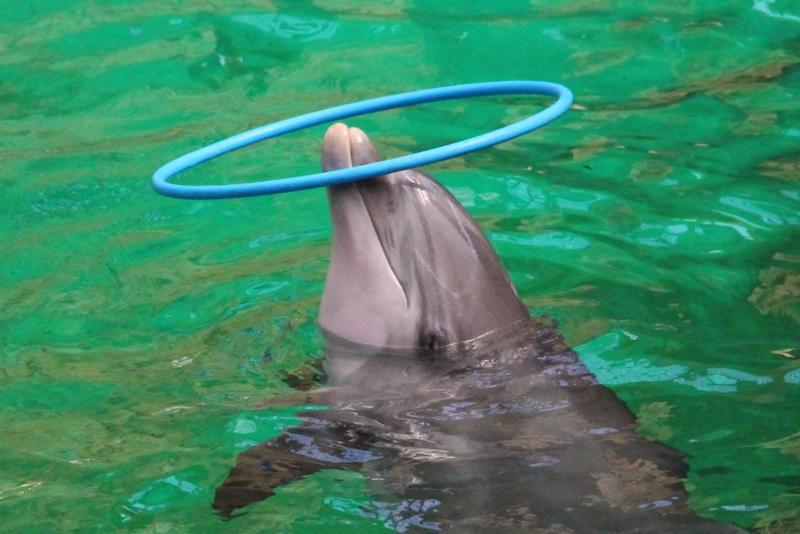
THE MAJOR travel company, Expedia has announced it will no longer sell holidays that include tickets to controversial whale and dolphin shows.
The Prime Minister’s wifeCarrie Johnson has been a leading voice in the campaign against the shows.
Captive whale and dolphin shows have been popular tourist draws in the past but they have attracted criticism in recent years due to allegations of cruelty.
Expedia said it would no longer sell tickets to the controversial shows.
In a statement the Expedia Group said: “We recently adjusted our animal welfare policy.
“As a result, attractions and activities that involve performances by or interactions with dolphins and other cetaceans will no longer be available on our sites.”
A spokesperson told the Mail on Sunday that Expedia would still sell tickets but only on one condition. “Seaside sanctuaries that provide captive animals with a permanent seaside living environment are allowed if they are accredited and do not feature interactions or performances,” they said.
The sanctuaries will have to be accredited and not involve any performances or interactions with staff.
Carrie Johnson, animal rights campaigner and the Prime Minister’s wife, has spoken out against the tourism practice.
The animal rights group PETA, praised the move by Expedia Group, saying: “PETA congratulates Expedia for officially rejecting cruel ‘swim with dolphins’ encounters and SeaWorld prisons.
WAV Comment: Well done Daniel for your actions over plant based. Yes, for sure, it is the way forward in future – you have the means to see this and believe in your actions; you have our full support.
In May, the Swiss cook transformed the menu at Eleven Madison Park, his three Michelin star establishment in Manhattan, scrapping its renowned meat dishes such as glazed duck for an entirely vegan offering, a move that raised eyebrows in the industry.
Critics are just critics; we are all critics in our own right; so what makes them know better than you ?
You have a vision, so stick with it. It is the right vision for sure.
Mark.
Top chef quits Claridge’s as hotel rejects his vegan vision
Claridge’s three Michelin star chef Daniel Humm has dramatically parted ways with the Mayfair hotel in a row over his attempt to give the restaurant a vegan makeover.
Talks were under way to overhaul the establishment’s menu, famed for its foie gras, roasted venison and dry-aged duck, after the 45-year-old axed meat from his “world-best” New York restaurant to make it fully vegan.
Claridge’s told The Telegraph on Friday that its culinary offering was under review, “including the possible introduction of a fully plant-based menu”.
But on Friday night the row came to a head as Mr Humm confirmed he was leaving the hotel after just two years, insisting that “the future for me is plant-based”.
A spokesman for Claridge’s said: “We completely respect and understand the culinary direction of a fully plant-based menu that Daniel has decided to embrace and champion and now wants to introduce in London.
“However, this is not the path we wish to follow here at Claridge’s at the moment and therefore, regretfully, we have mutually agreed to go our separate ways.”
In May, the Swiss cook transformed the menu at Eleven Madison Park, his three Michelin star establishment in Manhattan, scrapping its renowned meat dishes such as glazed duck for an entirely vegan offering, a move that raised eyebrows in the industry.
New fine-dining plates included cucumber with melon and smoked daikon, and sunflower butter with bread rolls.
Despite a scathing review from the New York Times’ acclaimed food critic, Pete Wells, Mr Humm justified the decision by stressing that “the current food system is simply not sustainable, in so many ways” and insisted “we need to inspire change”.
A similar vision was being pursued at Claridge’s, prompting concern that its two centuries of culinary tradition, including foie gras torchon, butter-poached native lobster and roasted venison, would be ditched for climate-friendly vegetables with a lower carbon footprint.
Mr Humm said on Friday night it was “with sadness” that in December he would leave Davies and Brook, which has gained one Michelin star, adding: “The future for me is plant-based. This is our mission and what we stand by as a company, and at this time this is not the direction that Claridge’s feels is right for them.”
‘Maybe he should bring back the celery root steamed in a pig bladder’
He said it was a “dream come true” to join the hotel in 2019 and praised the “beautiful restaurant with a dedicated and passionate team”. Claridge’s thanked him for his efforts and promised an update on its future plans in due course.
Mr Humm, a leading voice in the charge to make the food industry more eco friendly, visited the Cop26 environmental summit in Glasgow this week and expressed his wish to “make plant-based food delicious, magical and luxurious”.
After the vegan overhaul to his 12-course New York restaurant drew criticism, Pete Wells wrote in the New York Times: “Almost none of the main ingredients taste quite like themselves in the 10-course, $335 menu the restaurant unwrapped this June after a 15-month pandemic hiatus.
“Some are so obviously standing in for meat or fish that you almost feel sorry for them.”
The critic remarked that Mr Humm achieved “purer, deeper results out of vegetables before the restaurant went vegan” and suggested that “maybe he should bring back the celery root steamed in a pig bladder”.
William Sitwell, The Telegraph’s restaurant critic, suggested that a high-end vegan Claridge’s restaurant could be a “clever idea” without the costs of buying in protein. “That restaurant has driven away classic Claridge’s customers very successfully already and this cements that view,” he said.
While veganism was not for Claridge’s appetite, Alex Gauthier, the Michelin-star French chef, responded to protests at the doors of Gauthier, his Soho brasserie, over the force-feeding process to produce foie gras by turning his restaurant vegan.
Now he cooks a version made of lentils, walnuts and cognac.
Regards Mark
Photos – the Teklegraph
Comment – thanks Stacey:
Imagine being pissed off and indignant because a chef refused to prepare food requiring violence and suffering.
People are disgusting.
I hope Mr. Humm becomes widely, incredibly successful and famous.
Alexis Gauthier says he has emulated the buttery taste of the original in his ‘faux gras’ recipe. Photograph: Gauthier
UK government asks chefs for vegan recipes to replace foie gras
Restaurateurs invited to discuss plant-based ‘faux gras’ ahead of expected ban on liver-based spread
It is prized for its rich flavour and exclusive image by top restaurants and gourmands, but now foie gras is going vegan as the government meets chefs to discuss how to make alternatives out of nuts and mushrooms.
Vegan restaurateurs have been invited to meet UK government advisers to discuss how to create plant-based “faux gras” in the event of an upcoming ban, the Guardian has learned. Sources said the government hoped to show that a gap in the market left by a restriction on the trade of the controversial product could be filled by high-end chefs who are willing to produce alternatives.
MPs have vowed to ban trade in foie gras, and the Department for Environment, Food and Rural Affairs (Defra) is consulting on legislation to outlaw the sale and import of the liver-based spread.
Foie gras production is illegal in the UK on animal cruelty grounds, as the ducks and geese whose livers are harvested are force-fed to make it. However, top restaurants still import and sell from countries such as France.
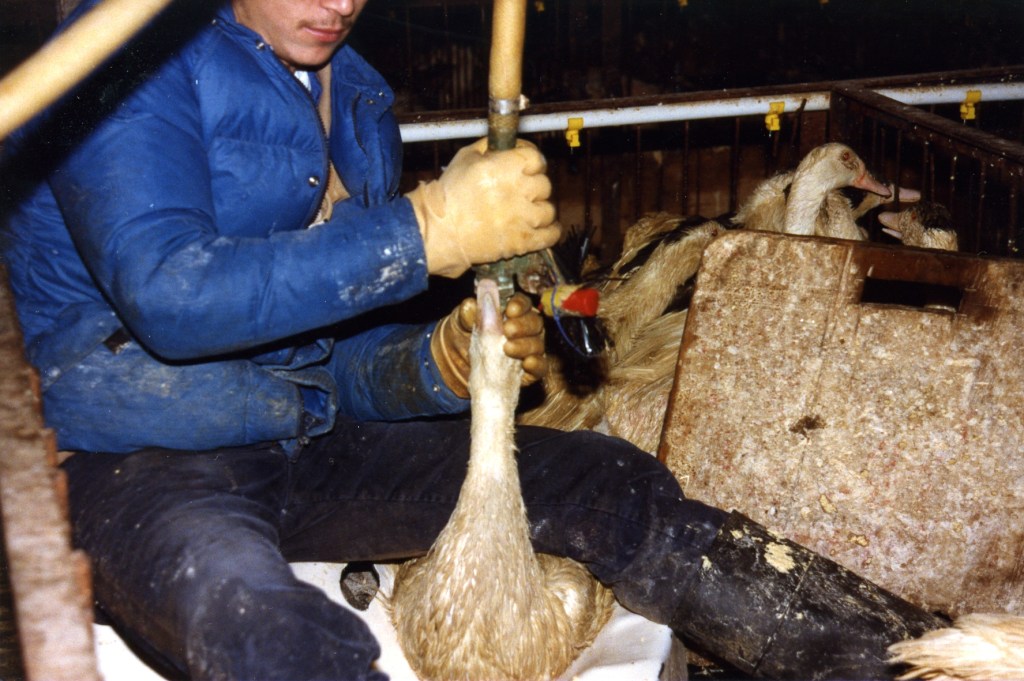
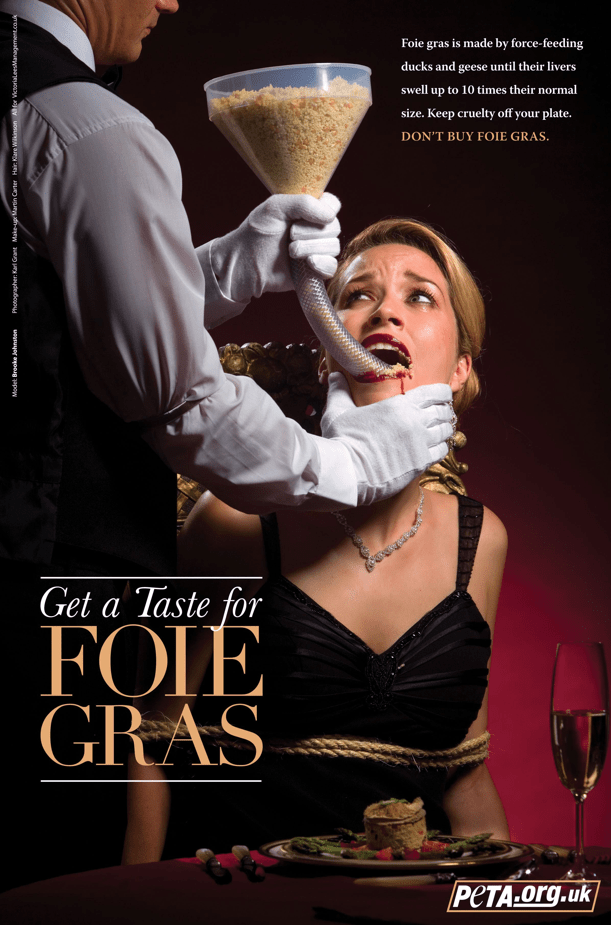
The force-feeding process is known as gavage, where grain is poured into a funnel or tube that has been thrust down the bird’s neck. After two weeks, the liver has swollen to many times its normal size.
Photo – WAV Archive
The French chef Alexis Gauthier, who runs fine-dining restaurant Gauthier Soho and plant-based restaurant 123V in Bond Street, both in London, decided to stop serving foie gras in his establishments after activists from Peta demonstrated outside and he read up on the meat and dairy trade.
He now serves a faux gras at his Soho venue made of mushrooms, lentils, walnuts and cognac, and says the concoction has emulated the buttery taste sought after by foie gras fans. Since this year, all the food served at his restaurants is plant-based.
The government has asked him for his recipe and invited him for talks with policy advisers to see if a gap in the market caused by a ban could be filled by his creation.
An email to vegan chefs, seen by the Guardian, says: “I understand your restaurant serves an alternative to foie gras. We would appreciate the chance to arrange a virtual meeting with the chef or someone else from the team to discuss a few questions in this area. These would be questions about your views on foie gras and the challenges and opportunities associated with ‘ethical’ alternatives.”
Gauthier says foie gras was once a bestselling item on his menu and that he used to sell 20kg of it a week, but claims people are now travelling from around the country to try his faux gras. He said it took patience and precision to emulate the texture, appearance and depth of the delicacy in a vegan version.
Many luxury shops and restaurants are turning their back on foie gras, including Fortnum & Mason, which stopped selling it earlier this year.
A government spokesperson confirmed officials were seeking meetings with those involved in creating faux gras to inform their decision on how the effects of a ban could be mitigated.
In a heavy pan, sauté the shallot in two tablespoonfuls of the olive oil until translucent. Add the garlic, chopped herbs, and mushrooms. Add the cognac and turn up the heat.
Add the soy sauce, reduce the heat, and cook over low heat for six minutes. Remove the pan from heat and let cool.
In a food processor, process the mushroom mixture, the remaining olive oil, the lentils, walnuts, beetroot puree and black pepper until almost smooth. Add an optional extra splash of cognac to give it that je ne sais quoi.
Place in a small glass jar and refrigerate for a few hours before serving. Serve alongside toasted slices of sourdough or other bread.
The finger has been pointed at animal rights activists who reportedly protest against the circus every year
Eight camels and a llama escaped from a circus in Madrid after the fence guarding the animals was reportedly cut.
Police shared a tweet stating that they had found the exotic animals roaming the streets of the capital at around 5am on Friday.
They were found not far from where the circus, named Gran Circo Quiros, is based, in the southern district of Carabanchel.
However, the circus has claimed that the animals were released in an act of “sabotage”.
The circus said on Instagram: “Last night we suffered an animal sabotage, the animals are well.”
Circus manager Mati Munoz blamed animal activists for the camels escaping, telling AFP that the electric fence around the animals’ enclosure had been cut.
He added that animal rights activists protest the circus every year.
The City Council of Madrid has banned wild-animal circuses, saying they don’t meet “animals’ physiological, mental, and social needs” or respect their welfare.
Bactrian camels originate from the rocky deserts of central and eastern Asia and are able to survive in extreme conditions. However, the vast majority of them are now domesticated.
Wild animals are now banned from travelling circuses in the UK after legislation was passed under the Wild Animals in Circuses Act 2019.
It includes any animal not typically domesticated in the UK, such as big cats, camels, elephants, reindeer and zebras.
Danish industry gather about solutions for laying hens
11 November 2021
Dyrenes Beskyttelse
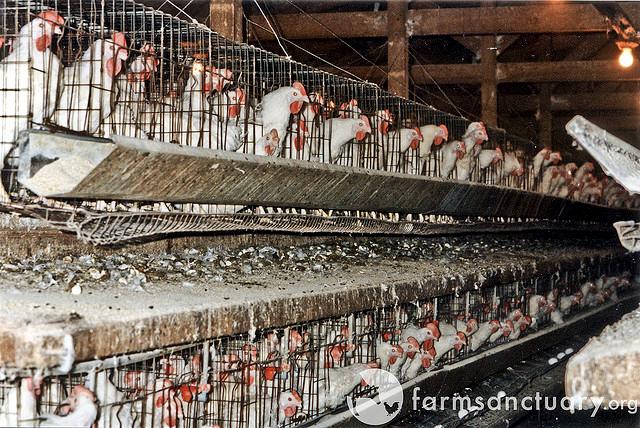
Together with The National Organic Association, Eurogroup for Animals’ member Animal Protection Denmark hosted a major industry meeting in the egg and poultry industry on sternum fractures in laying hens in Denmark. This was the first time that the whole industry is meeting, and that underlines the seriousness of this matter. The focus was on new initiatives and actions to bring the serious problem to life.
For the first time, the Eurogroup for Animals’ member Animal Protection Denmark and the National Organic Association brought together the entire Danish egg and poultry industry as well as the Danish Minister of Food, Agriculture & Fisheries, Rasmus Prehn. The purpose was to discuss sternal fractures and come up with a number of concrete initiatives and actions that the industry itself can initiate, and which Danish politicians and other stakeholders can support through their work. In the autumn of 2021, the Danish egg and poultry industry got a breather, after the University of Copenhagen published the report “Keel bone fractures in Danish laying hens: Prevalence and risk factors”. suffers from sternal fractures due to ovulation.
At Animal Protection, we are of course appalled at how widespread fractures of the sternum of laying hens are. It is completely and utterly unacceptable that this is more the rule than the exception for hens in all branches of egg production. At the same time, it is a difficult and very unfortunate situation for the profession. The support for today’s meeting shows how seriously the problem is viewed by everyone with responsibility for and influence on both the problem and the solutions.
Britta Riis, Director of Animal Protection Denmark
The meeting was also attended by the retail industry, which is met every day by consumers who want to buy eggs with a clear conscience. That is why the meeting has been particularly important.
We have had a joint discussion, which has given an overview and an understanding of the challenges in all parts of the food system, which unfortunately pushes the farm animals beyond any reasonable limit. We, therefore, look forward to both the Minister and the producers taking the task further from the action-oriented discussion today. We are pleased with the Minister of Food, Agriculture and Fisheries Rasmus Prehn’s call for everyone to put pressure on the European regulation of breeding, and that the Minister himself promised to raise the matter with his European colleagues since the problem is by no means only Danish. We ourselves are putting pressure on via the animal welfare organisations’ European association, Eurogroup for Animals.
Britta Riis, Director of Animal Protection Denmark
Richard Ratcliffe’s wife, Nazanin, has been used as a pawn now for over 5 years;detained by the Iranian authorities. Richard is now into his 18th day of a hunger strike to highlight this issue even more.
Boris Johnson, the UK PM, along with many of his senior ministers, have let this issue fester for far too long. It is a gutless British government led by a gutless British PM.
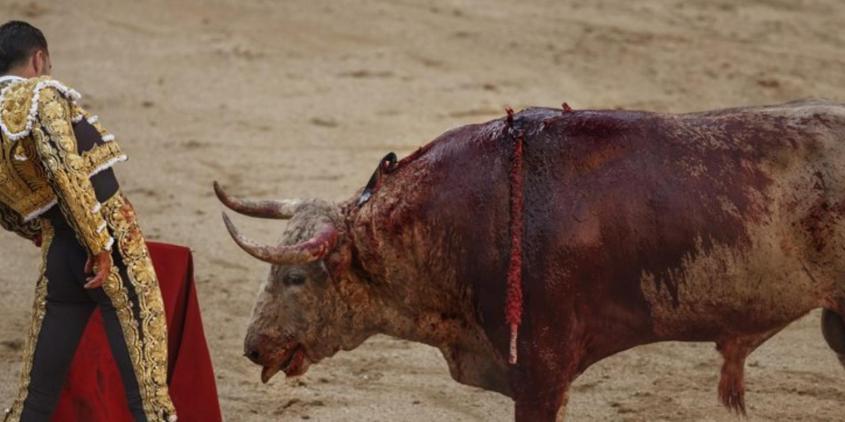
There will be no more corridas in the oldest bullring in Mallorca!!
Instead, it should be transformed into a socio-cultural center.
The bullring in Alcúdia is the oldest of its kind in Mallorca. Photo: Amalia Estabén
This has now been confirmed by the mayor of the municipality, Bàrbara Rebassa, on request in a municipal council meeting.
A company had been managing the community square for years. But now his license has expired.
As the “Ultima Hora” reports, the concession is not to be put out to tender again.
If Mayor Rebassa has his way, the arena will in future be used as a center for the activities of clubs and cultural institutions.
If possible, the community also wants to set up rehearsal rooms for musicians.
The Alcúdia bullring was built in 1892 in the Sant Ferran bastion, which is part of the 17th century city walls. It has 1037 seats.
Traditionally, two bullfights were held here every year.
In recent years these corridas have been accompanied by anti-bullfighting demonstrations outside the gates of the bullring.
But there are also headwinds from the advocates of bullfighting.
On October 12, the community received a letter from a law firm.
According to Rebassa, it pointed out that the corrida is a cultural asset and that the law obliges the community to maintain bullfighting. The mayor rejected this with the argument that the system no longer complies with the applicable regulations.
And the brave, civilized authorities of Spain, who view bullfighting as a disgrace to the country rather than a cultural asset.
There are still those too.
Time is ticking against the bullfight and we know… it will end!
Big disappointment in Sweden: the Board of Agriculture decided today to lift the mink ban
10 November 2021
Djurens Rätt
At the end of this year, the temporary ban on breeding mink for fur production will expire and the Swedish Board of Agriculture has just announced that it will not be extended. The decision means that 2022 may mean that half a million minks will once again be staying in cramped grid cages, with risks to animal welfare and continued spread of infection. Animal Rights are deeply disappointed with the decision.
In January 2021, the positive news came that the mink farms would be closed again for 2021 to reduce the risks of spreading the coronavirus SARS-CoV-2. The breeding animals remained on the farms, almost as a promise to the companies that they would be allowed to start up again. It has now happened.
With today’s decision, the mink farms will be allowed to start their operations again on 9 November.
This is in contrast to Denmark, which recently decided that their ban on keeping minks will be extended for 2022. Other countries have also taken a different path than Sweden: the Netherlands imposed a permanent ban on fur farms following the pandemic, and during the week British Columbia in Canada decided on a plan to close down mink farms due to the spread of infection.
In order for the Swedish mink farms to be able to breed mink again, certain specific restrictions have instead been extended, such as a ban on the movement of live mink and isolation of the farms. But this is clearly not sufficient.
“I am deeply disappointed with today’s message. There are many reasons to stop mink farms from breeding minks in cramped lattice cages, the risk of infection spreading is just one of them. When the authorities made this decision today, they also took a stand for the mink industry to continue to conduct unethical activities in Sweden. I now urge politicians to take a new approach to the issue and introduce a permanent ban” says Camilla Bergvall, national chair of Animal Rights Sweden.
Minks have proven to be extra susceptible to the coronavirus, which also affects humans. The majority of Sweden’s approximately 28 mink farms have had outbreaks of infection, with consequences such as increased mortality and respiratory symptoms. Despite the breeding ban in 2021, the infection came on a farm during this summer.
Investigation in Sweden is ongoing
The Government has commissioned the Swedish Board of Agriculture and the Swedish Veterinary Institute to investigate the risks of the spread of infection between animals and humans in Sweden. That assignment will be presented in February 2022, and may involve other proposals for restrictions than the current announcement. However, there are few indications that a breeding ban will be introduced again. It will be up to politicians, especially in government, to implement other legislative proposals to protect minks from suffering and disease.
Animal Rights, with the support of at least 76% of the population, is not alone in proposing the decommissioning of mink farms for infection control and animal welfare reasons. Other examples are the Swedish Veterinary Association and several farmers.
14 animals die during sea transport from Portugal to Israel
10 November 2021
AWF
Live animal transport from Portugal to Israel: livestock vessel stuck off the Italian coast for two days, 14 animals died during the trip.
NGOs call on the ANIT Committee to ask for a ban of live animal transport at sea.
The vessel Phoenix III, heading to Israel with a cargo of 1,200 young bulls and 5,644 sheep, was dangerously stuck for two days at sea near Mazara del Vallo, Italy.
Portuguese authorities were informed by PATAV (a Portuguese civic movement) that the vessel had stopped for 48 hours. The ship, which left Sines (Portugal) on October 22nd and stopped on 27th near Italy, then left again after two days and reached its destination port in Israel on November 4th.
A coalition of NGOs, which followed the ship and filmed the animals while they were unloaded in the port of Haifa, wrote to the ANIT Committee (Committee of Inquiry on the Protection of Animals during Transport) urging to support a ban of live export.
The images taken during the unloading process show stuck and exhausted animals in high overcrowded conditions, with animals on top of each other, and very dirty bulls with broken horns. Some of the animals also showed heat stress symptoms. The animals were quickly loaded again on trucks. They will spend eight days in quarantine in the region of Mehola (90 km from the port), and then they will be transported again to different feedlots in Israel for 4-8 months before slaughter.
This case, as in the well-known cases of Karim Allah and Elbeik at the beginning of 2021, shows again how dangerous sea journeys can be for the animals.
In this incident, 14 animals were reported dead, but if the vessel were stuck for more days, we could have witnessed another tragedy.
In the letter to the ANIT committee, the NGOs referred to the importance of contingency plans and the need, by competent authorities and organisers, to take into account the forecast weather conditions until final destination when authorising a transport. Lack of feasible contingency plans and lack of weather verification have the potential to negatively affect animal welfare when unexpected situations arise.
Phoenix III is a 43 years old livestock vessel (Ex-reefer converted in 2011 at the age of 33 when it should have been already scrapped). Most of the livestock vessels operating in the EU are under similar age and conversion situation, andsince 2017, they are the No. 1 category for the number of detentions worldwide, and considered as a high risk in Paris MoU risk profiling.
Furthermore, according to a recent study published in 2021, 36%of EU-approved livestock vessels have suffered major incidents, failures, or loss.
Besides that, there are concerns regarding the Phoenix III authorisation: according to the Romanian central authority Phoenix III had been transporting live animals without authorisation from April to August 2021 when it made 8 journeys exporting animals from Croatia, Portugal and Romania to Israel. On August 18 the vessel was re-authorised to export animals by Croatia.
Aside from the reason for the stopping, this episode is again a good example of how the welfare of exported animals remains largely unknown during the sea part of the journey, and during transport in third countries to the final destination.
The many tragedies already happened in the past (the Queen Hind, Karim Allah, Elbeik vessels among others) show that the protection of animals during transport at sea is not possible for various reasons: bad weather and technical failures can cause delays, most ports are not able to shelter the animals, and conditions at sea can deteriorate suddenly with no possibility to escape putting both animals and crew at great risk.
Given the comprehensive work that the ANIT did on transport via sea, the NGOs are now asking for the Committee to recommend a phase out of extra-EU sea transport and to urge stricter and refined rules on intra-EU sea transport.
 Captive whale and dolphin shows have been popular tourist draws in the past but they have attracted criticism in recent years due to allegations of cruelty.