Category: Live Transport

UK: Prime Minister Boris Johnson to Unveil Brexit BAN on ‘barbaric’ Live Animal Exports on Thursday 3/12/20.

BAA BAA BREXIT 

Boris Johnson to unveil Brexit ban on ‘barbaric’ live animal exports on Thursday 3/12/20.

MINISTERS will begin the abolition of cruel live animal shipments tomorrow — a ban only made possible by Brexit.

Under strict European Union Single Market rules that guarantee free movement of goods, no member state can ban livestock being transported across borders alive.

But with Britain finally cutting ties with Brussels in 29 days time, the controversial process will be outlawed to the delight of campaigners.

Boris Johnson has repeatedly vowed to use the “the opportunity of Brexit” to “champion animal welfare” and will unveil plans for new legislation on Thursday.

In 2018 Mr Johnson hit out: “I cannot believe that this barbaric trade is still going on — but it is. Every year this country sends thousands of live calves overseas for slaughter, and some of them are enduring nightmare journeys as far as North Africa.

“They are jammed together in the dark. They are terrified. They slip and slide in their own excrement as the boats buck in the swell.”

Then a backbencher, he wrote in The Sun: “They travel for more than 100 hours in conditions of such extreme discomfort that campaigners have been protesting for decades.

“The animals know they are going to die — and they are going to die far from home.”

HERE COMES THE BAN

The Sun can reveal the Department for Environment, Food & Rural Affairs are to reveal the ban plan to the farming industry, launching a formal consultation on Thursday.

Last night a No 10 source said: “The Prime Minster has always been a passionate supporter of animal welfare, and as part of his plans to build back better and fairer, he is determined to make sure that the UK continues its proud tradition of protecting animals.

The insider added: “Free from EU red tape, we can now do away with the cruel practice of exporting live animals for slaughter and fattening – setting an example to other countries with our world-leading standards.”

Yesterday talks between the EU and the UK over a post-Brexit trade deal continued.

Boris Johnson to unveil Brexit ban on ‘barbaric’ live animal exports on Thursday (thesun.co.uk)

Romania accused of ‘silence’ over ship that capsized killing 14,000 sheep.

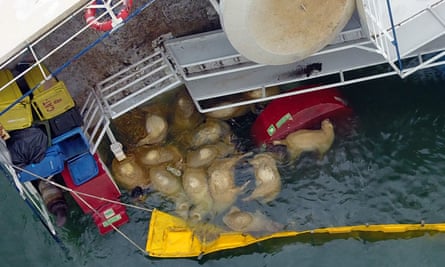
Livestock vessel Queen Hind capsized off Romania, leading to the deaths of more than 14,000 sheep.

Livestock vessel Queen Hind capsized off Romania, leading to the deaths of more than 14,000 sheep. Photograph: Animals International

Read our posts on the Romanian live export situation at:

Search Results for “romania live export” – World Animals Voice


WAV Comment – the situation is not un expected; “Romania has been accused of “complete silence” over its investigation into the sinking of the Queen Hind last November, which resulted in the deaths of more than 14,000 sheep”.

We have reported on some Romanian ‘baddies’ in the past – Romania: Portrays Himself As ‘Jeckyll’, The Child Lover; But In Reality He Is ‘Hyde’ – The Mass Animal Killer. – World Animals Voice


But there are some great Romanian animal welfare campaigner friends fighting continuously for the animals; such as a special lady and friend; Carmen.

Remember the name – Carmen Arsene.- a wonderful lady and campaigner who never stops fighting for animals !

Romania: Animal welfare round table – YouTube

Carmen Arsene, president of the National Federation for Animal Protection in Romania, Ruud Tombrock, Europe director of World Animal Protection and Dr. Marlene Wartenberg, animal welfare strategic consultant (Four Paws) discuss the situation in Romania, where corruption and criminal activities in connection with brutality is becoming a health threat to Romanians. Interviewed by EU Reporter’s Strasbourg correspondent, Peter von Kohl (DK).

 Regards Mark

 ———————————


Romania accused of ‘silence’ over ship that capsized killing 14,000 sheep

An investigation into the Queen Hind sinking a year ago is yet to be published and the live export trade continues to boom

Romania has been accused of “complete silence” over its investigation into the sinking of the Queen Hind last November, which resulted in the deaths of more than 14,000 sheep.

Rescuers who rushed to the sinking Queen Hind vessel, which left Romania’s Black Sea port of Midia a year ago, managed to save just 228 sheep out of a total 14,600, but only 180 ultimately survived the ordeal.

Romania’s prime minister Ludovic Orban vowed on television last year to end live exports in the “medium-term”. However, since the Queen Hind disaster more than 2 million live animals have been exported from Romania – mostly to north Africa and the Middle East.

Romanian authorities have claimed the vessel was 10% below capacity and that the animals were “clinically healthy and fit for transport”. But campaigners say the vessel was overloaded and this ultimately led to the thousands of sheep drowning in the Black Sea.

The only information to emerge since the sinking has been the discovery of secret compartments onboard with dead animals inside, by the company hired to remove the ship from the water.

Romania’s transport ministry told the Guardian this week that investigations are concluded and said a summary of the report will be published on the ministry’s website. They also said that the purpose of the technical investigation was to establish maritime safety issues and to prevent future accidents, and “not to establish guilt in people involved”.

EU law stipulates that investigations into maritime accidents should be reported in full within 12 months, but that if a final report is not possible in that timeframe, then “an interim report shall be published within 12 months of the date” of the event.

“They promised a cross-check investigation to find out what happened, and since then – complete silence,” said Gabriel Paun, EU director at Animals International.

The Guardian contacted MGM Marine Shipping, the management company behind the Queen Hind, and they denied any knowledge of secret decks. They said company procedures hadn’t changed since the disaster.

“Nothing has changed, I don’t want to talk any more about this vessel – I want to forget about it,” a company representative said in a telephone call before hanging up.

A European commission audit on Romania between September and October last year, which aimed to evaluate animal welfare during transport by livestock vessels to non-EU countries, raised multiple concerns, including “a general lack of records in the system of controls to ensure animal welfare during transport by sea to non-EU countries”.

“There is no evidence of checks confirming that the animals are fit to continue the journey. The absence of documented procedures, records and support to official veterinarians in checking vessels provide little assurances on the effectiveness of most controls carried out,” the report said.

“The Queen Hind was an iconic example of the intrinsic failures of the system,” said Reineke Hameleers, CEO of Brussels-based Eurogroup for Animals, an EU umbrella group for animal advocacy organisations. “The EU likes to pride itself as a global animal welfare leader, but it still makes its hands dirty with this cruel industry.”

Guardian investigation found that livestock vessels are twice as likely to suffer a “total loss” from sinking or grounding as standard cargo vessels. Livestock ships are often old and originally built for other purposes before being converted to carry animals. The Queen Hind was 39 years old at the time of the disaster.

Mary Pana, president of the association of cattle, sheep and pig breeders and exporters in Romania, said: “EU competition with Australia and New Zealand is acute.”

“Naval accidents have happened to us and to them. But these are accidents … I trust the EC [European commission] will find an efficient way to change the current legislation so that the animals have superior welfare conditions for breeding, transport, and slaughter,” Pana said.

Campaigners have complained that since the disaster little has changed to improve animal welfare standards for live exports.

“These are not five-star cruises,” said Paun. “I’ve spent time on cargo ships and conditions cannot be improved – there are always an enormous amount of problems that occur, and there is not one single [long-haul] shipment where there are no animals dying.”

Vasile Deac, a veterinarian and owner of a live export company, said a ban on live exports would harm the livelihoods of Romanian farmers.

“The live animal export trade is very important for Romanian farmers,” Deac said. “If there was no live export market farmers wouldn’t have anywhere to sell their animals and it would be a big loss for them.”

“As an exporter it’s very important for me to see the ships that the animals are exported on,” he said. “The Queen Hind was an accident, it wasn’t done intentionally.”

Sign up for the Animals farmed monthly update to get a roundup of the best farming and food stories across the world and keep up with our investigations. You can send us your stories and thoughts at animalsfarmed@theguardian.com

Romania accused of ‘silence’ over ship that capsized killing 14,000 sheep | Environment | The Guardian

South Africa: Live Exports – The Journey So Far. Further Information and Donation Links.

https://nspca.co.za/wp-content/uploads/2019/10/nspca-live-export.mp4?_=1

THEY NEED YOU NOW MORE THAN EVER

It has been a long and trying year as we continue to fight against a trade that is inherently cruel.
We have lost battles and we have won some, but the war is far from over ….

On 06 August 2020, the National Council of SPCAs was back in the Grahamstown High Court fighting to interdict the impending export of live animals by sea to the Middle East. On 25 August 2020 Acting Judge Dukada handed down an order, allowing the Kuwaiti exporters, Al Mawashi and KLTT, to export no more than 56,000 sheep over the equator on the Al Messilah vessel in the hottest month of the year.


Acting Judge Dukada also ordered the Department of Agriculture, Land Reform and Rural Development to monitor the loading process and provide reports to the court – this is the same Department that the NSPCA has laid animal cruelty charges against in previous shipments.
The Al Messilah, filled with some 51000 sheep, left South Africa on the 05 September 2020. A further two criminal dockets were opened against the exporters and the Department of Agriculture, Land Reform and Rural Development.


In October 2020 written reasons for Acting Judge Dukada’s order was received from the Grahamstown High Court. The application was not dismissed nor granted, it seems to have been an impractical compromise. Furthermore, in his judgement, Acting Judge Dukada stated that the NSPCA had ignored the Terrestrial Animal Health Code, published by the World Organisation for Animal Health (OIE) – Specifically, chapter 7.2 of the OIE Standards Transport of Animals by Sea. These guidelines are not even recognized as international law by the very body who developed them. These guidelines are in place as bare, minimum “recommendations” for countries which do not have adequate legislation for the protection of animals.

The Acting Judge further stated that Al Mawashi and LTTC would be expected to adhere to this ‘law during the loading and transportation of the animals aboard their vessel. This, however, was not the case as these basic guidelines were still observed to be disregarded by members of Al Mawashi and LTTC. It is interesting to note that the Red Meat Industry Forum (RMIF) who opposed the NSPCAs application has now launched a contempt of court application against the South African Government for not following the Acting Judge Dukada’s directives.


The NSPCAs’ legal team launched an application for leave to appeal Acting Judge Dukada’s order which was heard on 06 November 2020 and then declined by the Acting Judge Dukada On 17 October 2020. The NSPCA is left with no choice but to approach the Supreme Court of Appeal in Bloemfontein.


It has been a long and trying year for the NSPCA as we continue to fight against a trade that is inherently cruel. The undeniable suffering that these animals experience during these journeys to the Middle East is both unnecessary and unacceptable.

Unfortunately, this appeal process is a very costly battle as we continue to pursue the ban of live export.

We need YOUR help to protect these animals from unnecessary suffering.

YOUR support can help us win this fight and leave a legacy for our children and grandchildren for a much kinder world!

Donate to the NSPCA

Donate to The National Council of SPCAs | Donation Details for NSPCA

Read lots more about live exports to the Middle East by clicking on this link:  ‘The Journey So Far’ – 

The NSPCA’s Battle Against the Live Export of Animals to the Middle East

EU: ‘A Web of Lies’ – Horsemeat Imports (Into EU) In Regular Breach Of Alleged EU Rules Some 8 Years After NGO’s Alerted the Issue. EU – Toss As Always !

WAV Comment – Like so many live animal transport issues which is always backed up by hard evidence; the EU ignores the same and continues to live up with the fairies on another planet. Over 8 years ago this issue was covered by NGO’s in Argentina; and the EU has not acted. What is the point of the EU we ask ?

Horsemeat imports in regular breach of EU rules

25 November 2020

Horse meat - Wikipedia

European Commission tightens horsemeat import controls | Meat Management  magazine

Today, the Animal Welfare Foundation, supported by other NGOs, released a new documentary underlining animal welfare abuses in the production of Argentinian horsemeat. Unfortunately, as demonstrated by our report, this is not an isolated case.

The documentary, entitled  “A Web of Lies”, (click on title to see video) reveals that eight years after the first investigation carried out by NGOs in Argentina, the severe abuses and neglect of horses destined for slaughter continue, despite claims that the situation has improved. The film also puts the spotlight on key shortcomings in ensuring the traceability of the horses. 

Similar issues can be witnessed in several countries providing horsemeat to the EU, like Australia, Uruguay and Canada. Consumption and trade of horsemeat in the EU has overall declined between 2000 and 2015; yet, since 2017, EU imports of horsemeat from foreign countries have started to grow again, especially from Argentina.

It is thus high time for the European Commission to address the concerns around these imports.

Eurogroup for Animals launches today a report presenting an overview on animal welfare and traceability-related issues encountered in key producing countries. The report puts forward the following recommendations in order to ensure better equine protection: 

  • All imported equine meat must comply with EU animal welfare standards at slaughter (which are currently the only applicable animal welfare requirements for imported meat).
  • All imported equine meat should also respect other animal welfare standards applied in EU horse meat production (e.g. related to transport, in assembly centres and in horse feedlots). This means trade agreements should contain provisions on conditional liberalisation of horse meat imports (e.g. liberalised access to the EU market would be contingent on meeting equivalent welfare standards).
  • Suspension of imports from countries if EU audits demonstrate a lack of enforcement of the applicable provisions of the regulation on welfare at the time of killing and traceability requirements.
  •  Allowing for the possibility of unannounced audits.
  • Suspension of imports (e.g. from Mexico and Brazil) are not reversed unless the production meets the required EU animal welfare standards as confirmed by EU audits.
  • Working to improve equine welfare outside the EU through cooperation on animal welfare with relevant partner countries (at present Argentina, Australia and Canada), using technical assistance where required.
  • Greater traceability of horse meat products by introducing Country of Origin Labelling (CoOL) for fresh and frozen equine meat.
  • Reduced consumption of equine meat and derived products (through member organisations reaching out to retailers and consumers).

Read “From stable to Fork” Report 

Germany: Transport ban of 132 pregnant cattle to Morocco

The Cologne Administrative Court has banned 132 pregnant cattle from being transported to Morocco on the grounds that the cattle there are often not slaughtered in accordance with animal welfare standards.

The 132 Holstein cows were pregnant and, according to the carrier, should go to a Moroccan dairy farm. The judges didn’t believe that, however.

According to the court order, the sales contract and the logbook show that the buyer was a slaughterhouse.

Berlin, November 24th, 2020:
PROVIEH welcomes the decision of the Cologne Administrative Court to ban the export of live animals to Morocco.

Before the Cologne Administrative Court decided in favor of the ban, the veterinary office had initially refused permission to transport the pregnant cattle to Morocco.

Two exporters had sued against this – and lost in an urgent procedure.

The transport planned for November 18, 2020, was not allowed to take place because the judges in Morocco feared that the animals would be slaughtered in a manner that was not appropriate to animal welfare.

“The decision of the Cologne Administrative Court evaluates PROVIEH as a success for animal welfare. There is a very high probability that the cattle in Morocco would have been slaughtered under conditions that were contrary to animal welfare, ” comments Patrick Müller, Head of Capital at PROVIEH.

“The decision was intended to encourage other veterinary offices not to process any transports that are expected to contain animal welfare violations en route or in the destination country.

We finally need nationwide uniform regulations for animal transports so that there are no more blatant misjudgments, such as the one from the Potsdam Administrative Court a few weeks ago, where the transport of pregnant cattle was permitted with reference to the EU regulation.
The European regulation for the protection of animals during transport must also be interpreted uniformly and completely in terms of animal welfare. “

Time and again, massive animal welfare violations occur in the case of live animal exports.

Problems arise from the fact that the animals are not regularly and insufficiently fed and supplied with water, even at high temperatures.
Supply breaks are not observed, appropriate supply stations, especially in third countries, are not approached or do not even exist. In the EU, the regulations are completely inadequate, but compliance with these minimum requirements is not even ensured in third countries.

The applicable law is repeatedly circumvented when live animal exports to third countries: The animals are often declared as breeding animals, although experts doubt that the animals are actually used for breeding. Usually neither the climate is suitable, nor is there a suitable food base for the animals in the destination country.
The animals are “consumed” within a short time and are often slaughtered under dire conditions.

This has now also been recognized by the Cologne Administrative Court, at least in the case of a transport to Morocco.

Continue reading “Germany: Transport ban of 132 pregnant cattle to Morocco”

EU / Romania: Live Export from Europe to Third Countries is Booming Despite Tragedies.

WAV Comment: Just shows; even with all the evidence; how bloody useless the EU is.

Live export from Europe to third countries is booming despite tragedies

23 November 2020

Animals International

Press Release

1 year after the live export vessel MV Queen Hind capsised killing thousands of sheep no one is held responsible. Eurogroup for Animals and Animals International, its member organisation in Romania, today remember the thousands of sheep who endured the most horrible death a year ago in the Romanian harbour of Midia.

For immediate release: Brussels, Bucharest 24 November 2020

The tragic anniversary is the opportunity to remind the lack of action by the Romanian Government and the EU Commission which led this barbaric trade to continue, with over 4 millions cattle, sheep and goats being shipped in despicable conditions to countries where animal welfare doesn’t meet the European standards.

Romania alone experienced a major raise in live animal exports since the Queen Hind capsised, with more than 2 million animals leaving the country by sea to reach North Africa and the Middle East, a journey that may take up to three weeks. 

While Romanian authorities insist that the density was 10% less than usual, the company hired to take the ship out of the water found secret decks with extra animals that were not part of the official vessel documents. The Romanian Government has not published their conclusions on the incident’s investigation.

The Queen Hind was overloaded, and animals were sentenced to an unavoidable death caused by greed and corruption. The Romanian Government has made no step forward to end live export and has also failed to progress in its commitment to work towards phasing out the trade.

Commented Gabriel Paun, EU Director of Animals International.

Temperatures in the Gulf may reach 50 degrees Celsius in the shade. Despite evidence of Romanian sheep suffering extreme heat stress, in July the Romanian Parliament passed a new law allowing live exports to take place when temperatures rise above 35 degrees Celsius. Even with the added requirements to shear animals and reduce stocking density by 10%, thisnew law breaches the EU transport Regulation that clearly demands Member States to freeze exports if temperatures soar above 35 degrees. 

This bill was debated after the Queen Hind tragedy and was initially aiming to improve the welfare of exported animals by freezing exports during summer, as Australia has done, and having a veterinarian on board all ships. But interference by foreign animal trading companies in the Parliamentary debates saw the bill watered down in a form that breaches the current EU Regulation. 

The audits carried out by the EC in European harbours indicate major deficiencies, especially in Romania which dedicates more than half of their maritime fleet to export of EU animals to third countries. The Commission concluded that these authorisations were granted superficially and that the fleet endangered animals and crew. 

Moreover, within the Farm to Fork strategy the EC intends to revise the EU animal transport regulation and the EP created the Committee of Inquiry on the protection of animals during transport (ANIT). 

Thanks to the ANIT Committee we believe that MEPs will have all the evidence they need to investigate how Member States apply the current Transport regulation and finally stop live transport in favor of meat and carcasses trade.

Commented Reineke Hameleers, CEO, Eurogroup for Animals.

Animals International and Eurogroup for Animals call on the EU Commission to start an infringement procedure against the Romanian Government for continuously failing to comply with the EU animal transport regulation. 

In the aftermath of the incident Eurogroup for Animals members Animals International and Four Paws were both involved in the rescue operations.

ENDS

midia map.png
ROMANIA-SAUDI-ARABIA-SHEEPS
vytenis-andriukaitis-75902633

Above – The ‘do nothing EU Commissioner    Andriukaitis

Below – the ‘animal welfare’ ignorant Romania Minister Petre Deae

Image result for Petre Daea romanian minister

Some of our WAV posts associated with this:

EU;; Have the Welfare Lobby Been Saying This for Years ? – DG SANTE audit reveals major problems with live export from Romania ! – World Animals Voice

Romania: The Live Export Sheep Trade Is Killing Farmers -Romania Needs Meat Processing; and Fast ! – World Animals Voice

Breaking – Romanian Government Calls Off Rescue Efforts to Save Sheep Still Alive Inside Export Ship, Despite Claims That Sounds Can Still Be Heard. – World Animals Voice

Syrian Crew; Registered in the Pacific; A Rust Bucket Vessel 40 Years Old, Ignorant Romania ; Useless EU – It All Adds Up to a Cheap and Nasty Live Export Business as We Have Said for Decades ! – World Animals Voice

Well Done France- Imposing a Live Animal Transport Ban in Extreme Heat. But EU, What About the 70,000 Romanian Sheep Being Exported In 40 Degrees Temperatures ? – Time the EU Enforced Its Policies – Hard Action not Soft Talk ! – World Animals Voice

EU: Live Export Latest – MEP Demands Action Against Romania – and … Is the new President-elect of the Commission committed to making a change for animals? – World Animals Voice

Kuwait / Romania: Livestock Ship Watch – 70,000 Live Sheep Exported from Romania en route to Kuwait. – World Animals Voice

Romania: Is Exporting 70,000 Live Sheep to the Gulf. They are Still In Port in Midia (Romania) – More News to Come. – World Animals Voice

Regards Mark

EU: EC study find outs the livestock sector is responsible for 81-86% of the agricultural greenhouse gas emission.

https://www.eurogroupforanimals.org/news/ec-study-find-outs-livestock-sector-responsible-81-86-agricultural-greenhouse-gas-emission

EC study find outs the livestock sector is responsible for 81-86% of the agricultural greenhouse gas emission

October 2020

In mid October 2020, the European Commission published a report examining the environmental, economic and social consequences of EU livestock production and how this sector can contribute to sustainable agriculture.

While recognising the important economic role played by livestock production in the EU economy, the report stresses the significant environmental impacts associated with industrial animal production. Such impacts can affect biodiversity, human health, and the functioning of ecosystems.

In particular, by including in calculations the environmental impacts of the production, processing, and transport of feed, the report concludes that the livestock sector is responsible for 86-88% of the EU’s agricultural GHG emissions. Additionally, more than 80% of nitrogen of agricultural origin present in all EU aquatic environments is linked to livestock farming, and livestock farms are the main sources of ammonia.

On animal welfare, the report recalls the results of the last special Eurobarometer on animal welfare showing that 94% of European citizens attach importance to animal welfare, with 82% agreeing that farm animals should be better protected. Three key areas need to be addressed to respond to citizens expectations, and namely the intensification of farming, transportation of animals and slaughter. 

The report notes that the specialisation and intensification of livestock farming systems has had negative implications for animal welfare, leading to stress and pain due to artificial living conditions in industrial type buildings, damage to animal integrity (e.g., painful husbandry procedures), separation from familiar conspecifics and unnatural levels of mixing. Citizens expect animals to be spared fear and anxiety and to be offered the possibility to experience positive emotions. Such an approach can also have positive knock-on effects on the reduction in the use of antimicrobials in farmed animals, which should be halved by 2030 compared to current levels according to the Farm to Fork strategy. 

Read more at source

Publications Office of the EU

EU: All Talk and Paperwork, But NO Action. Welfarm to Release 3 Shocking Videos to Call for a (Very) Long-Overdue End to the Export of Live Animals.

WAV comment – having argued the case for animals in transport for over 30 years whilst also calling for a ban on live exports; we have always declared that the EU is utterly useless at enforcing (its own) legislation when it comes to live animal transports. The video here; the first of 3; shows this.

EU = junk = animal abuse.

Welfarm to release three shocking videos to call for a long-overdue end to the export of live animals

12 November 2020

WELFARM

It only takes three videos for Welfarm, Animals International and Animal Welfare Foundation to show the French government the horrifying state of play of what exporters and livestock breeders do to animals they export to North Africa and the Middle East.

From European ports to Lebanese slaughterhouses to Moroccan cattle markets – four NGOs captured the dreadful fate of the thousands of French cows shipped across the Mediterranean every week. These investigations will be released by Welfarm over the next three weeks.

In a petition to the French government, Welfarm calls for the suspension of live animal exports to third countries. “The Ministry of Agriculture, exporters, breeders and the port of Sète are aware of these violations, yet they continue to export animals” states Adeline Colonat from Welfarm. And for good reason as cattle exports generated nearly 1.5 billion euros in 2018, of which 118 million went to third countries.

“France cannot even detect and solve problems in its own slaughterhouses, so how can we imagine that we can have the slightest influence on what happens on the other side of the Mediterranean? The truth is that France no longer has any control as soon as the animals leave our soil. The only way to avoid their suffering is not to send them there alive. ” 

Eurogroup for Animals and its members urge the EU to stop live transport especially to Third Countries and to prepare a strategy to shift to a meat and carcasses and genetic material only trade.

Video 1: Death before boarding the boat

The first video of the investigation series is from July 2020 and sets the scene in Port of Cartagena, Spain, which calls itself a “pioneer in animal welfare”: A cattle with fractured legs is dragging itself along the foot of a ship. Born in the Puy-de-Dôme, exported to Spain for fattening, it is to be shipped to Libya.

A tractor will have to drag the paralysed and screaming animal into a lorry. Heading for the slaughterhouse. By law, it should have been euthanised on the spot, but in this case, it would be impossible to profit from his meat… Like this cattle, 425,000 French cattle are exported every year to Spain for fattening. How many then embark in Cartagena? “It’s impossible to say since they disappear from French statistics”, explains Adeline Colonat, head of the project team on transport in Welfarm, “but we are the leading supplier of cattle to Spain, which in turn is the leading exporting country in Europe.” 

Maria Boada (Animal Welfare Foundation), who captured these images alongside Animals International and Welfarm explains further: “In European ports as well as in Third Countries, the lack of controls, infrastructures and sanctions is disastrous for animals. The presence of a veterinarian is not even compulsory on board of ships leaving the EU. Thousands of animals are deprived of care for days or even weeks”

Read more at source

Action Transports

Netherlands: Are EU Governments Getting Concerned ? – Dutch Minister Now Finally Wants a Ban on the Long-Distance Transport of Unweaned Calves.

PMAF Inv 5

From Lesley; activist campaigner and friend at ‘Eyes on Animals’ in the Netherlands.

Dear donors and friends,

Carola Schouten, the Dutch Minister of Agriculture, Nature and Food Quality, wants a ban on the long-distance transport of unweaned calves. She is committed to a European ban and will therefore urge the EU Agriculture Council to amend the European Transport Regulation. She also wants the ban to apply to animals destined for slaughter.

A ban would mean, among other things, that The Netherlands can no longer import unweaned calves from Ireland, Denmark, the Czech Republic and the Baltic states. There are tens of thousands of them on the roads every year.

The Minister is of the opinion that the welfare of unweaned calves suffers when they are transported over long journeys because they cannot be properly fed. At this age their diet consists only of milk, something that cannot be offered to them on board.

We can only agree with her. Eyes on Animals has trailed many trucks carrying unweaned calves from Ireland, Latvia and Lithuania in the past 10 years. Our investigations proved that animal-welfare laws were structurally violated: calves were on the road for too long and were not given any milk.

We also exposed, in collaboration with the French organization L214, serious physical abuse of young calves at a frequently used control post in France where Irish calves on their way to the Netherlands were unloaded to rest.

Eyes on Animals also revealed the poor condition Polish, Latvian and Lithuanian calves were in once they arrived at veal farms in The Netherlands, many of which were too weak and dehydrated to walk out of the trucks on their own and were instead dragged.

PMAF Inv 7


The footage from our inspections made it on the major international news channels and sites, such as Swedish news, The Times, Le Parisien, BBC, Hart van Nederland, RTE Prime Time (Ireland), and The Guardian. After each inspection, we also sent an extensive report of our observations and the violations documented by our teams to the responsible authorities, including the Dutch minister of Agriculture.

We are very pleased that the Minister is insisting that long-journeys for unweaned calves and animals destined for slaughter be phased out and wish her every success. We will continue to carry out our inspections unabated so that the authorities of other countries also push for an EU-wide ban.

Lesley Moffat
director Eyes on Animals

In the past, we also presented a big report to the EU regarding the live transportation of live calves between Ireland and mainland Europe; which as expected and proven, documented that calves were not being given the rest times and food required of them by EU laws.

Please read more on this by visiting   https://serbiananimalsvoice.com/about-us/   and the scrolling down to the photos of the calves as shown in the above.

Thank you

Regards Mark