We have been in contact with ‘The Guardian’ team and hope that we will get approval to give links to all Guardian animal welfare and environmental reports in the near future.
I will keep you posted on this in coming days; in the meantime we will resort to publishing articles and news from many of our other contacts.
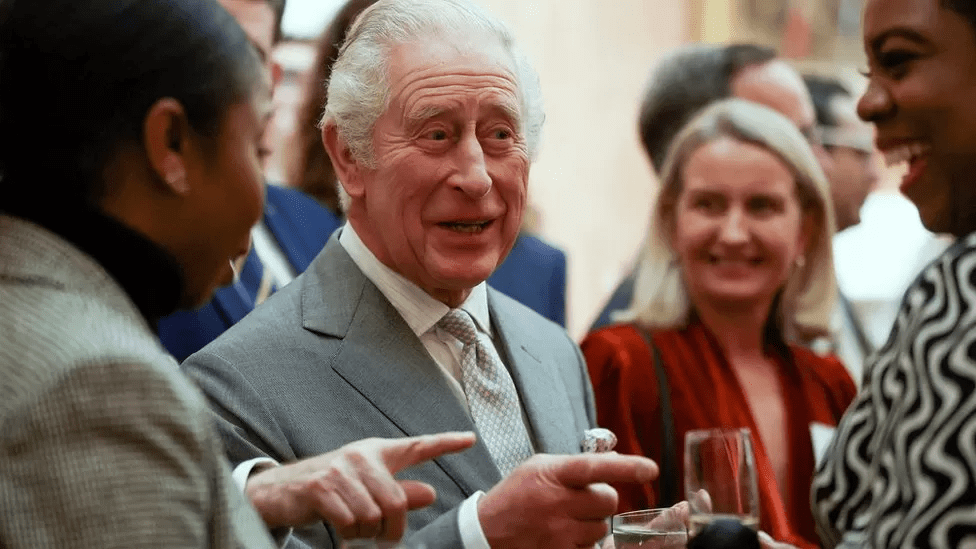
There will be no foie gras served in royal residences, a letter from Buckingham Palace to animal rights campaigners has confirmed.
King Charles is understood to have been a longstanding opponent of the food, made from the liver of a duck or goose, that campaigners say is cruel.
The King’s household wrote to the Peta campaign group that foie gras was not bought or served in royal residences.
There have been protests about force-feeding used to produce foie gras.
King Charles, when he was Prince of Wales, had been an advocate of higher welfare standards in farming and for over a decade had stopped the use of foie gras in his own properties and had been instrumental in a wider ban across royal residences.
Now as King he has reaffirmed this opposition – with the luxury food staying off the menu.
A letter received by Peta (People for the Ethical Treatment of Animals) confirms that a foie gras ban is in place across the Royal Household and for all royal residences, which would include Balmoral, Sandringham, Windsor Castle, Hillsborough Castle and Buckingham Palace.
Elisa Allen, vice president of the animal welfare group, welcomed this saying others should “follow the King’s lead and leave foie gras off the menu this Christmas and beyond”.
“Video footage of birds being painfully force-fed is enough to make anyone lose their lunch,” she said, describing how the livers of animals are engorged to produce the food.
The animal rights group has backed a “cruelty free” alternative called “faux gras” and is sending some of this to the King, which it says is in recognition of his “compassionate policy”.
There is a ban on the production of foie gras in the UK, but not a ban on its sale or importation.
But it will certainly not be on the menu next week for the first state visit of King Charles’s reign, when he hosts a state banquet in Buckingham Palace for the South African president, Cyril Ramaphosa.
The Peta group is also campaigning for the use of fake fur instead of ermine for robes at the King’s coronation next May.
Each day the Dakota Access Pipeline (DAPL) continues to operate, it violates Indigenous sovereignty and treaty rights and poses a constant threat to the Missouri River — a crucial water source for the Standing Rock Sioux and Cheyenne River Sioux Tribes as well as much of the United States.
Last year a federal court ordered the U.S. Army Corps of Engineers to evaluate the environmental impacts of the pipeline before the project can proceed. But, the U.S. Army Corps of Engineers is refusing to make many of their most critical findings public, especially relating to the effects of a potential oil spill and the effectiveness of spill response plans.
Showing the immense risk that this pipeline poses is an important step in the fight to end the threat DAPL poses to people and the environment. This information is crucial to understanding the immense risk this pipeline poses. The U.S. Army Corps of Engineers has access to data from the Department of Transportation (DOT) — but they won’t make it public.
DAPL crosses the Missouri River one-eighth of a mile from the Standing Rock Sioux Tribe Reservation and travels under Lake Oahe, a reservoir that is the primary water source for the Reservation. The risk of a spill poses an immense threat to the Reservation drinking water system as well as crucial fish and wildlife habitats that provide food for residents of the Standing Rock Sioux Tribe.
While the U.S. Army Corps of Engineers is assessing the environmental impacts of the pipeline, the results of which will likely be revealed next year, the pipeline operator Energy Transfer Partners (ETP) — a company with a disastrous history of pipeline safety violations — wants to double the flow rate of the pipeline to nearly a million barrels a day . This will inevitably put more pressure on the pipeline, increase the risk of oil spills, and risk the safety of the Tribes’ water sources — and makes it even more vital that the Army Corps produces a fair assessment of the impacts of the pipeline in order to head off this threat.
The continued operation of the pipeline and the lack of transparency that is playing out in the review is an environmental justice issue, as the communities being affected the most by the pipeline’s operation and who would be first responders to a potential spill are being left out of the assessment process.
Sincerely,
Matthew McKinzie Senior Director of Planning and Operations, NRDC
Above – Veteran reunited with girl he helped during WWII
Veteran reunited with girl he helped during WWII
A 99-year-old veteran who fed a French girl during the Second World War has been reunited with her 78 years on.
During the Battle of Normandy, Reg Pye served with the Royal Engineers as a driver carrying sappers, mines and ammunitions.
While moving through Normandy, 14 days after D-Day in June 1944, Mr Pye spotted a 14-year-old girl staring at him while he ate his evening meal – a slice of bread with jam and a tin of pilchards.
Aged 21 at the time, Mr Pye handed his bread and jam over to the girl who ran away to eat it.
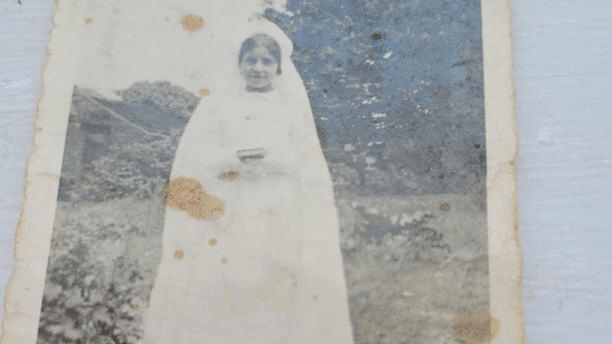
The following morning he found the girl had half-filled his mess tin with milk and left a handwritten note on the back of a picture of herself, which Mr Pye then kept in his wallet ever since.
Above – The picture Huguette left in Mr Pye’s mess tin
Some 78 years after their initial meeting, Mr Pye reunited with the girl who has been identified as Huguette, now 92.
The pair met in France where Mr Pye showed her the picture he kept, and gave her another jam sandwich.
“Nice to see you again after such a long time. We got older but we’re still the same,” Mr Pye said when meeting Huguette.
With the help of a translator, the pair drank champagne with their extended families.
“The memory of my very brief encounter with this young girl will stay with me forever,” Mr Pye added.
“In the bleakest of times this bit of human interaction made a huge mark on my life, I have carried her picture in my wallet for 78 years always hoping we might meet again.”
The reunion was made possible after Paul Cook, a volunteer from Taxi Charity for Military Veterans, started a social media campaign after hearing the story.
“There are no words to describe how elated I am that Reg has found Huguette, this is like a Hollywood blockbuster and I wouldn’t be surprised if this beautiful story was made into a film,” Mr Cook said.
Primates exposed to severe suffering in brain research experiments in Germany
15 November 2022
DAAE
News
Doctors Against Animal Experiments have revealed the severe suffering of non-human primates used for brain research experimentation in Germany, and reveal that eight institutions are currently carrying out similar tests that should be banned under EU law.
In 2009, six dead primates used for scientific experimentation at the Max Planck Institute for Biological Cybernetics in Tübingen were sent to a governmental pathological institution to investigate their cause of death. The examination revealed severe injuries on the skull, cerebral membranes and the brain which must have caused excruciating pain for months.
New photo and video evidence obtained by Doctors Against Animal Experiments has exposed the extreme cruelty of the experiments to the public. The footage garnered significant interest and was broadcast on a major German television programme.
Monkeys in brain research are subjected to unimaginable suffering. This is revealed by a dissection report documenting head injuries such as drill holes in the skull bone and stab wounds in the brain of such animals. Official veterinary pathologists found that the monkeys used by the Max Planck Institute for Biological Cybernetics (MPI Tübingen) in Tübingen were suffering not only severely, but extremely severely, which was fully known to the competent authorities.
Doctors Against Animal Experiments
This shocking case is not an isolated incident. The MPI Tübingen stopped its primate experiments in 2017 due to public pressure after years of campaigning and an undercover investigation in 2014. However, similar tests are still being carried out in Bremen, Göttingen, Magdeburg, Marburg, Frankfurt, and at three other institutes in Tübingen.
Directive 2010/63/EU sets an upper limit for pain and suffering above which animal testing should no longer be carried out. Recital 23 states that “from an ethical standpoint, there should be an upper limit of pain, suffering and distress above which animals should not be subjected in scientific procedures”, and article 15 states that “Member States shall ensure that a procedure is not performed if it involves severe pain, suffering or distress that is likely to be long-lasting and cannot be ameliorated.”
However, if for exceptional and scientifically justifiable reasons, a Member State deems it necessary to carry out a procedure involving severe pain, suffering or distress that is likely to be long-lasting and cannot be ameliorated, Member States may adopt a provisional measure to allow such a procedure. In that case, the Member State shall immediately inform the Commission and the other Member States, and provide reasons and evidence for its decision to allow a provisional measure. Then, the Commission may either authorise the provisional measure or require the Member State to revoke the provisional measure.
When applying for project authorisation, researchers classify the severity of this type of procedure usually as “moderate” (i.e. short-term moderate pain, suffering or distress, or long-lasting mild pain, suffering or distress). The unveiling of Doctors Against Animal Experiments have shown that primate brain research procedures often involve pain, suffering or distress that is “likely to be long-lasting and cannot be ameliorated”. Therefore, such procedures should only be authorised if they have been the subject of a request for a provisional measure, in accordance with the Directive.
Call for action in Germany
Doctors Against Animal Experiments are calling for decision-makers to no longer approve such procedures in Germany, and to stop the use of non-human primates in brain research immediately.
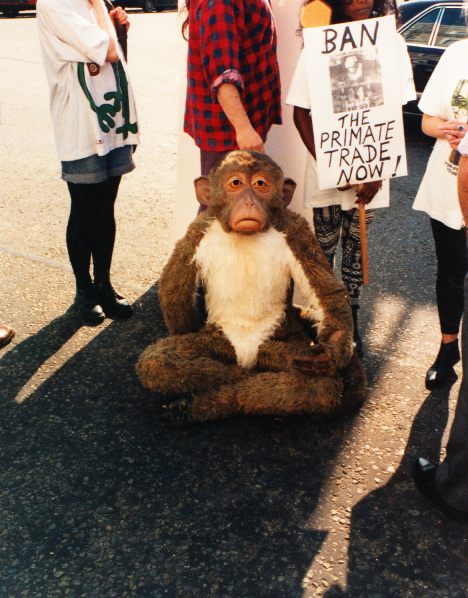
It was like over 35 years ago that Joanne and I, plus a few other members of our (then) group, went up to the Mauritanian embassy in London to protest against the primate trade. Read more and see photos of that day in the first link below.
I am unsure if the primates associated with the German issue detailed above were originallly supplied from Mauritius; all I can do is try to publicise what is still happening in Europe right now.




















 World Animals Voice