Category: Uncategorized

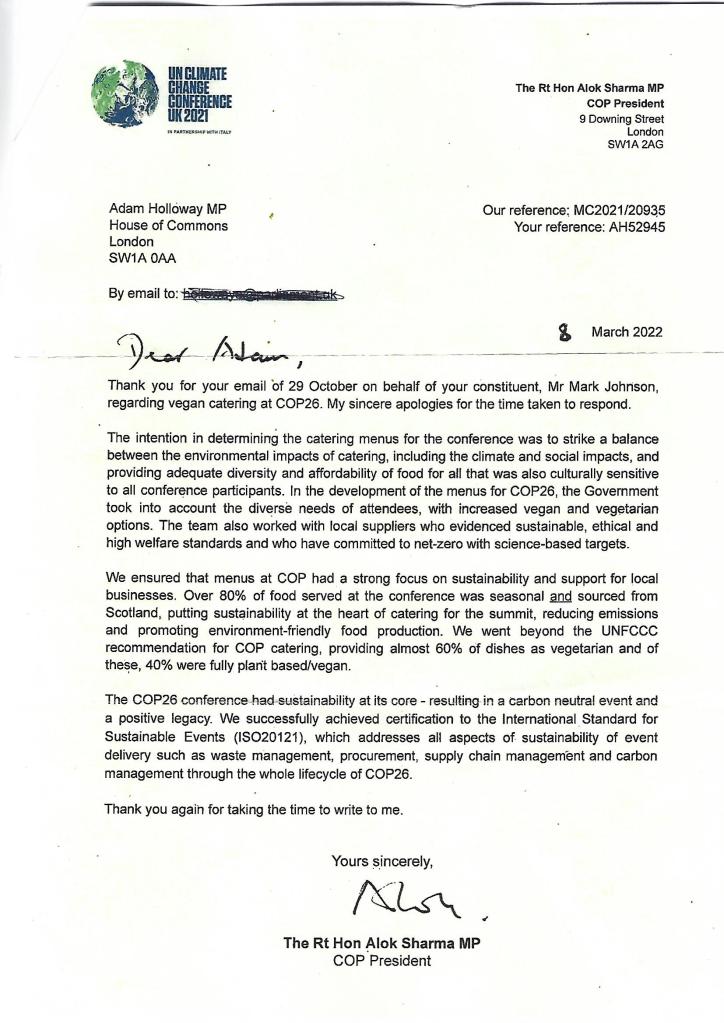
UK: Finally Alok Sharma Replies To Our COP26 Conference Letter Asking About Vegan Food.

Last year, October 2021 to be precise, I wrote to my MP asking him to contact Alok Sharma regarding what appeared to be a distinct lack of veggie and vegan food at the COP26 (Climate) conference.

You can read the original letter and information here:

8 October 2021 letter:

England: Vegan Food At COP26. Why None ? – WAV Now Write To MP and Ask Him To Contact Mr Sharma For Responses. Keep Ramping It Up Sort Of Thing ! – World Animals Voice

Well finally, like 8th March 2022,   Alok Sharma has written a reply to the letter.

I attach a copy of his letter for you to view and decide on the results for yourself.

Reply: 

Regards Mark

Related info:

https://worldanimalsvoice.com/?s=COP+26

Microplastics found in human blood for first time.

The Guardian, London.

Exclusive: The discovery shows the particles can travel around the body and may lodge in organs

Microplastics found in human blood for first time | Plastics | The Guardian

Microplastic pollution has been detected in human blood for the first time, with scientists finding the tiny particles in almost 80% of the people tested.

The discovery shows the particles can travel around the body and may lodge in organs. The impact on health is as yet unknown. But researchers are concerned as microplastics cause damage to human cells in the laboratory and air pollution particles are already known to enter the body and cause millions of early deaths a year.

Huge amounts of plastic waste are dumped in the environment and microplastics now contaminate the entire planet, from the summit of Mount Everest to the deepest oceans. People were already known to consume the tiny particles via food and water as well as breathing them in, and they have been found in the faeces of babies and adults.

The scientists analysed blood samples from 22 anonymous donors, all healthy adults and found plastic particles in 17. Half the samples contained PET plastic, which is commonly used in drinks bottles, while a third contained polystyrene, used for packaging food and other products. A quarter of the blood samples contained polyethylene, from which plastic carrier bags are made.

“Our study is the first indication that we have polymer particles in our blood – ​it’s a breakthrough result,” said Prof Dick Vethaak, an ecotoxicologist at Vrije Universiteit Amsterdam in the Netherlands. “But we have to extend the research and increase the sample sizes, the number of polymers assessed, etc.” Further studies by a number of groups are already under way, he said.

“It is certainly reasonable to be concerned,” Vethaak told the Guardian. “The particles are there and are transported throughout the body.” He said previous work had shown that microplastics were 10 times higher in the faeces of babies compared with adults and that babies fed with plastic bottles are swallowing millions of microplastic particles a day.

“We also know in general that babies and young children are more vulnerable to chemical and particle exposure,” he said. “That worries me a lot.”

The new research is published in the journal Environment International and adapted existing techniques to detect and analyse particles as small as 0.0007mm. Some of the blood samples contained two or three types of plastic. The team used steel syringe needles and glass tubes to avoid contamination, and tested for background levels of microplastics using blank samples.

Vethaak acknowledged that the amount and type of plastic varied considerably between the blood samples. “But this is a pioneering study,” he said, with more work now needed. He said the differences might reflect short-term exposure before the blood samples were taken, such as drinking from a plastic-lined coffee cup, or wearing a plastic face mask.

“The big question is what is happening in our body?” Vethaak said. “Are the particles retained in the body? Are they transported to certain organs, such as getting past the blood-brain barrier?” And are these levels sufficiently high to trigger disease? We urgently need to fund further research so we can find out.”

The new research was funded by the Dutch National Organisation for Health Research and Development and Common Seas, a social enterprise working to reduce plastic pollution.

“Plastic production is set to double by 2040,” said Jo Royle, founder of the charity Common Seas. “We have a right to know what all this plastic is doing to our bodies.” Common Seas, along with more than 80 NGOs, scientists and MPs, are asking the UK government to allocate £15m to research on the human health impacts of plastic. The EU is already funding research on the impact of microplastic on foetuses and babies, and on the immune system.

A recent study found that microplastics can latch on to the outer membranes of red blood cells and may limit their ability to transport oxygen. The particles have also been found in the placentas of pregnant women, and in pregnant rats they pass rapidly through the lungs into the hearts, brains and other organs of the foetuses.

A new review paper published on Tuesday, co-authored by Vethaak, assessed cancer risk and concluded: “More detailed research on how micro- and nano-plastics affect the structures and processes of the human body, and whether and how they can transform cells and induce carcinogenesis, is urgently needed, particularly in light of the exponential increase in plastic production. The problem is becoming more urgent with each day.”

Microplastic particles now discoverable in human organs

This article is more than 1 year old

New technique expected to enable scientists to find accumulated microplastics in humans

Microplastic particles now discoverable in human organs | Plastics | The Guardian

Regards Mark
Four Rescued Bear Cubs Find Happiness At Animals Asia’s Sanctuary.

Click here to read more:

Four rescued bear cubs find happiness at Animals Asia’s sanctuary

22 March 2022

Wonder, Marvel, Yen and Pudding were victims of the illegal wildlife trafficking trade. Torn from their mothers at just a few weeks old, they were thrown into tiny cages to be sold to the highest bidder. But just as they were facing a terrifying future, Animals Asia rescued Wonder, Marvel, and Yen, and Hanoi Wildlife Rescue Centre rescued Pudding.

First few weeks at sanctuary

The first few days at our sanctuary were understandably difficult for the cubs. Terrified, confused, and desperately missing their mums, they paced, swayed their heads and sucked their paws – typical signs of distress in captive animals.

Our bear care team took it in turns to look after the cubs day and night. They quietly sat with them, gently offering food and natural enrichment, and talking to them in calm, soothing and reassuring voices.

Baby steps

After a few weeks, the cubs had developed good appetites, were playing with the natural toys we gave them, and their distressing behaviour had eased. Yen showed a particular interest in hessian sacks and played with them for hours, while Marvel, despite being very nervous when he first arrived, loved the noisy toys the most!

They were ready to move to the special area of our sanctuary that’s reserved for our smallest and youngest bears, the Cub House!

The cubs were moved to their own dens which were joined together but separated by sliding doors, so they could hear, smell and see each other from the safety and comfort of their own spaces.

Click on the top link to read more.

Regards Mark

If you wish to make a donation:

Animals Asia | Make a donation to Animals Asia

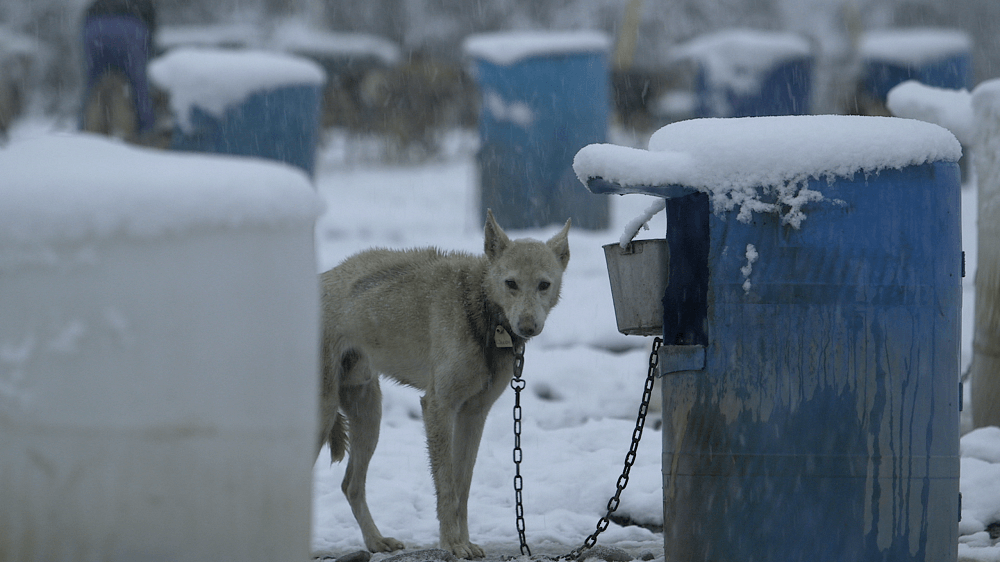
USA: Iditarod 2022 Is Now Over. Almost 250 Dogs Pulled Off The Event This Year Because of Exhaustion, Illness and Injury. Take Action.

Iditarod 2022 is now over.

Animal abuse is the name of the game for Alaska’s Iditarod dog-sled race—and this year was no exception. During the nearly two-week ordeal, which ended yesterday, two dogs went missing and a musher was apparently forced to drop out after dogs he used were found in poor condition. In addition, during training before the race even began, multiple dogs were attacked and one was killed.

Nearly 250 dogs were pulled off the trail this year because of exhaustion, illness, injury, or other causes—forcing the remaining ones to work even harder to pull the sleds. Brent Sass was crowned the winner, but the only thing he really won was the title of Top Dog Abuser.

Please join PETA in working to ensure that this year’s race is the last by urging companies to stop sponsoring the Iditarod

Check out PETA’s complete list of everything that occurred during the Iditarod—and share this e-mail with everyone you know.

Take Action:

The Deadly Iditarod Race Should Be Terminated: Here’s Why (peta.org)

Regards Mark

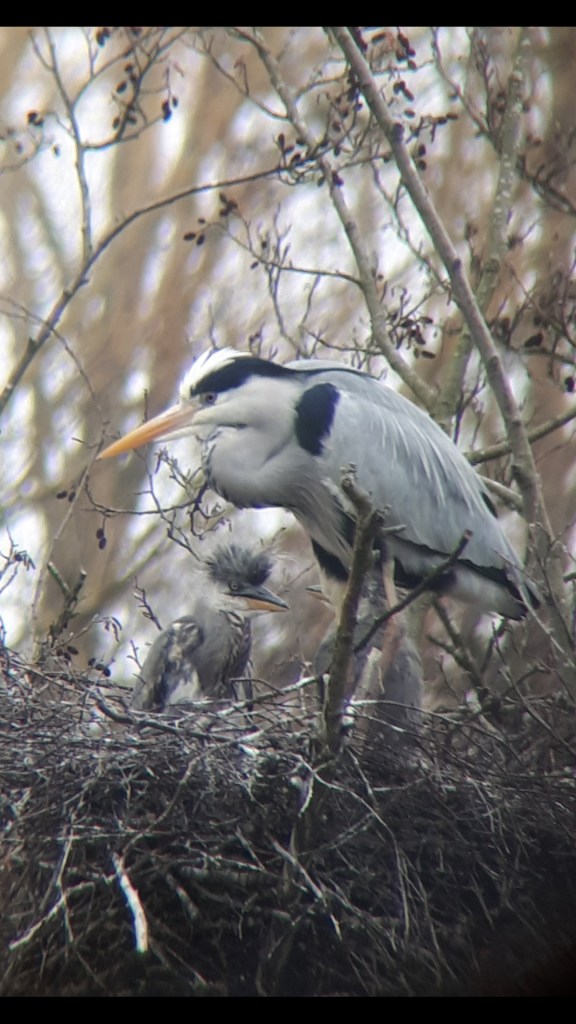
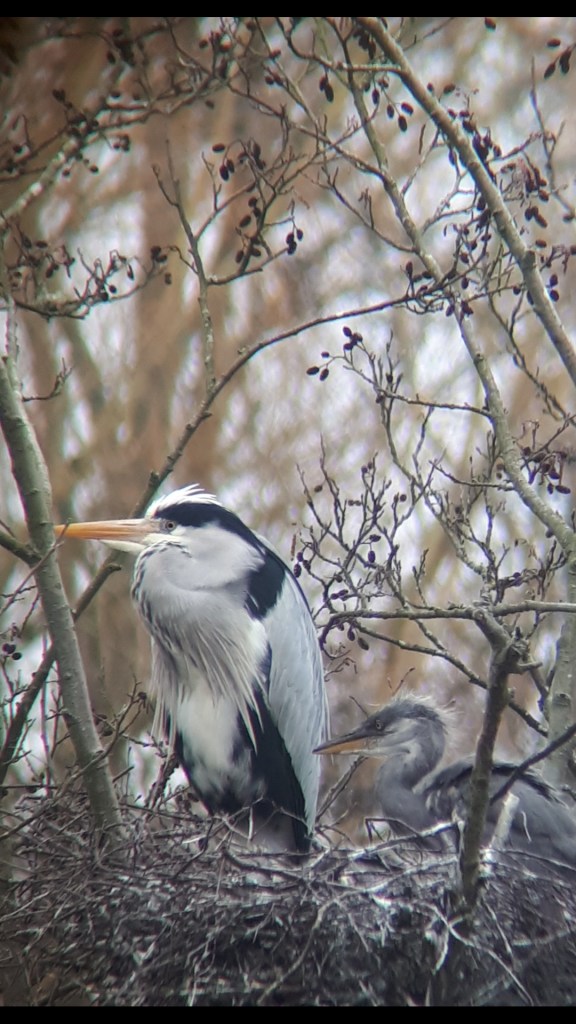
England: Punk Hair Baby Heron Dude !

Pictures supplied by friend Pauline; which we want to share with you.

She says:

Took these photos of 2 branchlings (baby herons) last week at a Sevenoaks Wildlife reserve (Kent, England).

Four nests high in the trees.

One unoccupied. Two with females laying on eggs (presuming on the eggs) and one with the female and two young.

I love the punk hair on the youngster – see first photo particularly !

Regards Mark

So, Why aren’t there polar bears in Antarctica?

© Provided by Live Science Polar bear on melting ice in Svalbard, Norway_Paul Souders via Getty Images

The Arctic and Antarctica, while similar habitats in some ways, are home to very different creatures. Both poles host a variety of seal and whale species, but only the Arctic is home to Earth’s largest bear, the polar bear.

Polar bears (Ursus maritimus) and their tumbly cubs can be found around the Arctic Circle in Alaska, Canada, Greenland (part of Denmark), Norway, Russia and, occasionally, Iceland. A polar bear’s fur is specially suited for temperatures that can dip below minus 22 degrees Fahrenheit (minus 30 degrees Celsius). They live on ice for most of their lives, feeding on fat-rich seals that keep them energized for long periods between meals.

Antarctica also has sea ice, cold temperatures and seals. So why aren’t there any polar bears on the southernmost continent?

The answer has to do with evolution and the geologic history of Earth.

Related: How do emperor penguin dads stop their eggs from freezing?

Bears are largely a Northern Hemisphere phenomenon,” said Andrew Derocher, a professor of biological sciences at the University of Alberta in Canada who has studied polar bears for nearly 40 years. Aside from the Andean bear (Tremarctos ornatus) of South America, bears appear only in the Northern Hemisphere. There’s no specific reason for this, just that some species evolve in some places and some don’t. “Biogeography is full of oddities,” Derocher said. “Some species made it to new places and some didn’t.”

For polar bears specifically, there was never a time in their evolutionary history when the North and South poles were connected by ice (or land, for that matter). People say polar bears are the “biggest terrestrial carnivore in the world, and yet they’re not a terrestrial species at all,” Derocher told Live Science. The big, white bears live on sea ice for almost their entire lives, only occasionally coming ashore to breed.

Polar bears are, evolutionarily, a relatively young species. They evolved from a common ancestor of the brown bear (Ursus arctos) sometime between 5 million and 500,000 years ago, Derocher said. But even 5 million years ago, the continents were in similar positions to where they are today, so polar bears never got the opportunity to travel from pole to pole. The closest landmass to Antarctica is the southern tip of South America, which includes Chile and Argentina. To get to Antarctica, polar bears would have to cross the treacherous Drake Passage. The area is also known for powerful storms and rough seas as cold water from the south runs into warm water from the north.

But if polar bears got the opportunity, would they survive on the South Pole?

To Derocher, the answer is simple: “They would have so much fun in Antarctica.”

In the Arctic, polar bears feed on seals and the occasional bird or egg. Antarctica is abundant in all three, with six seal species and five penguin species. Plus, none of those animals have evolved to be wary of large, land-roving predators. The Antarctic landscape would be a free-for-all buffet for a polar bear — which is why no one should ever bring polar bears there. Their voracious appetite, combined with the local faunas’ ignorance of large land predators, would likely lead to ecological collapse. It’s probably best for the great white bear to remain in the north.

Originally published on Live Science.

Regards Mark

England: RSPCA to bring prosecution against Zouma and brother.

The RSPCA has begun the process of bringing a prosecution against Kurt and Yoan Zouma under the Animal Welfare Act.

West Ham defender Kurt was filmed by his brother Yoan, who plays for Dagenham & Redbridge, slapping and kicking his own cats in a video that was shared on social media. The 27-year-old’s pets were taken away and remain in care.

An RSPCA statement said: “Following a full and thorough investigation, we have started the process of bringing a prosecution against Kurt Zouma and Yoan Zouma under the Animal Welfare Act.

“The two cats continue to be cared for by the RSPCA. We will be in a position to release more information once a court date is confirmed.”

Zouma misses Leicester game due to illness | Souness: Zero sympathyAntonio questions Zouma reaction: ‘Is what he’s done worse than racism?’West Ham fine Zouma after RSPCA take cats | Adidas drops defenderWest Ham back Moyes’ ‘footballing decisions’ over Zouma

A West Ham statement said: “West Ham United is aware of the RSPCA statement in relation to its investigation involving Kurt Zouma. Kurt continues to co-operate fully, supported by the Club.

“It is our understanding that Kurt’s cats have been checked by a vet, are in good health and have suffered no physical injuries. For legal reasons, neither Kurt or the Club will be making any further comment at this time.”

Kurt Zouma apologised for his actions earlier this year. He said: “I also want to say how deeply sorry I am to anyone who was upset by the video. I would like to assure everyone that our two cats are perfectly fine and healthy.

“They are loved and cherished by our entire family, and this behaviour was an isolated incident that will not happen again.”

West Ham were widely criticised for continuing to select Kurt Zouma, including for their Premier League match with Watford less than 24 hours after the video emerged.

Yoan Zouma was suspended by Dagenham in February. A statement said: “Dagenham & Redbridge FC note the decision of the RSPCA to charge Yoan Zouma under the Animal Welfare Act 2006.

“Whilst Yoan continues to fully co-operate with the RSPCA, as this matter has now progressed further, Dagenham & Redbridge FC feel it is no longer appropriate for either Yoan or the club to make any further statement.

“Dagenham & Redbridge FC maintain their position in that the club continues to condemn all animal cruelty.”

Dagenham said the defender would be available to play for them after his period of suspension.

“Since the allegation, and whilst investigations were taking place, Dagenham &Redbridge FC took the decision that Yoan should not play football for the club,” the statement continued.

“Four weeks have now elapsed however since the incident, and the club feels that any further suspension from the team would be detrimental to both the club and Yoan. A decision has been made therefore for Yoan to be available to play.

“The club reserves the right to take further action if deemed necessary after conclusion of the court proceedings.”

Regards Mark

Link:  RSPCA to bring prosecution against Zouma and brother (msn.com)

© Getty Yoan Zouma, pictured playing for Barrow in October 2020, has been charged under the Animal Welfare Act 2006, current club Dagenham have said

Past links:

https://worldanimalsvoice.com/?s=zouma

EU: Animal Welfare and International Trade: Looking into the Mirror.

15 March 2022

Together with the French Presidency of the Council of the EU, Eurogroup for Animals, in collaboration with its members Fondation Brigitte Bardot, Welfarm and Compassion in World Farming, today organised the event Animal Welfare and International Trade: Looking into the Mirror.

The conference aimed to discuss the trade dimension of the revision of European legislation on animal welfare, and to show how the approach adopted in “mirror measures”, one of the priorities of the French Presidency of the Council, can inject more coherence between the EU trade policy and the Green Deal, in particular with regard to animal welfare and the “Farm to Fork” strategy.

“Animal welfare is not properly considered in the framework of trade law, yet, it’s a crucial field when we discuss reciprocity”, said the French Minister for Agriculture and Food Julien Denormandie in his introductory remarks. “For the end of 2023 we’re expecting a legislative proposal on animal welfare in the context of the Farm to Fork strategy, and I believe it is essential for it to include a reciprocity component”, he added.

“Whilst facing huge global challenges, the EU can lead the way towards a truly sustainable and humane food system and trade policy. We believe that the mirror clauses represent a very good mechanism to support this transition. If the EU wants to become a truly sustainable producer and live up its reputation as leader in animal welfare, it is of utmost importance to revise the animal welfare acquis and this can only be done if our standards also apply to imported products. The concept of mirror clauses fits perfectly within this context and we thank the French government for being so persistent”, added Reineke Hameleers, CEO of Eurogroup for Animals 

After Philip Lymbery, CEO of Compassion in World Farming, closed the introductory remarks, three speakers set the stage for the discussions: Stéphanie Ghislain, Eurogroup for Animals, opened on the interconnections between international trade and animal welfare; Lucie Carrouée from DG SANTE elaborated on the discussions around the trade dimension in the current revision of the European legislation on animal welfare; and finally, Clémentine Baldon, lawyer at the Paris Bar, argued that, from a legal perspective, imposing new animal welfare standards on imports could be compatible with the rules of the World Trade Organisation (WTO).

During the panel discussion, Marie-Pierre Vedrenne MEP, vice-chair of the European Parliament INTA Committee, supported the idea: “Reciprocity is an essential topic, in line with strong and necessary demands from civil society, but also from farmers, because it fits with an objective of coherence between public policies.” She also rightly underlined the key challenge of implementing such rules, “An issue that will keep us busy is the implementation of this objective of reciprocity”, confirming it will be an important topic for the European Parliament. 

“Consumers are in favour of international trade as long as there is no race to the bottom in terms of regulations, and they can’t imagine that imported products do not respect the rules applied in the EU.  93% of EU citizens demand that trade policy reflect European norms, including on animal welfare”, explained Monique Goyens, CEO of BEUC. 

“WTO rules can be a hurdle but it’s not impossible. We have a caselaw very clear on that and on the conditions that have to be met. When there is a moral concern, we can of course legislate and we’ll be doing this in a number of areas”, indicated Iciar Chavarri-Ureta, Deputy Head of the Agriculture, Food and Sanitary and Phytosanitary Matters Unit in DG Trade. 

The event was also the occasion to launch the new report Bye Bye cages, by Eurogroup for Animals and Compassion in World Farming, on the legality of an EU ban on the sales of meat and eggs produced from caged animals including imported food

Watch event recording

Regards Mark

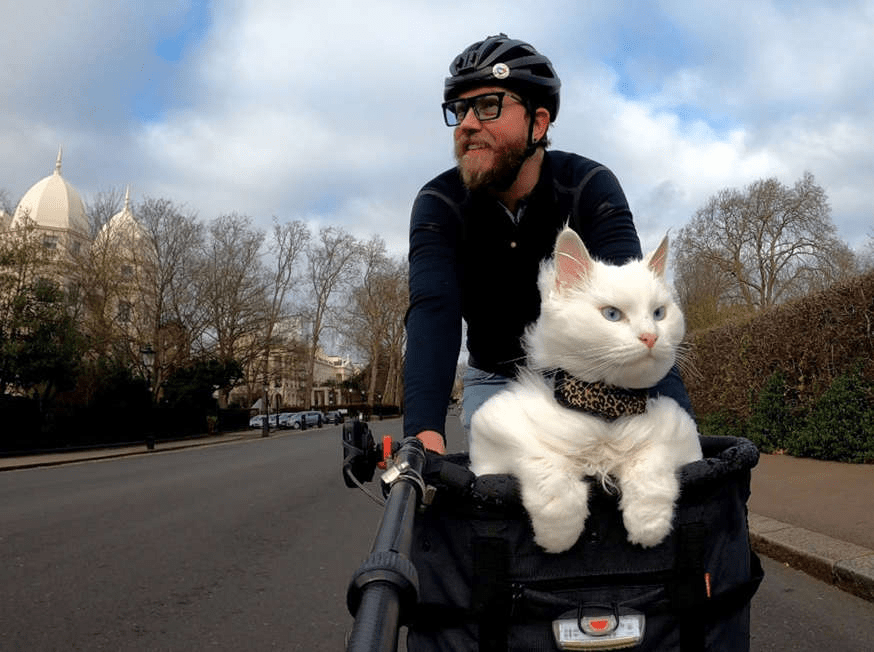
England: Meet the Adorable Deaf Cat Who Loves Bike Rides Around London.

 Sigrid rides in owner Travis’s bike basket (Picture: @sigirides/Caters News)

Norwegian forest cat Sigrid may be deaf, but it doesn’t stop her getting out and about.

In fact, the fluffy white moggy likes nothing more than going for a cycle – and you may even have spotted her traversing the streets of London in her owner’s handlebar basket.

Software engineer Travis Nelson, 46, takes Sigrid with him when he explores the city, with the four-year-old cat attracting plenty of attention from passers-by.

A typical journey for the pair will begin in Regent’s Park and end up in Jubilee Park, so Sigrid can see the sights.

Travis said: ‘This is fairly normal for us! Although we usually stop for more pets.

‘She definitely loves the bike rides. She often begs at the door to go out and gets excited when I start messing with my bike.

‘She’s always happy and inquisitive when we’re out.’

Travis first took Sigrid out on his bike when he was made redundant during the pandemic, looking to try something new with his ‘best friend’.

What started with training her to walk on a lead led to her being comfortable enough to relax in a basket, even wearing goggles to protect her eyes from wind.

Travis now shares photos and videos of their journeys together, during his time out from work spending up to four hours a day editing content and replying to Instagram messages.

Spot Jeremy Clarkson in the back, as well as Sigrid’s chic cycling goggles (Picture: @sigirides/Caters News)

Speaking to Ham and High, he said: ‘I usually describe us as best friends. We’re together all the time. Sigrid does mean a lot to me. It’s been a tough year and she’s been a big comfort. 

‘It’s a little odd now, almost every time we go riding we get recognised by someone. It feels like we have friends everywhere.’

Sigrid’s unique hobby has seen them attending the Pride Ride together, as well as their picture being shown on screens on the Moscow Metro.

It’s really more about the fun of it for the duo, however, and the adventurous cat has no problem making her intentions to head outside known to her owner.

Travis added: ‘She always seems to love going outside. She’ll stand at the door and whine.

‘She sees me messing with my bike and she starts running around getting excited, it’s her favourite thing to do.’

Travis and Sigrid’s usual route is through Regent’s Park, where passers-by often stop to pet the intrepid kitty (Picture: @sigirides/Caters News)

Love the picture of her in her little goggles – cool !

Regards Mark

USA: Camel kills two men at petting zoo in Tennessee.

Two men were killed in a camel attack at a petting zoo in Tennessee, officials say.

Law enforcement were called to Shirley Farms in Obion, Tennessee, after reports of a “loose” camel in the area.

When sheriff’s deputies arrived on the scene on Thursday afternoon they found “two unconscious victims on the ground.”

Both men died of their injuries at the scene, said authorities.

Officials say that while deputies tried to remove one of the victims for medical treatment, the animal attacked an Obion Sheriff’s Office patrol car and charged at the deputies.

“It was at this time officers had to put the camel down for the safety of everyone on scene,” the  department said in a statement.

Authorities have identified the victims as Bobby Matheny, 42, of Ridgely and Tommy Gunn, 67, of Obion.

It is unclear what kind of camel was involved in the incident, which took place around 100 miles north of Memphis.

There was no immediate information on how the camel got loose on the farm.

Camel kills two men at petting zoo in Tennessee (msn.com)

Regards Mark