Month: August 2020

Coronavirus: world treating symptoms, not cause of pandemics, says UN.

Source – England:

https://www.theguardian.com/world/2020/jul/06/coronavirus-world-treating-symptoms-not-cause-pandemics-un-report

Coronavirus: world treating symptoms, not cause of pandemics, says UN

Ongoing destruction of nature will result in stream of animal diseases jumping to humans, says report

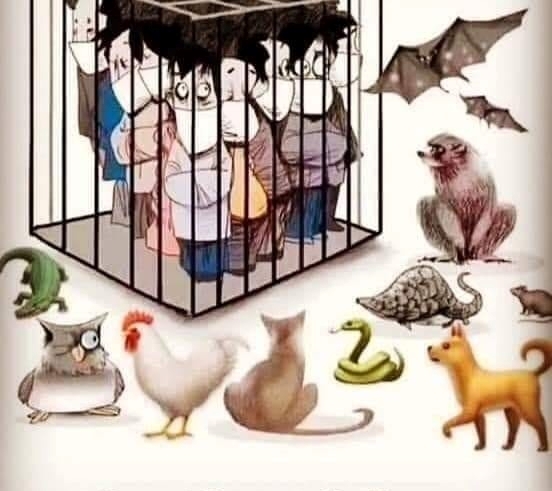
The world is treating the health and economic symptoms of the coronavirus pandemic but not the environmental cause, according to the authors of a UN report. As a result, a steady stream of diseases can be expected to jump from animals to humans in coming years, they say.

The number of such “zoonotic” epidemics is rising, from Ebola to Sars to West Nile virus and Rift Valley fever, with the root cause being the destruction of nature by humans and the growing demand for meat, the report says.

Even before Covid-19, 2 million people died from zoonotic diseases every year, mostly in poorer countries. The coronavirus outbreak was highly predictable, the experts said. “[Covid-19] may be the worst, but it is not the first,” said the UN environment chief, Inger Andersen.

Human impact on wildlife to blame for spread of viruses, says study

The biggest economic costs fall on rich nations – $9tn (£7.2tn) for Covid-19 over two years, according to the IMF’s chief economist. This makes a very good case for investment in the countries where diseases emerge, the authors say.

The report said a “one health” approach that unites human, animal and environmental health is vital, including much more surveillance and research on disease threats and the food systems that carry them to people.

“There has been so much response to Covid-19 but much of it has treated it as a medical challenge or an economic shock,” said Prof Delia Grace, the lead author of the report by the United Nations Environment Programme (Unep) and the International Livestock Research Institute (Ilri).

“But its origins are in the environment, food systems and animal health. This is a lot like having somebody sick and treating only the symptoms and not treating the underlying cause, and there are many other zoonotic diseases with pandemic potential.”

“An intense surge in human activity is affecting the environment all across the planet, from burgeoning human settlements to [food production], to increasing mining industries,” said Doreen Robinson, Unep’s chief of wildlife. “This human activity is breaking down the natural buffer that once protected people from a number of pathogens. It’s critically important to get at the root causes, otherwise we will consistently just be reacting to things.”

“The science is clear that if we keep exploiting wildlife and destroying our ecosystems, then we can expect to see a steady stream of these diseases jumping from animals to humans in the years ahead,” said Andersen.

Wildlife and livestock are the source of most viruses infecting humans and the report cites a series of drivers of outbreaks, including rising demand for animal protein, more intensive and unsustainable farming, greater exploitation of wildlife, surging global travel and the climate crisis. It also says many farmers, regions and nations are reluctant to declare outbreaks for fear of damaging trade.

“The primary risks for future spillover of zoonotic diseases are deforestation of tropical environments and large-scale industrial farming of animals, specifically pigs and chickens at high density,” says the disease ecologist Thomas Gillespie of Emory University in the US, an expert reviewer of the report. “We are at a crisis point. If we don’t radically change our attitudes toward the natural world, things are going to get much, much worse. What we are experiencing now will seem mild by comparison.”

Pandemics result from destruction of nature, say UN and WHO

The report highlights some examples of where zoonotic risks are being managed. In Uganda, deaths from Rift Valley fever have been reduced by using satellite data to anticipate heavy rainfall events, which can produce mosquito swarms and trigger outbreaks.

The report is the latest stark warning that governments must address the destruction of the natural world to prevent future pandemics. In June, a leading economist and the UN said the coronavirus pandemic was an “SOS signal for the human enterprise”, while in April, the world’s leading biodiversity experts said more deadly disease outbreaks were likely unless nature was protected.

“At the heart of our response to zoonoses and the other challenges humanity faces should be the simple idea that the health of humanity depends on the health of the planet and the health of other species,” said Andersen. “If humanity gives nature a chance to breathe, it will be our greatest ally as we seek to build a fairer, greener and safer world for everyone.”
„The vulture and the little girl“: a lesson for animal rights activists

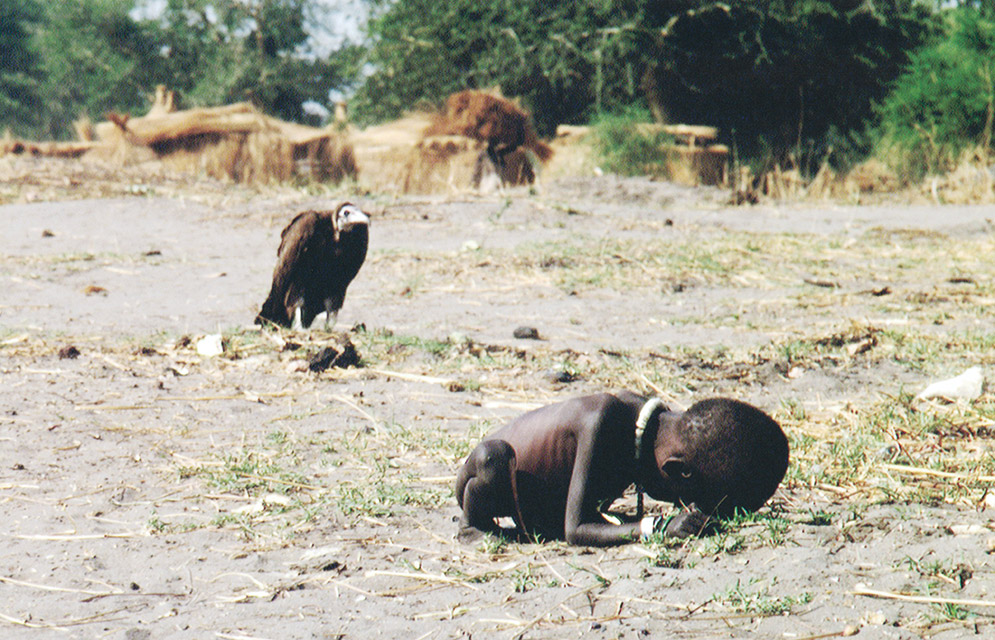
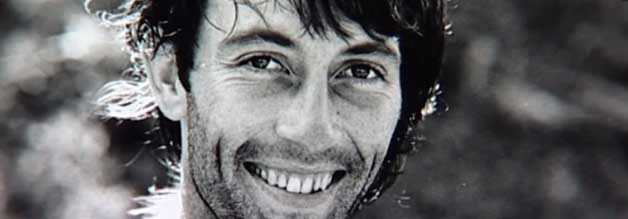
Kevin Carter is the author of a photo that has become a symbol of an emaciated continent: for “The vulture and the little girl”, the member of the famous Bang Bang Club was awarded the 1994 Pulitzer Prize. A few weeks later, Carter is dead.

Kevin-Carter

In April 1994, 14 months after capturing that memorable scene, Carter walked up to the dais in the classical rotunda of Columbia University’s Low Memorial Library and received the Pulitzer Prize for feature photography. The South African soaked up the attention.

What was the occasion?
A monumental photo from Sudan, March 1993.

A starved little girl crouches on the floor of the Sudanese steppe, watched by a vulture that just seems to be waiting for the child to stop moving.

-kevin-carter--child-vulture-87This photo of Kevin Carter’s photo was published in the New York Times on March 26th.
 

What happens after Kevin Carter’s photo is published in the New York Times on March 26th far exceeds any hope of donation aid.
It becomes a symbol of an independent continent, donations reach unimagined heights, hardly a humanitarian appeal for donations in the following years gets along without this motif.

Shortly after the picture appeared, the newspaper received numerous questions about the girl’s further fate. The Times slips an editor’s note, which can be summed up as follows: We don’t know anything more precise.

Kevin Carter himself reports that the little one has regenerated and found her way back to the village a few minutes after being admitted.
Critics accuse Kevin Carter of failing to provide assistance. Others go a little further: the real vulture was lurking on the other side of the viewfinder.

Even some of Carter’s friends wondered aloud why he had not helped the girl.

Carter was painfully aware of the photojournalist’s dilemma. “I had to think visually,” he said once, describing a shoot-out.

“I am zooming in on a tight shot of the dead guy and a splash of red. Going into his khaki uniform in a pool of blood in the sand.
My God.!! But it is time to work. Deal with the rest later. If you can’t do it, get out of the game.
Every photographer who has been involved in these stories has been affected. You become changed forever. Nobody does this kind of work to make themselves feel good. It is very hard to continue.”

The following year, in April 1994, Kevin Carter received the Pulitzer Prize.

The award does not silence the criticism, on the contrary: Carter is accused of having exploited the girl’s suffering for his fame as a photographer.
In the same month, his friend and work colleague Ken Oosterbroek was fatally wounded during an operation in South Africa.

A few weeks later, on July 27, 1994, Kevin Carter was also dead. He died of carbon monoxide poisoning, he gas himself to death. It was suicide.

In his suicide note, he wrote among other things … “I am haunted by the vivid memories of killings & corpses & anger & pain . . . of starving or wounded children, of trigger-happy madmen, often police, of killer executioners . . .”

Information: It was not until 2011 that Spanish journalists managed to locate the family. It turned out that the little girl was really a boy. Kong Nyong, the boy’s name, died in 2007, just of legal age, with malarian fever.

https://www.journalistenfilme.de/the-death-of-kevin-carter/


And I mean…The Kevin Carter case is very interesting for us animal rights activists because we often get the same moral accusations from others who only hear about animal suffering while they are sitting in front of their television.

We are also often accused of “only” documenting as if we had promised to save all animals in the world and have betrayed this mission.
When undercover videos come from laboratories or stables, it is a reason for many people to blame why the animal rights activists did not rescue or take the animals away.

We, in our struggle for the animal’s rights, are also “haunted by the vivid memories of killings & corpses & anger & pain” that we experience every day through the videos (or often life, in actions), which we have to endure only with good nerves if we want to fulfill our mission.

And our mission is objective information, education, documents of the truth about animal suffering, and the crime it causes.

In our private life, it burdens us very much that most people can only criticize, reproach, give advice.
If all of these would actively participate in our struggle, then today there would be no more or fewer pictures of dying children, suffering animals, and injustice in the world.

Kavin Carter paid for his guilty conscience with his suicide. It was a mistake to do so, after all, he was responsible for documenting the suffering in Sudan and making it known around the world.
The billions of people who drove him to suicide with their criticism did not tell us what kind of humane aid they provided to Sudan.

This is a lesson for us animal rights activists: we should know our limits, must remain active, and not expose ourselves to the risk of breaking under the moral pressure that we get every day from a vulture society.

My best regards to all, Venus

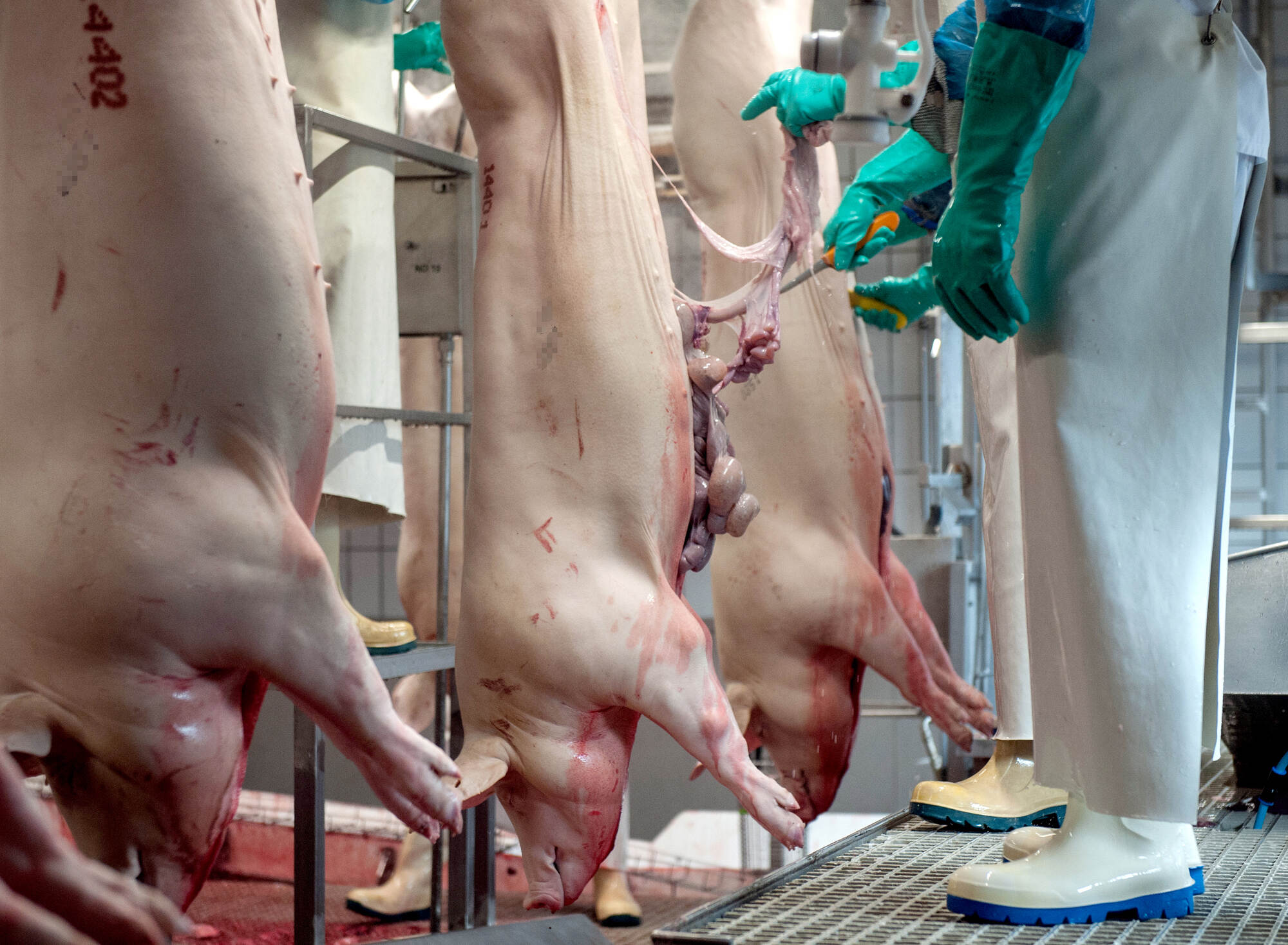
Slaughterhouse: How do people manage to kill hundreds of animals every day?


Two former butchers and a sociologist explain how animals are transformed from living creatures into row materials in professional, industrialized slaughtering, and what helps butchers to cope with their work emotionally.

_Schlachthof betrieb_65291592

“That was actually pretty abnormal,” says Thomas Schalz today, about his work in a slaughterhouse.
He worked there for 17 years, in all areas: driving, stunning, killing, and cutting the animals. The slaughterhouse in which he worked developed over the years into a large-scale slaughterhouse specializing in pigs.
Up to 3,500 pigs were slaughtered every day.

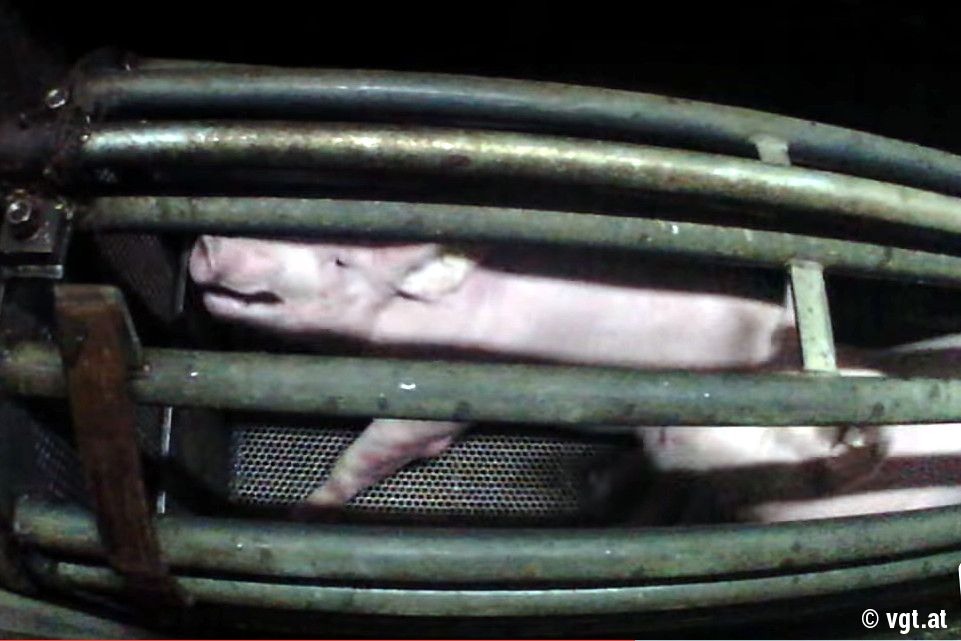
schweinefarm jpg

Above all, the anesthesia of the pigs with CO2, which happens before they are actually killed, is what Schalz still follows in his mind today.

Co2 betäubung3_gal

“The pigs go down in a gondola in over 90 percent CO2 gas. It usually takes 20 to 30 seconds until the animals are unconscious.
And yes, they just can’t breathe anymore. There is no longer any oxygen they can breathe.
The strongest animals try to climb over the others and stretch their trunks up out of the mesh basket to breathe oxygen. But there is no oxygen, ” says Schalz, describing the stunning process.

Peter Hübner also worked in a large slaughterhouse – as part of his apprenticeship as a butcher.
Like Schalz, he is also a dropout. He remembers: “You saw this fear in their eyes, you saw this helplessness and you deliberately drove the animals to their death.”

Looking back, he says: “That was incredibly difficult.”

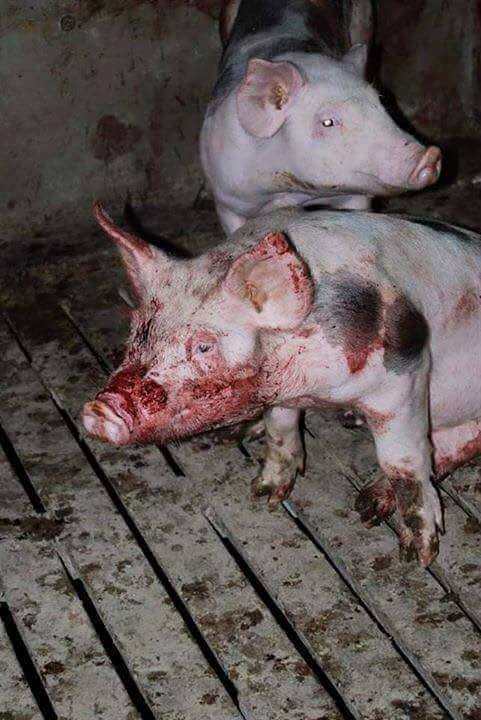
Verletzte Schweine_n

How did Hübner manage to drive so many animals to their death back then?

How did Thomas Schalz manage to drive thousands of pigs down into the CO2 pit at the push of a button over the years, knowing full well what was going on there?
How do slaughterhouse employees deal with slaughtering hundreds of animals on an assembly line every day?


How does the killing of animals become business as usual?

Continue reading “Slaughterhouse: How do people manage to kill hundreds of animals every day?”

UPDATE: Lion Cub with Legs Broken By Abusers for Selfies Is Off to Sanctuary! – They Still Need To Be Caught and Punished – Petition.

SIGN: Justice for Lion Cub With Legs Broken for Tourist Selfies

UPDATE: Lion Cub with Legs Broken for Selfies Is Off to Sanctuary!

Simba Is Headed to Sanctuary in Africa!

More than 40,000 of you signed Lady Freethinker’s petition for justice for Simba, a lion cub who had his back legs deliberately broken to keep him still during tourist selfies.

And now, we have a heartwarming update: Simba is headed to an animal sanctuary in Africa, where he can live out the rest of his life in peace!

Innovative surgery helped the innocent lion cub learn to walk again, but he will forever remain scarred by his abusers, who have yet to be identified.

They must not get away with abusing a baby lion. If you haven’t yet,

Sign the petition now to urge authorities to find and charge the perpetrator(s) who brutally snapped Simba’s legs.

Please sign the petition now to bring his abusers to justice:

Simba suffered unimaginable pain at the hands of his abusers, who put profit over his life. He endured beatings so bad his spine was severely injured, and after he got sick from lack of care, his captors dumped him in an old, dirty barn to die.

SIGN: Justice for Lion Cub With Legs Broken for Tourist Selfies

Rescuers found him literally wasting away, riddled with pressure sores and intestinal obstructions. It’s a miracle he’s alive today.

Simba deserves more than just his freedom — he deserves justice.

Sign the petition for justice for Simba.

Thank you for adding your voice to help stop animal cruelty.

Nina – Lady Freethinker.

Regards Mark

England: A Nice Saturday Story – Eggs Rescued (From an Illegal collector) Have Been Hatched to Produce Beautiful Birds – Who Have Now Been Released Into the Wiuld.

The RSPB (Royal Society for the Protection of Birds – a UK charity) has just issued the following release:

Three golden plover chicks and one curlew chick are getting a second chance at life after being found, as eggs, in a property in Huddersfield.

In April, following a report of suspicious behavior, South Yorkshire Police executed a search warrant at a Huddersfield address with the RSPB. Officers seized over 200 birds’ eggs alongside associated equipment, books and taxidermy items, and the investigation is ongoing.

Within the seized items was an incubator containing seven unhatched eggs. They were removed and taken to Smiths Nursey in Thorngumbald to care for the eggs until they hatched.

They have now been released into the wild, and experts say their chances of survival look good.

Sheffield Rural and Wildlife Crime Officer PC Elizabeth Wilson said: “When we executed the warrant at the property we were just expecting to find eggs that had been collected and stored in drawers or cabinets. We certainly didn’t expect to find live viable eggs in an incubator! I wanted to give those eggs the best chance of survival. 

“The laws against the taking of or possessing wild birds’ eggs are there for a reason. We are committed to the robust prosecution of those who commit offences against protected wildlife and urge anyone with concerns to report them via 101.”

A 63 year-old man remains released under investigation while further enquiries continue between South Yorkshire Police, the National Wildlife Crime Unit (NWCU) and RSPB.

Charles Hardcastle of Smiths Nurseries said: “When we first received the eggs we were concerned they might not hatch. Some of them had cracks in them or were infected and went bad. But these ones did hatch and luckily and we managed to rear three lovely plovers and one lovely curlew. We provided artificial heat and fed them every few hours, then soon they became very independent. We’re so pleased with how well they’ve done. It’s sad seeing them go, any parent will know what that’s like, but also really exciting to see them take this next step into the wider world. These birds would have had no chance of life had they been left as they were. Now when we see a curlew or a golden plover flying over, we’ll be wondering if it’s one of ours.”

Howard Jones, RSPB Investigations Officer, said: “We’re delighted to see a happy end to this story. Thankfully very few egg collecting cases come to light these days, but finding live eggs, which have then gone on to hatch, is unprecedented. Curlews are in dire trouble in England, having declined dramatically in the last 25 years. The RSPB and other conservation organisations are working hard to protect these magnificent birds.”

Watch the video.

If you notice anyone behaving suspiciously, who you suspect may be taking birds’ eggs, contact the Police on 101 and email RSPB Investigations on crime@rspb.org.uk, or fill in the online form: https://www.rspb.org.uk/our-work/our-positions-and-campaigns/positions/wildbirdslaw/reportform.aspx

You could say an Egg Cellent story !

Regards Mark

After poultry, pigs are the second most popular farmed animal species worldwide. They Suffer – Read On.

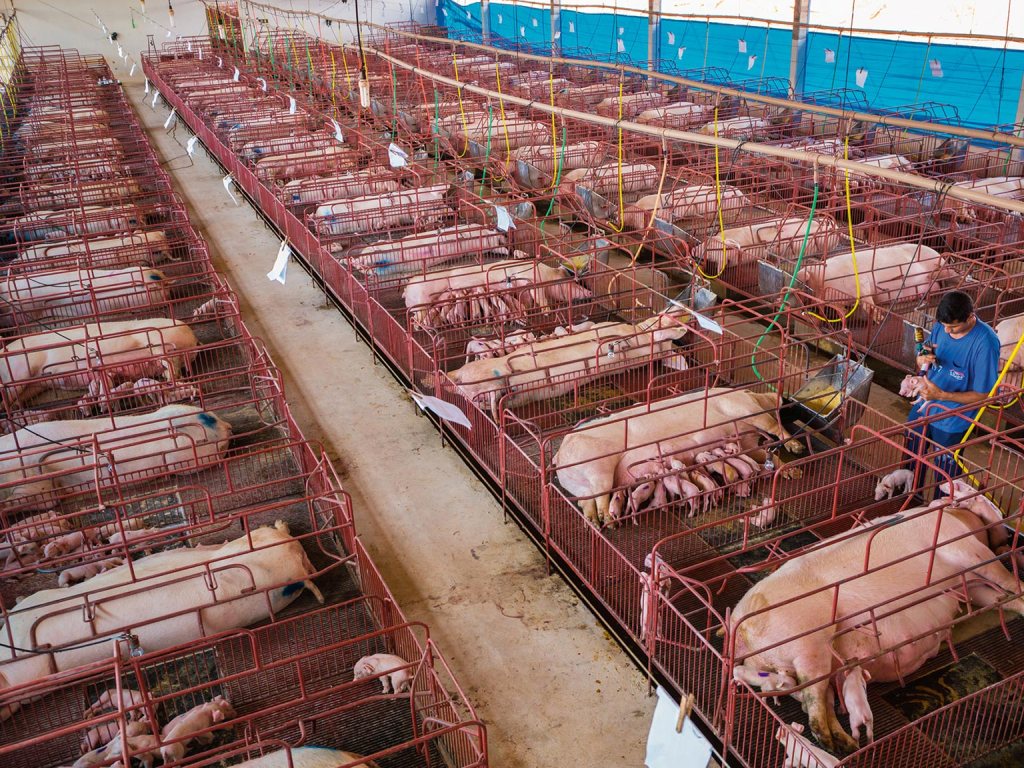
After poultry, pigs are the second most popular farmed animal species worldwide.

In 2018, 248 million pigs were slaughtered in the EU, which is the main global exporter of pig meat.

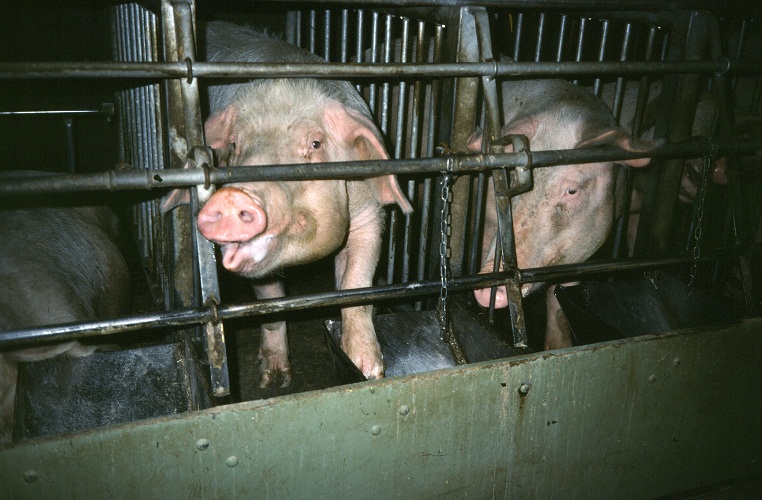
The vast majority of EU pigs are kept under intensive indoor conditions. Industrial husbandry systems largely fail to satisfy even the most basic behavioural requirements of pigs, to the extent that they need to be mutilated to avoid the consequences of abnormal behaviours due to boredom, stress and bad health.

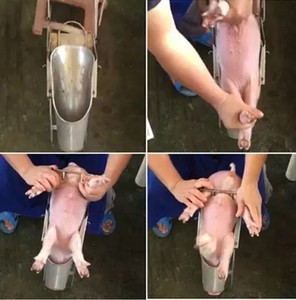
Instead of addressing environmental and managerial shortcomings, the industry still routinely subjects pigs to painful husbandry  procedures such as tail-docking, castration and teeth clipping or grinding, typically without any pain relief. 

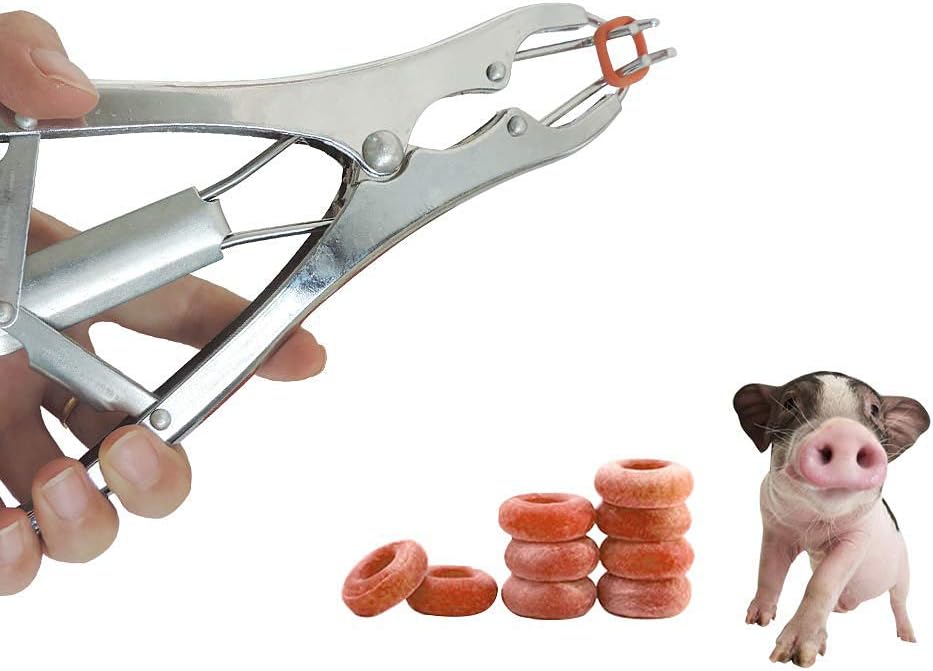
Tail docking is the practice of shortening a pig’s tail to prevent tail biting. Tail biting usually occurs when pigs are bored or stressed due to their poor quality environment, poor health or lack of stimulation. The procedure is normally carried out without pain relief on piglets younger than 7 days. Scientific studies have shown that the procedure is painful and can cause the formation of neuromas on the tail stump, potentially leading to chronic pain in the longer term.

Jnzr Animal Castration Pliers, Tail Cutter Castration Banding Tail ...

In addition, tail docking does not in itself prevent tail biting as a significant proportion of pigs with docked tails have tail lesions. While Directive 2008/120/EC on the minimum standards for the protection of pigs (the Pig Directive) forbids routine tail docking in pigs, a recent study showed that 77% of pigs’ tails had been docked in the 24 countries involved in the study.

Another unacceptable practice carried out on farmed piglets is the clipping or grinding of the corner teeth. This is done under the guise of protecting the sow and other competing piglets during suckling. However, this practice opens up a host of other issues for piglets, including infection, gum damage, abscess and fractured teeth.

Male piglets are subject to painful surgical castration to avoid the possibility that, once grown up, their meat will emit an unpleasant odour when cooked, known as boar taint. 

Although boar taint only occurs in 3-5% of pigs, and even though the presence of boar taint can be detected at the slaughter line, most countries still surgically castrate 80% or more of male piglets.

Piglet Swine Castration Device Stainless Steel One Person ...

In 2010, the ‘European Declaration on alternatives to surgical castration of pigs’ was agreed. The Declaration stipulates that from January 1, 2012, surgical castration of pigs shall only be performed with prolonged analgesia and/or anaesthesia and from 2018 surgical castration of pigs should be phased out altogether.

The Federation of Veterinarians of Europe together with the European Commission carried out an online survey via SurveyMonkey© to investigate the progress made in different European countries. This study provides descriptive information on the practice of piglet castration across 24 European countries. It gives also an overview on published literature regarding the practicability and effectiveness of the alternatives to surgical castration without anaesthesia/analgesia.

Forty usable survey responses from 24 countries were received.

Besides Ireland, Portugal, Spain and United Kingdom, who have of history in producing entire males, 18 countries surgically castrate 80% or more of their male pig population.

Overall, in 5% of the male pigs surgically castrated across the 24 European countries surveyed, castration is performed with anaesthesia and analgesia and 41% with analgesia (alone). Meloxicam, ketoprofen and flunixin were the most frequently used drugs for analgesia. Procaine was the most frequent local anaesthetic. The sedative azaperone was frequently mentioned even though it does not have analgesic properties.

pig castration – Google Search

Boar taint and the castration debate | The Pig Site

Half of the countries surveyed believed that the method of anaesthesia/analgesia applied is not practicable and effective. However, countries that have experience in using both anaesthesia and post-operative analgesics, such as Norway, Sweden, Switzerland and The Netherlands, found this method practical and effective. The estimated average percentage of immunocastrated pigs in the countries surveyed was 2.7% (median = 0.2%), where Belgium presented the highest estimated percentage of immunocastrated pigs (18%).

The deadlines of January 1, 2012, and of 2018 are far from being met.

The opinions on the animal-welfare-conformity and the practicability of the alternatives to surgical castration without analgesia/anaesthesia and the alternatives to surgical castration are widely dispersed. Although countries using analgesia/anaesthesia routinely found this method practical and effective, only few countries seem to aim at meeting the deadline to phase out surgical castration completely.

In the majority of cases, surgical castration is still carried out without adequate pain relief.

This happens in spite of the availability of painless alternatives, such as vaccination against boar taint or raising entire boars. 

Regards Mark

Close Hamerton Hell-Zoo. Immediately!

It’s time for this abusive zoo to be shut down and the animals to be freed to a sanctuary!


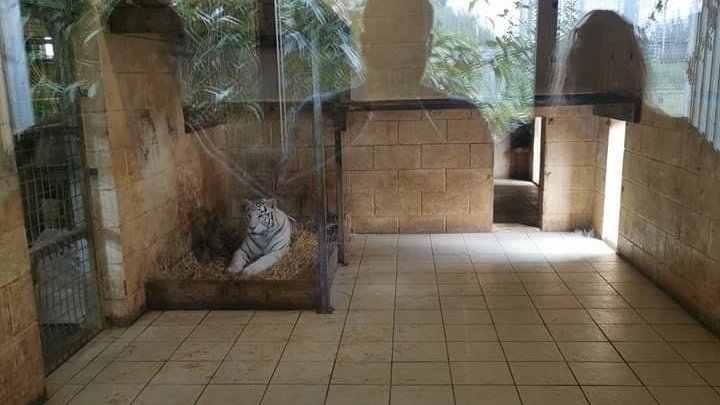
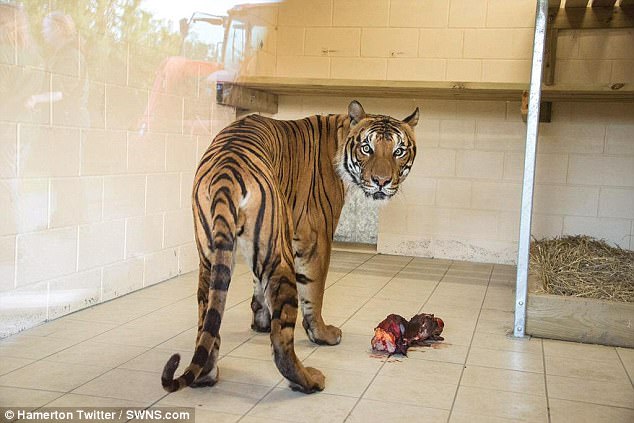
Hamerton Zoo’s animals look miserable and neglected. Numerous visitors have reported seeing animals visibly distressed, some are seen just sat staring, some are pacing back and forth – a sign of zoochosis;

-A camel with a deflated hump – a sign of malnourishment, other camels in a small barn covered in feces and no access to the paddock;

-Some animals had no food, water or enrichment; small enclosures that are rotting in some cases, made from crowd control fencing and back garden fencing;

-A donkey visibly depressed with no food, water, enrichment, or company, lying in the same position staring into the grass;

-Birds plucking all their feathers out; the middle of the park looking like a construction site; no keepers insight.

hamerton Zoo tigerjpg

Information: The zoo is a 25-acre wildlife park that has about 500 animals including monkeys, cheetahs, raccoons, sloth, and a collection of Malaysian tigers and white tigers.

This is a very Joe Exotic- place where the owner has obviously bought exotic animals as a private collection and uses it to profit.

We need to get these animals to a safe haven where they will be looked after properly.

hamerton

Text of the petition: Hamerton Zoo has no animal welfare.

Many animals were visibly distressed, had no water, food, or enrichment. Enclosures are tiny and rotting and in some cases, made using crowd control fencing and back garden fencing.

The middle of the park contains storage containers and what looks like a construction site. There were no keepers around. The only staff we saw worked in the coffee shop/gift shop.

Management is either no available or rude and condescending, calling us ignorant and telling others they are blackmailing when saying they will go to press.

hamerton Zoo tiger jpg

We are calling for this zoo to be closed and the animals to be moved to a sanctuary.

https://www.thepetitionsite.com/de/693/714/358/close-hamerton-zoo/

Petition: bit.ly/2FatI3w


And I mean…We used to think that such zoos only existed in third world countries.
It is the same with the “civilized” ones, and not just with the zoos.

It’s about the principle; no living being may be held captive and used, neither for eating nor for carrying, nor for entertainment! this applies to ALL human but also non-human animals.

We live in a century where we ALL, the animal rights activists, or animal owners should be morally sensitized enough to condemn and oppose any use of animals for human purposes.
Animals are not there to be of any use to humans, they have value in themselves.

And principles about animal rights should by now have reached a universal standard value in a civilized society.

My best regards to all, Venus

Australia: We Know the Government There Is From Another Planet; But We Have to Continue the Pressure to Stop Live Exports For the Animals. We Are Their Only Voice – Speak Out Link Below.


Exhausted, lying helpless on the scorching road and about to be stuffed alive into a car boot. She is one of thousands of Australian sheep we found being offered for illegal sale and slaughter across Jordan during the recent ‘Festival of Sacrifice’. And, sadly, in Indonesia, we discovered and documented the unthinkable occurring again…

Now we need your help to call for the Australian exporters responsible to be stripped of their licences.

Mark, when Australia’s live export industry ignores regulations, it makes an inherently cruel industry even crueller. Which is why I am so very grateful for your generosity and support which ensured our team of investigators were exactly where animals needed them to be.

Evidence gathered during our latest investigations reveals widespread breaches of Australia’s live export laws, with sheep and cattle being subjected to cruelties that the industry has long promised had been wiped out.

Exporters would have been banking on COVID-19 restricting our ability to monitor their activities, but, as ever, they underestimated the commitment of our supporters and the courage of our investigators. Thanks to you we were able to gather the evidence to lodge legal complaints and we will do all we can to hold those responsible to account.

Here’s just a snapshot of the media confirming a ‘regulatory system’ in complete disarray:

Perhaps our most shocking discovery in recent days is that some Australian cattle exported to Indonesia were still being killed in brutal slaughter boxes that were banned after our landmark investigation in 2011.

In these Australian government-approved — and industry-audited — slaughterhouses, animals were also being subjected to horrific roping slaughter. This is another outlawed practice that sees frightened animals pulled and tripped onto their sides before having their throats cut while fully conscious.


Mark, if live exporters thought a global pandemic would hamper our investigations, they were wrong. If they thought restricted international travel this year would provide them with a protective shield in importing countries, they were also wrong.

Thanks to your support, our dedicated team of local investigators were there for animals in the most difficult of circumstances this year. Our promise to you, to them — and to the animals — is that we’ll use this evidence to push for the strongest possible action. Please take a moment to add your voice to these calls here.

Speak Out Here:

Mark, having been in Indonesia in 2011 as well as in the Middle East on countless occasions witnessing what animals endure, I know you will also be thinking, ‘when will this end’?

All I can say to you is that a day will come when this industry will be no more. And when that day comes you will know that it was your compassion for these animals, and your commitment to stay the course with us, that was a key reason why.

From the bottom of my heart, thank you for enabling us to be there for animals.

With my deepest thanks,


Lyn White AM
Investigations Director


P.S. Our investigators working across eight countries also gathered evidence that will fuel our efforts to end live export from Europe and South America. We’ll be working with our international team to maximise outcomes for all of the victims of this global trade in animal cruelty, thanks to you.

If you thought July was hot, you were right: It was one of Earth’s hottest months ever recorded.

global warming – Google Search

We Didn't Start The Fire”... Or Did We? : Global Warming And ...

If you thought July was hot, you were right: It was one of Earth’s hottest months ever recorded

Doyle Rice USA TODAY

Published 10:28 AM EDT Aug 14, 2020

https://eu.usatoday.com/story/news/nation/2020/08/13/july-2020-record-heat-one-hottest-months-ever-recorded/3366762001/

Last month was a scorcher worldwide. 

July 2020 tied with July 2016 as the second-hottest month ever recorded for the planet Earth, according to a report released Thursday by the National Oceanic and Atmospheric Administration. 

Only July 2019 was hotter, and only by a fraction of a degree. 

“The July 2020 global land and ocean surface temperature was 1.66 degrees above the 20th-century average of 60.4 degrees, tying with 2016 as the second-highest temperature in the 141-year record,” NOAA said. “Last month was only 0.02 of a degree F shy of tying the record-hot July of 2019.”

July 2020 also marked the 44th-consecutive July and the 427th-consecutive month with temperatures above the 20th-century average, according to NOAA.

Experts say this is a sure sign of human-caused climate change: “The trend of record heat continues – a trend which we’ve shown in past publications can only be explained by the warming impact of fossil fuel burning,” said Penn State University meteorologist Michael Mann.

Record-hot July temperatures spread across parts of southeastern Asia, northern South America and North America. In the U.S., several states either set or tied their hottest month on record, including Virginia (tied), Maryland, Pennsylvania (tied), Delaware, New Jersey, Connecticut (tied) and New Hampshire.

What’s more, the Northern Hemisphere saw its hottest July ever – surpassing its previous record high set just last year, NOAA said.

“The unprecedented summer heat waves, droughts, wildfires and floods we continue to witness are all a consequence of the record warmth,” Mann said.

It was also very warm up north, as Arctic sea ice extent for July 2020 was the smallest-July extent in the 42-year record at 846,000 square miles (23.1%) below the 1981–2010 average, according to an analysis by the National Snow and Ice Data Center.

In addition, July continued the pattern of unusually warm months this year. For the year-to-date, 2020 is now the second-warmest year on record, trailing only 2016.

“The year-to-date global land and ocean surface temperature was the second-highest in the 141-year record at 1.89 degrees above the 20th-century average of 56.9 degrees,” the report said. “This value is only 0.07 degree less than the record set in 2016.” 

It’s the hottest year on record across a large portion of northern Asia, parts of Europe, China, Mexico, northern South America as well as the Atlantic, northern Indian and Pacific Oceans. 

“The year 2020 is very likely to rank among the five warmest years on record,” NOAA said.

Plastic kills, our garbage kills

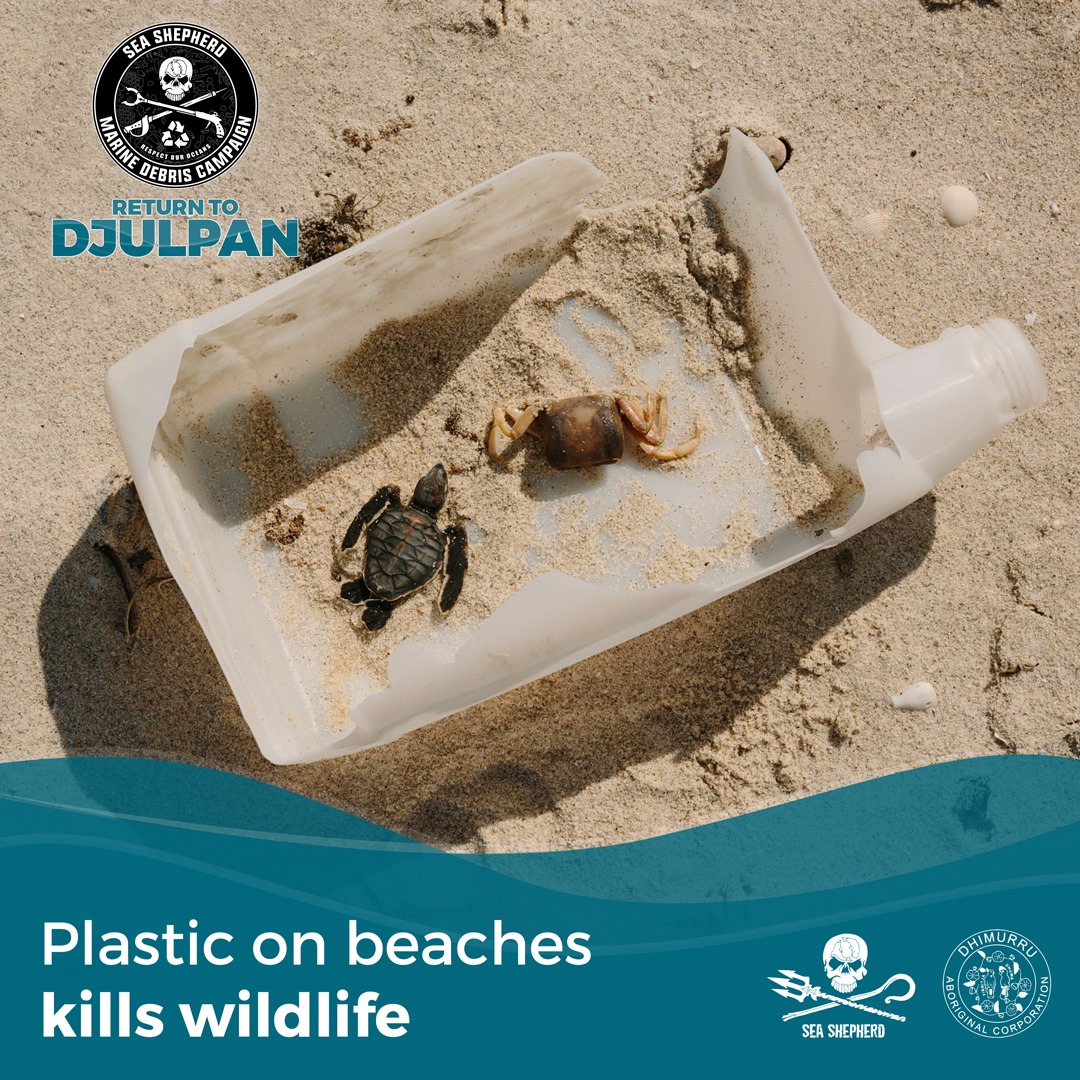
You may think a plastic container looks pretty harmless on a supermarket shelf but if discarded into the ocean and swept-up onto a beach, it is a different story.
This container, found by Sea Shepherd crew as they worked alongside the Dhimurru Rangers cleaning the 14km beach, had trapped and killed a turtle hatchling and crab.

plastik kills o

As the plastic crisis sweeps across Australia’s top-end beaches, we are seeing the same story in other places too.

Plastik66
Recently, in the first study of its kind, an IMAS-led research team estimated that around 570 000 hermit crabs have been killed on the Cocos (Keeling) Islands in the Indian Ocean.

Tauchen / Christmas Island
The hermit crab study found that piles of plastic pollution on beaches create both a physical barrier and a series of potentially deadly traps for crabs and other marine creatures.

The plastic waste lying around poses a risk of injury to all marine animals and blocks, for example, young turtles from getting to the water.

Animals like hermit crabs also crawl into the containers and cannot find their way out.
Unfortunately, the decaying smell of the dead conspecifics often attracts other animals, which then faces the same fate.

The actually “harmless” container thus triggers an insidious and deadly chain reaction.

Whether on the coast, in the city or in the country, you can find garbage everywhere.

Cans, balloon cords, bottles and and and … – if it’s lying around, take it with you, you could possibly save a life with it.

https://www.imas.utas.edu.au/news/news-items/half-a-million-crabs-killed-by-plastic-debris-on-remote-islands


And I mean…Of course, we will also clean up the garbage that threatens the lives of our flatmates, the animals.
It will be us again, who else?

We are the ones who save animals wherever they can be found.
We are the ones who are always on duty to correct fatal mistakes made by idiots, irresponsible people, or animal haters.
Like a concrete slab, this cruel reality presses us every day and forces us to work for abandoned, injured, neglected animals. And that’s a tough job!

We correct malice, injustice, violence; we cannot do otherwise, our own morals dictate that.

But if we see and feel the advancing catastrophe of our planet every day, which is taking place due to the indifference of the meat eaters, the molesters of nature, the exploiters of natural resources and animals, then we could say that Corona lasted far too short.

Our hope champion was too slow and too weak.

Corona_Cage

This Corona was a weakling.

My best regards to all, Venus