Month: August 2021

Ethical Veganism

From Helmut Kaplan’s Facebook page:

// In the UK, all nursing staff will be vaccinated from October. However, this does not apply to vegans. The so-called ethical
Veganism was declared a protected worldview in a court ruling last year and is therefore subject to special protection under British labor law.

Specifically, it is animal testing with vaccines that contradict the ethical vegan philosophy. Since a vaccination would automatically mean that the vegans would have to act contrary to their worldview, they are exempted from the obligation to vaccinate. //

“Unfortunately, the provision will have little effect, as ethical vegans have long been a species that is becoming extinct,” commented the Austrian animal ethicist Helmut Kaplan on the decision.

We welcome the decision of the British, they are one step ahead of us Germans.

In this case, veganism is seen (almost) like a religion and consideration is given accordingly.

On the argument …” Yes, but most drugs also come on the market with animal testing, why now only refuse the vaccination”, we can say that a painkiller, for example, is not subject to any obligation, I take it if I want.

In any case … that ethical veganism is subject to protection is a very big step in our justice system and one can therefore hope that this decision can also positively influence the morality of our society.

My best regards to all, Venus

UN special rapporteur on torture requests info after video shows German police officer throwing elderly woman to groun

Mayhem on streets of Berlin: Anti-lockdown protests turn into violent scuffles with police in Germany, 600 arrested (VIDEOS)

Video: https://www.rt.com/news/530843-berlin-lockdown-protests-scuffles-police/

Nils Melzer, the United Nation’s special rapporteur on torture, has issued a request for information after a video showing a German police officer throwing an elderly woman to the floor during a protest went viral online.

The footage, allegedly recorded during the anti-Covid-19 lockdown protests in Berlin on Sunday, 1. August, showed the woman attempting to walk past an officer before he grabbed onto her neck with both hands and threw her forcefully to the ground.

2 Aug, 2021 11:50

Fellow protesters could be seen in the video admonishing the officer and trying to help the injured woman, as several officers continued to push others in the area with less force.

Melzer – who is also the human rights chair at the Geneva Academy in Switzerland – confirmed on Sunday that the video had been brought to his attention.

He has requested both witness statements and details on whether “an official investigation has been launched.”

The anti-lockdown protests in Berlin became chaotic after police tried to forcefully shut the demonstrations down. Around 5,000 Germans took part in the protests on Sunday, and around 600 were arrested.

Videos showed other instances of police violence, including officers kicking protesters, shoving people, pushing their faces, pepper spraying, and even grabbing onto and detaining a man for playing the trumpet.

One video showed an officer punching a teenage boy in the face while he was on the ground, and a 49-year-old protester collapsed and died during an identity check.

https://www.rt.com/news/530892-nils-melzer-berlin-police-violence/

And I mean…So, the UN, a major player on the global covid war, will be imposing crippling economic sanctions against German regime for blatant human rights violations, right?
Had his happened in Russia, China or Belarus the whole Planet would be flooded with front pages!!!

State sanctioned brutality. Back in time to the 1930’s.

https://qpress.de/wp-content/uploads/2014/12/folter-in-der-heutigen-zeit-pruegel-misshandlung-gewalt-staatsgewalt.png

Unique phenomenon in human history: a world dictatorship takes over power without tanks, without weapons, without political prisoners.
Only with obedient, submissive People’s cattle on the side, which promises eternal loyalty to both the pharmaceutical industry and governments (verifiable) with its Green Pass.

My best regards, Venus

Online Event – Working Animals: Empowering Sustainable Growth.

Event – Working Animals: Empowering Sustainable Growth

4 August 2021

The Donkey Sanctuary

News

Eurogroup for Animals, in partnership with the International Coalition for Working Equids, are pleased to invite you to join us on 28 September as we present an interactive panel event to showcase the role working animals play in helping achieve the Sustainable Development Goals.

The event is part of European Sustainable Development Week 2021. Joe Collins, Chair of Eurogroup for Animals’ Equines Working Group, will introduce the presentations and lead discussion during an interactive question and answer session.

An estimated 200 million working animals are essential to the livelihoods of many communities around the world; they are often key to bringing sustainable growth to those communities, with the ability to transport goods, collect water and work for a source of income. The Sustainable Development Goals can be achieved through many cost effective simple solutions, the welfare of working animals is one of them.

Simple interventions can empower owners to keep their working animals healthy and ensure their continued productive benefit.

Register now to attend.

Regards Mark

England: Badger cull in England in the spotlight again as wildlife groups provide further evidence for alleged breach of international treaty obligations.

WAV Comment – Badgers are protected by law in the UK; if I did kill one intentionally, then quite rightly, I would be prosecuted.  But if you are the UK government, it appears that you can kill over 140,000 badgers in the name of ‘protecting the spread of bovine TB.  We agree fully with the statement put out from Eurogroup for Animals, that being:

The UK government has sought to portray itself as a champion for animal welfare, and yet the ongoing cull of badgers leaves such a claim in tatters. Their policy flies in the face of science, evidence and any notion of the badgers as sentient beings. No animal deserves to be treated this way.

The cull must stop and stop now; enough animals have already been murdered by the UK government, let alone continue until 2025 when another 140,000 could be slaughtered.

The UK government are fools to lie to the British public that this killing is for the better, to stop Bovine TB spreading.  It will be one big issue that will be raised when MP’s come knocking on doors, for votes, when the UK has its neat election. Ministerial fools who know nothing except bullshit. With Badgers visiting my garden every night, they are wonderful, and badgers have friends, and those friends have votes !

Regards Mark

Badger cull in England in the spotlight again as wildlife groups provide further evidence for alleged breach of international treaty obligations

3 August 2021

Badger Trust

Press Release

A coalition of animal welfare organisations have submitted further evidence in support of a complaint which claims that the UK Government’s ongoing badger cull policy in England fails to uphold its duties under the Bern Convention

UK based charities Badger Trust and Born Free Foundation, alongside Eurogroup for Animals, based in Belgium, have supplied additional information to support their original complaint made in 2019. The complaint challenges whether the UK Government has adequately considered the impact of mass culling of badgers on the badger population and wider biodiversity, and whether there has been any significant disease control benefits to justify the culls.

Britain is home to over 25% of the European badger population. However, with more than 140,000 badgers killed under licence since the cull policy started in 2013, and with culling set to continue until 2025 under recently confirmed UK Government plans, that population is coming under severe pressure. The case was put on ‘standby’ by the Bern Standing Committee in 2020, with a request for further information, the first time a complaint made against the UK Government had not been dismissed at the initial stage. 

The additional information covers the following issues:

  • After 8 years of culling badgers in England, there is little evidence to show any substantive benefits to bovine TB rates in cattle in the cull areas. By contrast in Wales, where no mass culling of badgers has taken place, bovine TB rates in cattle are being successfully reduced using cattle-based measures alone;
  • More than 140,000 badgers have been killed in England since 2013, and in spite of UK Government claims that badger culling is to be phased out, it is estimated that the same number again could be targeted over the coming years, with a real risk that badgers could be wiped out completely from swathes of the country where they have lived since the ice age;
  • The UK Government has consistently failed to adequately monitor the impacts of culling on badger populations or the wider ecology, risking unforeseen and potentially disastrous consequences for badgers and wildlife more widely;
  • These and other failures of the badger culling policy clearly place the UK Government in breach of its commitments to the Convention on the Conservation of European Wildlife and Natural Habitats (Bern Convention), under which badgers are a protected species.

Dr Mark Jones, veterinarian and Head of Policy at the Born Free Foundation, said:

‘The UK Government and proponents of the badger cull have hailed the policy as a success. However, after 8 years of culling evidence for substantial disease control benefits among cattle herds in cull areas is lacking. More than 140,000 badgers have been killed over the past 8 years, most by ‘controlled shooting’, a method rejected by the British Veterinary Association because of welfare concerns. This ineffective, inhumane and unnecessary policy must end.’

Dawn Varley, Acting CEO of Badger Trust, said: 

‘With 140,000 badgers already lost, and with another 140,000 set to be killed according to our estimates, it has never been more urgent to challenge the UK Government on a policy that whilst they claim ‘is working’, just doesn’t stack up whichever way you look at it. We know the UK Government will reply by saying the cull is about to end, but in reality there is another 5 years of culling to come, which we argue would wreak havoc on the badger population – at unknown cost to this usually protected species, and for little benefit to the cattle affected by bovine tuberculosis.’ 

Reineke Hameleers, Chief Executive of Eurogroup for Animals, added:     

“The UK government has sought to portray itself as a champion for animal welfare, and yet the ongoing cull of badgers leaves such a claim in tatters. Their policy flies in the face of science, evidence and any notion of the badgers as sentient beings. No animal deserves to be treated this way. For their part, EU Member States and the European Commission have long been bewildered by the rationale of the approach in England. If farmers were not moving their cattle with such frequency, bovine TB rates would be much lower than at present. It is time to end this madness once and for all and to ensure that the European badger is properly protected, if needs be through common European action.”     

The Bern Convention is a binding international legal instrument in the field of nature conservation, covering most of the natural heritage of the European continent. It is the only regional Convention of its kind worldwide, and aims to conserve wild flora and fauna and their natural habitats, as well as to promote European cooperation in this area. 

The treaty also takes account of the impact that other policies may have on natural heritage and recognises the intrinsic value of wild flora and fauna, which needs to be preserved and passed to future generations.

Fifty countries and the European Union are signed up to the Convention, signalling their commitment to promoting national conservation policies, considering the impact of planning and development on the natural environment, promoting education and information on conservation, and coordinating research. 

Notes to Editors

The original complaint lodged with the Bern Convention in 2019 can be found at https://rm.coe.int/files22e-2020-uk-badger-culling-complaint-form/16809ce9d6 

The ‘additional information’ to the original complaint of 2019, and further to additional information supplied in 2020, was submitted prior to the deadline of 31st July. It is understood the Bern Convention will seek a response from the Department of Environment, Food and Rural Affairs for the UK Government. 

It is anticipated the case will then be subject to review by the Bern Convention Bureau, due to meet in September 2021.

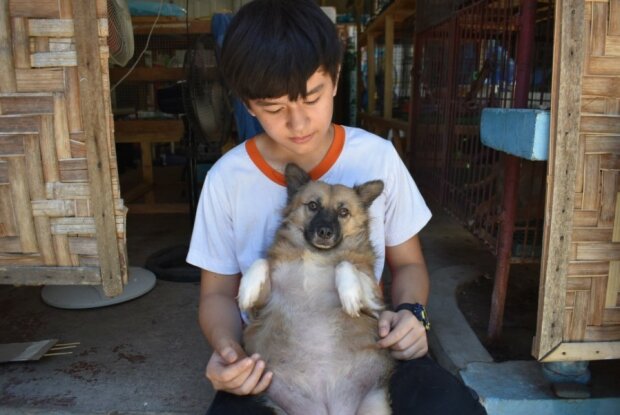
Philippines: A 9 year old boy opened his own animal shelter

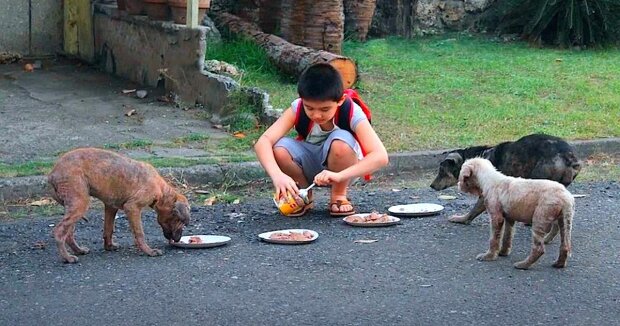
A 9 year old boy spent his pocket money on stray dogs and then opened his own animal shelter

The father was happy about his little son’s deed

Ken Amante is a minor citizen of the Philippines.
The boy has already set himself apart from his peers and deserves special respect.
Ken loves animals all his life.
And as soon as his parents gave him pocket money, he bought food for stray dogs.
Ken spent all of his money on it every day.

One of those days, his father decided to find out what his son was spending his money on. He was surprised by what he had learned because his young child bought food for stray dogs and fed them.

The animals had serious problems due to exhaustion, all their fur fell out and they had many wounds on their bodies.
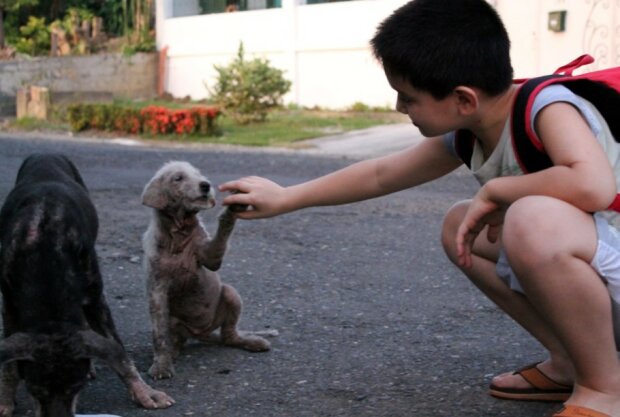
Ken fed the dog and her little pups.
The boy even gave nicknames to his new friends: Belysh, Kashtan and Chernysh.

Although the dogs were happy to accept the food, they were afraid of approaching the boy.

The father was happy about his little son’s deed. The man took several photos and posted them on the Internet.

Photos immediately became popular, and many who did not remain indifferent began to offer him help, and there were many such people from all over the world.

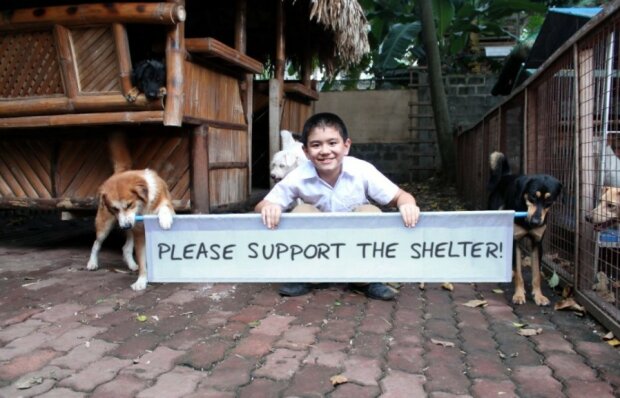
With her help, Ken was able to fulfill his dream. And when he was nine years old, he founded his own animal shelter.
He named it “Happy Animals Club”.

The shelter started operating in 2014 and became the first in the Davao area.
Now the shelter is still working, and all thanks to the support of interested and caring people.

Ken’s parents are responsible for the organizational work.

They rented a plot of land independently, and also bought everything necessary for their full-fledged work.

Ken asked his parents to buy only high quality, healthy food for their dogs. At first the shelter was only intended for dogs, but now there are other animals.

The first to come to the shelter were the three dogs that Ken fed. And thanks to the veterinarian, they got rid of their health

problems. And shortly thereafter, Ken found a family for them!

The shelter has already rescued around a hundred animals and given them new homes and caring owners.*

*all photos by feiky.net

https://livreviews.com/welt/2858-ein-9-jaehriger-junge-gab-seine-taschengeld-fuer-streunende-hunde-aus-und-eroeffnete-dann-sein-eigenes-tierheim

And I mean…Respect and admiration for the little boy.
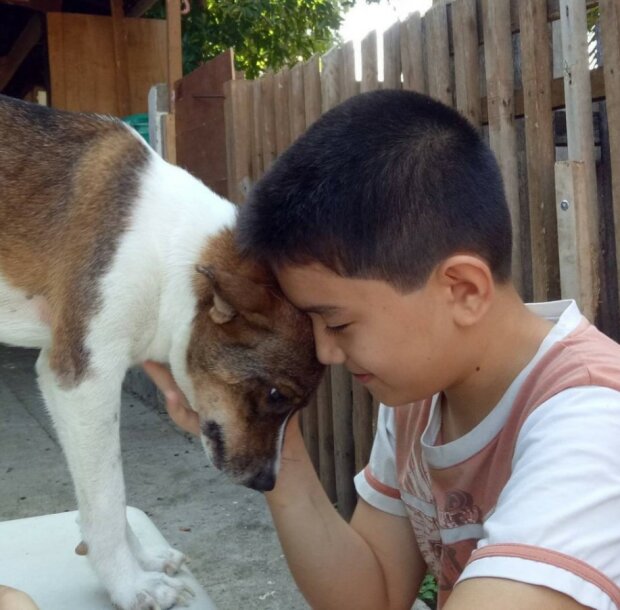
The earlier one learns love and compassion for the other animals, the more useful it becomes to our society

My best regards to all, Venus

Scientists create embryos to save northern white rhino.

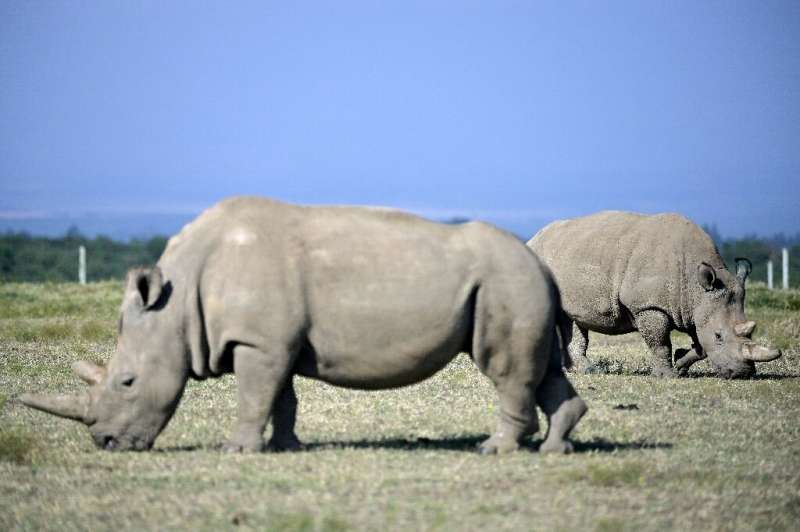
Fatu, right, and her mother Najin are the only two remaining northern white rhinos

Scientists create embryos to save northern white rhino

Scientists working to bring back the functionally extinct northern white rhino announced they had successfully created three additional embryos of the subspecies, bringing the total to 12.

One of world’s two remaining live specimens—female Fatu who lives with her mother Najin on Kenya’s 90,000-acre Ol Pejeta wildlife conservancy—provided the eggs for the project, while the sperm used was from two different deceased males.

Scientific consortium Biorescue described in a press release late Thursday how the eggs were collected from Fatu in early July before being airlifted to a lab in Italy for fertilisation, development and preservation.

Neither Fatu nor Najin is capable of carrying a calf to term, so surrogate mothers for the embryos will be selected from a population of southern white rhinos.

Ol Pejeta director Richard Vigne told AFP on Friday that he believed in the project’s chances of success, while emphasising the high stakes.

“No one is going to pretend that this is going to be easy,” he said.

“We are doing things which are cutting-edge from a scientific perspective and we a dealing with genetics, with the two last northen white rhinos left on the planet,” said Vigne.

“There are many, many things that could go wrong,” he said. “I think everybody understand the challenges that remain.”

Since 2019 Biorescue has collected 80 eggs from Najin and Fatu, but the 12 viable embryos all hail from the younger rhino.

The project is a multi-national effort with scientists from the German Leibniz Institute backing the Kenya Wildlife Service and Ol Pejeta, and the Italian Avantea laboratory providing fertilisation support.

Kenyan Tourism Minister Najib Balala welcomed the news.

“It is very encouraging to note that the project has continued to make good progress in its ambitious attempts to save an iconic species from extinction,” he said in the press release.

Rhinoceroses have very few natural predators but their numbers have been decimated by poaching since the 1970s.

Modern rhinos have roamed the planet for 26 million years and it is estimated that more than a million still lived in the wild in the middle of the 19th century.

Scientists create embryos to save northern white rhino (phys.org)

Regards Mark

Why some vegans have a problem with palm oil

Palm oil is found in many products. Although it is vegan as an ingredient, it is not obtained in an animal-friendly manner

In products such as spreads and vegan sausages, palm oil ensures a firm consistency and prevents other liquid fats from settling. In addition, palm oil is cheap because the cultivation is efficient because the oil palm has a very high yield.

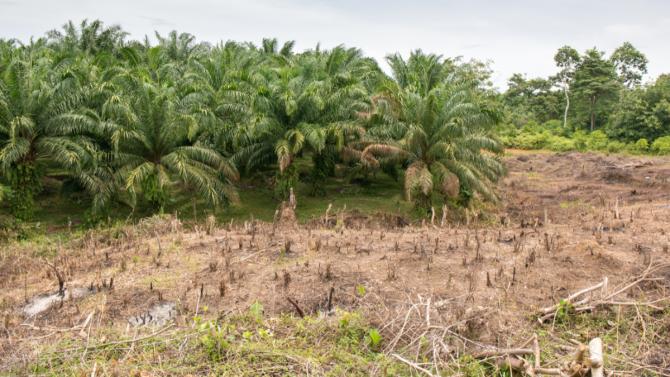
The problem starts with the fact that oil palms grow in jungle areas and rainforest is cleared for the plantations, mostly illegal.
In this way, the last remaining habitats for orangutans are also being destroyed.

After a few years, palm oil yields decline.
Old areas are being given up and more rainforest is being cleared for new areas.
Child labor is also a problem in the extraction of palm oil. This is why some people avoid products that contain palm oil.

Since December 2014, according to the EU Food Information Regulation, the origin of the fats has to appear on products instead of “vegetable oils or fat”.
A boycott of the products is possible, but difficult.
In addition to food, palm oil is also found in cosmetics, cleaning agents, candles, paints, varnishes and agrofuels.

Seals have so far been of little help in making a decision.

The RSPO-certified palm oil, for example, has minimum standards such as no deforestation of primary forests and forests that are particularly worth preserving, the core labor standards and payment according to minimum standards.
However, implementation is only mandatory and there is no independent control body.

Other seals only identify a tiny fraction of palm oil.

If you want to do something about the deforestation of the rainforest for palm oil, you can write to food manufacturers and ask them to switch to other oils. But you can also do a lot yourself.

Try our chocolate and nut cream. And we also have a few vegan snacks that don’t contain palm oil.

https://www.petazwei.de/warum-manche-veganer-ein-problem-mit-palmoel-haben

And I mean…The production of palm oil is a destructive and violent business.

It’s the fault of mogul companies like OOPC, for example, that forests are disappearing at breakneck speed.

Malaysia: palm oil production

Palm oil is omnipresent in our lives – it is in our food, in cosmetics, in cleaning products and in the car tank.

44% of the world’s palm oil harvest is used as an additive for biodiesel. The rest for food, livestock feed, cosmetic products, detergents, care products and cleaning agents. The majority of products on supermarket shelves contain palm oil.

It brings huge profits to large corporations and robs small farmers of land and livelihoods. Displacements, clearing of the rainforest and extinction of species are consequences of our palm oil consumption.

At 66 million tons per year, palm oil is the most commonly produced vegetable oil.

The palm oil plantations worldwide now extend to more than 27 million hectares of land.

On an area the size of New Zealand, the rainforests, people and animals have already had to give way to the “green deserts”.

Only 70,000 orangutans are still roaming the forests of Southeast Asia.

About 54,000 animals live in the wild in Borneo and are highly endangered, in Sumatra there are 14,000 animals.

They are burned, displaced or starved in search of food as a result of the destruction of the rainforest.

Mother animals are killed by criminals, the young animals are sold and enslaved. In five to ten years, as a result of this horrific business, none of the three orangutan species could exist anymore; their habitat could have disappeared by then.

The great apes today are restricted to Borneo and Sumatra.

We can still do something about it in everyday life:

Check the ingredients carefully and strictly: Buy organic products and products with local oils (e.g. sunflower or rapeseed oil). Substances such as palmitates, glyceryl or vegetable oil can be indications of palm oil, which should be avoided.

Write to companies: The more people tell companies that they are not satisfied with or disagree with a product that has palm oil, the greater the pressure on the company.

Public pressure and increased awareness of the problem have already led some producers to stop using palm oil.

About this video:
The British supermarket chain Iceland planned to run a heartbreaking commercial on television in 2018.
Branded products such as chocolate or shampoos that contain palm oil should disappear completely from the shelves.
Iceland wanted to advertise this with a moving video.
But that was not allowed as a TV commercial.

The video spread rapidly on the Internet, more than 13 million Facebook users saw it: You can see a small orangutan turning a child’s room upside down. The girl who lives there has to watch the little monkey knock down plants, chocolate and shampoo.
She calls the monkey Rang-Tan.

He tells his story in the video: His rainforest was destroyed for the cultivation of palm oil.

My best regards to all, Venus

White orcas sighted off the coast of Japan

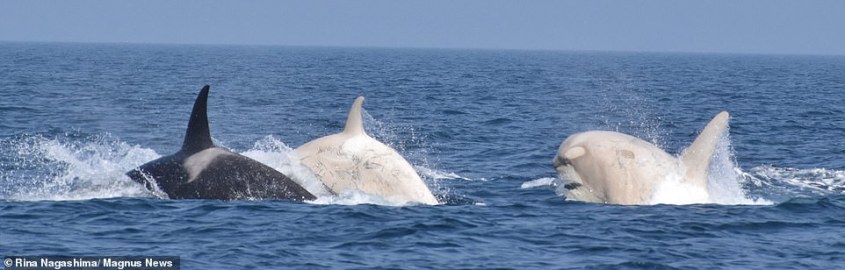
-Whale-watchers off coast of Japan’s northern island Hokkaido spotted two white orcas swimming together
-One was an older animal first spotted two years ago, but second was younger and had not been seen before
-The two orcas are not thought to be albinos but to have leucism, meaning they still have some skin pigment
-That means their markings are still faintly visible and their eyes are still dark instead of being bright red

The pair are part of a pod that contains mostly normal-looking orcas, but these two are thought to carry a gene which partially removes pigment from their skin – making them appear white
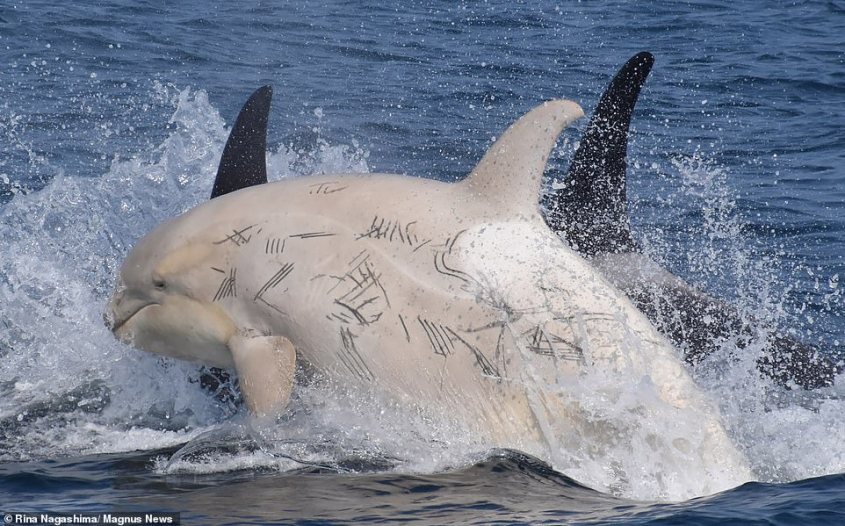
Whale-watchers off the coast of Japan could scarcely believe their eyes after catching sight of two rare white orcas swimming together as part of the same pod.

The orcas were spotted during a whale-watching tour on July 24 in the Kunashirskiy Strait, a 20-mile stretch of water between the northern islands of Hokkaido and Kunashir.

Mai, an employee of the Gojiraiwa-Kanko tour company, said one of the pair was older with slightly darker skin while the other was younger and had clearly-visible scratch marks down its back.

Japanese whale-watchers were stunned to spot two rare white orcas swimming off the coast of Hokkaido, one of the country’s northern-most islands, over the weekend
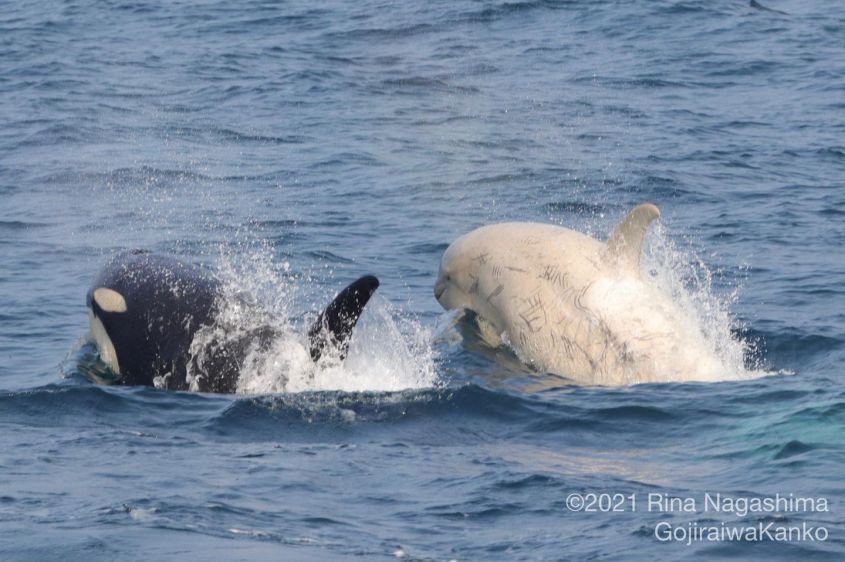
She said the older whale was first spotted around two years ago but it is the first time she has seen the younger animal and the first time she has seen both of them together.

‘It was the best day ever. This is the first time two white orcas have been seen off the coast of Japan, ‘she said.

The pair are not ‘true’ albinos, which is caused by a genetic trait that means the affected animal produces no melanin at all – the compound that gives skin, hair, feathers and eyes their color.

True albinos will be completely white and have red eyes – a color given by the red blood in vessels which are usually hidden behind the iris showing through.

Instead, these two whales are thought to have leucism – an umbrella term that covers a range of conditions where animals produce some melanin, but either have noticeably whiter skin or skin that is white in patches.

White orcas live with their black and white relatives in family groups
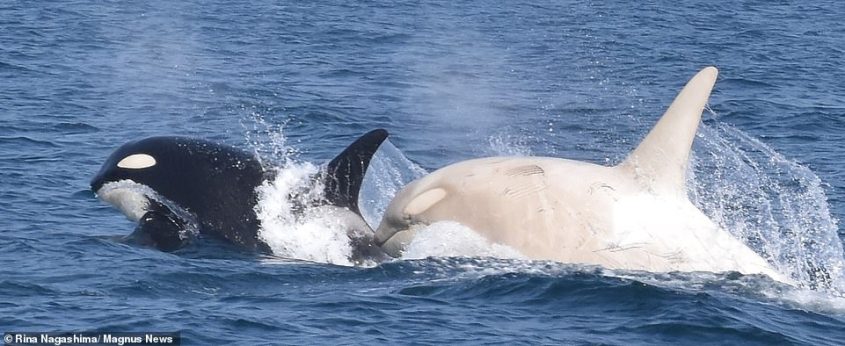
© Rina Nagashima / Gojiraiwa Kanko Whale Watching

That explains why the white patches that traditionally surround an orca’s chin and eyes are still visible on the two animals spotted near Japan, and why the eyes themselves are still dark.

It may also help explain the scarring down the side of the younger animal – which is particularly visible as the scar tissue seems to have healed in a darker shade compared to the surrounding white skin.

White orcas and whales were once so rare that they were thought to be a myth, but are becoming increasingly common, with scientists aware of at least five individuals alive today.

It is not clear exactly why they are becoming more common, but scientists theorise that it may be down to dwindling numbers of the whales and is a sign the species is in trouble.

As the population of a species declines, so does its genetic variation because the animals left have fewer potential mates to choose from.

White whales and orcas are becoming more common – which scientists think may be due to falling numbers of the animals which decreases their genetic variation, meaning rare traits crop up more often

Depending on the genes carried by those remaining individuals, it could accentuate some traits that were previously thought of as genetically rare.

That includes rare genetic disorders that hamper an animal’s ability to survive in the wild, threatening to accelerate the species’ decline.

While it is not known exactly what effect the leucism has on the lives of the orcas that inherit it, it does make them more visible – potentially hampering their ability to hunt, and attracting unwanted attention from rivals.

However, the trait is not always harmful. For example, Kermode bears are traditionally black but are increasingly being born white thanks to a recessive gene.

Scientists have found the trait leads to them catching more fish because salmon find it harder to spot them.

https://www.dailymail.co.uk/news/article-9826529/Two-rare-white-orcas-spotted-coast-Japan.html

And I mean…Let’s just hope they swim away from Japan as soon as possible – Japanese hunters have a thing for whaling, whale murder and whale trading.

And it would be better if the media didn’t make so much fuss about the news.
Because there are many zoos that would also be interested in these beautiful animals, catch them in a tank and earn money with the captives

My best regards to all, Venus

USA: A New York City Leader Who Takes Animal Rights Seriously – Opinion By Zelda Penzel – President of PEACE.

WAV Comment – With both our organisations, Serbian Animals Voice and this site, we have supported animal rights issues in NYC, especially relating to that of carriage horses being used.  This is one issue dealt with below.    Zelda writes an excellent article (below), and no matter where you are in the USA, this is worth a read. An Animal Welfare leader NYC is Long Overdue – This article should be read by all Americans.

Regards Mark


Opinion

Wanted: A New York City Leader Who Takes Animal Rights Seriously

July 30, 2021 | by Zelda Penzel

Animal issues were given short-shrift in the recent Democratic primary for New York City Mayor. In fact,  most of the major Democratic candidates did not come out publicly in support of any important animal concerns. In 2013, the last open mayoral race, animal issues were front and center in the election. This included a mayoral debate on animal issues attended by almost every candidate jockeying for support from the animal protection community. There is little doubt that Bill de Blasio’s promise to ban horse-drawn carriages on day one, a promise that was nevertheless broken, helped him win the election. 

This year, the Democratic primary’s focus was on crime, the economy, jobs, health care, housing, homelessness, children, and education. Important issues to be sure — however, major animal issues, a blight on our city, continue to be ignored. 

The still-low turnout of voters this year was perhaps indicative of the failure of any of the candidates to put forth a truly bold platform. Eric Adams emerged victorious and is the Democratic nominee for Mayor. Among others, he faces Curtis Sliwa, the Republican nominee, who also managed to get an Animal Welfare Party line on the general election ballot — clearly an effort to appeal to New Yorkers who care about animal issues but who might not otherwise support a Republican.

The major Democratic candidates were contacted by animal protection organizations to ascertain their positions on various issues but only a few responded. New Yorkers concerned about the deafening silence surrounding persistent animal crises staring us in the face felt they were being ignored by most of the Democratic candidates. 

The failing, archaic New York City animal shelter system is reputed by many as a ‘hellhole for animals,’ a place where many get sick, and others are designated as “behavior” risks, both of which are used to justify their killing. It is appalling and disheartening to know that thousands of healthy, treatable, adoptable cats and dogs continue to be destroyed in our dysfunctional and outdated New York City Animal “Care” Centers, even when life-saving alternatives exist.

These include legislation, the state-level Shelter Animal Rescue Act (SARA; bill A.7155), which offers practical solutions to these issues, and could save thousands of lives in our three New York City animal shelters, but is stalled in the State Assembly. While shelters around the country were emptied out by a flood of adoptions during the most difficult period of the pandemic, New York City shelters continued to kill homeless animals. Although money has been allocated by the city for critically needed shelters in the Bronx and Queens, as well as funding for desperately needed renovations in the Manhattan and Brooklyn shelters, these things have yet to happen. 

Eric Adams was one of the few candidates who did respond to an animal issues questionnaire, circulated by NYCLASS, however his responses were not made public. And while some responses regarding the sale of fur, live animal markets, and a ban on horse-drawn carriages may not be entirely satisfactory to animal advocates, Adams has indicated that he is “open to further discussion” and said he will bring stakeholders together. Adams has a long history of positive actions on behalf of animals both as a State Senator and as Brooklyn Borough President. They include opposition to wild animals in circuses; opposition to the slaughter of geese; encouraging people to eat more plant-based food; and support of the Foie Gras ban. He has also advocated for pet adoptions, supported feral cat initiatives, and pet-friendly programs in housing and homeless shelters.  

Sliwa, on the other hand, presents himself as an animal welfare candidate, but did not respond to the same NYCLASS questionnaire submitted in great detail by Adams. He has never gone into specifics about how he would make New York City “no kill,” a challenging paradigm, at best. He has no history of supporting other animal issues such as bans on carriage horses, puppy mill dogs and cats sold in pet shops, the sale of fur, circuses, rodeos, etc. New Yorkers want to know that any candidate seeking the highest office in our city cares about these issues that matter to us.  

There cannot be silence from candidates when it comes to the carriage horse issue, which is still dire. Since 2020, two carriage horses have collapsed in Central Park. One was forced to get up and continue to work. The other died. Politicians continue to look the other way but most New Yorkers care about animals and need a compassionate and savvy mayor to lead the way.  

There is a proposal  by the Compassionate & Responsible Tourism group that would substitute electric, battery-operated carriages for horse-drawn carriages, saving jobs and finding homes for the horses, in addition to giving a shot in the arm to the tourism industry, which has suffered greatly this past year.

This is not about reliving past campaigns, but instead offers a practical solution to resolving the carriage horse issue. Electric, horseless carriages currently exist in a number of cities around the world, including Berlin and Cologne, Germany; Dubai, UAE; and Guadalajara, Mexico, where they have been a success since 2017 when they were introduced. This proposal is worthy of serious consideration by the next City Council and mayoral administration. It’s a win-win for all.

As a long-time animal activist advocating for animal issues for over 30 years, I know that even though change is slow, it is inevitable. Animal Rights is the emerging social justice movement of the 21st century, as consciousness about animal sentience and the impact of animal agriculture on global climate change are raised, and justice and compassion take precedence over cruelty, indifference, and greed.

Anyone running for the second most important job in the United States — Mayor of New York City — must pay close attention to animal rights. Being a compassionate, visionary leader means caring for animals, and for those who care deeply about animals and vote!

***
Zelda Penzel is President of People for the End of Animal Cruelty and Exploitation, or PEACE.