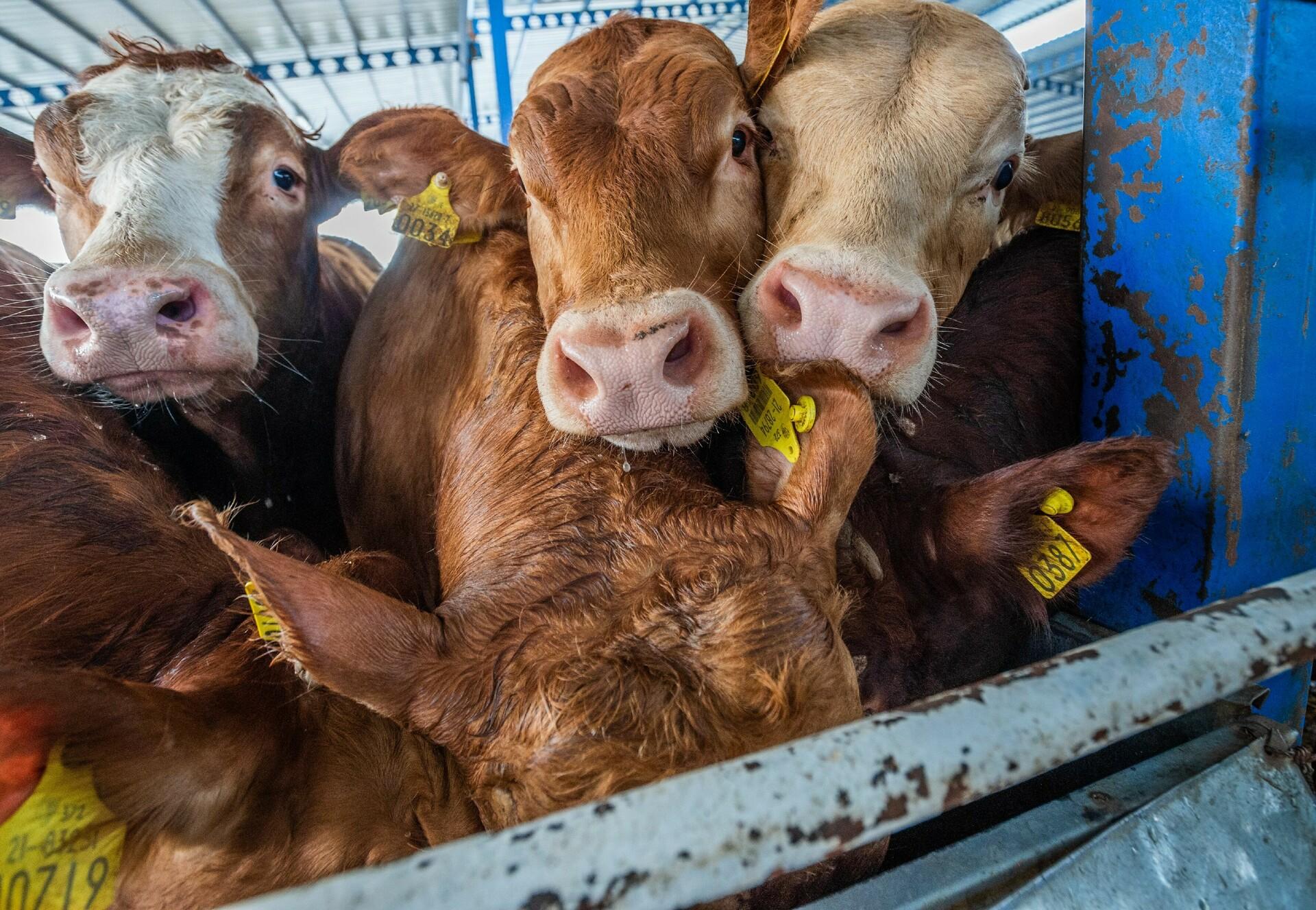
WAV Comment – 14/3/21 – There is something grossly wrong with some people on this planet. Unfortunately, I have to report to you that the ‘Elbeik’ livestock carrying vessel; loaded with 1,776 young bulls; is still in the Mediterranean sea after 3 months.
As we reported in other posts, the ‘Karim Allah’ which carried 895 young bulls, finally returned to Spain (Cartagena) recently and all the animals carried were slaughtered. This time it is the 1,776 young bulls that are allegedly infected with bluetongue disease. This has not been confirmed, as no medical examination has been made possible to date. While it can be assumed that the authorities have failed, the health of the animals is believed to be very poor due to the extreme exposure.
With what has / is going on with these 2 vessels; there is an urgent need for international political action. The two ships alone are representative of a sick system that must change; without even taking into account all the other animal carrying, sea going vessels that are crossing the globe at this present time.
The only way to prevent such catastrophes in the future is a clear ban on the transport of ALL live animals by ship; and we mean all; everywhere, period; not for a few months, but a permanent ban.
Picture courtesy of Four Paws International
Three months have passed, during which the 1,776 young bulls on board the ‘Elbeik’ suffered not only from a shortage of water and food, but also from poor ventilation below deck. The vessel, which sails under the Togolese flag, disembarked in the Catalan city of Tarragona in mid-December last year (2020) and was on its way to Libya.
Upon arrival at the port of destination, the local authorities refused to unload the live cargo. The local authorities feared that animals infected with bluetongue were on board, as they came from a region in Spain where there had allegedly been an outbreak of this notifiable disease, Bluetongue, which is spread via insect bites, but is not transmissible to humans.
EU law states that live animals that have already been exported may no longer be re-imported into the EU. However, the fact that the animals have never set a hoof on soil in a third country is disregarded.
As we have always stated on this site, we have no time for the officials at the EU; in our opinion, they are useless at best. We now put our voice behind the massive international welfare group call for a complete and utter ban on the transport of animals by sea; and a ban on all long distance international transport for animals that are currently transported by road.
We will try to post further updates on this tragic situation when we have more;
The splendid victory of David against Goliath! Farmer’s triumph over a multinational oil company.
Thirteen years ago, three African farmers decide to sue Shell Nigeria for poisoning their fish farms in the Niger River Deltaand making their land barren.
They turn to Dutch justice, where Shell is based, but initially nothing to do.
They reply that they cannot claim damages from the parent company for the behavior of the multinational subsidiary Shell Nigeria.
Farmers are not giving up and in 2021, the Hague appeals court overturned the sentence: Shellwill have to pay damages to the three Nigerian farmers. The amount of the compensation will be established in May.
Meanwhile, the sentence is historic.
Thus, the Court of Appeal in The Hague, in the Netherlands, has found the oil giant Shell responsible for the oil pollution in the Niger River Delta, caused by the subsidiary Shell Nigeria.
And it finally does justice to the three farmers; not only that, it affirms the principle of responsibility even in places in the world where multinationals adopt uncontrolled systems.
Not only. It is justice for the Earth: Enough with the poisoning.
It is justice for human rights: enough that the poor around the world are starving to death because powerful ones are draining their resources.
Stop creating poverty to get richer.
In recent years, various journalistic sources have denounced the colossal disasters that other multinational oil companies also create in the Niger River Delta: a real environmental massacre, operated by several hands, where previously there was paradise (e.g. International Report of 2015 ).
Leaking oil pipelines, for example, cause fires and devastate the land. There is something to worry about.
Villains that devastate, starve, kill, with the indifference and tolerance of the institutions. But no: justice can exist.
Fingers crossed. We hope that the compensation is very very high.
And I mean...Who would have thought … Although it took the judiciary thirteen years to reach a verdict, it is a battle won.
We are happy and congratulate the three “Davids”!
Even if the penalty is not high, it is a precedent case and will therefore motivate others to take action against the multinational criminals.
WHO and UN leaders condemned by animal welfare charity for ignoring root cause of Covid pandemic a year on
The letter says high-risk practices, such as the commercial wildlife trade, the dog and cat meat trade, and fur, must be phased out if we are to prevent another crippling global pandemic
Upon the first anniversary of the World Health Organisation declaring Covid-19 a pandemic, a leading animal-welfare organisation has accused governments of “not addressing the actual issues around animal abuse” which lead to zoonotic pandemics.
In an open letter, addressed to the WHO, the Food and Agriculture Organisation of the United Nations (FAO) and the World Organisation for Animal Health (OIE), animal charity Four Paws demanded that risky practices be “urgently phased out”, with a ban on fur farms, live animal markets, and the dog, cat meat, and wildlife trade.
It also urged that there is greater acknowledgement of the need to eat less meat – a key driver of the climate crisis and habitat loss – and a crackdown on risks created by factory farming.
The letter said that “pharmaceutical responses are not the sole and long-term solution”, and said it was “deeply concerning” that despite WHO director-general, Dr Tedros Adhanom Ghebreyesus, speaking a year ago on infection-prevention, the way humans treat animals has not been factored into the pandemic response alongside the development of vaccinations.
Josef Pfabigan, President of Four Paws wrote: “The settings in which a huge proportion of animals globally are raised, traded, transported and slaughtered – cramped and overcrowded environments, poor hygiene, myriad origins, and conditions suppressing immune systems and encouraging pathogen excretion and uptake – create an ideal situation for the exchange, genetic modification and emergence of new pathogens.”
In 2007-2011, the three global organisations, the WHO, FAO and OIE, set up a plan called One Health, which was an attempt to reduce health risks, including animal-human interactions.
Four Paws wants them to add a “One Welfare” plan, stressing links between animal welfare and people’s wellbeing.
Mr Pfabigan said: “The underlying problem is the dysfunctional relationship between us, humans, with animals and nature.
“Only when concrete measures ending animal suffering are introduced worldwide can future zoonotic pandemics be stopped.
“We demand a holistic approach from those responsible, because animal welfare equals environmental health equals human wellbeing.”
Speaking to i, PETA’s Director Elisa Allen said: “PETA wrote to the WHO last year to emphasise that treating animals with disrespect and regarding them as ours for the taking will come back to bite us again, just as it has with the Covid-19 pandemic.
“Animal markets and factory farms – including those that cage animals for their feathers and fur – are breeding grounds for diseases that mutate and spread to the human population. And if we continue to pillage the natural world and kill the other animals in it, we also exacerbate the climate crisis.”
Previously, scientists have said zoonotic diseases – viruses that jump from animals to humans – have become four times more frequent in the past 50 years, with zoonoses causing a billion cases of illness in people and millions of deaths every year.
According to both the WHO and a UN environment report last year, 75 per cent of all emerging infectious diseases originate in animals, and Four Paws is warning of “ticking time bombs all over the world” from practices where pathogens may emerge and spread.
Free Xuan and Mo from a life in darkness Dear Mark, We are still in shock. Never have we seen more cruel bear keeping conditions.
Since they were cubs, Xuan and Mo have been kept in a windowless basement of a shop. No light, no fresh air, nothing but the rusty bars of their tiny barren cages. They are so desperate to get out.
A life in darkness
Some days ago, we visited the bears to talk to the owner and see if there is any possibility of us rescuing them. To take pictures, the room had to be illuminated with flashlights to see the cages and the animals at all. It was hard to breathe because the air reeked of faeces.
The only time Xuan and Mo get to see light is when their owner comes to feed them or worse: puncture their gallbladder with a needle, a painful procedure to extract their bile. This bile was then used for medicinal purposes by the family of the owner.
Kept in a basement: Free Xuan and Mo from a life in darkness
A life in darkness
No light, no ventilation or fresh air, nothing but the rusty bars of tiny barren cages. Kept in a windowless and wet basement since they were cubs, bears Xuan and Mo have suffered unimaginably.
The only time they get to see light is when their owner comes to feed them or worse: puncture their gallbladder with a needle, a painful procedure to extract their bile. This bile was used for medicinal purposes by the family of the owner. For years these bears have known nothing but pain and abuse. Without our help, Xuan and Mo will go through this cruelness until the end of their life.
Our team is still shocked by what they discovered in Son La Province, Vietnam. These keeping conditions are one of the worst we’ve ever seen. We have to get them out as soon as possible. Will you join this mission and support their rescue?
At our BEAR SANCTUARY Ninh Binh, they could get all the care and time they need to recover from the horrors they have endured. There, they could discover for the first time what a species-appropriate life for bears can look like. But we can’t rescue them without you.
The fate of Xuan and Mo depends on your donation. Will you help us to rescue them?
From wherever you are reading this, you can join their rescue mission now. With your support, we will bring them to our BEAR SANCTUARY Ninh Binh and give them the life they deserve.
Helping them will only take 3 minutes – can they count on you?
Kind regards,
The FOUR PAWS team
PS: For years these bears have known nothing but pain and abuse. Without our help, Xuan and Mo will go through this cruelness until the end of their life. Please join this mission and help us to get them out of this dark basement!
‘These viruses could convincingly spillover from wildlife into either people or animals farmed in the region’
The most likely origin of the COVID-19 pandemic is still the Wuhan wet market, scientists confirm.
Members of a World Health Organization (WHO) delegation to China recently made the claim in a recent Chatham House briefing.
They also found zero evidence to support theories the disease was deliberately made in a lab. Or, that it was caused by an ‘accidental lab leak’.
‘Most likely’ origin of COVID-19
Dr. Peter Daszak is a zoologist and President of NGO EcoHealth Alliance.
The company says it found ‘a viable conduit’ between the Wuhan wet market and where the ‘closest relatives of COVID-19 are found in bats’.
Dr. Dasszak told the Evening Standard: “It provides a link and a pathway by which these viruses could convincingly spillover from wildlife into either people or animals farmed in the region. And ,then [be] shipped into the market by some means.”
He then suggested the disease came from domesticated or farmed animals which then got into the wet market.
Wuhan wet market
It has been long speculated that the COVID-19 outbreak came from a wet market in Wuhan – where live animals are sold and slaughtered alongside dead ones.
According to Animal Equality: “Wet markets get their name in part from the blood, guts, scales, and water that soak the stalls’ floors, remnants of animals brutally killed so customers can eat freshly killed meat…
“These markets are also a threat to public health,” the charity added. “[They] have been the source of documented disease outbreaks in the past, including SARS…
“It’s because of the public health crises wet markets cause, as well as the intense suffering inflicted on farmed animals, that Animal Equality is urging the United Nations to demand a ban on all wet markets. Not only do these markets pose an immediate danger to humans, they are also intensely cruel to animals.”
WAV Comment – Looks Really Cool !! – Things are really starting to move plant based now. That’s the Future.
MINNEAPOLIS TO GET ITS FIRST VEGAN BURGER CHAIN
New vegan burger chain Stalk & Spade—the first of its kind to open in Minneapolis—will expand nationally through franchising starting this spring.
Next month, vegan fast-casual burger shop Stalk & Spade will open in Wayzata, MN, a suburb of Minneapolis. Created by restaurateur Steele Smiley, Stalk & Spade will feature vegan versions of traditional fast food, such as burgers, cheeseburgers, chicken sandwiches, French fries, chicken nuggets, and shakes. All recipes were developed by the team after months of testing.
Smiley believes the plant protein concept can be a market leader and plans to build on the Wayzata location by expanding nationally through franchising, starting this spring. “I’m utterly convinced we’ve cracked the code on plant-based burgers. You won’t know the difference,” Smiley told media outlet Twin Cities Business. “I knew the only way people would come is if the food tastes like classic favorites.”
Plant-based eating is the future
A long time vegan, Smiley says his 11-year-old son inspired him to create the plant-based burger concept when, one night, he asked for a burger while eating at Smiley’s salad chain Crisp & Green. “We’re going to look like a national brand from day one: dine in, order ahead, car-side pickup,” Smiley said. “I believe all-plant eating is our future. It’s exciting to be first.”
Love the plant-based lifestyle as much as we do? Get the BEST vegan recipes, travel, celebrity interviews, product picks, and so much more inside every issue of VegNews Magazine. Find out why VegNews is the world’s #1 plant-based magazine by subscribing today!
Our local favourite brother-sister vegan butcher duo will open their second brick-and-mortar later this year. Herbie Butcher’s Fried Chicken is set to open late spring from Aubry and Kale Walch, the pioneering siblings behind The Herbivorous Butcher. The new location on 48th and Chicago in South Minneapolis (735 East 48th Street) will provide comforting and homestyle classics including vegan fried chicken biscuit sandwiches, mac and cheese, seasonal sides, milkshakes, malts, and a fried chicken bucket.
Co-founder Kale Walch said, “Our mission has always been to try to save the world by bridging the gap for omnivores that haven’t quite made the full jump to veganism yet. By making vegan meats and cheeses that are even better than what they were used to, we start to accomplish just that. Herbie Butcher’s Fried Chicken continues our brand’s mission by making a fried chicken that won’t leave anyone questioning if a plant-based lifestyle is possible without sacrificing the foods we love.”
This is second major win for Kale and Aubry Walch who recently stood up to big-time conglomerate Nestlé. Nestlé aimed to trademark “The Original Vegan Butcher,” “The Vegan Butchers,” and “Vegan Butcher,” but met opposition from the siblings and eventually backed down, giving up all claims. Twin Cities residents know that the Herbivorous Butcher’s homemade meat-free meats and dairy-free cheeses are deserving of the term “vegan butcher,” one they have proudly embodied since opening in 2016. Now that Nestlé will not own these titles, it benefits and allows small businesses everywhere to use them.
Announcing a vegan fried chicken concept and trademark victory in less than the span of a month this early in the year is the bit of good news we’ve all been waiting for.
Cultured meat from Eat Just – which debuted in Singapore last year Credit: Eat Just
‘Cultivated meat presents as an achievable low-carbon, cost-competitive agricultural technology that can play role in achieving a carbon-neutral food system’
Cultivated meat, compared with conventional beef, can slash global warming impacts by up to 92 percent, states a new study.
Researchers from CE Delft also found cell-based meat could cause 93 percent less air pollution and use up to 95 percent less land and 78 percent less water.
The studies model a future large-scale cultivated meat production facility. It shows that by 2030, the cost of cell-based meat, when manufactured at scale, could drop to $5.66 per kg.
The LCA analyzes various scenarios. This includes the adoption of renewable energy by both the conventional and cultivated meat industry ‘should they go all-in on their climate mitigation efforts’.
In the most optimistic scenario, which factors in ambitious projections of conventional animal agriculture’s achievements in environmental impact improvements, cultivated meat outperforms all forms of conventional meat.
The LCA shows that cultivated meat, when produced using renewable energy, reduces the cumulative environmental impacts of conventional beef by approximately 93 percent, pork by 53 percent, and chicken by 29 percent.
In these scenarios, the conventional products are also produced using renewable energy.
Moreover, CE Delft says this production cost will enable cultivated meat to ‘compete with multiple forms of conventional meat’. As well as ‘serve as a high-quality ingredient in plant-based meat products’.
‘A carbon-neutral food system’
Ingrid Odegard is CE Delft’s Senior Researcher. In a statement sent to PBN, she said: “We show that cultivated meat presents as an achievable low-carbon, cost-competitive agricultural technology that can play a major role in achieving a carbon-neutral food system.
“This research provides a solid base on which companies can build, improve, and advance in their goal of producing cultivated meat sustainably at scale and at a competitive price point.”
‘Massive reductions in emissions’
Elliot Swartz is a Senior Scientist at The Good Food Institute (GFI). He added: “As soon as 2030, we expect to see real progress on costs for cultivated meat. And, massive reductions in emissions and land use brought about by the transition to this method of meat production.
“This research signals a vote of confidence. It serves as a practical roadmap for the industry to address technical and economic bottlenecks, which will further reduce climate impacts and costs.
“Government investment in R&D and infrastructure will be critical to accelerating the development of cultivated meat. And, help us achieve global climate goals.
Swartz then concluded: “Favorable policies and carbon markets can incentivize the restoration of agricultural land for its carbon sequestration and ecosystem services potential. This maximizes the climate benefits of cultivated meat.”
Alternative proteins
GFI Executive Director Bruce Friedrich also said the world will not achieve net-zero emissions ‘without addressing food and land’. Moreover, he states that alternative proteins are a ‘key aspect of how we do that’.
“Decarbonizing the global economy is impossible with the diffuse production process and range of gases involved in conventional animal agriculture,” Friedrich explained.
“As these new models illustrate… If we can concentrate the environmental impact of meat production in a single, manageable space — and if we power that space with electricity generated from clean energy sources — that’s how the world gets to net-zero emissions.”
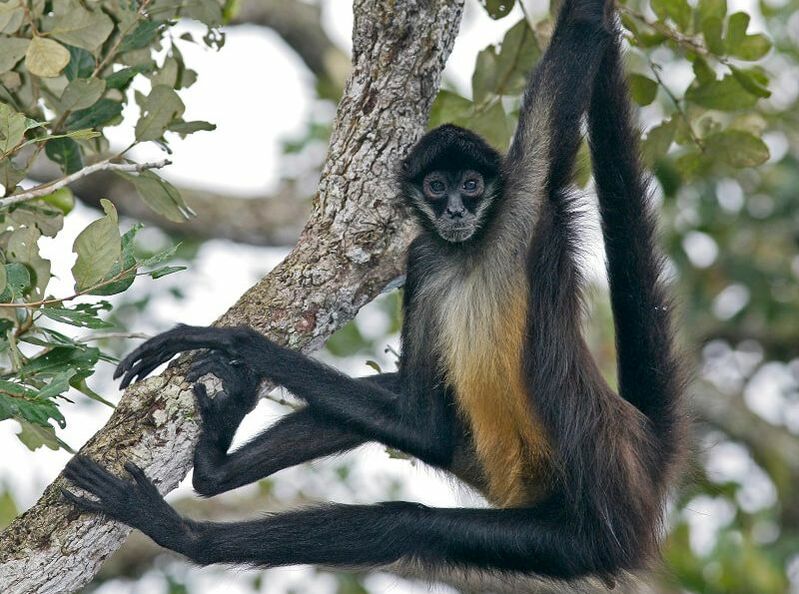
The spider monkeys are a genus of primates from the family of the spider-tailed monkey.
The genus is divided into two types, the northern arachnid, and the southern arachnid.
They live in the forests of southeast Brazil.
In the past, its range stretched from the state of Bahia in the north to the state of Paraná in the south, but today its range is greatly reduced and fragmented.
The habitat of these animals is the coastal rainforests, where they occur up to 1600 meters above sea level.
Spider monkeys are the largest New World monkeys.
They reach a head-body length of 45 to 78 centimeters, plus a 65 to 80-centimeter long tail.
Males are 12 to 15 kilograms heavier than females, which reach 9.5 to 11 kilograms.
Their whole body is adapted to the tree-dwelling way of life, arms and legs are noticeably long and slender.
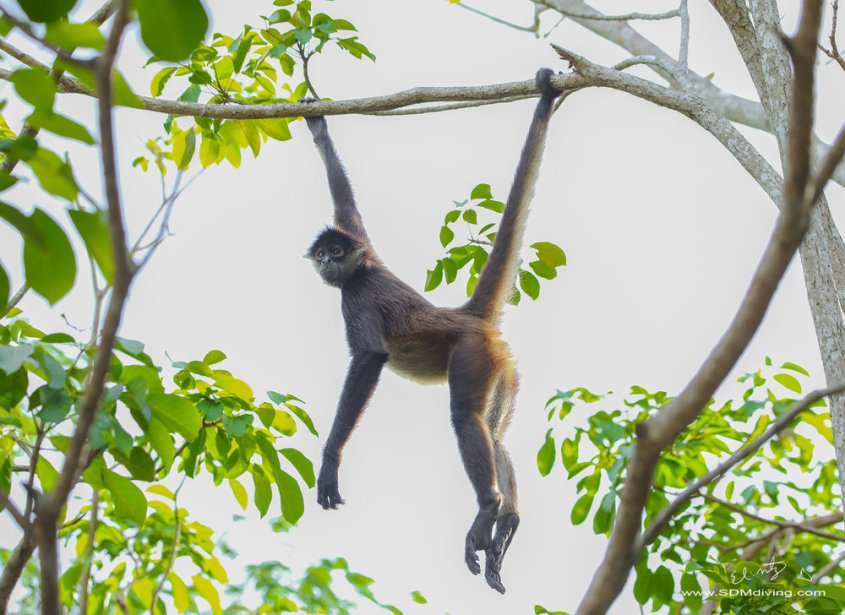
The thumb is small in the northern species, but it is present, in the southern species it is completely absent. The tail, which is as long or longer than the body, is used as a prehensile tail.
As with the other spider-tailed monkeys, it is hairless on the underside of the tip, which allows for a better grip. Spider monkeys are diurnal tree dwellers and prefer to stay in the upper crown area.
They are skilled climbers who often move suspensively – swinging by their arms or hanging by their tails – or on all fours.
If necessary, they come to the ground as well.
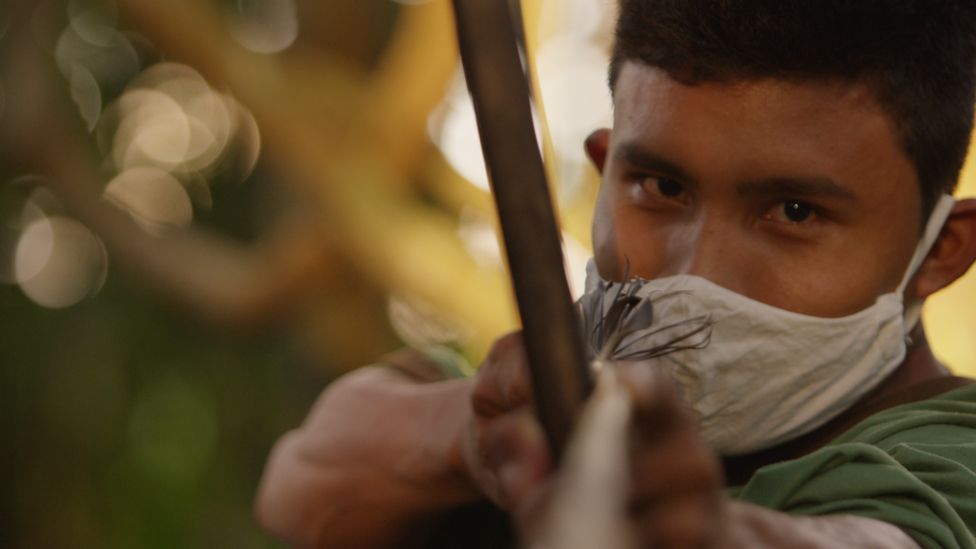
WAV Comment – we are an animal rights group; but that does not stop us from sometimes dealing with human rights issues also when we think it is right. Here are a few stories from Brazil which we hope you will enjoy reading and support. We hope this information will help one of our supporters, Barbara Crane Navarro – of the Rainforest Art Project;
The court is asking the government to “take the appropriate civil and criminal measures”.
Facebook has said it is “ready to work with local authorities”.
But the tech firm has indicated it will not take independent action of its own to halt the trade.
The Amazon is the largest rainforest in the world and a vital carbon store that slows down the pace of global warming. It is home to about three million species of plants and animals, and one million indigenous people.
Still online
Brazilian Supreme Court Justice Luís Roberto Barroso has asked the country’s attorney general and Ministry of Justice to investigate the BBC’s findings.
He was already overseeing a lawsuit brought to the Supreme Federal Court by an NGO – the Articulation of Indigenous Peoples of Brazil – and six political parties.
The plaintiffs have accused the government of failing to do enough to prevent the coronavirus from affecting indigenous communities.
The judge took the decision to extend the case to include the Facebook ads.
And he drew particular attention to the Uru Eu Wau Wau community. The BBC’s documentary reported that land inside a reserve used by the indigenous group had been listed for sale for the equivalent of about £16,400 in local currency.
No papers
The BBC has flagged up some of the ads involved to Facebook, but the social media giant has failed to remove them.
The listings include areas inside indigenous territories and national forests, which have protected status.
Some feature satellite images and GPS co-ordinates. Many of the sellers admit to not being able to prove legal ownership.
To find them, users need only type the Portuguese for terms such as “forest”, “native jungle” and “timber” into Facebook Marketplace’s search tool, and pick an Amazonian municipality as the desired location.
The BBC arranged meetings between four sellers on Facebook and an undercover operative posing as a lawyer, who claimed to represent wealthy investors.
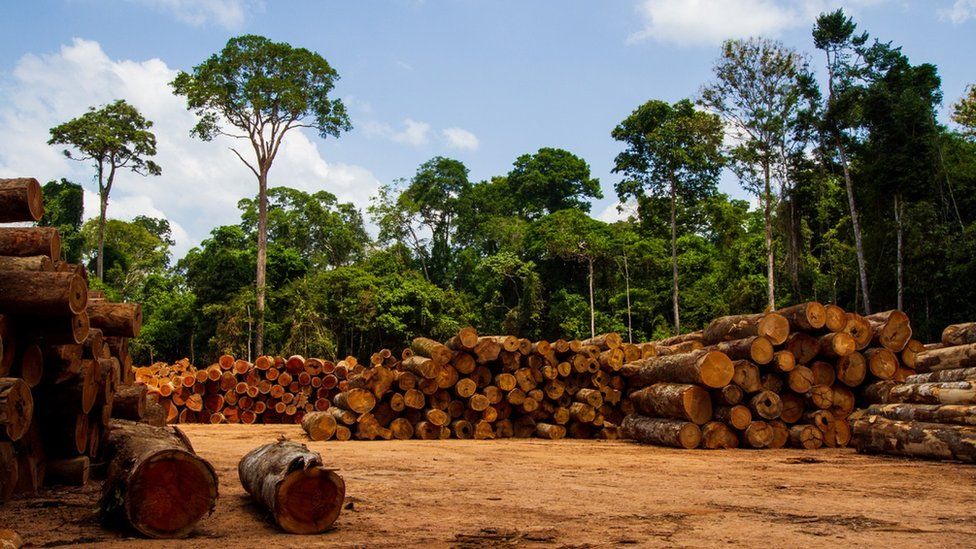
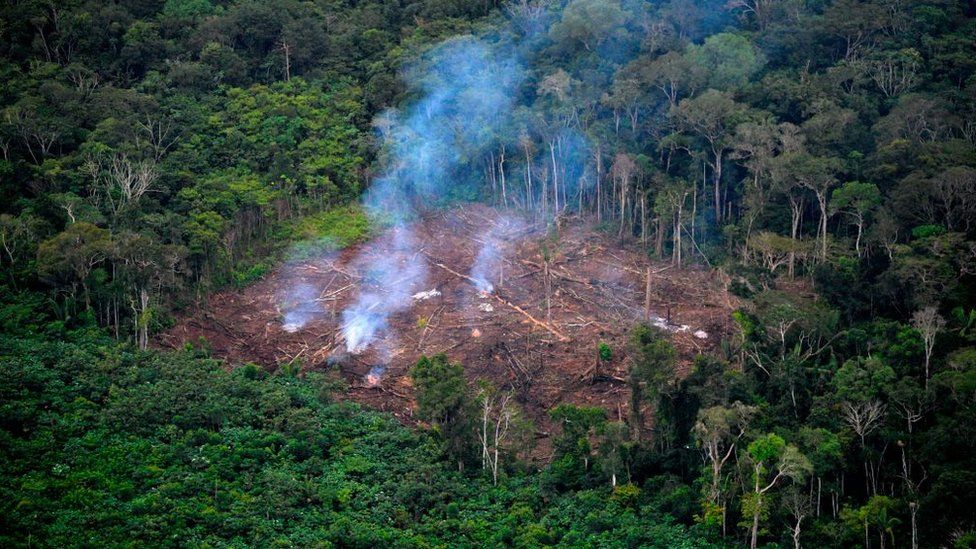
The sellers caught on hidden camera were illegally selling and clearing rainforest so it could be used as cattle pasture and farmland.
‘Stolen land’
The head of the Brazilian Senate’s Environment Commission, Senator Jaques Wagner, has described the land deals as “criminal”.
He said his panel of lawmakers would write to Facebook demanding it “review its policy so that this practice is curbed”.
Facebook has previously indicated it believes the task of trying to deduce which sales are illegal is too complex for it to carry out itself.
But one congressman mocked this explanation.
“What is the difference between selling stolen land with violence against indigenous rights on Facebook and selling narcotics through the platform?” asked Nilto Tatto, a member of the lower house’s environment commission.
“Can Facebook then be used to sell narcotics? As a parliamentarian, I will ask this question.”
International pressure
Photo – Getty Images
Brazil’s government has faced international criticism for failing to curb deforestation, which is at a 12-year high.
Conservationists have accused the country’s President Jair Bolsonaro of encouraging loggers and farmers to clear parts of the rainforest.
And some of the sellers captured on hidden camera by the BBC said they viewed him as an ally.
The BBC approached Brazil’s Minister of the Environment Ricardo Salles with the findings of its investigation.
He said: “President Jair Bolsonaro’s government has always made it clear that his is a zero-tolerance government for any crime, including environmental ones.”
A UN Environment Programme spokesperson told the BBC: “Illegal deforestation undermines international treaties and commitments, including the Paris Agreement and the Convention on Biological Diversity.”
Amazonian groups sue French supermarket chain over deforestation
French supermarket chain Casino is being sued by indigenous groups from the Amazon, for allegedly selling beef linked to deforestation.
The 11 indigenous groups, backed by NGOs in the US and France, are seeking €3.1m ($3.7m; £2.7m) in damages.
In a statement, the groups linked Casino meat to an area of deforestation “five times the size of Paris”.
Casino told AFP and Reuters news agencies that it took a “rigorous” approach to its supply chains.
The company is being taken to court under a French law enacted in 2017. Under the law, businesses must avoid human rights and environmental violations in their supply chains.
The indigenous groups from Brazil and Colombia have accused Casino of “damages done to their customary lands and the impact on their livelihoods”.
In the statement they said deforestation in South America, particularly in Brazil, was mainly driven by cattle ranching.
“According to evidence compiled and analysed by the Center for Climate Crime Analysis for this case, Groupe Casino regularly bought beef from three slaughterhouses owned by JBS,” a meatpacking company accused of deforestation, they said in a joint statement.
“The three slaughterhouses sourced cattle from 592 suppliers responsible for at least 50,000 hectares of deforestation between 2008 and 2020… The deforested area is five times the size of Paris.”
Casino also controls Brazil’s largest food retailer, Grupo Pão de Açucar (GPA), and Colombian retailer Almacenes Éxito.
The indigenous groups also accuse Casino of violating indigenous rights, and cite one case in particular in which indigenous lands were invaded and used by cattle farms that supplied beef to GPA.
“The demand for beef by Casino and Pão de Açucar brings deforestation and land-grabbing and violence, and the murder of indigenous leaders when they choose to resist,” Luiz Eloy Terena, a leader of Brazil’s Terena people, said in the statement.
“With this lawsuit, we seek to hold the company accountable for the consequences of these impacts and to bring some relief to the reality confronted by our indigenous peoples on their lands.”
Casino told Reuters news agency that its Brazilian-sourced beef was not sold in its French shops.
GPA also told the agency that in 2016 it set out criteria that its suppliers must comply with – including “zero Amazon deforestation, no slave-like condition, no child labour and no invasions of indigenous land or conservation areas”.









/cdn.vox-cdn.com/uploads/chorus_image/image/68929250/herbie_butchers_fried_chicken_2.0.jpg)

 They reach a head-body length of 45 to 78 centimeters, plus a 65 to 80-centimeter long tail.
 As with the other spider-tailed monkeys, it is hairless on the underside of the tip, which allows for a better grip.