Category: Farm Animals

40 Pigs Thrown Into the Sea in Animal Transport Horror.

WAV Comment

Bulgaria IS a member state of the European Union.  As such, it is required to adhere to Regulation 1/2005 for the welfare of animals when any livestock is being transported.

This expose shows again that the EU has no control over the transport of live animals; and what’s more, it does not care. Flashy new videos and driver guides etc; which amount to nothing – no changes.  The EU Commission passes the buck of any responsibility back to the member state involved.    The EU just wipe their hands of the situation and turn the other way.   I have experienced this for over 25 years investigating live animal transport within Europe.  Nothing changes despite what the EU thinks. – Mark

Eyewitness: 40 Pigs Thrown Into the Sea in Animal Transport Horror


Dramatic video footage of live-animal transport reveals that pigs suffered and died in the summer heat during a four-day ferry journey.

PETA Germany received the footage, which was shot by an eyewitness on the vessel between 24 and 28 July 2018, showing lorries loaded with pigs being transported by ferry from Bulgaria to Georgia.

So far, it’s not known where the pigs were farmed.

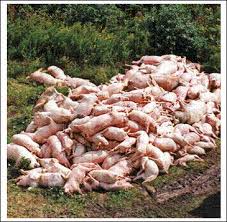
According to the eyewitness, the animals were given no water or food while on board and, because the lorries were in the blazing sun, were subjected to extreme temperatures. Weak pigs were left to suffer, receiving no veterinary care. The eyewitness saw 40 ill or dead pigs being taken from the lorries and thrown into the sea.

PETA Germany is currently unable to report the companies responsible for these animals’ suffering to authorities because it hasn’t received enough information to do so. But the group has written to the Bulgarian and Georgian authorities to inform them of the incident and to call for an investigation.


What You Can Do

Every week, more than a billion live animals worldwide are transported over long distances, often through blazing heat or freezing cold and without food, water, or veterinary care – as if they were nothing more than freight. Their gruelling journeys typically end at an abattoir, where they face a terrifying death. Others end up in pet shop displays or laboratory cages.

The best way to help animals is never to buy them or their body parts for any reason, but we can also help reduce their suffering by taking action now to call for an end to cruel live-animal transport.

PETA Germany is campaigning against long-distance transport to non-EU countries (page in German). And closer to home, PETA UK is asking Ireland to end the live export of cows.


Last year, an estimated 30,000 cows were forced to make long, harrowing journeys from Ireland to Turkey, sometimes in temperatures of up to 41.5 degrees. Exhaustion, dehydration, and death are common during these trips. Ireland plans to export 50,000 cows this year. Contact the country’s Minister for Agriculture, Food and the Marine to let him know that live export is incompatible with animal welfare and must come to an end.


https://www.peta.org.uk/blog/eyewitness-40-pigs-thrown-into-the-sea-in-animal-transport-horror/


Germany : (Reuters) -Germany gives free rein to boar hunters to contain swine fever risk. And What About German Livestock Transporters Biosecurity ? – Do They Have Any ?

deutsche flagge

https://www.reuters.com/article/us-germany-swineflu/germany-gives-free-rein-to-boar-hunters-to-contain-swine-fever-risk-idUSKCN1G51CI

 Jäger mit ermordeten Wildschweine(4)

Germany gives free rein to boar hunters to contain swine fever risk

BERLIN (Reuters) – Germany issued a decree on Wednesday to allow hunters to shoot wild boar year-round to stop the animals, which can carry African swine fever, from passing the deadly infection on to farm pigs.

While no case has yet been detected in Germany’s wild boar population, the spread of the disease in eastern Europe is causing immense concern in Germany, whose pork industry has seen huge growth in exports to countries including China.

A government spokesman said the cabinet’s decision was taken to bring about a “significant reduction” in the wild boar population and contain the risk of farm pigs being infected.

The cabinet also agreed on protection measures which would kick in if a case of swine fever was reported in Germany, such as the creation of security zones around affected areas and mandatory disinfection of animal transportation vehicles.


WAV Comment –

See paras 258 to 274 of this following link for further detail:

http://animaltransportguides.eu/wp-content/uploads/2017/03/Animal-Transport-Guides-Cattle-2017-1.pdf


Disinfection of transport vehicles should always be undertaken after every journey according to EU Reg 1/2005 – otherwise disease could be spread from (possibly diseased) animals that have left the truck, to new animals being loaded onto it.  Its called ‘Biosecurity’ – although in reality, there is little security of disease control.    This is not something ‘new’ from a government; it should be a routine standard for livestock hauliers !

Are we saying that normally German hauliers do not disinfect according to 1/2005 normally ? – seems that way – so according to 1/2005, they should be prosecuted as they are not enforcing EU regulations ! – Does the German government care ? – of course not.

So, blame the wild boar and hunt them all instead.  Much easier to kill rather than disinfecting livestock transporters which haul (infected ?) livestock all over the EU.  Livestock biosecurity and disease control has always been a big issue of mine and I have raised the issue many times with the EU – response – the EU does not give a toss; as with anything associated with live animal transport – this is why EU live animal transport is in such a mess.

– Mark.


The virus, which causes African swine fever, is harmless to humans and other animals. But for wild boar and farm pigs, the disease is deadly in almost all cases within 10 days. There is no vaccine against African swine fever.

 FF9

Germany, a major European Union pig producer, has watched with growing concern as the highly contagious disease has spread westward across Europe. A reported case could trigger mass culls.

Animal protection group PETA criticized the cabinet’s decision, saying the government was subordinating animal welfare to economic interests.

 “The de facto cancelling of the off-season will cause great animal suffering, because the young are dependent on their mother during the rearing phase,” PETA said in a statement. “Countless piglets will starve to death.”

Infected wild boars have been found in the Czech Republic and Poland, while backyard pigs with the disease were found in Romania in January.

German farmers have called for 70 percent of the country’s relatively large wild boar population to be culled.


WAV – why don’t they (German farmers) call for tightening of biosecurity rules in transporters hauling live animals (ie pigs) all over the country and to other parts of Europe.  A kind of link with Bovine TB in the UK – probably not badgers spreading, but the fact that TB infected livestock is transported all over the UK in trucks that may not be disinfected after each consignment.  Again; blame and kill Badgers – it is much easier than enforcing rules for hauliers ! – Mark.

German Agriculture Minister Christian Schmidt has rejected a plea from the farming association to refrain from imposing an export ban if African swine fever was identified in wild boars, saying Germany was not in a position to bypass EU rules.

Myths and facts about swine flu!

Farmers fear economic losses from the swine fever

One thing in advance: For humans and other animals, such as dogs, swine fever is no danger. One can not be infected by contact with animals or eating meat. But for pigs, sooner or later infection usually ends in death.

Although people do not get the swine flu, many are still scared – and especially the people who keep and kill pigs ANYWAY: pig farmers.

FF12

Because if swine fever is present in their stable and an animal of their “stock” infected with the disease, all animals must be killed prematurely. A loss business for the farmers who earn money with the pigs only by the death in the slaughterhouse.

massenproduktion-nahrungsmittel-mit schweine

Wild boars are brutally hunted

Actually, it is travelers from Eastern Europe who can bring the causative agents of swine fever on their shoes, car tires or thrown away food (meat or sausage from infected pigs) to Germany.
The argument of the pig breeders is that these pathogens could be taken up by domestic boars and possibly dragged to a pigsty.
But only the human being can bring the pathogen INTO the barn because the most pigs today no longer see blue skies in their narrow and dark concrete cells, and never come directly into contact with wild boards!

Fact is: it’s not the wild boars that spread the plague across the continents and into the stables, it’s the humans. The problem is industrial animal husbandry in itself, as other cases such as bird flu have shown.
Under this false and ridiculous argumentation, a brutal hunt for wild boars is now being “preventively” being carried out.

Jäger mit ermordeten Wildschweine(4)
Programs in the millions should encourage hunters to shoot more at the animals. This hunt is not only cruel, but simply counterproductive. Because: The more wild boars the human kills, the more animals multiply.

Now it has been known for about ten years that the African swine fever was found not far from the Caucasus. But we have not read anything about millions of dollars worth of programs that could have eradicated the disease in an effective and animal-friendly way.

Meat and swine fever

Through animal husbandry, epidemics can spread rapidly. This has already shown the bird flu. In this case, even the innocent wild boars must serve now, so that “your schnitzel” can still be killed only in the slaughterhouse.

Tenderize slabs of meat on wooden board
Our conclusion: Instead of shooting wild boars preventively, one could honestly deal with the real problems once and then quickly come to the solution, that one should rather preventively stop the pig breeding.

https://www.veganblog.de/ernahrung/afrikanische-schweinepest/

At the latest, and after watching the video, we realize with what dirty “solutions” ( such as the mass murder of wild boars) against innocent beings act the meat mafia and the hunters. Because the main culprit is human. Both for the transmission of the disease, as well as for the criminal conditions in the animal farms all over the world, that favor this disease.

My best regards to all, Venus

Intensive Farming Pork Karma !

flying pig


Please read our recent post re swine fever in Germany:

https://worldanimalsvoice.com/2018/10/13/legal-mass-murder-of-wild-boars-murderers-cheer/

So German hunters have to kill 90,000 wild boar to protect the German pig industry from being hit.  Any excuse for a good kill one could say !

FF7


https://www.politico.eu/article/spread-of-swine-fever-raises-alarm-in-europe/


Spread of swine fever raises alarm in Europe

Germany and others are going to extraordinary measures to protect their prized pork.

By Simon Marks

9/3/18, 6:45 PM CET

Updated 9/11/18, 5:38 AM CET

As African swine fever spreads, European countries — especially Germany — are afraid of the damage that could be caused to their farming sectors.

The deadly disease — which causes internal bleeding and hemorrhages in pigs — is moving quickly through Eastern Europe, typically through wild boar, which travel long distances and can infect domestic pigs being bred on commercial farms.

In response, countries like Germany, the EU’s largest pork producer, are stepping up efforts to protect their pig populations, some going so far as to consider building border walls to keep boars out.

Over the summer, Romania recorded nearly 800 outbreaks of swine fever, including one last week that resulted in the culling of 140,000 animals. The epidemic has rocked the government, with Agriculture Minister Petre Daea holding talks with Prime Minister Viorica Dăncilă on Monday about how to contain the escalating situation.

Liviu Dragnea, the leader of Romania’s ruling Social Democratic Party, urged the government over the weekend to step up its efforts to curb the spread of the disease, and the country’s former Prime Minister Dacian Cioloş gave a strongly worded press conference on Sunday where he accused the government of aggravating the spread of the disease through its inaction.

Adding to the sense of urgency on the matter, Bulgaria on Friday announced its first African swine fever outbreak, at a farm located close to the border with Romania.

So far outbreaks of African swine fever have been confirmed in nine EU countries, affecting Estonia, Poland, Latvia, Lithuania and Romania the worst. Outbreaks have also been confirmed in Russia, Ukraine and Moldova. China, the world’s biggest pig producer, has also recently been hit by the disease.

Germany, which is home to massive pig farms in the east of the country, is becoming increasingly concerned about how countries in the east are dealing with the outbreak. The confirmation of just one case of the disease in Germany could put at risk the roughly 250,000 tons of pork meat that’s exported every year to non-EU countries, according to Verena Schütz, head of the meat livestock sector for the German Raiffeisen Federation, which represents agricultural cooperatives.

The German agriculture ministry has gone to extraordinary measures to keep the disease at bay by collaborating with officials in the Czech Republic, Poland and farther afield. As part of these efforts, Germany has dispatched experts abroad, carried out simulation exercises on containment and given lectures to other governments, advising them on how best to stop the disease from spreading.

FF8

https://ec.europa.eu/food/animals/animal-diseases/control-measures/asf_en

https://www.politico.eu/article/belgium-investigating-suspected-case-of-african-swine-fever/

https://www.express.co.uk/news/world/1017519/african-swine-fever-belgium-eu-pork-exports


https://edition.cnn.com/2018/10/02/health/african-swine-fever-europe-china-spread-intl/index.html

Humans are suspected to have caused the recent spread to Belgium, where eight cases were confirmed, as of September 25, according to the World Organisation for Animal Health.

FF4

https://www.agriland.ie/farming-news/african-swine-fever-outbreak-kills-72-pigs-in-china-report/

A total of 72 pigs have purportedly died in another outbreak of African swine fever in China, according to reports.

The outbreak is believed to have occurred in the country’s northeastern province of Liaoning – which Reuters says is the fourth reported incident this week in the province.


https://www.reuters.com/article/us-china-swinefever/china-agriculture-ministry-says-72-pigs-dead-in-new-african-swine-fever-outbreak-idUSKCN1MM117

BEIJING (Reuters) – China’s agriculture ministry said on Friday that 72 pigs had died in another outbreak of African swine fever in the country’s northeastern province of Liaoning, the fourth reported in the province this week.

The highly contagious fever was detected on a farm in the city of Anshan with 120 pigs, of which 88 were infected, according to a statement from the Ministry of Agriculture and Rural Affairs.

FF2

https://www.express.co.uk/news/world/1022009/african-swine-fever-outbreak-china-mongolia

https://www.scmp.com/news/china/society/article/2165501/could-humble-cabbage-help-stop-march-african-swine-fever-china

Common plants such as cabbage, cauliflower and rapeseed could hold the key to stopping the spread of the deadly African swine fever virus threatening pork production around the world, according to research by a major Chinese government laboratory.

China has about 700 million pigs, half the world’s swine population, and reported its first outbreak in Shenyang, Liaoning province, last month, prompting authorities to order tens of thousands of pigs to be culled.

The authorities have tried to contain the virus by banning the transport of live hogs and pig products from 16 provinces and regions, shutting live markets and prohibiting the use of feed derived from pig blood.

But China was still struggling to stop the spread, state news agency Xinhua reported on Friday.

Below – Chinese factory farm pollution.

china factory farm pollution 1

England: The Beef Farmer Who Recognised Each Animal Was An Individual – So The Farm Became Vegan To Save All Animals From Slaughter.

England


The cow (Beef) farmer who learnt that each animal is an individual; and he did not want to send them for slaughter.

So, he had his entire heard taken into lifelong care at Hillside sanctuary, Norfolk, England; where they could live out the rest of their time safe from the slaughterhouse.

He became the Vegan farmer; growing cops instead of killing animals.


See the story of the very compassionate man here:

https://vimeo.com/293352305?ref=tw-share


Hillside animal sanctuary link –  http://www.hillside.org.uk/index.htm  


Factory Farts – And The Growing Number Of Storms Etc – Is There A Link ???

When he heard that methane was responsible for around 18% of the Greenhouse Effect, Ed decided to take action.

Farming livestock – cattle, sheep, goats, pigs and chickens – contributes around 6 billion tonnes of greenhouse gases (carbon dioxide, methane and nitrous oxide) to the atmosphere each year. While estimates vary, this could represent up to 18% of global emissions.


How does livestock cause pollution?

And their wind and manure emit more than one third of emissions of another, methane, which warms the world 20 times faster than carbon dioxide. Livestock also produces more than 100 other polluting gases, including more than two-thirds of the world’s emissions of ammonia, one of the main causes of acid rain.

 cow gas 1

How does livestock contribute to greenhouse gases?

A cow does on overage release between 70 and 120 kg of Methane per year. Methane is a greenhouse gas like carbon dioxide (CO2). But the negative effect on the climate of Methane is 23 times higher than the effect of CO2. … Cattle-breeding is taking a major factor for these greenhouse gas emissions according to FAO.


How does animal manure pollute the air?

Stored for long periods of time in giant tanks or lagoons, the animal waste decomposes and pollutes the air with hundreds of different gases. … Hydrogen sulfide, methane, ammonia, and carbon dioxide are the major hazardous gases produced by decomposing manure.


How does meat production affect the environment?

Air pollution’s effect on human respiratory health. Meat production is one of the leading causes of greenhouse gas emissions and other particulate matter pollution in the atmosphere. … That prolonged exposure to airborne animal particulate, such as swine dust, induces a large influx of inflammatory cells into the airways …


Do cows pollute as much as cars?

A significant portion of these emissions come from methane, which, in terms of its contribution to global warming, is 23 times more powerful than carbon dioxide. … The world’s 1.5 billion cows and billions of other grazing animals emit dozens of polluting gases, including lots of methane.

 factory farming 1

How much pollution does factory farming produce?

Factory farms typically concentrate tens or hundreds of thousands of animals in one area, and a large operation can produce as much excrement as a small city. According to the EPA, “A single dairy cow produces about 120 pounds of wet manure per day, which is equivalent to the waste produced by 20–40 people.”

 cow fart 1

Do cows fart?

Much like humans, when they eat, gas builds up inside of their guts and has to be expelled. (See Why Beans Make You Fart) Cows fart and burp… a lot. The result is a large amount of methane being introduced into the atmosphere.


India: Celebrate Saving Lives With Animal Aid Unlimited. Please Donate If You Can.

India


animal aid unlimited india

David’s Trusting Heart 

He had wedged himself between a motorbike and the wall of someone’s garage, hiding in excruciating pain from a wound in his head that had become a deep hole filled with maggots clear down to the bone. So lucky for him, he had chosen to hide in the home of people who cared, who had our rescue number and who called us to help. We found him panting in stress and confusion and hurried him to Animal Aid’s hospital for treatment. We had to sedate him in order to clean out the wound, but even before we started, his eyes melted us with their trust. What a sweetheart we had on our hands-a gentle older boy whose precious life it was a privilege to save. Meet David today.

Please donate for happy endings.

Cutest little piglet learns to walk again after accident

Dragging his hind legs behind him, Tinku was hit by a car and couldn’t walk. Someone spotted him, and when our rescue team arrived, in terror and confusion he tried to hide in tall grass on the side of the road. He was easy to catch up to though, and we wrapped him in a blanket to cover his eyes to calm him down a bit. Back at the hospital his round black eyes were full of fear. Before rescue, he had never been touched by a person before, but incredibly, he took comfort in being stroked and loved. We found that he had a complete femur fracture and injury to his other hind leg as well that prevented him from being able to stand at all. With 6 weeks of bed rest including cuddles from Kamla and others every day, this determined little boy healed and learned to walk again. Meet Tinku today.

Please donate for rescue and consider adopting a meat-free diet today.

Wounded and staggering in traffic, dog rescued just before collapsing

Staggering and wobbling on a busy road a wounded dog was on the verge of collapsing right in the traffic. When we got up close we saw that he had a wound full of maggots on his neck. We hurried him back to the Animal Aid hospital and sedated him so that we could clean the wound, remove all the maggots, bandage and start him on the road to recovery. Thank goodness we arrived before he collapsed, and what a precious old boy was saved. Meet Marlo today.

Please donate. Because in an emergency, there’s no time to lose.


Celebrate the Care-givers: Radha  

radha

Anyone who notices Radha Gameti‘s show-stopping beauty is quickly distracted from it by being even more impressed by her care for animals. Radha joined Animal Aid 10 years ago and she’s been a main-stay of astounding love every day since. The mange treatment area is her current queendom, but she’s worked wonders from puppies to cattle over the years, rushing here and there to feed, hold fearful animals, organise baths, cleaning kennels, assisting vets and nurses, enticing reluctant eaters with hand-fed morsels…but most impressive is the accompanying ingredient of pure radiant love she adds to her every action. Animal Aid would not be the place of vitality and courage without Radha, whose energy and smile lift the hearts of everyone here. And many of the “everyone”s are recovering animals, who without doubt heal faster because of Radha’s shining light.


EU: Does The EU Support Bullfighting Financially ?- Well Yes, Um No; Blame The Spanish, Not Us – We Are Squeaky Clean !

eu crumble 1

bul1 octAll pictures – Peta.

Reality Check: Does the EU subsidise Spanish bullfighting?


https://www.bbc.co.uk/news/uk-politics-eu-referendum-36270209

The claim: £110m a year of EU agricultural subsidies go to fund Spanish bullfighting.

Reality check verdict: The EU does not give any agricultural money specifically for bullfighting, but that doesn’t mean that no EU money reaches the industry. There are no official estimates for how much.

Uxbridge MP Boris Johnson popped up on BBC Breakfast last week to say that more money could be spent on science and the NHS, instead of Greek tobacco or bullfighting, if the UK left the EU.

“£110m a year of CAP money goes on Spanish bullfighting for heaven’s sake,” the former Mayor of London said.

bul 2 oct

A 2013 report by Green MEPs on bullfighting in Spain found that around €130m (£103m) a year from EU funds was being used to subsidise the industry. The report itself notes that “facts and figures about bullfighting are hard to obtain” and “lines of funding are difficult to track”.

Spanish farmers receive direct payments under the Common Agricultural Policy (CAP) to subsidise food production and support sustainable practices.

Payments to farmers are granted per eligible hectare of land, rather than on what and how much they produce.

The European Commission told BBC News: “To say that some Spanish farmers are receiving payments specifically for breeding fighting bulls or that the EU is somehow pro-bullfighting is disingenuous.”

But the EU has no legal power to stop Spanish farmers raising and selling bulls for bullfighting using CAP money – it’s a matter for Spanish national law.

In October 2015, MEPs voted for an amendment to the EU budget, which called for agricultural payments not to be made to land being used for the rearing of bulls for bullfighting.

While the MEPs’ amendment was included in the EU budget (you’ll have to scroll to page 635), there was a footnote to it.

The footnote says that this decision is “not executable” because it “modifies the legal provisions of the CAP”, so it sounds like although MEPs tried to prevent money being spent on bullfighting, nothing will change unless the CAP is changed first.

Note: An earlier version of this story said that the vote by MEPs would prevent CAP money getting to farmers rearing animals for bullfighting. This version has been amended to make clear that the MEPs’ vote by itself does not stop this happening.

bull july 4bul 3 oct

28 October 2015

EU cuts subsidies that support Spanish bullfighting

European Parliament votes to stop EU agricultural subsidies being used to support bullfighting in Spain in latest blow to traditional activity

Read more – https://www.telegraph.co.uk/news/worldnews/europe/spain/11961010/EU-cuts-subsidies-that-support-Spanish-bullfighting.html

 bull july 5

 bull july 6


International Competition in Cruelty!

Planet


While half a million cows have been slaughtered in the dairy industry in the US to raise milk prices, and despite the fact that there is too much milk on the market, it continues to invest heavily in mega cases.
The Chinese government is striving to build more megastars with large livestock units, and plans to build the largest dairy farm in Europe are currently causing great excitement in northern Spain.

The factory near Zaragoza is said to have 20,000 dairy cows!!

But it is still bigger and crazier! A German has around 30,000 cows in the stable in Russia, and in Brazil a Dutchman plans a stable for 1 million cows. In the desert state of Saudi Arabia, there is a megastall with 50,000 cows. (see the video)

Continue reading “International Competition in Cruelty!”