Category: Live Transport

Portugal: mobile coffin crashed- 100 creatures dead


This Tuesday morning, on the N17-1 road, near the exit to the Industrial Area of ​​Alto do Padrão (between Miranda do Corvo and Lousã), a truck carrying pigs to the slaughterhouse collapsed, having been in the situation that you can see in the video. The driver of the vehicle, as far as we know, was not injured.

But the animals it carried, yes.

portugal jpg

We were unable to provide support as the road was closed. But we managed to register some images, so that everyone can see and hear the suffering of these animals. According to the information that arrived at the site, about 100 animals died.

But that was not all we found: the scene was of many dead pigs, but even more pigs in agony. Bleeding, with broken legs, with a broken spine, dying … an authentic Dante scene.

We also captured the moment when a guy repeatedly kicks a pig, so that it does not move away from the place where his brothers perished.


At the end of the day, more than 9 hours later, we returned to the place.

Some animals had already been taken, but many pigs were still there, clearly very injured.
A pig, probably with a broken spine, just fiddled with its nose in the dirt.
Another, with broken back legs, tried to get up and walk, succumbing and lying down again.

None of these animals were rescued to end their suffering.
These animals were more than 9 hours to be removed from the site.

And make no mistake: they were not rescued, as they will still be killed.

Deniz Rehklau


My comment: The driver almost always remains unharmed with every transport accident involving animals.
How can one believe in justice and God when half of the coffin hangs in the abyss and the coffin leader still escapes alive?

If we had 100 dead truck drivers instead of 100 dead pigs each year during animal transports, that might be a reason not to have any more.
Only in this case will be the business no longer profitable.

The animals are slaughtered anyway, a few less are calculated as losses on each trip.

When do we finally say stop? until here and not further? WHEN?

My best regards to all, Venus

EU To UK – Want A Trade Deal ? – You Must Do Better Animal Welfare; Like Us !

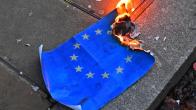
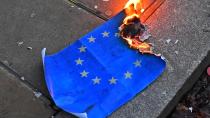
Pro-Brexit supporters burn an EU flag during a UKIP demonstration in central London


https://worldanimalsvoice.com/2020/02/29/lithuania-poland-croatia-slovenia-israeljourney-to-death/

Supposedly – The ruling of the European Court of Justice in April 2015 clearly defines the legal situation: “EU Animal Welfare Ordinance No. 1/2005 must be complied with until the animals’ final destination, even if it is outside the EU.

The Reality is: The violation of the animal transport law is the rule in the EU and not the exception.


https://www.youtube.com/watch?v=dR5-P6z6CDo


https://www.youtube.com/watch?v=wxsRYaeN9GE


https://www.youtube.com/watch?v=m23TrbPZBJA


https://www.youtube.com/watch?v=4IencEit1q4


https://www.youtube.com/watch?v=qa92PjWsKRI


WAV Comment – The crap legislators at the EU have the audacity to say that there will be no access for the UK if ‘animal welfare standards are not protected’ !!

Watch the videos in the above links and see how the EU ‘protects it animals during transport; farming; foie gras production etc’. The EU is filth; and don’t ever take them as being any other way.

From day 1 when the UK voted to leave the EU, the EU has tried everything in its power to make things extra difficult. Now we read here from the Eurogroup that the European Parliament declares that there should be no access for GB if animal welfare standards are not protected.

The UK is a world leader in animal welfare. She has used her position in the EU to influence animal protection policy in the largest trading bloc in the world. For instance, the UK was the driving force behind Article 13 of the Treaty of Lisbon, which recognises animals as sentient beings. Based on the Treaty of Lisbon, the EU and member states must pay full regard to the welfare of animals when formulating and implementing policy. By ‘must pay’ simply read ‘ignore’; because that is the reality.

‘Brexit: getting the best deal for animals’ is a wide-ranging report published by the Wildlife and Countryside Link (Link) and the UK Centre for Animal Law (A-Law). The report is a product of a large coalition of leading UK animal protection NGOs including the Royal Society for the Prevention of Cruelty to Animals (RSPCA), Compassion in World Farming (CIWF), World Animal Protection (WAP) and the International Fund for Animal Welfare (IFAW). The report describes how Brexit presents a major juncture in the history of UK animal protection:

‘As the UK prepares to leave the EU (it has now left), the welfare of animals is at a critical crossroads and selecting the route ahead will determine the welfare of billions of animals. We have a once in a lifetime opportunity to either define or undermine our country’s identity and reputation as a global leader in animal welfare science and standards’.


Lets look at this again – ‘no access for GB if animal welfare standards are not protected’. So the EU is saying that the UK does not meet its ‘standards’ ?- lets see; That is the EU standards which include.

Exporting live animals

The EU allegedly puts a number of restrictions (Regulation 1/2005) on exporting live animals for slaughter or further fattening, such as ensuring adequate space, and providing food, water and rest, which all EU member states are supposed to abide by; but simply don’t (see video footage in above links). As we have shown so many times on WAV; the ‘protection’ of live animals transported across the EU – Reg 1/2005 is a complete and utter joke.. The regulations were implemented into the UK (by legislation) in 2007.

Member countries are allegedly entitled to take stricter measures, if they wish – the EU welfare standards are supposedly a minimum all countries have to follow, but do not. Again, watch the videos above to see non compliances.

If the UK wanted to put further restrictions on live animal exports Reg 1/2005, it could do so while it was still in the EU.

But if it (UK) wanted to fully ban live animal exports whilst a member state of the EU, it would not be allowed to do so under the current EU single market rules. But now (2020) free from the shackles of the EU; the UK is free to; and will, ban the export of live animals.

After the UK leaves the EU, which it has now done; a ban on the export of live animals could still be challenged under World Trade Organization (WTO) rules.

Export bans are prohibited by the WTO, but bans that protect endangered species and animal welfare, including ensuring that animals are not killed inhumanely, are allowed. So, there is a basis for challenging a ban under WTO, but there would also be a basis for defending it.

There is a private member’s bill being put forward by (UK) Conservative MP Theresa Villiers that would ban live exports “for slaughter or fattening, and for connected purposes”, but it stands little chance of becoming law without government support. But now (in 2020) the government has 80+ MP’s majority; to support votes in Parliament; there is little doubt that this ban would be voted through.

Animal welfare standards

The EU has a wide range of animal welfare laws the UK has had to abide by. These include consumer-information law, such as the labelling of eggs from battery hens.

It also regulates the use of animals in research, and it bans cosmetics tested on animals.

On top of these laws, individual countries can set their own animal welfare standards as long as they do not affect the operation of the EU’s single market (in the UK, the issue is devolved).

For example, the UK, as well as most other EU countries, has domestic legislation that prohibits production of foie gras on animal welfare grounds.

Belgium, France, Hungary, Spain and Bulgaria do not prohibit the production and under the EU principle of free movement of goods, the UK was in the position that as an EU member state; it was unable to ban the import of foie gras

As a (now) non EU member, it can now ban the import of foie gras into the UK.

Exploitative trade in pets

The UK government says EU rules on the pet travel scheme restrict the UK’s ability to crack down on puppy smuggling.

The EU pet travel scheme enables the owners of dogs, cats and ferrets to move freely between EU countries with their pets, providing their pet is micro-chipped, has a pet passport, has been vaccinated against rabies and, in the case of dogs, treated for tapeworm.

Pets have to be at least 15 weeks of age before they can travel, and one person can travel with up to five pets.

Pet passports are issued by EU countries and a short list of other countries such as Norway, Iceland and Switzerland.

However, the UK charity Dogs Trust, in its report on puppy smuggling, says the EU pet travel scheme is abused by gangs in Hungary, Poland, Lithuania and elsewhere, who take puppies as young as four weeks from their mothers and transport them hundreds of miles in poor conditions to British ports, often with little food and water, to be sold in the UK.

The UK has been a particularly attractive target for EU puppy smugglers because of the relatively high prices that some breeds command. Outside the EU membership, though, it (UK) could also introduce stricter rules for importing puppies from other EU member states

Now the UK has left the EU; it can make parliamentary changes to resolve the smuggling.

So much then for the EU telling the UK that it needs to step up to the EU plate with regard animal welfare.

As an organisation partly based in the UK (England); we take this EU statement as a complete and utter insult. When the EU enforces all the un enforced activities which are shown in the above video links, then they can talk. Until then, we kindly suggest the EU shuts its mouth and continues to do what it does best – which is nothing apart from writing pathetic regulations on bits of paper; which in reality, it never enforces !

Don’t tell the UK to get better; it is already a lot better than most other member states of the EU when it comes to animal welfare legislation enforcement. It is not perfect; nobody is, but at least we in the UK do not have the situation of the arsonist as the head of the fire brigade !

Only in meat mafia world; the EU, does this happen continually.

https://worldanimalsvoice.com/2020/02/26/eu-eu-spending-tens-of-millions-of-euros-a-year-to-promote-meat-eating-despite-all-the-evidence-against-it/


Lithuania – Poland – Croatia – Slovenia -Israel=Journey to death


Business model “animal cruelty”: In the global livestock trade, only profit counts. For weeks, cattle or sheep suffer painfully on ships before they come ashore to die – on broken legs if necessary.

schaf mit elektro bolzjpg

This footage was taken in July 2019 and is no exception. It is the everyday reality of live transport in Europe. Only this time an investigating team was following trucks.

The investigators from the Animal Welfare Foundation (AWF) and Israel Against Live Shipments (IALS) were trailing calves all the way from Lithuania to their destination in Israel over two weeks.

Only the road part of the journey is as much as 1.700 kilometres.

For several hours, investigators from AWF were following two trucks on their route from Lithuania. Suddenly, they notice a leg sticking out from the truck and immediately call ITD, the Road Traffic Inspection (road police) in Poland.

tote kuh im Schiff jpg

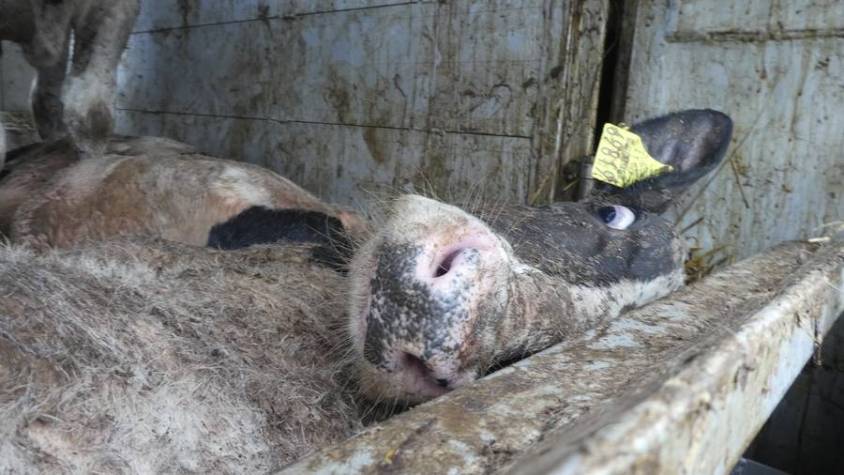
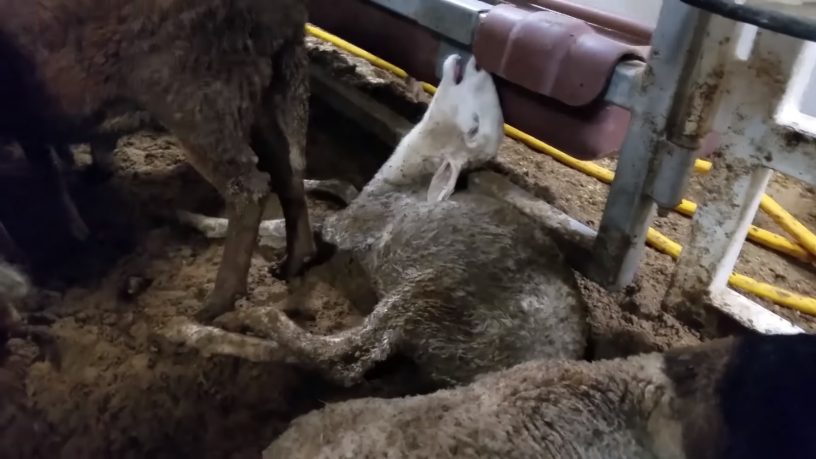
The officials are speechless by the conditions they see inside the trucks.Veterinary inspectors are called who find multiple legal violations, with calves transported in extremely overcrowded conditions, lying in a thick layer of manure, suffering from high ammonia level, heat and extreme thirst.

These conditions caused the death of some animals, but also made other animals so exhausted that they had to be dragged by their legs from the trucks.

tiere schmutzig im schif milchgrenzen5_gal

Nevertheless, after a 24-hour-long rest at a stable, the animals are carried further on to the ports of Koper (Slovenia) and Raša (Croatia).

This time on three trucks instead of only two, but investigators of IALS observe again some terribly weak and exhausted calves at the arrival of the trucks in the ports.

From here, the transport continues by sea and the animals are loaded on the livestock vessels with destination Israel.

Our experience shows that sick animals are usually left untreated and their dead bodies are regularly dumped into the Mediterranean Sea.

AWV BildlIt is common practice to simply throw sick or dead animals overboard. Many even alive.The ear tag is removed beforehand so that the place of origin cannot be located.
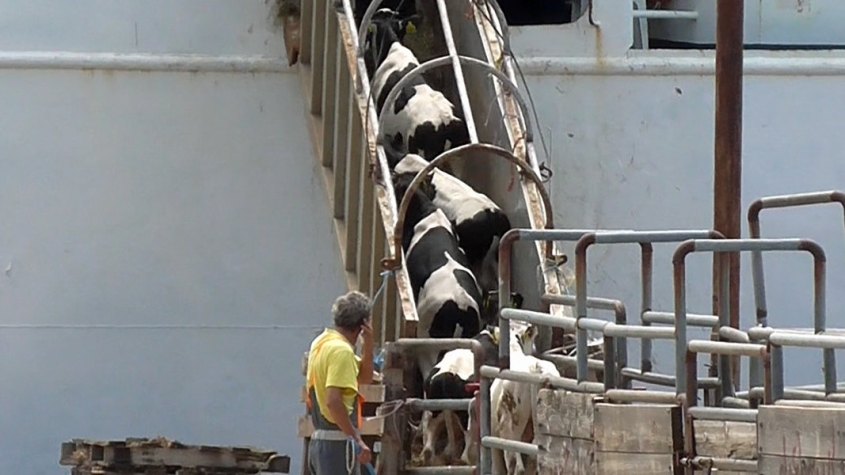
 

After arrival at Israel Shipyards located in Haifa, the journey of these animals is not over yet. The investigators from IALS find “our” calves, beside many others, loaded on small trucks and carried further on to quarantine stables.

During this stage of transport, the temperature measured inside the trucks exceeds 37 degrees Celsius. The calves will be kept in quarantine for a month due to local potential illnesses in the area, before they are sent to fattening farms.

These findings illustrate the failure of the industry, EU Member States and the EU Commission to protect the welfare of animals during long distance transports to non-EU-countries. The suffering of animals on long journeys is inevitable and thus the European Union must stop this cruel and archaic trade involving sentient beings.

Please share this video and help us expose the truth behind the horrors of live transport. And the sign + share the petitions to stop this cruel trade.

https://www.change.org/p/help-to-suspend-all-animal-export-activities-in-the-port-of-ra%C5%A1a-now


And I mean… With the failure of the 8-hour campaign (the initiative of 1.2 million EU citizens to limit animal transport to 8 hours), animal suffering during animal transport has remained the same, if not worse.

A catastrophic consequence of globalization or world trade is the increase in animal transport and the extension of transport distances. This enables the animal industry to market animals internationally.

Around 3.8 million animals are transported every day in the EU alone. That is 1.4 billion animals a year.

In the EU, producers and processors have long since recognized animals as general cargo and are treated like “export goods”. The steps in meat production are separate: breeding, husbandry and fattening concentrate where the feed and wage costs are low.

Many animals do not survive the cruel transports or they collapse due to exhaustion after days of torture.

-60-Minutes-Live-Export-schafen 816x459

These cases are clearly violations of applicable EU animal welfare law, but are rarely punished.

The ruling of the European Court of Justice in April 2015 clearly defines the legal situation: “EU Animal Welfare Ordinance No. 1/2005 must be complied with until the animals’ final destination, even if it is outside the EU.”
In reality, however, every right ends as soon as the EU borders are reached.

And because the EU Commission is the strongest and worst agricultural lobby, it does not see this as its duty to impose sanctions on lawbreakers.
The violation of the animal transport law is the rule in the EU and not the exception.

Schafen im Schifpng

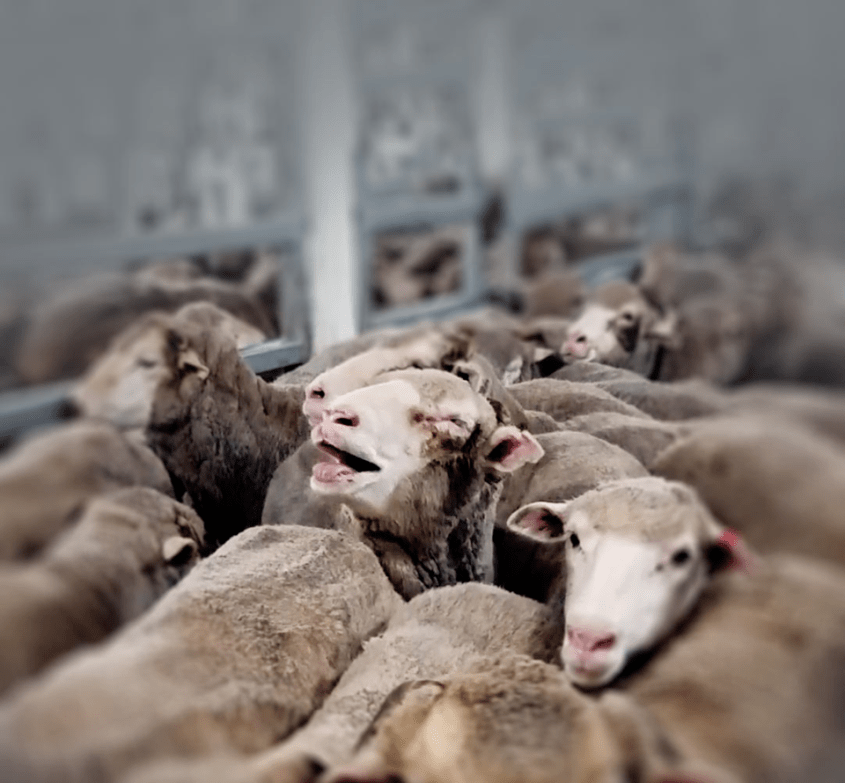
They are images that shock deeply and shake even strong nerves. Sheep, cows, calves and lambs crammed together in ships’ overheated storage rooms and then mistreated.
Sick and dead animals lie around, smeared with excrement and blood. Many suffer injuries and broken bones.

schiffstransport mit Kühenpg

As in all other sectors of the economy, “livestock farming” is all about money. That is why animal transports go where the highest profits are – even if it is over thousands of kilometers.
The main thing is that every meat eater gets his cheap daily meat and the second thing is the meat industry makes its billions with the suffering of animals and the support of the EU.

My best regards to all, Venus

South Africa: The NSPCA and Gerrie Nel head to the High Court against Live Export by Sea.

SAfrica


‘dangerously high ammonia levels on some of the enclosed decks, widespread diarrhoea, with much of it falling into the feed and water troughs’

26/2/20.

The NSPCA and Gerrie Nel head to the High Court against Live Export by Sea

https://nspca.co.za/ 

Dear Animal Warrior


The National Council of SPCAs (NSPCA) confirms that an urgent application to the High Court has been launched to interdict the impending export by sea of live sheep to Kuwait. The matter is set to be heard in the Grahamstown High Court on Friday, 28 February 2020. This, following the live export by sea horror that took place in October 2019 where sheep were transported to the Middle East in horrendous conditions.

Since the shipment in October 2019, the NSPCA has attempted to gain information from both the exporters and the government, of when the next shipment is scheduled, to no avail. The NSPCA was recently made aware that the sheep are mounting in the feedlot owned by the Page Farming Trust and leased by Al Mawashi in Berlin, Eastern Cape, and there were in excess of 30 000 sheep in the first week of February 2020. This number has increased by another 40 000 since 13 February 2020 – totalling 70 000 sheep. It is clear that an imminent shipment is planned.

Afriforum agreed to assist the NSPCA with this High Court case. Advocate Gerrie Nel leading the team, along with advocates Phyllis Vorster and Gustav Weich. The attorneys for the NSPCA case are Matthew Klein and Justin Powers. The NSPCA is indebted to Gerrie Nel and Afriforum for taking this important case on. The NSPCA has a bevy of esteemed experts, including Australian Veterinarian Dr Lynn Simpson who has first-hand experience on these ships, Professor Gareth Bath, Dr Shaun Morris, as well as our own veterinarian, Dr Bryce Marock. The papers will be served to the following respondents:

  1. Minister of Agriculture, Land Reform and Rural Development
  2. The Director General, Department of Agriculture, Land Reform and Rural Development
  3. The Director, Veterinary – Public Health, Department of Rural Development and Agrarian Reform, Eastern Cape
  4. The Provincial Executive Officer, Rural Development and Agrarian Reform, Eastern Cape
  5. The MEC for Rural Development and Agrarian Reform, Eastern Cape
  6. The Chief Veterinary Officer Department of Agriculture, Land Reform and Rural Development
  7. The Director for Veterinary Public Health and Welfare, Department of Agriculture, Land Reform and Rural Development
  8. The Harbour Master, National Ports Authority
  9. The Director, National Ports Authority
  10. Al Mawashi Reg K2018520686
  11. Dave Muller T/A The Meat Men
  12. John Page
  13. Bruce Page
  14. Glen Page


It has come to light that other exporters wish to export live cattle by sea to the likes of Cambodia. The voyage is even longer than that of the Kuwait exports, it exceeds 21 days.

“This case is not only important for this shipment of sheep, but for all the animals that are destined for this harrowing journey to various countries around the globe – we simply cannot allow the perpetuation and growth of this cruel and brutal trade” explained Senior Inspector Grace De Lange, manager of the NSPCA’s Farm Animal Protection Unit.

Afriforum’s CEO Kallie Kriel emphasises that the action is not intended to stop the trade in animals, but rather the way it is done, bringing about cruelty to the animals involved.

In November 2019, the NSPCA laid criminal charges in terms of the Animals Protection Act No 71 of 1962 against the Department of Agriculture, Land Reform and Rural Development (DALRRD), as well as Eastern Cape Rural Development and Agrarian Reform, Al Mawashi – the owners of the Al Shuwaikh vessel, who have a company in South Africa, the captain of the Al Shuwaikh, the Page Farming Trust, and individuals from the Page Farming Trust following the harrowing days spent at the East London harbour by Inspectors of the NSPCA in October 2019, when approximately 57 000 sheep were loaded for shipment to the Middle East. The matter is with the South African Police Services (SAPS) and the investigation is still ongoing.

Conditions on board the Al Shuwaikh in October 2019, included dangerously high ammonia levels on some of the enclosed decks, widespread diarrhoea, with much of it falling into the feed and water troughs, sheep in respiratory distress, together with other serious welfare concerns. On the dock and feedlot, animals were treated in an inhumane manner, and attempts were made to load sick, injured and lame animals onto the vessel. These sentient beings meant nothing to the handlers and exporters.

The costs incurred thus far have been exorbitant and the matter is far from over. The motion will be heard in Grahamstown in the Eastern Cape, so travelling costs, as well as legal costs are placing huge pressure on the NSPCA’s resources. We appeal to caring citizens to assist the NSPCA with this landmark case.

Let us stand together against this abhorrent suffering.


Account Name: SPCA National Council of SA

Bank: Standard Bank

Account No.: 220 639 744

Branch Code: 051 001

Reference: Sheep


Kind regards

The NSPCA Team


EU: EU spending tens of millions of euros a year to promote meat eating; despite all the evidence against it !

Pro-Brexit supporters burn an EU flag during a UKIP demonstration in central London


WAV Comment – we have always called the pro-meat industry; the lobbyists at the EU, the ‘meat mafia’; and in this article by the very respected ‘Guardian’ newspaper in the UK; which we ask you all to read; our labelling is not far from the truth.


“The EU has been accused of an “indefensible” approach to human health and the climate crisis in spending tens of millions of euros each year on campaigns to reverse the decline in meat eating”

“About €60m has been spent in the last three years on 21 meat marketing campaigns …”

“A campaign by the Association of Poultry Processors and Poultry Trade which will be run in six member states at a cost to EU taxpayers of €4.4m aims over the next two years to “contradict myths and fake news” about the rearing and slaughter of chickens for meat”.


We wait with interest to see if the EU bans the intensive cage animal rearing systems of the EU members states; if Germany takes action about the intensive farming of its pigs, and if the EU will ever get any closer to reducing or stopping the transport of live animals. In all cases, we very much question / doubt that there will be any positive progress; especially when all this pro meat eating campaigns are funded by the european taxpayer; who from all accounts; is actually eating less meat now !

And EU citizens are supposed to have faith in the Parliament that represents ‘them’ in Brussels ?

Regards Mark.


Schweinestall---Kastenstand-34414-detailp

_schwein_sauen_produktinfos

EU spending tens of millions of euros a year to promote meat eating


The Guardian is an English newspaper – WAV

https://www.theguardian.com/environment/2020/feb/14/eu-spending-tens-of-millions-of-euros-a-year-to-promote-meat-eating


Campaigns to promote consumption of pork and veal labelled ‘indefensible’ in light of health and climate concerns

The EU has been accused of an “indefensible” approach to human health and the climate crisis in spending tens of millions of euros each year on campaigns to reverse the decline in meat eating and trying to rebut so-called “fake news” on the mistreatment of animals bred for food.

Campaigns range from those designed to counter official warnings about the risk of cancer from eating red meat, to improving the public image of veal products said to be crucial in “deriving value from young male calves” superfluous to the dairy industry.

The EU provides an annual €200m (£166m) subsidy for the “promotion of agricultural products” each year. About €60m has been spent in the last three years on 21 meat marketing campaigns, including in the UK, according to research by the Dutch animal welfare organisation Wakker Dier.


irish 3


The stated ambition of many of the projects has been to halt a decline in meat consumption amid a growing trend to vegetarianism among Europe’s young people.

The livestock sector is responsible for about 14.5% of total human-derived greenhouse gas emissions. Scientists have provided evidence of a link between cancer and diets involving pork, beef and lamb products.

The description on the European commission website of one recent campaign entitled Pork Lovers Europe, which secured €1.4m for marketing, including a “road-show” with a pink bus painted to look like a pig, noted “that the consumption of pork meat in Europe has decreased in recent years”


caged chicks


It continued: “Therefore, it is very important to promote pork meat to restore the confidence of the consumer, which was shaken by news such as the last IARC [International Agency for Research on Cancer] report.”

Scientists at the IARC, a UN agency, reported in 2015 that the consumption of bacon, red meat and glyphosate weedkiller increased the risk of developing cancer. The Pork Lovers Europe adverts targeted consumers in the UK, Spain, Germany, France and Portugal.

A campaign by the Association of Poultry Processors and Poultry Trade which will be run in six member states at a cost to EU taxpayers of €4.4m aims over the next two years to “contradict myths and fake news” about the rearing and slaughter of chickens for meat.


Cage age 1


“EU poultry consumption in the European Union is still increasing but at a slower pace, as more and more consumers are mistrustful regarding the poultry meat production,” the European commission’s website says. The campaign, targeting a 1.22% growth in chicken consumption in 2020 and 2021, is aimed at “young children, professionals, media and opinion leaders”.

A second pork campaign received a €2.5m subsidy for an initiative aimed at Danes and Swedes. “Pork is no longer a natural part of the diet of young Scandinavians,” the commission website says. “They tend to eat less meat in general and to avoid pork in particular. The aim is to increase consumer demand and thus halt any otherwise expected fall.”

A campaign in favour of the Dutch veal sector to promote the meat of calves in the Belgian, Italian and French markets received a €6m subsidy.

“The veal market has been declining since the 2000s,” says a description of the project on the commission website. “There are various reasons for this: the economic crisis, changes in consumption behaviour and above all a lack of top-of-mind awareness. France, the Netherlands, Belgium and Italy are minded to fight this fall in consumption by boosting the image consumers have of European veal.”


End the Cage Age


Sjoerd van de Wouw, a researcher at Wakker Dier foundation, said the funding policy was outdated indefensible. “We understand that you need to consider the interests of producers but not by completing ignoring the interests of consumers and the climate,” he said.

In response, a European commission spokesman said: “The selection of projects is based on a strict and defined procedure involving external evaluators. The producers’ organisations send proposals regarding their campaign ideas and also participate in the funding of the campaigns.

“In an effort to constantly evaluate and adjust its existing policy, the commission will soon launch a public consultation on the EU promotion policy for agricultural products.”


anja

Spain: animal transporter tips over


spanien-flagge-spaniens-r531xg


The truck loaded with 170 pigs was headed to a slaughterhouse in Cuenca when it has overturned at 9:05 am at km 23 of the A6 towards Madrid. Two of the animals have escaped from the vehicle while the rest, 168, have remained locked inside the dump truck for about 5 hours.

Time that animals have spent agonizing and crushing each other with their own weight.

The shrieks, deafening during the first two hours, have gone out as time went by. The transport company staff has not opened the truck until approximately 2:00 p.m.

Live animals, about a dozen, have been loaded into a new truck and taken to the slaughterhouse.

On the other hand, the injured have been sacrificed inside the truck itself.

Animal Equality will ask the Ministry of Agriculture and Food to make public the way in which the slaughter of these animals has been carried out, what standards and protocols have been followed. In addition, the animal organization will demand the development of action protocols for accidents of this type that guarantee adequate and humane treatment.

The two pigs that have been released have been tied with ropes to the median by firefighters and subsequently dragged to the new truck to be and taken to the slaughterhouse.

The members of Animal Equality who have been present during the event have documented how the operators dealt with blows and kicks to the surviving pigs to get them into the new truck.

Igualdad Animal


And I mean…Animals are considered things.
Animals are systematically ignored politically, as if they didn’t exist.
There are no animal rights anywhere in the world. Not a single animal has a single right. Nowhere.
Only humans have rights, all other animal species have no rights.
We humans don’t know what it feels like to be without rights.

Transported in trucks for days as if the load were not living beings but sacks of potatoes.
And be picked up with cranes as if the living beings were fallen trees.

That is what I undestand under fascism.
With the right of the superior race to deny the right to life, freedom, integrity, protection to all other animal species.

My best regards to all, Venus


England: Remembering Jill.

gemalt-england-flagge-5d


JILL


Sticking a little with some Brits who have been killed in their belief for the rights of animals, this year on 1st February we did not publish anything on Jill as we were heavily involved with the German pig campaign. We know would have wanted us to do something current for the animals.  But now we have a bit more time; here is information on Jill who was killed at a live animal export protest in 1995.  Some of you will know about here; some overseas visitors may not.

Recent post:

https://worldanimalsvoice.com/2020/02/19/in-loving-memory-of-mike-hill/


I remember the ‘Jill’ incident well; as I was personally involved with live calf exports around that time from the port of Dover, Kent, SE England.


Mark Dover 94

Top – me at Dover shaking a crated John Major warmly by the neck; bottom: 

the then Prime Minister John Major is shoved in a veal crate. Alongside – a liberated calf !


Jill was aged just 31; was a British animal rights activist who was crushed to death during an animal rights protest in Baginton, Warwickshire, England, while she was trying to slow down a lorry transporting live veal calves heading for continental Europe via Coventry Airport.

On 1 February 1995, Phipps was one of 35 protesters at Coventry Airport in Baginton, protesting at the export of live calves to Amsterdam for distribution across Europe. Ten protesters broke through police lines and were trying to bring the lorry to a halt by sitting in the road or chaining themselves to it when Phipps was crushed beneath the lorry’s wheels; her fatal injuries included a broken spine. Phipps’ death received a large amount of publicity, being brought up at Prime Minister’s question time in the House of Commons.

The Crown Prosecution Service decided there was no evidence to bring any charges against the truck driver. Phipps’ family blamed the police for her death, because the police appeared determined to keep the convoy of calf carrying lorries moving despite the protest. The inquest heard that the driver may have been distracted by a protester running into the road ahead of him, who was being removed by a policeman. A verdict of accidental death was returned and Phipps’ father insisted that she did not want to die as she had a young son to live for.

Veal calf exports from Coventry Airport ended months later, when the aviation firm belonging to the pilot responsible for the veal flights, one Christopher Barrett-Jolly, went bankrupt following accusations of running guns from Slovakia to Sudan in breach of EU rules. One of the planes used to transport the calves also crashed in the UK, when returning empty from a calf delivery flight. https://www.coventrytelegraph.net/news/coventry-news/coventry-news-plane-crash-1994-12346964


Barrett-Jolley

Barrett – Jolly


In 2002 Barrett-Jolly was charged with smuggling 271 kg of cocaine worth £22 Million from Jamaica into Southend airport which is located in the South East of England. He was later sentenced to twenty years in prison. https://www.theguardian.com/business/2002/dec/06/theairlineindustry.drugs

The continuing level of protest was such that several local councils and a harbour board banned live animal exports from their localities. All live exports of calves later stopped due to fears of BSE infection. In 2006 this ban was lifted, but Coventry Airport pledged that it would refuse requests to fly veal calves.

Jill paid the ultimate for her belief in saving animals. On 1st February every year since her death 25 years ago, grassroots animal rights remembrance services in the name of Jill are held all over England and the UK.

She was much to young to die the way she did in the defense of animals – she still had so many years to give to the movement. Sadly, her life was cut short on that fateful day in 95. Jill’s day will always be marled as a day of unity for animal rights campaigners across the UK.


Regards; for Jill

It still hurts and upsets me; a beautiful girl; 25 years on; all she wanted was a world of compassion;

Mark

https://www.youtube.com/watch?time_continue=9&v=78o0Uh9J_aQ&feature=emb_logo


Other Links:

https://worldanimalsvoice.com/2019/04/19/some-questions-about-the-case-jill-phipps/

https://worldanimalsvoice.com/2019/04/18/england-there-is-more-to-the-jill-story-when-you-have-the-facts/

https://worldanimalsvoice.com/2019/02/01/england-1st-february-remembering-jill-warrior-of-the-rainbow/

https://www.youtube.com/watch?v=xFeKx_M-EJ0

https://www.youtube.com/watch?v=5UifagfLMoY

‘Dirty Secret’ – It Is Still Cheaper to Kill Male Calves Than it is to Rear Them.

EPym0LpX0AE8cC_

Have You Seen This Baby ? – Vegan Street


The Dirty Dairy Secret – It is still cheaper to kill male calves than it is to rear them.


Thanks for sending Stacey – https://our-compass.org/2020/02/03/dairys-dirty-secret-its-still-cheaper-to-kill-male-calves-than-to-rear-them/

Please note the use of euphemistic terms and phrases such as “early disposal”, ie., killing infants; “it”, ie, a male, him. Please also note a serious lack of ethics or consideration for sentient beings and the “victimized” farmer who is unable to kill the calves herself but has no issue with hiring others to do so.

Please never forget that caring does not equal killing, if farmers cared for the animals,  they would not exploit or kill them; there is no legitimate way to consider the well-being of an animal if you exploit and kill him/her. Terms such as “red tractor”, “high welfare”, “cage-free”, etc., are phrases meant to console human conscience, while animals are still exploited: subjected to confinement; inflicted with mutilations; separation of mother and child, causing extreme distress and psychological trauma; stealing of milk for other species; and abbreviated lives ended in violent death.

Here’s your dairy:

https://www.theguardian.com/environment/2018/mar/26/dairy-dirty-secret-its-still-cheaper-to-kill-male-calves-than-to-rear-them (UK Newspaper – London)

Dairy farms need female cows to produce milk but with little demand for male calves many farmers can’t afford to keep them beyond birth

The number of male calves being killed straight after birth is on the rise again, despite efforts by the dairy industry to end the practice known as ‘the dirty secret’.

A Guardian analysis shows that it can cost a farmer up to £30 per calf to sell it on for beef or veal, while early disposal costs just £9. A growing number of farmers feel compelled to take the latter option, with 95,000 killed on-farm in the most recent set of figures.

Dairy farms depend on female cows to produce milk, so when male calves are born, they are surplus to requirements and farmers are currently faced with few options.

They can immediately dispose of the calf, either by shooting it themselves or contracting a knackerman to do it [licensed slaughter business that will kill or collect dead farm animals]. They can sell the calf to be raised for veal or beef. Or they can sell the calf for live export. A few farms are experimenting with keeping the calves with the mothers for longer, but this is an expensive and rarely chosen option.

Early disposal is known as the ‘dirty secret’ by farmers, and none relish it. But keeping the calf to sell on to be raised for beef or veal means the farmer will have to rear them for two to four weeks to a good enough weight to interest buyers, at a typical cost of around £2 a day, with selling prices at market as low as £25-40. This doesn’t include extra costs such as getting the calf to market, registering its birth or veterinary bills.

In contrast, shooting the calf costs as little as £9, including the cost of the knackerman who will incinerate the body, or in some cases send them to kennels to be turned into dog food. Calves shot on farm cannot enter the human food chain and farmers can only dispose of calves themselves if they have a licensed incinerator.

Dairy farmers in the UK have been under extreme pressure to cut costs for the last two decades, with milk long used as a loss leader by supermarkets to draw shoppers into their stores. “Some farmers might do the maths and figure out after rearing, transport and time away from the farm it might not add up,” says Chris Dodds, from the Livestock Auctioneers’ Association (LAA).

The estimated 95,000 calves disposed on-farm represents 19% of the male dairy calves born, according to the most recent figures from the dairy industry body AHDB. In 2013 the number had fallen to 13% of male dairy calves born from a previous 21%. The exact numbers shot on farm is difficult to collate as farmers destroying calves within a few days of birth on farm do not need to register the birth – and neither does the company collecting and disposing of the animal.

One dairy farmer, who asked to remain anonymous, explained to the Guardian that she could not find a market for her male calves. “This year we’re shooting the Jersey crosses, because we’ve not got the space or money to keep them. It doesn’t make me feel good.

“We get the knackerman out to do it. I could never do it. I can’t even feed them if I know they are going to be dead in a few days.” She said the issue was still “kept under the carpet” by the wider food and farming industry and that consumer markets needed to be developed and farmers financially supported to rear the calves.

Another farmer told the Guardian: “I shoot black and white bull calves [the Holstein Friesian breed that predominates the dairy sector in the UK], but am still not hardened to like doing it. We have too many calves here. The space available on the farm [an 800-cow dairy herd] is only suitable for a maximum of 80. The less calves I have the better for the overall farm. This is a business and it has to be financially viable to make it worthwhile.”

A joint NGO, retailer, farming and government initiative to promote markets for bull calves, that closed in 2013, estimated more than £100m was being lost from calves killed before realising their economic worth.

The alternatives to early disposal are not simple. Half a million calves used to be exported from dairy farms via ferries to the continent, which has a larger market for veal. But public protests and industry pressure against animals being sent on long journeys in lorries and lower animal welfare standards in other countries has seen that outlet largely disappear. No calves were exported from England last year, although an estimated 5,000 calves did leave from Scotland and a further 20,000 from Northern Ireland.

Attempts to promote a market for high welfare British rosé veal, championed by the likes of Jamie Oliver and Jimmy Doherty, have met with mixed success with margins for farmers tight and consumer interest low. The RSPCA is calling for the food industry to be allowed to rename veal as rosé beef to end consumer misconception of it as a white meat produced from calves kept in crates and fed milk – a system that was banned in the UK in the early 1990s.

Another alternative is to rear the calves for longer and sell them as beef. One of the companies doing that is Buitelaar, set up in 2006 and which collected more than 35,000 calves from dairy farms across the UK last year. It arranges for them to be reared indoors on a mixed diet and then sold after 12-14 months through UK supermarkets, restaurants and fast food chains. But some breeds such as Jersey cows are not seen as suitable for this option.

There has been a steady growth in the use and effectiveness of sexed semen since the early 1990s, accounting for 18% of total semen sales in 2017. It increases costs for farmers but can reduce the proportion of male calves being born to less than 10%.

Supermarkets could play an important role in reforming the situation and providing a market for meat from bull calves. Tesco, Aldi, Iceland, Lidl, the Co-op and Asda do not ban their milk suppliers from shooting bull calves and it is not outlawed under organic standards. But some of the large chains – the Co-op, Morrisons, Sainsburys and Waitrose – have launched schemes, in conjunction with beef companies such as ABP, Buitelaar and Dunbia, to collect calves and ensure they are reared rather than destroyed.

The National Farmers’ Union (NFU) warns that post-Brexit trade deals could make it harder for farmers to find a market for male calves. “A trade deal that allows cheap beef from countries with lower standards of production will most definitely damage many of the positive initiatives that have been developed over recent years to utilise dairy bull calf beef and veal within the UK market,” said NFU dairy advisor Siân Davies.

A small number of dairy farmers are experimenting with trying to make more use of the bull calves. David Finlay, who runs Cream O’Galloway, one of the UK’s largest “ethical” dairy farms in southwest Scotland, keeps his male and female calves with their mothers for the first five months. The male calves are then reared separately before being sold to a veal producer at eight months.

He loses a large proportion of the milk produced by the female cows, but says his use of a dual purpose breeds of cows (good for milk and meat) means he gains a better market price for the animals. “The message coming to farmers from their peers and the industry is still to chase litres at all costs. But if you are chasing milk there will be a cost in terms of bull calves.”

vjeciupx2bpmj5xodhah

Above – Typical US calf rearing system

Click HERE to go Dairy-Free

Order a FREE vegan kit: http://www.peta.org/living/food/free-vegan-starter-kit/

Take PETA’s Cruelty-Free Shopping Guide along with you next time you head to the store! The handy guide will help you find humane products at a glance. Order a FREE copy HERE

Searching for Cruelty-Free Cosmetics, Personal-Care Products, Vegan Products, or more?
Click HERE to search.

Click HERE to find out How to Wear Vegan!

Want to do more than go vegan? Help others to do so! Click below for nominal, or no, fees to vegan literature that you can use to convince others that veganism is the only compassionate route to being an animal friend:

PETA: https://www.petaliterature.com/

Vegan Outreach: https://veganoutreach.org/order-form/

Get your FREE Activist Kit from PETA, including stickers, leaflets, and guide HERE

Have questions? Click HERE


England: Snapshot – Part 2 To Our Recent Post.

England


As we said in our recent post – https://worldanimalsvoice.com/2020/01/31/member-of-the-eu-then-you-have-to-abide-by-these-crazy-regulations-any-wonder-why-brits-want-out-get-real-eu-what-about-important-things/   – ‘Being involved ourselves with live animal transport investigation work for a long time; we have a bit to say about this’.

Hmm; below is a tiny little snapshot of some of the articles we have produced re live animal transport on our WAV and SAV sites over the 30+ years we have been investigating the live animal transport business. As you must be able to tell by now (yes really !); we have no faith in the EU or those involved within EU ‘political elite’ areas it to try and stop live animal transport. We hear now smooth talk of a ‘farm to fork’ strategy only just being recognised by the EU; and we ask ourselves; potential reality or another EU pipe dream ? – pipe dreams look good when they take the form of ‘EU Regulations’; it’s the enforcing of them that is the ‘no go’.

Let us turn to 2 issues that we personally have in depth experience of. Whilst I (Mark) was running SAV in the early days –   https://serbiananimalsvoice.com/ and https://serbiananimalsvoice.com/about-us/ – I was also the EU Correspondent for KAALE- Kent Action Against Live Exports; a Kent group which is now still fighting the live animal trade. We then worked with Kent Trading Standards, an official body, to bring about a (successful) prosecution of Mr Onderwater; a Dutch livestock haulier, who had been illegally shipping British sheep to mainland EU, whilst declaring on the formal export paperwork that they were cartons of ‘boxed meat’ and not actual live animals. At a resulting court trial here at Folkestone Magistrates Court, Kent, England; on 5th July 2010  Mr Onderwater pleaded guilty to no less than 6 offences (under the Animal Health Act) of causing animal suffering of sheep in contravention of the Welfare of Animals (Transport) (England) Order 2006 and EU Council Regulation (EC) 1/2005 (Protection of animals during transport).. He was also fined £10,370 and by being convicted under UK law, effectively became a convicted criminal.

https://serbiananimalsvoice.com/2019/07/18/the-dutch-convict-who-still-exports-sheep-from-the-uk-to-mainland-europe-and-guess-what-the-eu-does-nothing/


More reading on the issue from a Kent newspaper::

https://www.kentonline.co.uk/deal/news/meat-firm-onderwater-agnueax-fin-a83202/


It involved a lot of work on our part. We presented all of our evidence relating to the Onderwater offences / prosecutions to both the EU and Dutch authorities; and guess what, the Dutch simply gave him a ‘ticking off’, but allowing him to continue operations in the live animal transport business, whilst the EU simply and totally ignored all of our evidence which simply allowed him to continue with his operations; which he does to this day regardless of his convictions in the UK under a court trial; now shipping live calves and sheep out of (Ramsgate) England to the mainland EU. And the EU thinks it is more important to have legislation about bent bananas that taking action here ! ? !!! – we disagree rather strongly !

For the ‘boxed meat’ shipments, Onderwater was using a ‘sealed type box trailer’ (see photos below), which carried live animals, but from the outside looked like a normal refrigerated trailer. We have always had issues with this type of trailer being used to transport live animals and have been doing running battles with the EU about it for many years !

box 1

ValCameron141113_7598 _2

Both these box trailers are full of live sheep – would you know ?

– where is the signage we ask ?


We were always very concerned that despite what the EU Reg 1/2005 says; about clear identification that live animals are being transported; trailers that we witnessed on the road (as shown above); and there were many times; they hardly ever carried any hint of signage to say that live animals were being carried within. We had specific concerns that should the trailer be involved in a road accident; local emergency rescue crews would not open access doors as they had no information written on the trailer that live animals were being carried. As a result; many animals could have suffocated or endured serious injuries without rescue teams having any idea that live beings were inside. In our reports, we even proposed signage which should be fitted to All areas of the trailer – top / underside, both sides, the rear – making it utterly clear to any emergency rescue crews that live animals were on board. This was nothing new, it should have been automatically undertaken to comply with EU Regulation 1/2005 anyway; but as with most, if not all animal welfare transport regulations in the EU, the hauliers largely ignore them; knowing that there is not really anyone around to enforce !


Here below is a copy of the label which we suggested to the EU that should be fitted on all panels to all box trailers carrying live animals.  We suggested about A3 size; with colours of back, red and yellow – a yellow background, wording in red and the animal pictures in black.

In this example we did English and German wording; but suggested that maybe 4 ‘prime’ EU languages should be shown on the warning label.  As you can see at the bottom we made it clear to help emergency services – “LIVE ANIMALS – In the event of an emergency; open the trailer doors to provide ventilation immediately”.

The EU never came back to us about this; what, some 10 years ago.  Un identified box trailers are still hauling live animals in un-identified configurations on a daily basis !


Box trailer warning label


Have a look at some previous posts we have published on this, and the box type sealed trailers:


Onderwater


https://serbiananimalsvoice.com/2019/07/18/the-dutch-convict-who-still-exports-sheep-from-the-uk-to-mainland-europe-and-guess-what-the-eu-does-nothing/

https://serbiananimalsvoice.com/2019/08/08/england-sealed-box-animal-trailers-how-the-industry-dodges-identifying-what-they-carry-and-the-eu-does-nothing-about-it/

https://serbiananimalsvoice.com/2017/07/21/uk-as-we-said-away-from-the-useless-eu-shackles-the-uk-can-and-will-take-back-control-for-the-better-of-animals-and-the-environment/

https://serbiananimalsvoice.com/2017/08/30/england-live-animal-export-protests-by-dutchman-onderwater-ramsgate-kent-24817/

https://serbiananimalsvoice.com/2016/09/09/england-big-protest-against-live-exports-as-always-but-lots-of-sailings-by-dutchman-onderwater-for-muslim-eid-festival-in-eu/

https://serbiananimalsvoice.com/2014/10/09/netherlands-uk-footage-of-live-british-sheep-exported-by-dutchman-onderwater-to-mainland-eu/

https://serbiananimalsvoice.com/2019/05/05/the-cruelty-transport-of-unweaned-calves-direct-from-ireland-to-france-and-from-scotland-via-ramsgate-england-for-further-fattening-in-spain/

https://serbiananimalsvoice.com/2018/02/21/live-transport-new-video-one-sav-commentator-expresses-the-views-of-so-many-eu-citizens/

https://serbiananimalsvoice.com/2017/12/03/the-eu-is-failing-millions-of-animals-exported-live-a-guardian-uk-press-investigation/


Image result for eu bernard van goethem"

Mr Bernard Van Goethem is an EU official very involved with live animal transport; but in our opinion; he does the animals in transport no favours at all. If you look at the EU (DG SANTE) structure chart for ‘Health and Food Safety’, which includes G” – animal health and WELFARE; there is a so called ‘Crisis Management Team’ which is headed by Mr Van Goethem. Sorry, but we have been pointing out a ‘crisis’ with unidentified animal carrying sealed box trailers to him for probably the last 10 years or more – and like all crisis managers; he has decided to ignore the evidence we give, and remedies to correct we propose. When does a crisis become a real crisis we ask ?

VDG Crisis management EU


In our opinion this man represents everything which is so pathetic about the EU – nice job title; well paid, nice office no doubt; nice suit; but utterly ineffective at taking very important animal welfare issues and decisions on board; and even more seriously; doing anything about rectifying them !

Our section leader at G3; Mr Gavinelli; we have found in our correspondence, is much better than his boss; always willing to listen to our case and being very supportive of animal welfare, for which we thank him. Sadly, Van Goethem is at the top; so in compliance with much of the important things at the EU; nothing really ever gets done.

Here are some posts we have published in the past; many from our ‘SAV’ site – including our requests for him to resign; such is our personal experiences of his animal welfare ‘crisis management’.


WAV – Mr Van Goethem


https://worldanimalsvoice.com/2019/09/06/england-wav-now-write-to-europe-regarding-romanian-sheep-and-animal-carrying-box-trailers/

https://worldanimalsvoice.com/2018/09/08/eu-how-it-is-enhancing-knowledge-on-animal-welfare-or-is-that-dismissing-eu-meat-mafia-or-what/

https://worldanimalsvoice.com/2018/08/24/netherlands-summer-heat-by-margreet-eyes-on-animals-amsterdam/


Image result for eu bernard van goethem"


SAV – Mr Van Goethem


https://serbiananimalsvoice.com/2016/07/21/mr-van-goethem-and-eu-others-all-talk-and-no-action-a-real-head-in-the-sand-situation/

https://serbiananimalsvoice.com/2016/06/29/mr-van-goethem-resign-now/

https://serbiananimalsvoice.com/2016/06/07/eu-must-ensure-animal-welfare-or-mr-van-goethem-will-get-you-and-the-next-joke-is/

https://serbiananimalsvoice.com/2016/06/06/the-eu-excuses-get-more-pathetic-by-the-day-contact-mr-van-goethem-and-show-your-disgust/

https://serbiananimalsvoice.com/2016/12/03/romania-take-action-for-romanian-live-exports-a-useless-van-goethem-eu-as-always/

https://serbiananimalsvoice.com/2016/09/05/nl-the-situation-in-turkey-gets-no-better-in-fact-even-worse-blame-mr-van-goethem-and-his-in-effective-team-at-the-eu/

https://serbiananimalsvoice.com/2016/06/17/uk-map-proves-uk-is-ready-to-wave-eu-goodbye-van-goethem-and-others-have-failed-the-animals/


https://serbiananimalsvoice.com/2017/09/13/uk-campaigners-from-over-25-nations-work-together-today-13917-to-end-live-animal-exports/

https://serbiananimalsvoice.com/2017/07/21/uk-as-we-said-away-from-the-useless-eu-shackles-the-uk-can-and-will-take-back-control-for-the-better-of-animals-and-the-environment/


https://worldanimalsvoice.com/2018/09/21/the-eu-and-its-failure-of-animal-welfare-c-o-junker-tusk-vangoethem-etc/


So; just a very short snapshot of how to do a lot (from our side); gather information; present the evidence; and then be completely ignored by the EU or anyone who can actually make proper, effective changes.

Do we get angry with this attitude to what we say ? – yes; a bit; but we are kind of used to it after all these years, but on the flip side, it just gives us additional conviction to fight those like both the above, and the animal transport industry in general.

We do this for nobody but the animals who suffer – for them it is an ‘Eternal Treblinka’.


EoA June 5

Photo – Eyes on Animals (NL)


You can run but you cannot hide !


Regards Mark.


Member of the EU ? – Then You Have To Abide By These (Crazy) Regulations. Any Wonder Why Brits Want ‘Out’. Get Real EU; What About Important Things ?

Friday 31st January 2020. Brexit Day, when the UK leaves the European Union.

Ever wondered why the Brits want to get out of this shambles ? – in celebration of the historic event, Express.co.uk has uncovered some of the European Union’s most bizarre laws that the UK has had to abide by (because it was a member state).

We are not even touching animal welfare issues here. Animal welfare is a story book of its own. So here are a few other EU rules which we have (until tonight) had to adhere top as members of the EU:


Banana Dolphins


·         Bananas cannot be too bendy

In a widely ridiculed ruling, Brussels bosses banned rogue bananas with “malformations and abnormal curvature”.


Image result for stilton cheese"


·         Illegal to make Stilton in the village of Stilton

The small Cambridgeshire town named after the famous blue-veined cheese for being the first place to sell it is banned from producing Stilton under EU law.

The European law was put in place after officials ruled the cheese originated in another part of England.


Image result for water"


·         Water does not hydrate you

In 2011 the EU banned drink manufactures from claiming that water can prevent dehydration.

EU officials concluded that, following a three-year investigation, there was no evidence to prove drinking water prevents dehydration.


·         Tampon tax


WAV Comment – it is not a ‘luxury non essential’, it IS an essential that should be provided without any tax to ALL girls and women ! – especially when women living on the street (yes Brussels, they do exist !) have to use dirty old rags, socks, woolen hats and anything else they can get their hands on to help them. Give them some respect and dignity – we say feminine sanitary products should be available free of tax to anyone that needs them.  Deprive female EU MEP’s of any tampon use and see how quickly things will change within after 6 months ! – EU ‘officials’ can afford the ‘luxury’; many girls cannot – so get real.


Currently, all sanitary protection in the UK is charged a VAT of five percent, the lowest rate permissible under EU VAT rules.

The UK Government has indicated willingness to scrap the controversial tampon tax, but existing EU laws prevent member countries from introducing a zero percent rate on products.

Britain will be free to scrap the tax, which treats sanitary products as a luxury non-essentials item, from January 1, 2021 – the end of the transition period.

It should be implemented fairly quickly, as David Cameron’s Government included a provision in the 2016 Finance Bill to allow for sanitary protection to be zero-rated, once the UK had discretion to do this.

The European Commission did agree to abolish the tax in 2018 after extensive lobbying from the UK, but it will not come into effect until January 2022.


Image result for fishing quotas"


·         Strict fishing quotas

The Common Fisheries Policy sets annual fishing quotas on each type of fish and mandated that if fish of the wrong species were caught accidentally, they had to be thrown overboard.

As a result, thousands of dead fish ended up being chucked back into the sea as fishermen attempt to reach the right quotas of the required species.

This practice was heavily condemned as tonnes of dead fish were being discarded.

In 2019 the EU outlawed the controversial practice and obliged skippers to land unwanted fish.


Image result for energy bulb head"


·         Halogen light bulbs banned

The EU banned member states from selling halogen light bulbs, replacing them with LEDs.

The final stage of the EU energy regulations was put in place in September 2018.

LED lights are more efficient and require significantly less power to operate but are more expensive than its predecessor.

Earlier versions of LEDs were criticised for being slow to light up, but newer versions of the light bulb instantly light up.

But since the halogen ban was introduced, scientific studies have found LED lights can permanently damage eyesight and disturb natural sleep rhythms.

Last year the French Agency for Food, Environmental and Occupational Health and Safety warned the “blue light” emitted from LEDs can lead to “irreversible loss of retinal cells and diminished sharpness of vision”.

.

Yes, it is all true ! – fortunately we will now leave highly paid MEP’s and Commissioners to come up with even more absurd rulings in the future.


Breaking News from the EU !! – a new animal welfare unit on its way !

Here is what the Eurogroup for Animals have to say about it on their site:


One small step from the Commission, or one giant leap for animal welfare? – new Animal Welfare Unit on the way

https://www.eurogroupforanimals.org/one-small-step-from-the-commission-or-one-giant-leap-for-animal-welfare-new-animal-welfare-unit-on-the-way

According to Politico, the European Commission is poised to establish a new animal welfare unit this March as part of a restructuring of its department on Health and Food Safety (DG SANTE).

Eurogroup for Animals welcomes the news, which comes as DG SANTE embarks on a reorganisation so that it can lead on the Commission’s Farm-to-Fork Strategy, which is the agricultural and food policy component of the new von der Leyen Commission’s European Green Deal.

Such a unit existed previously, but was merged with a much larger team dealing with animal health under the previous Juncker Commission.

“This is welcome news indeed, and bodes well for a prominent role for animal welfare actions within the Commission’s Farm-to-Fork Strategy. After all, animal welfare must be an integral component of any transition to a sustainable form of agriculture,” said Reineke Hameleers, Director at Eurogroup for Animals. Citizens, MEPs and Member States have all now called for stronger animal welfare provisions at EU level, and Eurogroup for Animals wholeheartedly commends the von der Leyen Commission for this development.” 

Since they took office six weeks ago, we have heard several encouraging statements on animal welfare, and now we are seeing the first signs of action.

“Of course, what any unit is tasked with doing is even more important than its creation. The list of actions that it could be tasked with is very long indeed, and it will need to be adequately resourced too,” added Reineke Hameleers. “Only when we know this will we be able to sufficiently judge whether this development amounts to one small step from the Commission, or one giant leap for animal welfare.” 


Being involved ourselves with live animal transport investigation work for a long time; we have a bit to say about this.

See Part 2 which we will be publishing soon to experience some of our experiences. We hope to publish very soon.

Regards WAV.