EU: Live Export Latest – MEP Demands Action Against Romania – and … Is the new President-elect of the Commission committed to making a change for animals?

stop live transport

Netherlands (Dutch) MEP Anja Hazekamp calls on the European Commission to launch an infringement procedure against Romania, after the country authorises mass transport of 70.000 sheep from the Port of Midia to the Persian Gulf while temperatures rise above 45 °C.

AnjaHazekamp.jpg

Fighting for the animals – MEP Anja Hazekamp


This is in breach with European rules on the protection of animals during transport, which state that inside the vehicle or vessel, temperatures must be maintained below 30 °C during the entire journey.

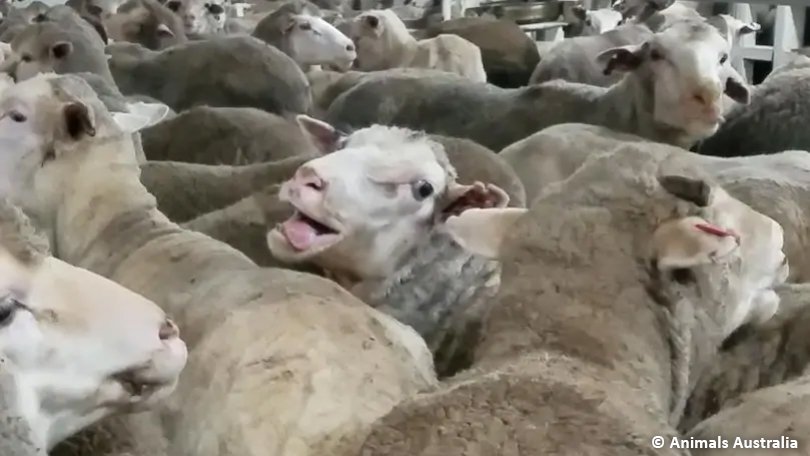
Over the past couple of days, MEP Hazekamp – as well as European Commissioner Vytenis Andriukaitis – urged the Romanian authorities not to authorise this particular transport. As Romania ignored their calls, the  Kuwaiti vessel ‘Al Shuwaikh’ left the port on Sunday night, carrying tens of thousands of exhausted and mistreated sheep.  “This is totally unacceptable! Despite the many warnings, Romania keeps on violating EU rules, allowing all these animals to suffer and perish aboard this monster boat,” says Hazekamp.

Hazekamp visited the Port of Midia last weekend, where she observed horrendous animal abuse during loading. “Sheep were kicked, beaten and attacked with electric poles, but Romanian authorities refused to intervene.

Europe can no longer look the other way. Animal welfare rules are being violated systematically. The Commission must act now.”

Total ban on live exports

In addition to the infringement procedure, Hazekamp has been advocating a total ban on live animal exports to non-EU countries.

Last February, the European Parliament supported her proposal (in its Implementation Report on Animal Transport). However, as live exports are still continued and as animal suffering during transport has not been stopped yet, Hazekamp called on the newly installed MEPs, to establish a Committee of Inquiry to investigate breaches of EU rules and put an end to the suffering.

Source – https://www.europeaninterest.eu/article/romania-authorises-shipment-70-000-sheep-persian-gulf-hazekamp-insists-upon-infringement-procedure/?fbclid=IwAR3XwkAYMOyg_8V9XhaegprEKFSp_PBtOZYidWfQO3BkhKi8Va8yKmRjXw4


Is the new President-elect of the Commission committed to making a change for animals?

vondeleyen2

Ursula von der Leyen will be the next President of the European Commission after a majority of MEPs voted in favour of her appointment tonight. While animals or agriculture weren’t mentioned in her statement addressing the European Parliament today, Eurogroup for Animals did welcome the support she expressed for renewed actions to improve animal welfare during hearings with Parliamentary political groups last week.

Following a question by Petras Auštrevičius at the Renew Europe meeting, she explained that animal welfare is included in the programme related to biodiversity and climate neutrality. She said that it is one of the questions the people of Europe want the European institutions to act upon, and that it is a “noble task to take on.” After a question by Yannick Jadot at the Greens/EfA meeting, she also stated that animal welfare “should be one of the main pillars of the Common Agriculture Policy”.

During her half-hour opening statement today on political guidelines for the next five years, the President-elect said that she would support the de facto right of legislative initiative for the Parliament – which could mean that long-awaited legislative improvements to animal welfare might finally be within reach.

Notably, Frederick Federley MEP (Renew Europe, SE), a Vice President of the Intergroup on the Welfare and Conservation of Animals, said that the Parliament has long been asking for a framework law on animal welfare, and that since von der Leyen said that she would support a right of initiative – meaning that she commits to respond to Parliament own-initiative resolutions with draft legislation – they are going to “hold her accountable” for this, and would expect such a proposal to be forthcoming as a result.

“After a decade of legislative stasis, we are pleased to welcome a President of the Commission who is a friend to animals both personally and politically,” said Reineke Hameleers, director of Eurogroup for Animals. “We are encouraged by her statements last week, and look forward to working with her Commission over the next five years to deliver real improvements for animals across our Union and beyond.”

When she is sworn in on November 1st, the Brussels-born German politician – who is a horse, goat and dog-owner – will be the thirteenth President of the Commission and the first woman to hold the position.

Source – https://www.eurogroupforanimals.org/is-the-new-president-elect-of-the-commission-committed-to-making-a-change-for-animals

Australia: More Live Exports – Show the Gutless EU Up – Take Action for Aus Sheep.

australia


Mark, with your support, we successfully stopped the live export of sheep into searing conditions in the Middle East from June to August.

But we know the highest risk period for heat stress is from May to October, and right now, exporters are preparing to resume their cruel trade and consign thousands of sheep to suffering from September onwards.

Right now, we have a chance to stop this.

Hit send on your response, and we can ensure the regulator stops live sheep exports during the incredible heat and humidity of September – as they should, and starting this year.

HIT SEND NOW!

The Department of Agriculture has opened a public consultation on this issue, and is proposing three options for regulation of the trade, including an option that would see no ships leave for the Middle East in September.

We need your voice to call to back this decision in the final regulatory conditions – and importantly, to demand it’s extended to include October as well.

The science is clear. The evidence is indisputable. Sheep will continue to suffer and die in long-haul live exports during September and October.

Conditions on ships during these months are simply too hot, and too humid.

We have just 5 days to take action. Please, speak up for Aussie sheep today.

HIT SEND ON YOUR SUBMISSION TODAY!


HIT SEND NOW!


HIT SEND ON YOUR SUBMISSION TODAY!

EU-animal law: legalized murder


eu-flagge-zerrissen-pg


The murders in the meat industry all have the same goal: to make money with the blood and suffering of the animals. This also applies to most politicians and lobbyists.

A few days ago, a ship with 70,000 (still) living beings has been send from the Romanian port Midia to the Midle East.
The hangmen of the Muslim and Jewish slaughterhouses are a bit different from the hangmen of European slaughterhouses.
To understand this, the following video will help:

“Shot in December 2018 in a slaughterhouse in Aveyron, these images show the legal abuse of slaughter without stunning allowed in France by derogation for the Jewish and Muslim cults.

According to the INRA Animal Pain expert report, an animal shot without stunning can remain conscious for up to 11 minutes”.

schächten 1

The meat lobby is located in the individual countries, which are not interested in getting a handle on the transport problem.
Animal transports mean subsidies from Brussels and that is why corrupt politicians are involved in the business (as we see in the case of the 70,000 sheep from Romania to Midle East ).

In Europe we have something called Animal Welfare.
On the paper, we are right at the forefront.

First section-German animal welfare law, § 1

“Nobody is allowed to cause pain or harm to an animal without an acceptable reason”.

For this we -the Europeans- have entrusted to some brain-brillant commissioners the preservation of this law. With our voice and our money.

In recent years, however, we observe a provocative cooperation (man calls it tolerance) of the “competent” commissioners with the animal transport mafia, and especially with countries that, as poor and weak EU partners, the meat business under any circumstances operate because that’s their main financial source. With devastating consequences for the animals.

They try to enforce their own interests and power games, nobody controls them, ( because according to EU, animal welfare is “country thing” ) so their chances of maximizing their profit are very high.
Let’s put it this way: they have all the options to live from the animas und from their suffering.  And they do it.

And now to the case “Midia”, Romania.

“Nobody is allowed to transport 40-degree-a-day animals without water and food, unless one manages to make millions of them.” says the brain-brilliant Commissioner Andriukaitis a word of power, but finally the EU has learned to respect the law of the strongest, and thus ships the Kuwaiti Transport Mafia (with the permission of the Romanian Minister) the 70,000 animal victims in countries that do not need to give an “acceptable” reason for the muslim massacre, because they consider animal welfare as unacceptable!

With that, the topic animal welfare law is done!
At least for our continent, it’s not even worth the paper it was written on.

_Breaking_tail_of_Romanian_tiertransport _in_Egypt

What is it about finally here?

It`s about torment, it’s about deliberate, illegal animal cruelty.
For days in the ship, with pre-programmed and painful death for many animals and with an unimaginable hell for the survivors. That`s about it!
And further, it is about the outrageous hypocrisy of the EU Commissioner, who allows all this, because “who is brutally killed in other cultures, is none of our business”!
Animal welfare is murder thing!!

Best regards, Venus


Kuwait / Romania: Livestock Ship Watch – 70,000 Live Sheep Exported from Romania en route to Kuwait.

Kuwait


Livestock ship watch.

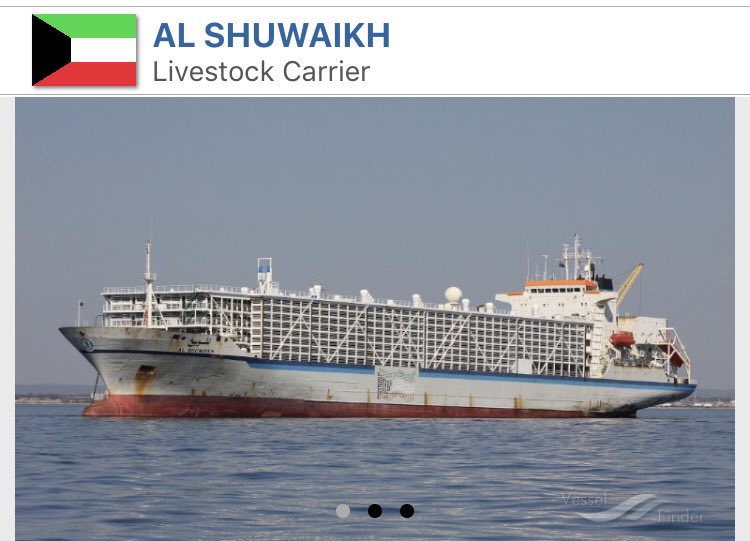
AL SHUWAIKH


We can confirm that the AL SHUWAIKH which is carrying 70,000 live sheep to the Middle East (Kuwait) for Eid ritual slaughter is currently in the Med Sea to the West of Cyprus.

This is ritual slaughter ………….


It is currently expected to arrive at Kuwait on Saturday 20th July at around 0700 hrs.


It is travelling at a speed of about 15-16 knots.

It was built in 1986, has a gross tonnage of 18,341, and sails under the flag of Kuwait.


Watching us, watching them !

Regards WAV.


EU: MEPs to vote on first female EU Commission president.

zerissene EU-Flagge am Stock


https://news.sky.com/story/meps-to-vote-on-first-female-eu-commission-president-11764222


MEPs to vote on first female EU Commission president

Ursula von der Leyen, currently the German defence minister, has been nominated to take over from Jean-Claude Juncker.

The European Parliament will decide later whether or not to block the appointment of Ursula von der Leyen as the new president of the European Commission.

Ms von der Leyen, currently the German defence minister, was nominated to take over from Jean-Claude Juncker (Below) by the leaders of EU countries at a marathon three-day summit in Brussels two weeks ago.

J C Drunker 3

The 751 MEPs of the European Parliament in Strasbourg will vote this evening in a secret ballot.

Ms von der Leyen needs 374 votes in order to secure the job but anything less than 400 would give her a weak mandate.

Ms von der Leyen will replace Jean-Claude Juncker if the move is approved by MEPs

She has spent the past two weeks trying to secure her position by promising policy pledges to the various different political groupings in the parliament whose votes she needs.

It has emerged that the current secretary-general of the commission Martin Selmayr, a controversial shadowy figure who has wielded significant power under Mr Juncker, will not continue if she gets the job.

Her pitch culminated with a speech earlier in the parliament chamber setting out her agenda for Europe.

It is expected that the vote could be tight.

The group representing green parties from across the union has already said it will not be supporting her nomination.

This could put her in the unusual, controversial and contradictory position of having to rely on votes from far-right parties in order to be voted in.

She is a member of Germany’s centre-right Christian Democratic Unionist (CDU) party and is a close ally of Chancellor Angela Merkel.

Ms von der Leyen has already said that she will stand down as German defence minister.

She said in a tweet on Monday: “Tomorrow I will ask for the confidence of the European Parliament.

“Regardless of the outcome, I will step down as Minister of Defence on Wednesday in order to serve Europe with all my strength.”

Her challenge is to make several different political groups from across the spectrum happy enough to vote for her.

The fact that she would be the commission’s first ever female president will hold some weight for MEPs.

She is from a centrist political party with values that should appeal to the majority of MEPs.

But against that is the fact that the EU member state leaders ended up ditching the “lead candidate” system in which the parliament proposed the candidates for commission president.

That angered a significant number of MEPs from across the board.

She is overtly a federalist who has said she would like to see a United States of Europe, though she conceded that it would not be likely in her lifetime.

On Brexit, she has said that she is open to a further extension if the UK requests it and there is good reason for it.

However no real changes should be expected in the EU stance on Brexit under her leadership because it is the EU member state leaders who drive the Brexit policy.

The commission and its president simply enact the mandate given to them.


WAV Comment – like stopping 70,000 Romanian sheep being exported to the Middle East in temperatures way above the maximum set under EU Reg 1/2005 – or not ! – Yes, NOT.

Romsheep 1


Romania: Re 70,000 Sheep Exported to the Middle East. How to Contact Romanian MEP’s to Express Your Disgust at Their Nation.

RMNA0001

The issue:

https://worldanimalsvoice.com/2019/07/15/romania-is-exporting-70000-live-sheep-to-the-gulf-they-are-still-in-port-in-midia-romania-more-news-to-come/


If any of you wish to make e mail contact with Romanian MEPs about their nation allowing 70,000 live sheep to be exported in conditions that do not meet EU transport standards – Regulation 1/2005; then here is the way to get the full list of all the MEPs which represent Romania in the European Parliament.


Click on: http://www.europarl.europa.eu/meps/en/search/advanced?countryCode=RO 


Then in the drop down box for ‘Country’ – select ‘Romania’.


You should then be presented with a photographic list of all the MEPs which represent Romania in the Parliament.

It is very easy to make contact. Lets take the first name on the list as an example – Clotide Armand.

Simply click on her name below the picture. This then enlarges to a larger picture with graphics below – if you put the mouse pointer over the first 2 then you will get e mail access. Simply click on either one of these and you should then have the ability to write an e mail direct to Clotide Armand.

SAMPLE LETTER TO COPY AND SEND

Dear MEP`s

We have read these days with horror in the media that a ship of the company AL SHUWAIKH (which made very negative headlines in the past and in the transport of animals) transports 70,000 sheep from Romania to the Middle East.

According to Article 3 of EU Regulation (EC) 1/2005, animals may not be transported if the transport results in injuries and unnecessary suffering (in this case, temperatures above 40 degrees are clearly an unnecessary suffering).

Although Romania is an EU country and subsidized accordingly, it disregards the instructions of EU Commissioner Andriukaitis to the Romanian Agrarian Minister Petre Daea to stop transport in Midia and acts in his own right and interest against animals, morals and laws.

KLTT, a major exporter of Australian sheep, was the subject of a major scandal that attracted attention from Animals Australia over the past year. This company has a long list of violations and is responsible for the death of more than one million sheep on board in recent decades.

In 2018, animals were found to bake on their own skin on KLTT vessels, gasping for breath, suffocating in faecal matter and not lying down to rest or even reach for food or water.

During such travels, heat and moisture combinations reached levels that caused heat stroke, resulting in sheep literally cooking alive in ship holds.

Such visions of Australian sheep, suffering and dying of heat stress, have sparked outrage throughout the country and across the world over the past year and led to comprehensive reform of the regulations – including the ban on trade in live sheep from Australia during the summer months in the Middle East.

EU membership requires certain moral rules based on common culture and manifested by basic civilization standards. We urge you, as EU representative of Romania, to ask the relevant ministry of your country to respect laws and ban animal transport in the summer.


Best regards,

Your name here


Other options you can select also include Twitter and Facebook.

Write to the Romanian MEPs now to express your disgust at what their nation is doing for 70,000 sheep en route to the Middle East.


https://www.bbc.co.uk/news/world-europe-48421430?intlink_from_url=https://www.bbc.co.uk/news/topics/cnx753jennet/romania&link_location=live-reporting-story


https://www.bbc.co.uk/news/world-europe-46951855?intlink_from_url=https://www.bbc.co.uk/news/topics/cnx753jennet/romania&link_location=live-reporting-story

stop live transport


Germany: the land of 8 million tons meat!


deutsche Flagge mit Bananen jpg


German Development Minister Gerd Müller returns to Germany on Sunday after a week’s state visit to Brazil and complains that the rainforest is being cut down!!

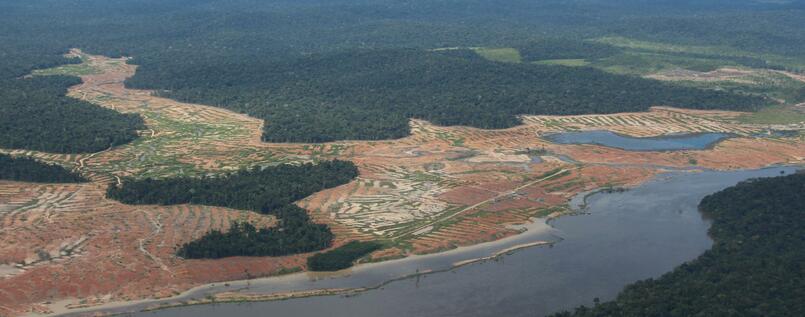
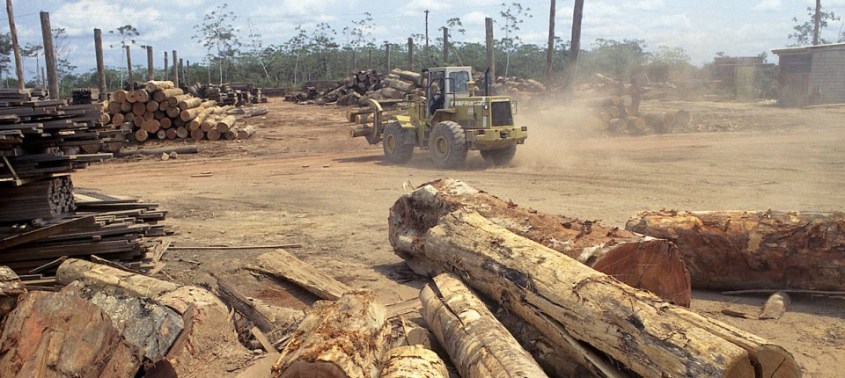
Abholzung in BrasilienpgClearcutting: According to the Brazilian space research institute INPE alone in June 2019, 920 square kilometers of Amazon rainforest were destroyed. This is an increase of 88 percent over June 2018

 
His mission was to further develop the cooperation projects, in particular for the protection of the rainforest, the indigenous population and the Amazon Fund.
He says in the media: “I expect more engagement in the Amazon (!!!)

abgeholte Flächen in Brasilienjpg

Why does he say it in the media and not his colleague, Minister and lobbyist of Agriculture, Julia Klöckner?

It is well known that Germany not only supplies Brazil with dangerous pesticides, which are banned even in the EU, but is also responsible for cutting down the Amazon in Brazil.

Germany is not only one of the largest milk producers, but also one of the largest meat producers in the world. Subsidized with tax money!

Germany produces 8 million tons of meat every year! In order to be able to produce that amount of meat at all, it needs food for the animals.

Kühe im Stall

Germany imports most of the soya from Latin America. Incidentally, the most important supplier of beef to the EU is Argentina. To be able to produce this amount of soy, forests are cleared and burned. An extraordinary ecosystem with a high biodiversity disappears.

animals-in-brazils-amazon-rainforest

Few people are aware that an invisible bond of destruction is moving from European mass animal farms to the forests of South America. There huge soy plantations destroy the native fauna and flora. It is an environmental crime that often forests are cut down for cultivation, the soil is leached out and water is polluted.

regenwald amazonasjpg

In 2016, this was about 2.9 million tonnes of soy and soy products.

This soya is used by food and meat processors and is used for the rearing of chickens, pigs and cattle or for the production of eggs and dairy products, which are sold in many German supermarkets and restaurants.

So if the topic of Amazon, climate change or CO2 is discussed, why is the issue of factory farming not mentioned? Animal products are associated with high greenhouse gas emissions, water consumption and inefficient land use!

Poultry Farm And A Veterinary

Livestock for meat, eggs and dairy products has high CO2 emissions and produces 15% of the world’s greenhouse gas. That’s more than all the cars, planes and other means of transport in the world.
A person who eats plant-based foods 1 day a week for 1 year can lower their CO2 emissions by 234 kg per year (estimated based on the carbon footprint of various foods).

Please calculate this now, if you consider that Germany produces 8 million tons of meat per year and about 33 million tons of milk!

The agricultural lobby is powerful, that means. And it is subsidized in Germany with tax money, which then for education, care and so on. is not available.
From the EU, the German agricultural lobby receives about 6 billion Euros and these are causing severe damage in other countries. On average, every EU citizen pays 32 cents a day for the EU criminal agricultural policy.

Massentierhaltung_

It is estimated that over 30 million tonnes of genetically modified feed are imported into Europe each year to feed pigs, poultry, dairy and beef cattle and farmed fish.
Much of the soybean and corn used for this purpose is grown in South America, including Brazil, Argentina and Paraguay.

Cheap meat, milk and eggs can only be produced with cheap soybeans, which, however, cost the countries of origin expensive: Deforested rainforests, destroyed environment, poisoning of humans and animals are the result.

abholzen-in-suedamerika

This is not agriculture. This is a murder factory in the field.

This documentary explores the effects of soybean cultivation in South America and shows people in South America and Europe alternatives to the devastating vicious circle. The Video is in English and Spanish with German subtitles.

https://netzfrauen.org/2019/05/17/agrar/


My comment: The solution would be a Germanexit.

Only incompetent and irresponsible politicians have Germany.

We are dealing with a ruling clique, with corrupt oligarchs who are at least interested in the rights of animals and the rescue of the climate.
Everywhere scandals and manure stands in slaughterhouses we read lately.
And instead of finally abolishing factory farming or at least punishing criminal slaughterhouse operators, the slaughterhouse’s girlfriend, Agriculture Minister Klöckner, wants stricter penalties for activists exposing these crimes.

No more subsidies for the meat.
Meat consumption must be private, as well as smoking.
This state-subsidized factory farming must cost as much as the damage it does.
I consider it a political prostitution to subsidize meat.

My best regards to all, Venus


Romania: Is Exporting 70,000 Live Sheep to the Gulf. They are Still In Port in Midia (Romania) – More News to Come.

RMNA0001

Final Update 15/7 – 22-15hrs GMT.


We can confirm that the 70,000 Romanian sheep ARE now en route to Kuwait for slaughter.

Below our comments is the confirmation from EU sources

This is typical of the farce that is the EU, and which shows that Commissioner Andriukaitis is simply being ignored by member states who only do what they want to do. His pleas with them to stop the exports mean nothing – he is a man regarded as a joke.

Oh, now he is talking about ‘infringement proceedings’ against Romania because they have disobeyed him !

There is one way to stop all of this and that is to impose a maximum 8 hour journey time for all animals in transport. Commissioner Andriukaitis will not do this because he does not have the guts; and the meat mafia lobby will grind him down to crawl round every obstacle to meet their demands as they always do. In the meantime; our elected so called ‘politicians’ in the EU parliament just sit there and let it all go on – so what, another 70,000 animals which would have been slaughtered anyway.

Any wonder that EU citizens have no faith in the ‘masters’ that sit in the ivory tower called ‘the Parliament’. MEPs and Commissioners are paid to take action – this is yet another example of how they are simply ignored by some member states who do not give a toss about animal welfare (Romania) – and only think about lining their pockets as a result.

We will watch to see what strict actions Commissioner Andriukaitis will take against Romania about all of this. Expect nothing as usual – he and the rest are all talk and no action.


EU Confirmation:

Today’s Agri-Fish Council meeting saw a debate on live animal transport by the ministers in attendance, with the majority supporting Commissioner Andriukaitis’ call for the suspension of journeys during summer.

In his opening speech on the topic, the Commissioner stated that Australia has banned live export during the summer season, stating that “the EU cannot lag behind.” He welcomed initiatives from certain Member States that have suspended temporarily long-distance live transport in line with last year’s request by the EU Commission.

On the subject of this weekend’s decision by Romania to go ahead with the transport of 70,000 sheep from Romania to the Persian Gulf, Commissioner Andriukaitis said that the Commission is investigating the issue and that “infringement proceedings against Romania cannot be excluded at this time”.

ENDS

————————————————————–

Old Info:

Please stick with us – we are finding out this info as we do searches.

Latest is below:


More More news

The Al Shuwaikh livestock carrier is:

AL SHUWAIKH current position is 40.92476 N / 28.87827 E on Jul 15, 2019 19:45 UTC. Vessel AL SHUWAIKH (IMO: 8506361, MMSI: 447070000) is a Livestock Carrier built in 1986 and currently sailing under the flag of Kuwait.

Current destination of AL SHUWAIKH is KUWAIT and the estimated time of arrival (ETA) is Jul 20, 06:00.


More news – 2019hrs 15/7/19


10/7/19 – Commissioner Andriukaitis asks the Romanian Minister to stop the shipment of 70.000 sheep


Commissioner Andriukaitis has called on Petre Daea, the Romanian Minister of Agriculture and Rural Development, to stop the cruel shipment of 70,000 sheep from Romania to the Persian Gulf. This is welcomed by Eurogroup for Animals and its member organisation Animals Australia, which carried out investigations of this terrible practice in previous summers and has been campaigning against it ever since.

The EU Commissioner for Health & Food Safety’s request follows outcry from civil society and is based on the impossibility of guaranteeing the welfare of the animals transported under extreme temperatures.

70,000 sheep are expected to be loaded into the vessel Al Shuwaikh, owned by the Kuwaiti company Livestock Transport & Trading (KLTT), also known as Al Mawashi, and sent to Kuwait, Qatar and the UAE for the “Festival of Sacrifice” which takes place in August.

KLTT, a major exporter of Australian sheep, was the subject of a major scandal brought to the attention of the media by Animals Australia last year. This company has a long record of violations and is responsible for the onboard deaths of more than a million sheep in the past decades. In 2018 animals on KLTT vessels were found baking in their own skins, gasping for air, smothered in faeces  and unable to lie down to rest or even reach food or water. During such voyages, heat and humidity combinations reached levels that caused heat stroke, resulting in sheep literally cooking alive in the holds of vessels. 

Such visions of Australian sheep suffering and dying of heat stress created outrage across the country last year and led to major regulatory reforms – including the banning of the trade of live sheep from Australia during the Middle East’s summer months. 


https://www.eurogroupforanimals.org/commissioner-andriukaitis-asks-the-romanian-minister-to-stop-the-shipment-of-70-000-sheep

“Taking into account the weather forecast in the Persian Gulf area during July” – said the Commissioner in his letter to Minister Daea – “I urge you as a gesture of responsibility to stop the imminent export of sheep to the Persian Gulf”. He stressed the impossibility of complying with EU animal welfare legal provisions under extreme temperatures.

“We are pleased with the intervention of Commissioner Andriukaitis, and we urge the Romanian Ministry to respond positively to his call. Indeed, this shipment is likely to breach Art 3 of the EU Regulation (EC) 1/2005 stating that animals shall not be transported in a way likely to cause injury or undue suffering,” says Reineke Hameleers, Director of Eurogroup for Animals. “At their destination, these animals will be slaughtered without stunning. To go through this after enduring terrible conditions throughout the voyage – if they survive at all – is barbaric. We cannot let this happen yet again.”

Sign the petition and ask Romania’s PM to stop this


———————————————————————————–

WAV Comment:

We have the ability nowdays to know exactly where the ship is at all times – where it is going to and its current position.

We do not have any proof, but strongly suspect (as we have done live export for about 30 years) that this consignment is going for the Eid al-Adha 2019 – the ‘festival of sacrifice’ – and will begin in the evening of 11 August and end in the evening of 15 August.  

We are expecting the Dutch (livestock exporters) to start exporting British sheep from the UK to mainland Europe for the same reason in the next few weeks.  We may give reports about this also in the near future.  One thing is for sure, the crap that is the EU don’t give a damn about enforcement of regulations when it comes to live animal transportation; and the Romanians (an EU member state) will not give a damn either – making money at whatever cost is all they are interested in.


Update:  70.000 sheep cruel export from Romania to the Gulf: despite the urgent call from

@V_Andriukaitis

yesterday, we hear from reliable sources the KLTT ship is still waiting to dock in the Port of Midia, (Midia is a small Romanian port)  please help the sheep & call on

@VDancila_PM

to stop the shipment


USA: Trump Administration Proposal to Remove Federal Protection for Gray Wolves Is Scientifically and Legally Flawed. Last Day for ACTION.

UNST0001


FOR IMMEDIATE RELEASE – July 15, 2019

Trump Administration Proposal to Remove Federal Protection for Gray Wolves Is Scientifically and Legally Flawed


Washington, D.C. – Today is the final day to submit comments on the Trump Administration’s proposal to strip Endangered Species Act (ESA) protection for all gray wolves living in the lower 48 United States, except for the separately listed Mexican gray wolf.

Comments submitted by conservation groups The Rewilding Institute, Project Coyote and Wildlands Network point to substantial flaws and omissions in the U.S. Fish and Wildlife Service’s (USFWS) analysis of the relevant science and their interpretation of various ESA mandates.  The ESA requires that decisions to remove endangered species from federal protection under the ESA must be based on “the best scientific and commercial data” available at the time of the decision.  It also requires a determination that the species is no longer in danger of extinction “throughout all or a significant portion of its range.”

Wolves are as essential to the health of their ecosystems as they are reliant upon healthy ecosystems for their survival.  When allowed to exist at ecologically effective population densities and distributions, vital functions of wolves include keeping large herbivores from overgrazing their habitat and limiting populations of mid-sized predators.  Removal of wolves or other top carnivores from an ecosystem can unleash a cascade of responses that diminishes biodiversity and overall ecosystem health.  By disproportionate predation on the sick and weak, coursing predators such as wolves generate evolutionary selection for healthier, faster prey.  With Chronic Wasting Disease rapidly infecting big game herds across the country, scientific studies indicate that restoring wolves to vast areas of their former range could be an effective strategy for reducing the prevalence and checking the spread of this devastating disease and other wildlife diseases.

“The USFWS proposal erroneously claims that restoring gray wolves to the three Great Lakes states of Minnesota, Wisconsin, and the Upper Peninsula of Michigan plus the three Northern Rocky Mountain states of Idaho, Montana, and Wyoming at a minimum population of about 2,000 wolves will assure their long-term survival in the lower 48 United States throughout all or a significant portion of their range,” said David Parsons, a wildlife biologist who formerly led the USFWS’s Mexican Wolf Recovery Program and who is now the Carnivore Conservation Biologist for The Rewilding Institute and a science advisor to Project Coyote.  “It is hard not to conclude that the proposal to delist gray wolves represents a political decision in search of a science-based justification, rather than a well-reasoned decision that flows from a critical application of the best available science, as is required by the ESA.”

Gray wolves formerly ranged throughout all or parts of 42 states and historically numbered at least in the hundreds of thousands.  The USFWS has determined that the restoration of gray wolves to about 10 percent of their historic range and only a fraction of 1 percent of their historical abundance is sufficient to deem them recovered and no longer in danger of extinction.

“No credible conservation geneticist would consider the USFWS’s gray wolf recovery goals to be anywhere near adequate to ensure the long-term viability, ecological function, and evolutionary potential of gray wolves in the lower 48 states,” said Dr. Michael Soule, a Project Coyote science advisory board member and a founder of the discipline of conservation biology.

“The proposed rule ignores vast swaths of existing, highly suitable habitat, which will remain indefinitely impoverished by reduced biological diversity and impaired ecosystem health,” said Kim Crumbo, Senior Carnivore Expert for Wildlands Network. “Today, wolves inhabit only a small fraction of their historic range within the lower 48 states. But wolves have yet to recover in additional parts of the country—including the Pacific Northwest, northern California, the southern Rocky Mountains, the Grand Canyon ecoregion and the Northeast—where prime wolf habitat still exists.”

A peer review by independent scientists, commissioned by the USFWS, found demonstrable errors of scientific fact, interpretation and logic throughout the proposed gray wolf delisting rule and the accompanying biological report.  Substantive reviews by other conservation organizations and independent scientists corroborate and add to the findings of the commissioned peer reviewers.  For example, on May 7, more than 100 scientists and scholars sent a letter to Interior Secretary David Bernhardt stating that the proposal to remove Endangered Species Act protections for gray wolves across nearly all of the lower 48 states “does not represent the best-available science pertaining to wolf conservation.”

The peer reviewers’ recommendations leave the USFWS with two options:  1) produce a proposal that is consistent with the best available science as informed by the independent peer reviewers and others, or 2) retract the proposal altogether.  Ignoring the peer and public review findings and recommendations in part or in whole will be met with public outcry and most likely litigation.

Americans remain supportive of wolf conservation and of the ESA.  Recent research indicates three in five hold a positive attitude towards wolves.  Even those living in wolf range have a largely positive attitude toward these magnificent animals. In 2013, the last time the USFWS proposed a national delisting of wolves, approximately one million Americans stated their opposition to stripping endangered species protection from gray wolves, and it appears there will be substantially more public opposition this time.

###

Comments on the gray wolf delisting proposal are being accepted until midnight July 15.  Click here to submit comments. 

###


References:


See Project Coyote’s and The Rewilding Institute’s comments on the proposed rule here.

See Wildlands Network’s comments here.


Learn more about gray wolves here.


###


Project Coyote, a national nonprofit organization headquartered in Northern California, is a North American coalition of wildlife educators, scientists, ranchers, and community leaders promoting coexistence between people and wildlife, and compassionate conservation through education, science, and advocacy. For more information, visit ProjectCoyote.org.

The Rewilding Institute’s mission is to develop and promote ideas and strategies to advance continental-scale conservation in North America, particularly the need for widely distributed and ecologically effective populations of large carnivores and effective landscape corridors for their movement.  TRI offers a bold, scientifically credible, practically achievable, and hopeful vision for the future of wild Nature and human civilization in North America. Visit Rewilding.org to learn more.

Wildlands Network is a western-based, national organization whose mission is to reconnect, restore and rewild North America so that the diversity of life can thrive. We envision a world where nature is unbroken, and where humans co-exist in harmony with the land and its wild inhabitants. Visit WildlandsNetwork.org to learn more.

Portugal: Putting pigs in the shade: the radical farming system banking on trees – or, How It Used to be Before Intensive Factory Farming !

PORT0001


Putting pigs in the shade: the radical farming system banking on trees

A farm in Portugal is showing how the ancient art of silvopasture – combining livestock with productive trees – may offer some real answers to the climate crisis

The land to the north of the village of Foros de Vale Figueira in southern Portugal has been owned and farmed through the centuries by Romans, Moors, Christians, capitalists, far rightists, even the military. It has been part of a private fiefdom, worked by slaves as well as communists.

Now this 100-hectare (247-acre) patch of land just looks exhausted – a great empty grassland without trees, people or animals, wilting under a baking Iberian sun.

But look closely and you can just see the future: tips of thousands of tiny oak and nut trees following the contours and poking through thick mulches of grass and leaves.

“This will be the new montado,” says Alfredo Cunhal, referring to a pre-medieval Portuguese system of farming. He is an agricultural scientist whose great-grandfather cleared the cork and olive trees that were once scattered around, and whose family then overworked the land by dosing it with chemicals and growing monocultures of cereals.

The montado system combines herds of animals with productive trees and shrubs. Cunhal’s vision is to create an oasis-style abundance on land where there is often no rain for nine months of the year and where temperatures can reach 49C (120F

“Imagine tall trees, like 40-metre tall walnuts, putting down leaves, letting light through, drawing up water. Below them, cork oaks giving shade, and a line of citrus and olive trees; and then imagine vines climbing the trees. The fruit and nuts will provide the food for the pigs, chickens, cows and other animals who graze there,” he says.

“Animals are the key,” he says. “They are important for the whole ecosystem, as well as part of the food chain. They must be balanced with the tree system. Pigs provide digestion, and are good for the soil, they disturb the ground and fertilise the land. The natural fertility cycles work better with them. The pig is not a meat machine but a friend of nature.”

The “new montado” at Herdade do Freixo do Meio farm will take years to mature but will repay itself many times over with the variety of food produced and healthier soils, he says. “It offers resilience against fires and global heating and it soaks up the carbon,” he says.

‘The pig is not a meat machine but a friend of nature,’ says Cunhal
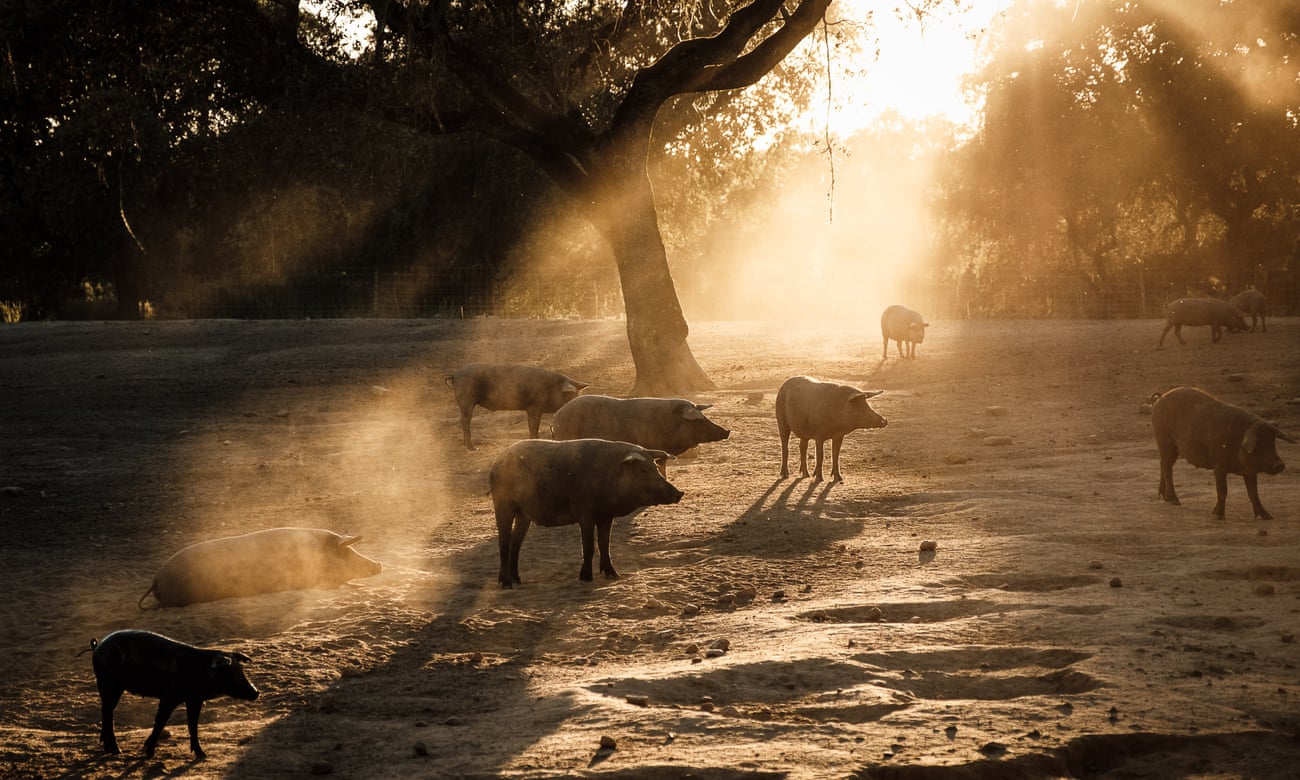
Animals are free to roam under the shade of trees and shrubs at a co-operative farm in Portugal.

“We are aiming to go from zero to abundance in a few years. We can put chickens on the land soon, pigs and sheep will follow, cows come later. We invest now, and the next generation sees the real benefits,” he says.

Cunhal, who comes from a large landowning family related to Portugal’s legendary communist leader Álvaro Cunhal, says he has had to reject much of what he was taught about farming at college.

“I spent five years studying agriculture and I never heard the word ecology. We were taking more and more from the land but we were farming monocultures. We were eating the system. I was managing 7,000 hectares for my family but I never noticed the trees. I really didn’t know anything. I produced a lot but I needed so many inputs. I needed carbon, energy, chemicals. I could do nothing efficiently. The land was eroded, the soil damaged.”

Demoralised, he gave up managing the family estate in 1990, took a share of the land, and started to run 600 hectares on organic, co-operative lines with a collective of 35 people, many of whom had worked on the estate for years. Together, these “partners” are converting the whole farm into a full montado system.

The results are beginning to show. Wild boar, lynx and deer roam freely, while old varieties of pig, cattle, chickens and turkeys are rotated among the established oak and olive trees and in newly planted orchards. The farm grows almost every type of Mediterranean food among the trees, as well as 40 varieties of fruit and nut.

“We can grow water,” says Cunhal. “By planting trees whose roots go deep we are drawing moisture up and building soils, creating the possibility to grow even more.”

The complexity of the system baffles conventional farmers who mostly specialise in a handful of crops or products. But Cunhal dismisses monocultures as “the end of life” and insists there is resilience and safety in diversity.
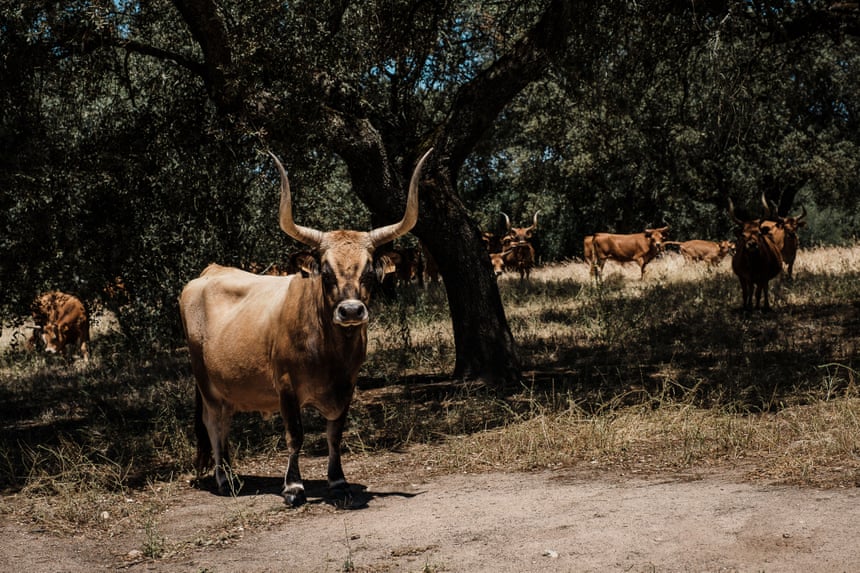
Cows at Herdade do Freixo do Meio

The variety of food produced is astonishing. The farm grows dozens of fruit and vegetable crops and makes and sells 600 different products, ranging from eight kinds of oak flours and breads, to meats, wine and olive oils.

“It’s far more than any normal farm would ever consider. This used to be a cork oak farm. Now cork is just 5% of the turnover. Four years ago we were 100% dependent on the open market and wholesalers. Now nearly 50% of what we grow is sold directly to consumers. We have a butchery, bakery, olive oil press, smoker,” he says.

A montado system also demands a new social approach. “It’s not right that a system of farming as complex as this should be run by one person. Far better that a whole community should propose how it works. Eventually we want consumers to be part of the farm, too,” says Cunhal, who says he intends to eventually hand the land over to the co-operative.

“It works because the risks and the benefits are shared. Together we are resilient to shocks. We employ more people. We produce variety. It’s a different approach.”
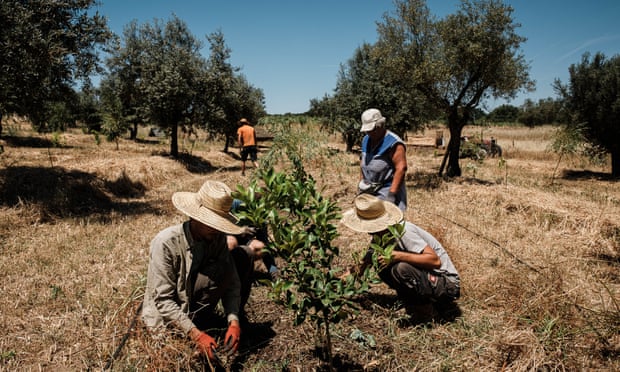
Partners working at Herdade do Freixo do Meio

“It is very exciting. This is the meeting place of trees, crops and animals,” says Ricardo Silva, a trained biologist who switched to forestry before coming to Herdade do Freixo do Meio. “The results are measured not just in profits, but in the social and ecological benefits created. We cannot say exactly, but our hypothesis is that we can double, even treble production without taking away from the land.”

Twenty years ago, an approach like this might have been dismissed as marginal, perhaps as an ecological experiment to be conducted by wealthy landowners. But that idea is changing fast as the needs of the environment are recognised, says Patrick Caron, chair of the UN’s high-level panel of experts on food security and nutrition and a former head of Cirad, the French food research agency.

“We need a transformation of our food systems. It does not involve a return to the way our grandparents farmed – that would be a catastrophe. But we must take stock of the principles of what they were doing, and their knowledge.

“Change is happening. The big companies know it, too. The meat industry used to laugh, but now they are preparing for change. It is possible to move from mass production to quality.”.

“Farmers became fascinated by the baubles of technology in the 1930s. They tried to simplify everything,” says Patrick Worms, senior science policy advisor at the Nairobi-based World Agroforestry Centre.

“What Cunhal is doing is the opposite – using more animals, growing more crops, making everything more complex. He is supported by the science, which shows that you get much greater production when you mix things up, and when animals and plants interact.”

Studies from Africa, Brazil, Europe, Sri Lanka and elsewhere all show conclusively that interspersing trees, animals and crops can boost food production, but also build soil, increase biodiversity and sequester CO2 from the atmosphere, he says.

“Agro-forestry isn’t a ‘no man’s land’ between forestry and agriculture,” says Maria Helena Semedo, deputy director of the UN Food and Agriculture Organization. “We know it can help diversify and sustain food production and provide vital social, economic and environmental benefits for land.”

But even as scientists and policy-makers wake up to the potential of silvopastoralism as both a better way to grow food and as a way to respond to the climate crisis, the speed and the scale of change challenges the farm.

“We are more resistant to climate than our neighbours who farm conventionally, but a 3C rise in temperature here, which is where we are heading, means everything is lost. Higher and more extreme temperatures are a death threat to the animals. The land will go to desert. I am really worried. I have no doubt the climate crisis is happening. I feel it every day … Now we get more irregular summers and temperature increases every year,” says Cunhal.

He is one of eight Europeans trying to sue the EU over its climate change policies, which they argue are inadequate. “We had 49C last year. We are used to 43C. In 2017-18 we had an eight-month drought. Then in mid-December we had 100mm of rain in two hours. I have lived here for 30 years. It’s more unpredictable now; we risk stopping almost all the biological process.”

Barring disaster, Cunhal says he will continue to plant trees and rear animals. “We don’t want a square metre without shade. We must treat the farm as a common good. The satisfaction is in creating something beautiful.

I want to leave a landscape where everyone – humans and animals – feel good.”

https://www.theguardian.com/environment/2019/jul/13/pigs-radical-farming-system-trees-climate-crisis


…… and what system would you prefer ? ……

σψηςειν ιν Καστεν 3jpg