Looking for vegan school lunch ideas that are kid-friendly and easy to make? You’re in luck! These vegan recipes are easy to pack for lunch, whether it’s for the kiddos, for teenagers, for college students, or the adults who need a grab n’ go lunch for work. These recipes are allergen friendly and include plant-based, whole-food ingredients.
6 incredible facts that will change the way you think about lobsters
Beneath that hard shell there is a soft and sensitive side to lobsters that reveals we have much more in common with these ocean dwelling creatures than you might think! Read on to discover what scientists are learning about the lives of lobsters — and why they need our protection.
This is one healthy three bean salad recipe that you don’t want to pass up! Perfect for summer picnics and potlucks, this classic vegan salad has been revamped with chickpeas, kidney beans, black beans, and fresh apples to add a flair of sweetness.
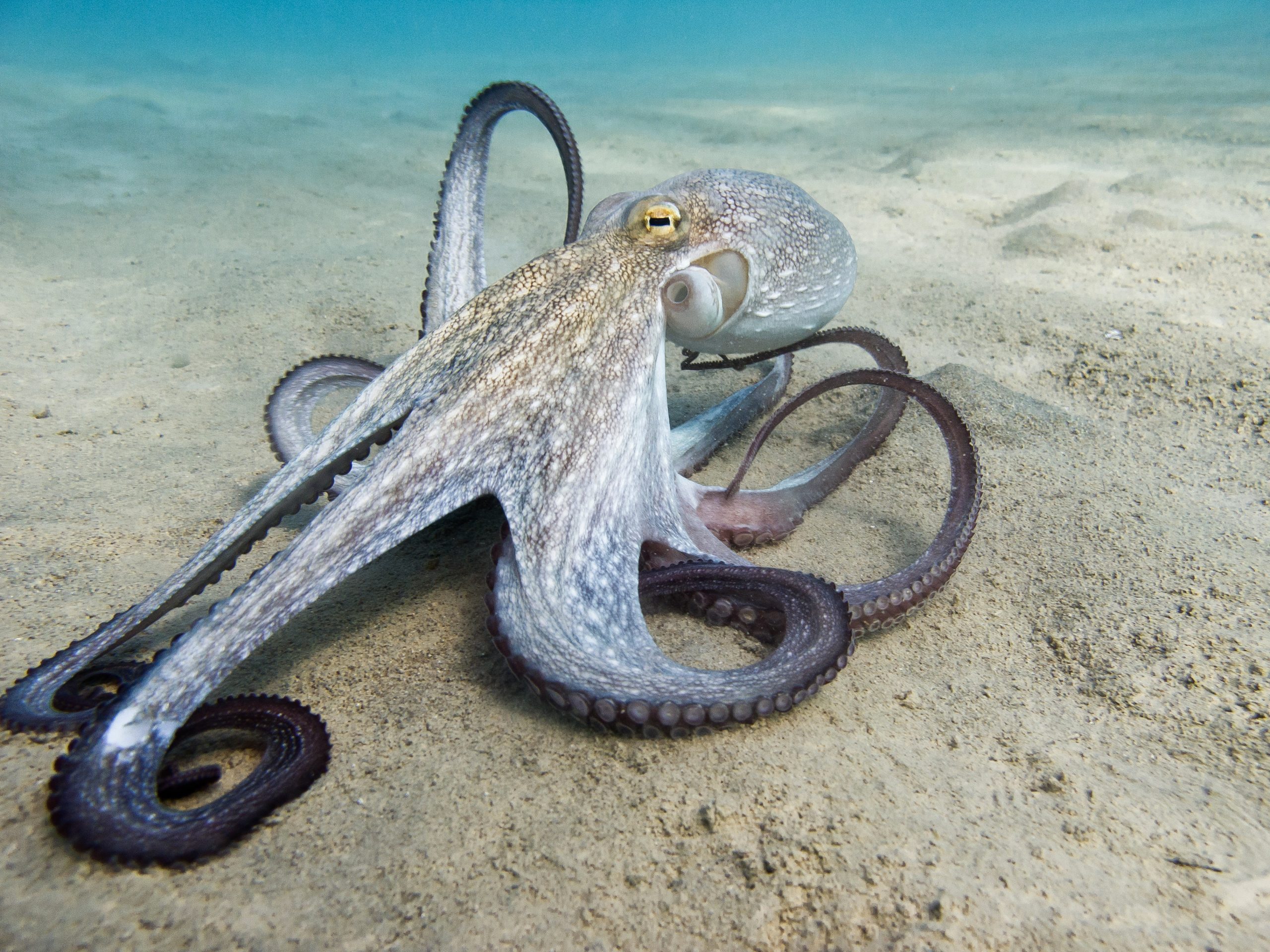
A group of conservative politicians in the UK is pushing for the inclusion of lobster and octopuses in a new animal sentience bill, The Guardian reported. The influential Conservative Animal Welfare Foundation (CAWF) is meeting with the government to push for the sentience of invertebrates.
As it stands now, the bill recognizes that fish and other vertebrates feel pain, but does not include invertebrates. MPs in the CAWF believe they should be included. A report from CAWF found that fishing operations in the UK land 420 million cephalopods and crustaceans annually.
“Common arguments against crustacean and cephalopod sentience focus on distinctions between these animals’ anatomy and human anatomy (such as that they process information outside the brain, eg in ganglions). However, this anthropocentric view fails to capture what it means for an animal to be sentient. Crustaceans and cephalopods undoubtedly experience the world in extremely different ways to ourselves.
What matters, though, is whether that experience entails conscious experience of pleasure and pain. We believe that the evidence is sufficient to show that these animals do experience pleasure and pain,” the report said.
The report points to scientific studies to back up their proclamations as well as the backing of multiple scientists.
Lorraine Platt, founder of CAWF said in The Guardian, “All but a very small minority of scientists agree these are sentient animals capable of pain and suffering. It’s very important they are kept in the animal sentience bill. My Octopus Teacher is a very moving film about a female octopus, about how clever she is, how she can avoid predators, sharks, on a daily basis. If I feel this way I am sure many others feel the same way.”
Sign this petition to tell the European Union to pass laws declaring that all animals are “sentient beings” with rights to legal protection!
Classify Animals as “Sentient Beings” With Legal Protection in the EU
Please think about the suffering that wil go on in this event; and the suffering and abuses of all sentient beings worldwide who will be murdered in the slaughterhouse today.
Animal rights pioneer Regan Russell, 65, was violently struck and killed by a pig transport truck in front of Sofina’s Fearmans slaughterhouse in Burlington, Ontario on Friday, June 19, 2020.
She regularly attended pig vigils and on this day was at a Toronto Pig Save vigil with other activists giving pigs water on one of the hottest days of the year.
Without warning, the driver of the lorry revved his engine and knocked Regan to the ground, cutting her body in half as she was dragged 30 meters.
It was murder!
Her legacy of love and compassion lives on. Up to her very last breath, she tried to expose the injustices that animals endure at our hands, and her story should be heard around the world.
WAV Comment: Now that is really cool news – who would have ever thought ? – the burger giant now seeing the future as palnt based. Well done Cologne !
A store in Cologne served meat-free burgers and plant-based nuggets from June 7-11 Credit: Burger King DE
Huge Queues Gather After Burger King Store Hosts ‘Plant-Based’ Takeover
In what has been described as a ‘world’s first’, one Burger King outlet ditched meat from its menu for a limited-time…
A Burger King store witnessed huge queues gathering outside after it hosted a plant-based takeover.*
One of the fast-food chain’s outlets in Cologne, Germany, ditched meat from June 7-11.
Burger King’s ‘plant-based’ takeover
In what has been described as a ‘world’s first’ – the store sold exclusively meat-free versions of its whopper and Chicken Royale burgers, as well as plant-based nuggets.
All vegan meat served was created by The Vegetarian Butcher – a Unilever-owned brand that partnered with Burger King last year.Pictures from social media show the restaurant’s exterior undergo a green makeover. Posters stating: ‘100 percent taste, 0 percent meat’ were displayed outside and inside the store.
‘The burgers were delicious’
“I was there today. It was really busy, people were standing outside,” one social media user wrote on Facebook.
“The burgers were delicious and tasted like the original. Thanks also to the great staff, who kept a clear head despite this rush and did a great job.”
Commenting on the success of the pop-up, Burger king Deutschland said: “Thank you cologne! “Thanks to the many, many enthusiastic guests. And especially thanks to our super team from the Plant-based Burger King Restaurant.
“For the past five days, you’ve been plant-based whopper and co. [You’ve] Made a lot of guests happy! Big shout out to all of you. You are simply plant-astic!”
*While all meat served during the meat-free takeover was vegan. Some items contained cheese and mayonnaise.
Before dying under a hail of bullets on Thursday, so-called Mpumalanga rhino poaching kingpin Petros “Mr Big” Mabuza (57) instilled fear wherever he went.
Mabuza lived a very adventurous and risky life as an alleged rhino poacher. He made a lot of cash, allegedly had police officers on his payroll and was not shy to splash his loot on what others may call hedonism. Most people called him by his clan name, Mshengu, as a sign of reverence.
According to Jamie Joseph, the director of Saving the Wild, who has been working closely with police to get Mabuza arrested and convicted for rhino poaching, the man from Hazyview lived a lavish lifestyle. “He has been throwing illegal parties which, according to someone in regular attendance, included naked women dancing on the tables, class A drugs on the bar dished out like canapés and armed guards at the entrance,” Joseph said.
The loaded man he was, Mabuza allegedly owned houses – from Hazyview, White River and Mbombela.
Mpumalanga police are on the trail of Mabuza’s killers.
Brigadier Leonard Hlathi, the provincial police spokesperson, said Mabuza was sitting in his double-cab Ford Ranger on Thursday in Hazyview when three armed men in a black VW Polo opened fire on him in broad daylight, before fleeing.
“He was rushed to hospital where he later succumbed to the gunshot injuries. During the shooting, an elderly woman passerby, also became a victim as she too was shot on her lower body but she is recuperating in hospital,” Hlathi said.
The motive for Mabuza’s killing was still unknown, Hlathi said. According to those who knew “Mr Big”, it will not be easy to pinpoint why he was a marked man because he had “multitudes of enemies” as he had interest in various “businesses”.
Beside his alleged involvement in the lucrative illicit rhino horn trade, he was also rumoured to be commanding and sponsoring cash-in-transit heists.
He was a bully at the rank and his profile is really, really bad
Local resident
“Another thing, he was a loan shark who confiscated people’s houses and cars. Even in the taxi business, he was a bully at the rank and his profile is really, really bad,” said a local resident.
The person said Mabuza started from “rock bottom, playing dice”, before he ventured into more illegal and serious businesses.
He was facing two rhino poaching charges in the Mpumalanga High Court. In one case he was out on R250 000 bail, He was charged alongside two accomplices. In another case he was out on R90 000 bail. He was arrested with five accomplices. Mabuza was first arrested in 2018.
Saving the Wild’s Joseph said had Mabuza lived long enough, he would not have been convicted because the courts in Mpumalanga and KwaZulu-Natal, where his operation had extended, were “captured”.
“A successful conviction with a strong sentence would have sent a powerful message to other rhino poaching traffickers that government is serious about cracking down on wildlife crime – but they are not,” she said.
“Mabuza was a ruthless killer and stole the lives of many humans and rhino. And he got away with it for so long because of his political allies. We’re down to the last of the rhino and President Cyril Ramaphosa has never acknowledged the crisis,” she added.
Joseph was allegedly threatened by Mabuza and his henchmen during one of his court appearances.
Lieutenant Colonel Leroy Bruwer, of Mpumalanga Hawks, who was investigating rhino poaching cases, was assassinated on March 17 2020. The criminals waylaid him as he drove to work from his home in Sabie to Mbombela.
He was killed after he had testified in one of rhino poaching court cases.
Mr Big’s Ford Ranger found riddled with 17 bullet holes
Alleged rhino poaching kingpin Sydney Petros Mabuza was gunned down in Hazyview, Mpumalanga, on Thursday afternoon.
His car, a Ford Ranger, was found riddled with 17 bullet holes.
Mabuza, who was known as Mshengu and Mr Big in the community, was facing a number of charges, including rhino poaching and murder.
He was out on R200,000 bail for rhino poaching following his arrest in eMalahleni in 2019.
Provincial police spokesperson Brig Leonard Hlathi confirmed that Mabuza was killed.
“We are calling for the community of Hazyview to help us locate the suspects responsible for the fatal shooting, which is clearly a hit. The man was shot in broad daylight in town, in front of people, and we believe people have seen and know the wanted suspects. We call on the public to contact the police anonymously,” said Hlathi.
In footage that surfaced on social media, the bakkie is seen parked on the side of the road, next to it a black vehicle.
Several people are seen opening the bakkie’s doors as the black car drives off and makes a U-turn.
A number of men also come from the front passenger side and hop into the black vehicle before driving away.
In the footage, one can hear people screaming.
“We do not want to speculate if this was gang related or not but the investigation is going to lead us,” said Hlathi.
Hawks spokesperson in the Province Cpt Dineo Sekgotodi Said as the hawks dealing with cases of Mabuza they have come to know that he was shot dead on Thursday but that will not hinder their investigation as they have other suspects on the cases.
“We have got the news that one of the suspects in the rhino horn cases have been killed. But as we speak he was facing charges along other accused which means our investigation will not stop. There are other cases we are investigating around that and if his Murder was part of his crew hiding information we will know as the investigation progresses,” Said Sekgotodi.
In the case of the murder charge Mabuza faced, he and another three people allegedly conspired to murder a man who owed him money and then dumped his body in a river in Bushbuckridge.
It’s a few weeks since Bidelia was murdered and her tiny calf, Shriya became an orphan. Bidelia was found with her head and horns trapped under a cattle gate – her neck had been broken. Shriya, who was born blind, was traumatized and alone, trying to suckle from her dead mothers body.
This is Eilin ( Shriya), Bidelias beautiful calf. She is home with us now so we can care for her round the clock.
We housed the Irish cows in a rented barn close to the Sanctuary as we simply didn’t have enough housing here to accommodate everyone whom we were asked to save from slaughter last Winter. Nothing beats the security and comfort of being at Hugletts Wood. That we have learned, first -hand at the cost of sweet Bidelias life. Still reeling from the horror of it all, we have decided the safest move for us all is to improve the facilities we have here and bring everyone home, where they can be protected and cared for 24/7, as has been the case since 1995. We need to raise and renew an already massive roof, re-build and re-clad walls and utilize every inch we have available to ensure we have enough shelter for everyone, come Winter.
We urgently need to start work, to get everything finished and ready in time. We can do the work ourselves, as we usually do but after the most challenging of Winters, where our feed bills trebled and the haulage costs of bringing fodder from the North (as there was nothing available in East Sussex), have wiped us out financially, we simply cannot fund it.
Your help is needed to cover the cost of the basic materials, which will total £15,500, ( £15,506.90), with discounts applied.
Whatever you can donate will be much appreciated.
Together we can make this happen and ensure the memory of Bidelia lives on in the barn that will bear her name.
While we carry out the work, we plan to house the 20 cows in the other two barns so that they are no longer away from here whilst their usual residents are out grazing. This is only temporary, and we must be finished in time for Winter 2021.
Thank you for your support. It is never taken for granted and very much appreciated.
WAV Comment – If you are here in England and need a bit of Veggie / Vegan food; then check out this fantastic listing from Happy Cow. In addition, there is also a European lsting with over 58,000 listings – all European nations and a list of places to eat. We reproduce this from the data on the Happy Cow site – Vegan Restaurants in England (happycow.net)
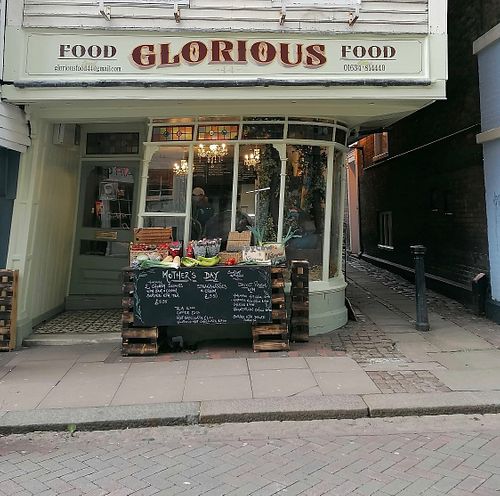
Just for the record, Rochester in Kent is fairly near to me. ‘Food Glorious Food’ Vegan Restaurants in Rochester, England (happycow.net) is the restaurant there. Rochester was home to author Charles Dickens, hence the name; and Rochester is small but is also a city, complete with cathederal. It hasw a strking castle which we have enjoyed visiting many times. I show you a few pictures here.
Rochester has a ‘Dickens Festival’ each year, where folk dress up as Dickensian characters and walk through the high stret of the city – see lots of pictures at:
Report from Association against animal factories, VGT Austria
Slap in the face – Salzburg Fiakers prevent heat-free!
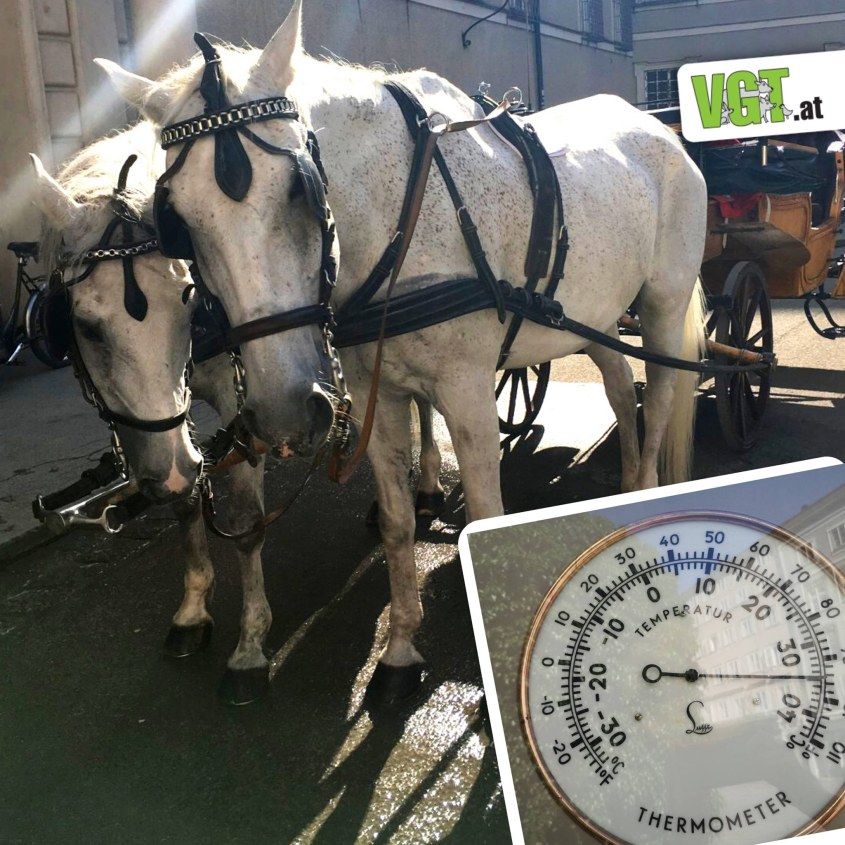
After our years of campaigns and dozens of actions and a great outcry in the population, the Salzburg municipal council passed a heat-free regulation for Salzburg from 30 degrees from summer 2021 in autumn 2020.
Background:
In December 2020, a heat-free rule from 30 degrees was unanimously passed in the Salzburg municipal council.
The value should be measured directly in the city center. The application was introduced by the Salzburg citizens’ list and will come into force in summer 2021.
😮 Now the decision turns out to be a zero number, the mayor refers to the small print: It was only decided to negotiate an amendment to the contract, “we could not force the horse cabs (“Fiaker”) to do anything” (!!!)
And despite the decision, they continue to extend at a sweaty 30 degrees plus. Anyone who forces his horses to do this pointless activity in such heat cannot claim to like horses.
This Fiaker horse died while driving at the Burgring in downtown Vienna- Image: Marcello Farabegoli
VGT campaigner Georg Prinz said: “It is no longer possible to work with these “fiakers”. We therefore expressly request the city of Salzburg not to extend the contract with the horse cabs from 2023 onwards. “
Next Tuesday, June 22nd, we will again hold a rally in Salzburg from 4:30 p.m. to 7:00 p.m. directly at the FiakerStand placeResidenzplatz, where signatures will also be collected for a new petition on the Fiaker ban in Salzburg.
✍ http://www.vgt.at/fiaker-salzburg
Please sign the petition and share it to many possible ones
And I mean…These animals are only able to endure the noise and traffic of the city through the use of blinkers and often also ear plugs.
The long standing at the Fiaker meeting places with horses – which are in the natural so constantly in motion – is a great torture for their tendons and joints, let alone pulling the load on asphalt ground.
Many of these workhorses suffer from hoof diseases and joint problems, which will become massive with increasing age.
And even in their free time – if we can still speak of ‘free time’ with carriage horses- the horses usually lead a lonely and completely unsuitable life.
They work 365 days a year, their official working hours in winter are from 10 a.m. to 4 p.m. (at the 6-week Christmas market you can often see them until 8 p.m.), and in summer from 10 a.m. to 9 p.m.
One thing is for sure: for carriage horses this traditional ‘customs’ means, and not only from the point of view of animal rights activists, a life-long torture!
At ‘Salzburg Info’ we read on the internet: “Today the “fiaker horses” are used exclusively for tourism and fun.”
Instead of fiaker horses it would be more realistic to say “slaves”.
Because only slaves serve.
And that with the “fun”, that’s probably always been the language of the rulers and the slave owners
The Jordanian government has made a groundbreaking decision: The regional authority for development and tourism for the Petra region has decided that 20 environmentally friendly electric vehicles should replace the horse-drawn carriages that previously used to drive tourist groups through the famous rock city.
We at PETA Germany and our international partner organizations welcome this animal-friendly step.
Electric vehicles are to replace tourist horse-drawn carriages
The decision of the Jordanian government is a groundbreaking step, which we hope will only be the first of many: In the future, electric vehicles will replace the tourist horse-drawn carriage rides through the archaeological park of the city of Petra.
In the past, tourists outraged by animal suffering had repeatedly turned to PETA.
Video recordings from PETA Asia show animal suffering and abuse: In addition to horses, donkeys and camels are also forced – often violently – to transport heavy loads and people over stony surfaces and slippery steps.
Due to public pressure, the electric vehicles will at least alleviate the suffering of the horses exploited in Petra.
“In the future, horses will no longer have to suffer from being forced to pull heavy people behind them – the new vehicles will take care of that and we hope that there will be further developments of this kind soon.” (Jason Baker, PETA Asia)
In October 2020, the Egyptian Ministry of Tourismannounced that it would ban tourist camel riding and horse-drawn carriages at the Giza pyramids.
We hope that these important decisions are only the first steps leading to exclusively animal-free transportation.
Donkeys and mules have to transport people up and down hundreds of steps













 This Fiaker horse died while driving at the Burgring in downtown Vienna- Image: Marcello Farabegoli

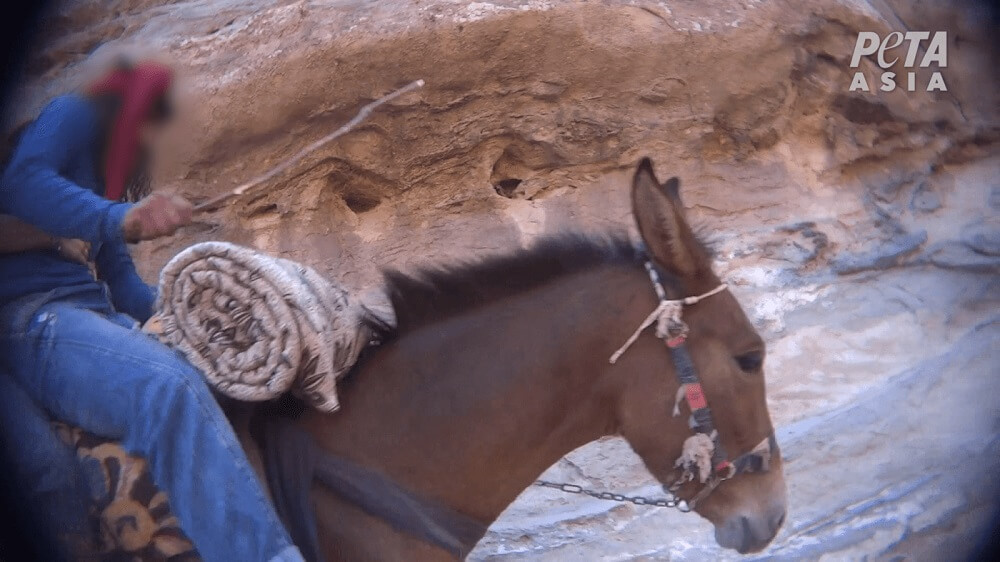
 Donkeys and mules have to transport people up and down hundreds of steps
