Month: December 2021

Oxfordshire county : only vegan food at events-great!

The Oxfordshire county council has passed a rule that only allows vegan food to be served at official events.
The idea was brought up in order to lead by example in tackling climate change and global warming.

The ruling read, “This council recognizes that global meat and dairy production is a significant contributor to greenhouse gas emissions and deforestation and that reducing consumption of these foods is a key part of tackling climate change.

The government’s independent Climate Change Committee, advises that meat consumption should be reduced by a fifth and that public bodies should promote plant-based foods.

That and the avoidance of food waste are powerful ways to cut carbon emissions.
Furthermore, in the UK, only 18 percent of children consume the recommended five portions of fruit and vegetables per day, and most young people’s diets lack fiber.
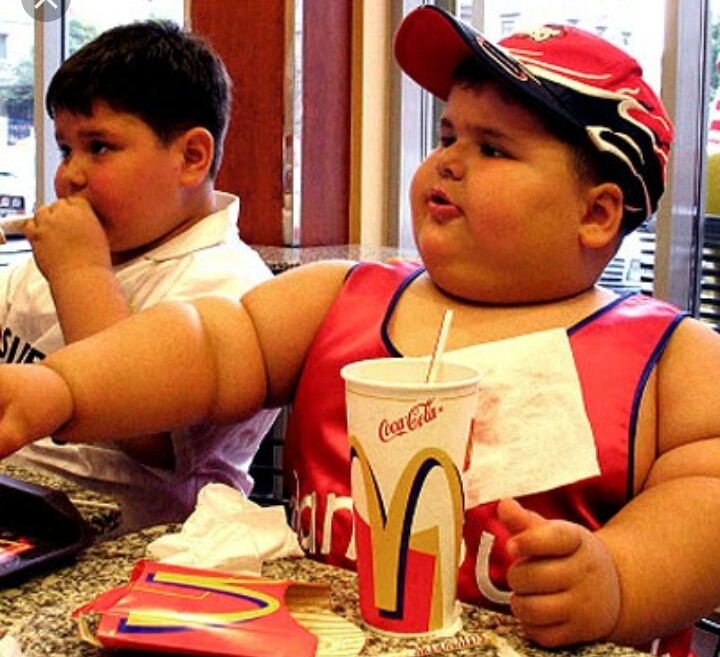
Providing appealing plant-based school meals along with education on healthy, climate-positive food choices are excellent ways to address these problems.”

With this ruling, the Oxfordshire county council’s events will only be catered with plant-based foods.

The ruling has met some opposition from other council members who do not follow a plant-based diet.
Other than that, this is wonderful news and sets an example for other city council members to adopt more plant-based foods into their diets.
This is wonderful progress as animal agriculture is a huge part of climate change and needs to be addressed more frequently.
They are now setting a positive example for citizens and aligning their actions with their climate goals.

https://www.onegreenplanet.org/news/oxfordshire-county-council-votes-to-only-serve-vegan-food-at-events/

And I mean…It is good to read such news.

Is it really a “doctrine of salvation” or an “extreme” if one refuses to actively participate in an ecological catastrophe?
What if someone refuses to ignore the barely comprehensible suffering of pigs, chickens and cattle etc.?

There is not one, not a single argument FOR meat consumption that cannot be debunked.
But hundreds against it.
Food from factory farming comes mainly from third countries.
Especially soy.
Rainforest is cleared for soy.
It is said that 4 m² of rainforest have to give way for a hamburger.
All agriculture in third world countries is being destroyed.
The result is hunger.
Millions of people starve to death because we don’t want to do without our cheap schnitzel.

Animal population Germany:
26 million pigs
11 million cattle
173 million poultry

In the first 6 months of 2020, 233,000 tons of pork were exported to China, half of the years before.

Factory farming has a huge impact on the environment.
A pig eats and metabolizes 4 times that of a human.
Most of this feed is imported.
Animal rearing is the main reason the rainforest is cleared!

In Europe, too, feed production contributes to the reduction of biodiversity.

Whether methane gas, ammonia or faeces, the environmental pollution is enormous, groundwater and surface water are contaminated.
The effects on nature are enormous.
Feed imports for 25 million pigs in Germany alone (F 13 million, Ita 9 million).

A pig metabolizes four times as much as a human … pig keeping in Germany alone corresponds to a doubling of the faeces of the German population and an enormous demand for feed is required.

Therefore: We welcome the decision of the Oxfordshire county council and can hope that other institutions will follow suit.

The argument that “nothing should be forbidden when it comes to eating” is irrelevant and can only be explained by the fact that it is first about eating and then about morality, only that in Europe eating is not meant in the sense of survival, but because of it culinary experiences and mostly at the cheapest level.

My best regards to all, Venus
Oh you nice Christmas time…

On the 24th there will be delicious goose in the evening wafer-thin with horseradish – delicious!

First holiday: the usual pork ribs with sauce, Potatoes and Peas & Carrots.
Second holiday: stuffed duck

The “animal-loving” people always look forward to that “Festival of Love”
We call it hypocrisy, we call it perverse !

It’s the year 2021, in a few days even 2022.

We know about pain perception, self-awareness and needs of non-human animals …
Every week we see burning fattening systems, animal transports,
Reports from animal husbandry and slaughterhouses, we smell, hear and see all the fear, agony and panic …
We got sickness from consumption of “animal products”.

Nevertheless, we consider ourselves “fond of animals” and “environmentally conscious”.

Not logical, not ethically correct, not up to date!
Our morale breaks down with a crash- more than otherwise in Christmas time .
“Festival roast” is not a tradition, it is the shame of an over-fed human race

So … let’s take the “Festival of Love” by its name and replace our Christmas dinner with a peaceful Christmas menu for which no sentient being was subjected to violence.

In this senseHappy Christmas

Mark and Venus

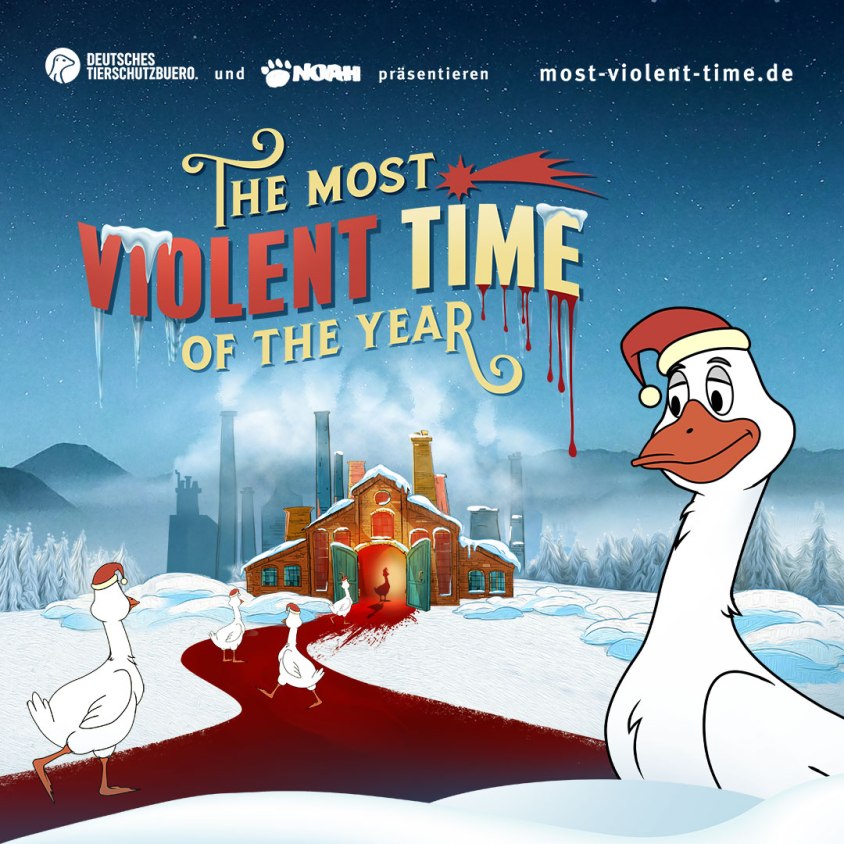
The Most Violent Time Of The Year

England: 24/12/21 – Videos From Some Animal Friends – Enjoy and Celebrate Your Achievements !

We have been sent some videos celebrating some of the animal achievements this year.

Enjoy watching the videos and celebrate your victories; but please remember, at this time, there are still animals confined to cages and stalls, and bears confined to horrific cage systems in order to be milked daily for their bile. 

The fight for animal rights is not over – will it ever be ? – but we must celebrate our wonderful results this year and the new lives that are happening for so many animals.

Regards Mark and Venus.

The first video is from Jill at ‘Animals Asia’; who says:

In Vietnam, 16 precious bears are celebrating their first-ever Christmas at our sanctuary.

And in China, 99 bears who made the long journey from the ex-bear bile farm in Nanning to our Chengdu Sanctuary will be celebrating Christmas with their new furry friends outside of concrete enclosures and surrounded by lush green trees.

What an incredible gift you’ve given these beautiful brave survivor bears. They may be thanking Santa Paws, but we are thanking you.

As a small gift to you, we’ve put together a special Christmas video that we hope will bring festive cheer and leave you grinning from ear to ear.

Some supporters sent baubles with touching notes of love and peace to Tuong Lai. You’ll see we made sure she received them.

And you’ll spot Goldie, Wonder, Yen and more joyful bears opening their Christmas gifts and filling up their big round bellies with some of the most deliciously sweet festive treats…

Once again, thank you so much. Your love and dedication to Asia’s animals are the reason so many bears have been freed from pain and suffering this Christmas. And it’ll be the reason no bear is left behind as we work towards ending bear bile farming in Vietnam.

I’d like to wish you and your family a bear-y merry Christmas, on behalf of everyone here at Animals Asia, including, of course, the rescued, contented bears whose lives you’ve changed for the better.

With festive bear hugs,

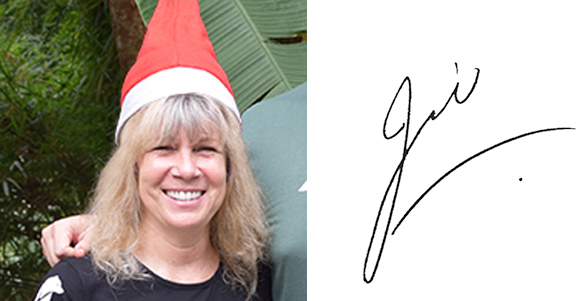
A close-up headshot of Animals Asia’s Founder and CEO, Jill Robinson smiling into the camera with blonde shoulder-length hair. She’s wearing a black t-shirt with the white Animals Asia logo on her shirt sleeve and a red and white Father Christmas hat.

Jill Robinson MBE, Dr med vet hc, Hon LLD
Founder and CEO

The second video is from live export campaigner friend of several decades, Phil at ‘Compassion In World Farming’ (London.

Philip says:

Every petition you have signed, every letter you have written and every £1 you have donated has contributed to making big changes for farmed animals this year that will significantly improve their lives in future. Without you, none of our work would be possible, so thank you.

To show you just how incredible you are, please have a look at this short video highlighting some of the wonderful changes you have helped to achieve. 

I do hope you and your loved ones have a wonderful Christmas and I look forward to the great things we can achieve together in 2022. Once again, on behalf of everyone at Compassion: thank you so much for being wonderful! With my warmest wishes,

I do hope you and your loved ones have a wonderful Christmas and I look forward to the great things we can achieve together in 2022. Once again, on behalf of everyone at Compassion: thank you so much for being wonderful!

With my warmest wishes,

Phil Lymbery

Philip Lymbery
Global CEO, Compassion in World Farming

Animal Aid – Kent, England UK

Belgium: GAIA Investigation – Turkey Farms In Flanders: Dire Poverty.

GAIA

See video footage here:

https://www.gaia.be/fr/actualite/les-elevages-dindes-en-flandre-misere-noire

All photos from our animal friends at GAIA, Belgium.

22 December 2021

GAIA

GAIA reveals once again the sordid state of Flemish turkey farms with a brand-new video footage, shot in November 2021. The footage shows thousands of turkeys crowded together, severely weakened, crippled, injured and dying; and even corpses in an advanced state of decomposition.

The situation is exactly the same as when GAIA went to three turkey farms in 2019. The intensive farming of turkeys for meat is still completely out of order and respect for animal welfare is totally absent. How is this possible? The reason is simple: there are no specific legal standards for turkey farms. This must change immediately. “In the turkey farms we visited, the situation is so bad that they must be closed down,” insists Ann De Greef, General Manager of GAIA.

Belgium still does not have specific legislation to protect the welfare of turkeys. For example, there is no clear legal limit concerning stocking density: breeders therefore determine for themselves the number of turkeys they wish to cram into a henhouse. “It is practically impossible to squeeze even more turkeys together, because hardly any animals would survive and the death rate is already so high,” says Ann De Greef.

The appalling conditions our investigation team found in the turkey farms we visited shows what the absence of concrete standards leads to. We can’t just settle for minimum standards that make little difference to the well-being of turkeys

Ann De Greef, General Manager, GAIA

GAIA therefore demands strict regulations that will set the bar very high to make a real difference and put an end to the recently exposed abuses.

State of play

There are currently around 25 intensive turkey farms in Flanders. GAIA filmed the living conditions of turkeys on four farms (Casteele turkey farm in Heuvelland, Lavens turkey farm in Wervik, a third in Lichtervelde and a fourth in Lendelede). It is important to note that the Casteele turkey farm in Heuvelland belongs to the president of the Flemish Association of Turkey Breeders: the images of its operations give an idea of ​​the state of play of the sector.

The situation as we discovered it in the four farms visited is terrible

Many turkeys crowded to the point where no additional animals can be added, stocking density taken to the extreme; numerous turkeys with necrotic tissue on their foreheads and hindquarters as a result of pecking, necrotic tissue on the ischium, elbow and other parts of the body, turkeys with bedsores, heavily soiled plumage (by faeces) and tangled, heavily soiled abdominal area, various decomposed and undecomposed carcasses, black scabs on bare skin caused by contact excoriation on a bony protrusion, severely lame turkeys, sick, weak and dying birds unable to stand on their feet in soaked litter, soiled with urine and faeces, rotten, turkeys with bony protrusions, birds with skin sores and heavily infected subcutaneous tissue, with gangrenous scabs on the scapula, severely weakened turkeys unable to reach the watering hole (starving and thirsty), several carcasses gnawed by one or more cats near the boot storage area (we saw a cat who was able to access the carcasses and feed on them); a basin filled with filthy and disgusting water, stagnant water near where a carcass was found; a large number of turkeys with cut beaks, etc. 

Turkeys live in their own faeces and those of their fellows, in overcrowded barns, injured due to pecking behaviour which is due, among other things, to a hierarchy disturbed by the excessive number of crowded animals. As in 2019, GAIA observed appalling necrosis (necrotic skin where pecking wounds were inflicted) on the heads and flanks of many turkeys.

GAIA demands strict standards that meet the behavioural needs of turkeys

GAIA therefore calls for very strict legal standards for the breeding of turkeys, which meet the natural behavioural needs of the animals. Stocking densities should be much lower, animals should be able to roam outdoors, perches should be adequate and sufficient, the use of slower growing breeds should be made compulsory, bedding should be dry and sufficient enrichment should be provided (such as straw bales to peck).

Disgusting scandal

As the breed used in intensive turkey breeding is selected for rapid growth, turkeys grow so fast that many suffer from lameness. These animals can die of hunger and thirst because they can no longer reach the watering hole and the feeder. Birds are also unable to clean their plumage, a vital need. “The current intensive farming of turkeys in Flanders is a crying shame,” says Ann De Greef. “The whole system is still a disgusting mockery of the concept of animal welfare, rotten through and through. The situation in Flemish turkey farms is totally unacceptable. There is an urgent need to adopt standards. Concrete, genuinely strict and animal-oriented legal regulations that will effectively protect turkey welfare must be a top priority, otherwise it would be better to stop and no longer breed meat turkeys in Flanders.”

Basic principles of animal welfare and welfare

The veterinarian François Sivine, who analysed the images, speaks of general lack of hygiene and a deplorable quality of litter. He calls the “infirmary” (the place where some animals are kept in isolation) “unbelievable”: the litter on the ground is filthy and soiled with faeces and soaked in ammonia. The average morbidity (disease rate) is “excessive”. Sivine draws a damning observation:

The management of these facilities and their hygiene, as well as in the individual monitoring of animals, is totally unprofessional. This is pure negation of any notion of animal welfare. The behaviour of those responsible for the farms in question is in every way contrary to the most elementary principles of animal protection and welfare

François Sivine, Veterinarian

And Wallonia?

The Walloon Government recently adopted at first reading a draft decree relating to the welfare of turkeys on farms (the intensive / industrial type does not yet exist in the Walloon region). However, the Walloon Minister for Animal Welfare, Céline Tellier, and her colleagues preferred not to follow the recommendations of the experts of the Walloon Council for Animal Welfare who proposed to ensure a density in each henhouse of maximum 30 kg/m2 for females and 36 kg/m2 for males, which corresponds to 3 females per m2 and 2 males per m2. The draft decree provides for 42 kg/m2 for females (4 per m2) and 48 kg/m2 for males (3 per m2). “Obviously, the interests of certain lobbies weigh more in the balance than ensuring a level of decent animal welfare,” remarks Ann De Greef. GAIA, just like the Walloon Union for Animal Welfare and the Francophone Federation of Shelters for Horses and Farm animals for that matter, ask Céline Tellier and the other ministers of the Walloon Government to amend the text for the passage in second reading.

Read more at source

GAIA

We cant change all the world, but when it comes to animal abuse, we will have a bloody good try !

Regards Mark

How WWF becomes a traitor to the animals

@WWF_Germany-23.12.21 

The Christmas 🎄clock is ticking. And with it the question: What should we eat?

If you want meat, then please organic from the region or game from the area. We have a guide for conscious meat consumption.

Please read: wwf.de/aktiv-haben/t…

Photo: WWF

The WWF advises you to buy meat consciously and recommends that you choose meat, the production of which has as little impact on the environment as possible.

This basically includes meat that has been produced according to the criteria of the EU organic seal, the organic cultivation associations and the Neuland production association, as well as so-called “pasture meat”, which comes from animals that have been on the pasture all year round.

The main criteria for “good” meat are:

– No synthetic nitrogen fertilizers are used for the production of the animal feed. A material and energy cycle that is as closed as possible should be aimed for.

– No synthetic pesticides are used in the production of the animal feed.

– The use of genetically modified forage plants for the production of animal feed is prohibited.

– The animals were kept animal-friendly. This includes, among other things, that the animals have sufficient space for movement throughout the year and that they are given access to exercise or grazing all year round. Fully slatted floors are prohibited.

– Painful interventions on animals are only carried out with anesthesia or pain treatment. In addition, the usual interventions in conventional animal husbandry, such as cutting off the tails, pinching the teeth in pig breeding and docking the beaks in laying hen husbandry, are prohibited.

– The use of conventional medication is only permitted in exceptional cases. The administration of antibiotics as fattening aid or preventive medication is prohibited. The use of synthetic substances that promote growth or increase production is also prohibited.

– Cattle, sheep and other ruminants spend a lot of time in the pasture and their feed consists largely of green forage (grass, hay, silage, clover). The meat is known as pasture meat.

-The live transport of livestock does not exceed four hours.

https://www.wwf.de/aktiv-werden/tipps-fuer-den-alltag/vernuenftig-einkaufen/fleisch-einkauf

Our answer..WWF and animal consumers have signed a tacit agreement: We lie to you – We let ourselves be deceived.
This has advantages for both sides: Undisturbed maximization of donations against a clear conscience.

Organic attitude

With this clever organic philosophy, the product – meat – can be saved elegantly and, above all, “ecologically” on morally safe grounds using arguments: Meat from animals that had a happy life!
Meat from animals that lived in the wild until their death is simply the ideal solution!

But behind the organic-lying fairy tale of beautiful words – “organic”, “eco”, “respect” – and beautiful pictures – on the packaging and in the advertising – there is pure horror, pure horror: absolute lawlessness of animals, absolute ruthlessness of their tormentors.

Organic attitude

A company that works according to “organic” and “eco” guidelines is not an idyllic farm with a few happy animals, but here too you will find the same factory farming with hundreds, thousands and tens of thousands of animals as in the “conventional” ” Area.
The desolate life of the so-called “eco-animals” is consistently propagated as “species-appropriate”: the “happy animals” are “gently transported” and treated “humanely”.
Because that makes the conscience easier.

Organic attitude

The reality: breeding sows in the crate, lethargic calves without mothers and far and wide no green meadow.
Tethered dairy cows, fattening pigs in defecated stalls, “organic chickens” that are just as torn as their female companions in barn housing.

Meat, milk and egg producers here in Germany who, under the eyes of the “German Animal Welfare Association”, are committed to “animal welfare”, “limits” animal husbandry in the affiliated companies to a “manageable” 10,000 (!) laying hens 6000 broiler chickens, 2000 broiler ducks, geese and turkeys per farm, as well as 650 fattening pigs or 500 fattening pigs plus associated breeding sows.

Organic attitude

A fattening pig weighing 100 kg does not become “happier” because it is given 2.3 square meters of space as a so-called “organic pig” instead of 0.65 square meters (“conventional husbandry”).

Such an “organic pig” also has no right to actual free run in the country and, like its conspecifics in the “conventional husbandry”, usually never sees a meadow.

“Eco” and “Bio” are not a happy pig that can splash around in the water to their heart’s content.

“Eco” and “organic” deceives and simulates a healthy world of livestock that does not exist.

Organic attitude

What is the meaning and purpose of “organic” then?

The same sense and purpose that Rip and fraudulent labeling always has: to calm the conscience of the consumer and to pull double and triple the money out of his pocket.
Not more.

Conclusion: “Bio” = cruelty to animals, a huge consumer deception and easy game for the criminal companies who like to cavort under the same dirty blanket with the ministries of agriculture.

We forgot another winner: an organization that loudly claims to be one for animal rights, but turns out to be nothing other than the loudspeaker of the food mafia.

In order to be an ethical and decent human being, one must be vegan. There is no gray area here. You are either vegan or you are complicit in the war on animals.

Even WWF must know that too!

Venus Reichenbach

Why should animals have rights?

People who support animal rights recognise that all animals have an inherent worth – a value completely separate from their usefulness to humans. We believe that every being with a will to live has the right to live free from exploitation and suffering.

It’s a Philosophy

Animal rights is based on ethical and moral philosophy.
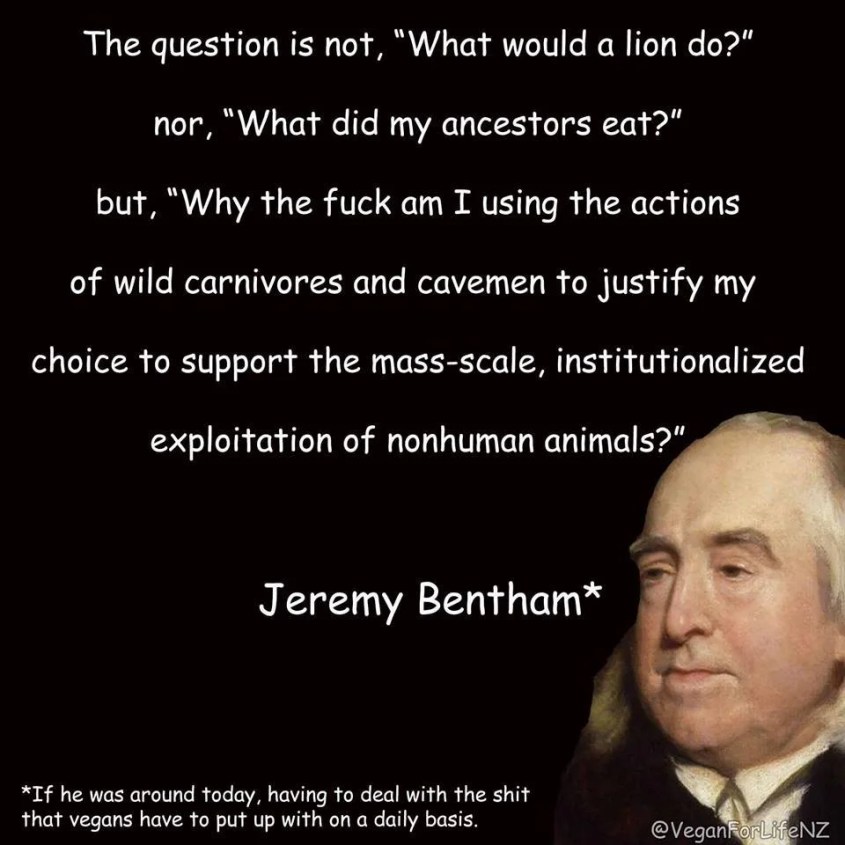
It has been discussed by some of the world’s most influential thinkers, from historical figures such as Pythagoras and Leonardo da Vinci – who embraced vegetarianism – to Jeremy Bentham, the founder of the utilitarian school of philosophy, who famously identified animals’ capacity for suffering as the characteristic that gives them a right to equal consideration.

“The question is not ‘Can they reason?’ nor ‘Can they talk?’ but ‘Can they suffer?’”
– Jeremy Bentham

All animals have the ability to suffer in the same way and to the same degree that humans do.
They feel pain, pleasure, fear, frustration, loneliness and familial love. Whenever we consider doing something that would interfere with their needs, we are morally obligated to take them into account.

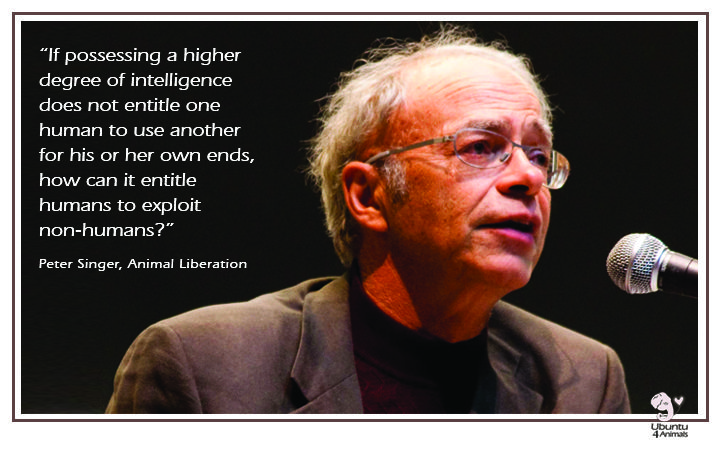
In his book Animal Liberation, the philosopher Peter Singer states that the basic principle of equality does not require equal treatment – it requires equal consideration.
This is an important distinction when talking about animal rights.

People often ask if animal rights means that animals should have the right to vote or drive a car.
Of course, that would be silly because those aren’t rights that would benefit animals. But animals have the right not to suffer at the hands of humans and to live their lives free from suffering and exploitation because they have an interest in doing so.
That is the difference between equal consideration and equal treatment.

It’s Intuitive

You don’t have to be a philosopher to know that hurting animals is wrong. At its core, animal rights is simple. It’s about being kind to others – whether they’re members of our own species or not.

Almost everyone cares about animals in some context, whether it’s a beloved family companion, an irresistibly cute kitten or a majestic wild animal seen in a documentary. After all, we each have some built-in capacity for empathy and compassion, as can be seen from the lengths that children often go to in order to help animals.

Logically and morally, there’s no reason to differentiate in the way we treat the animals we share our homes with and those who are farmed for food.

They’re all individuals, with the same capacity to feel pain and fear. Animal rights helps us to look past the arbitrary distinctions between different species, to rediscover our innate compassion and to respect all animals equally.

“When it comes to pain, love, joy, loneliness and fear, a rat is a pig is a dog is a boy. Each one values his or her life and fights the knife.”
– PETA founder Ingrid E. Newkirk

It’s a Way of Life

There’s nothing abstract about animal rights, and there are no barriers to getting involved. Anyone who cares about animals can start putting these principles into practice every single day with the food they eat, the clothes they wear and the products they buy.

These choices are a form of nonviolent protest that makes a real difference both by reducing the profits of corporations that harm or kill animals and by creating a growing market for cruelty-free food, fashion, services and entertainment.

To learn more about making kind choices, visit the Living section of our website and order a free vegan starter kit.

“Never doubt that a small group of thoughtful, committed citizens can change the world.”
– Margaret Mead

It’s a Social Movement

Like other major social movements, animal rights brings people together from across political, religious and cultural boundaries to fight against injustice.

And like those movements, it’s also about fairness. Only prejudice allows us to deny others the rights that we expect to have for ourselves.
Whether it’s based on race, gender, sexual orientation or species, prejudice is morally unacceptable.
Alongside the struggles against racism, sexism and homophobia, there’s the struggle against speciesism – discrimination against other beings on the basis of their species.

“Injustice anywhere is a threat to justice everywhere.”
– Dr Martin Luther King Jr

It’s the Way Forward

Society is evolving and becoming fairer all the time. Despite all the people who say change will never happen, most countries in the world have outlawed human slavery and child labour.
Recognising the rights of animals is the next stage in our progress towards a fairer world.

As biologists and animal behaviourists learn more about animals’ intelligence and the complexity of their lives, there’s even less excuse for treating them as commodities rather than the sensitive individuals they are.

Most of us grew up eating meat, wearing leather and visiting zoos.
Yet, just as we’ve made the mental shift towards a way of life that respects animals, so society as a whole must outgrow the unethical mindset that animals are here for us to use and kill as we please.

“The greatness of a nation and its moral progress can be judged by the way its animals are treated.”
– Mahatma Gandhi

https://www.peta.org.uk/action/what-is-animal-rights/

And I mean…We have a moral duty to educate.

We’d like our governments, lawmakers, and politicians to help end factory farming, but they just don’t seem interested in animal slavery, suffering, and murder.

Therefore: we have the moral duty to actively and massively oppose all forms of animal exploitation and to encourage and educate others to become vegan with the core goal of eradicating speciesism. We have to go together, and together we can make some important changes.
For the animals.
Because we owe it to them

My best regards to all, Venus

England: Primary School Teacher Sacked After Being Caught on Film (By Hunt Sabs) Kicking Horse.

Footage of Sarah Moulds shared online by Hertfordshire Hunt Saboteurs viewed by millions in November

A primary school teacher has been sacked after footage of a horse being kicked and slapped sparked outrage on social media.

Sarah Moulds, 37, was initially suspended from her position after the video showed a horse being kicked in the torso, slapped repeatedly in the face and dragged back to a trailer.

The footage was shared online in November by the anti-hunt group Hertfordshire Hunt Saboteurs, who said it filmed the incident while observing the Cottesmore Hunt, based in Rutland, east Midlands.

The clip, which has been viewed millions of times, sparked anger and Moulds was suspended by the Mowbray education trust, which represents seven schools in the Melton Mowbray area.

The trust has now said she has been dismissed. In a statement, Paul Maddox, the chief operating officer, said: “I can confirm that Sarah Moulds’ employment with the trust has been terminated.

“As a trust, we are committed to ensuring the best standard of education for all of our young people and we look forward to continuing this throughout the 2021/22 academic year and beyond,” the statement continued.

Moulds was also removed from her volunteer leadership position at the Pony Club, which organises horse rides for children.

Her uncle, David Kirkham, said Moulds was a “fantastic person who absolutely loves her horses”.

He added: “I’ve seen the video but we don’t know what the horse had been doing and if it was out of control. But we know it ran out on to the road and she told it off. There was no malice intended.”

In a statement at the time, the Pony Club said: “The welfare of horses and ponies is of the utmost importance to the Pony Club, therefore the lady in question has been removed from her voluntary position as a team organiser for a branch.”

The Hertfordshire Hunt Saboteurs called the footage “shocking”, while the RSPCA described it as “upsetting”. Moulds is being investigated by the RSPCA and the Hunting Office, the governing body which oversees hunting, and Leicestershire police confirmed it would assist the RSPCA with its inquiries.

In response to the video, the Hunting Office said it “expects the highest level of animal welfare at all times – both on and off the hunting field – and condemns the actions taken by this individual, who is not a member of the hunting associations”.

The Cottesmore Hunt said it did not condone the actions shown “under any circumstances”.

Regards Mark

Enjoy !

Vietnam: New Jingle Bears – AA Vietnam Rescue Sanctuary Welcomes 6 New (Ex Bile Bears) To Their New Forever Home.

Will you help us care for these six rescued bears?

WAV Comment – we were happy to provide Animals Asia with a donation yesterday re on going work and updates at their Vietnam bear (rescue) sanctuary.  As you can read below from Tuan, the sanctuary has just welcomed 6 new (ex bile abused) bears to their new forever home.  Please continue reading below for more details.  This will be their first Christmas free from the daily abuses and suffering for the bear bile industry, and we really welcome that.  Free all the bears from suffering !

Regards Mark

Dear Mark,

Yesterday, thanks to the generous support of animal champions like you, we stood ready to welcome six more bears through the gates of our Vietnam sanctuary – just in time for Christmas.

The bears were being looked after at Hanoi Wildlife Rescue Centre before they made the short journey to their new forever home. The details of each individual are limited at the moment but I promise to keep you updated as we learn more.

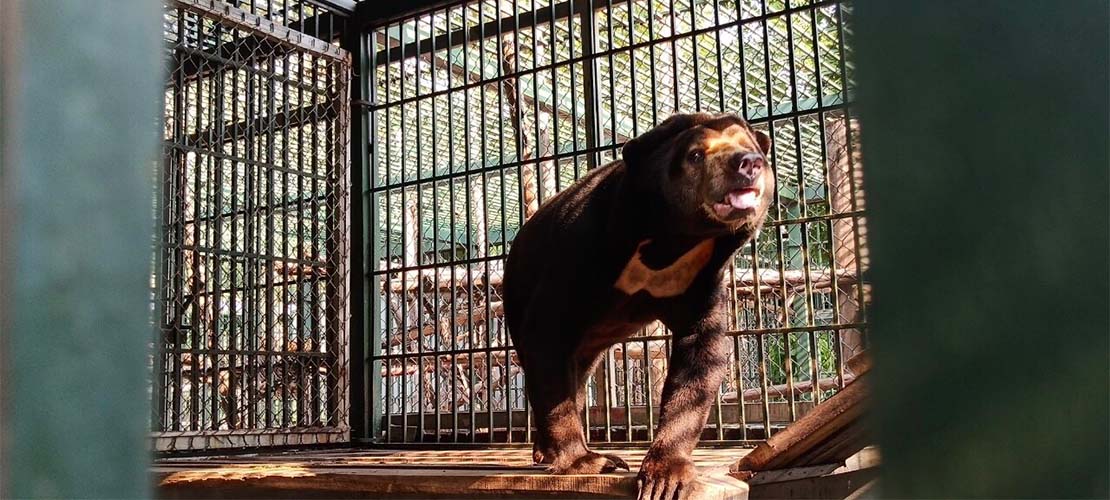
What I can share with you, Mark, is that the group includes five moon bears – one of whom is a gorgeous little cub around the same age as our other recent arrivals Wonder, Yên and Marvel – and one sun bear, who we hope will thrive when bonded with our resident rescued sun bears.

In the spirit of the festive season, we’ve named the sun bear Angel and the five moon bears Thông (Pine tree), Noel, Pudding, Giáng Sinh and Tuyết (Christmas and Snow in Vietnamese).

It really is thanks to the continued kindness and generosity of supporters like you, that our Bear Rescue Team can be ready in a moment’s notice to help a bear, or two or six, and provide the tender loving care they’ll need long into the future.

And not only that, but your support is helping to foster invaluable relationships with local authorities and rescue centres like this one, which in turn will help more vulnerable animals throughout Vietnam. Thank you, Mark.

The arrival of these six precious bears means our Vietnam sanctuary is now only four places away from being full.

I understand that Christmas is a busy and expensive time for many. But if you’re able, will you make a loving donation today?

Your festive goodwill could help provide ongoing care for our rescued residents, as well as help to build a life-changing second sanctuary to take in more broken bears.

If you’ve already sent across your special Christmas donation to the animals, please accept my heartfelt thanks for helping to give animals the lives they truly deserve.

I hope you’re as overjoyed as we are to welcome six more beautiful bears to sanctuary, where, with your support, they’ll be able to snooze, splash, munch, climb and wrestle to their heart’s content.

With festive hugs of gratitude to you and yours this festive season,

Tuan Bendixsen,
Vietnam Director

PS Please note that our offices will be closed for Christmas from 23 December and will reopen on 4 January.

Regards Mark

https://www.animalsasia.org/

EU: (Hopefully ?) – EU proposal for Indonesia trade agreement strengthens position on animal welfare.

22 December 2021

The EU’s latest proposal for the sustainable food systems chapter in its trade agreement with Indonesia marks an improved position on animal welfare. However, the language could be further strengthened to better protect the interests of animals.

The EU has released a proposed legal text for the chapter on sustainable food systems (SFS) in the EU-Indonesia Comprehensive Economic Partnership Agreement (CEPA). CEPA negotiations were launched in July 2016, but progress is slow as the EU and Indonesia have quite different positions on key issues, such as on the content of the sustainable development chapter. The 11th round of negotiations was held in November 2021.

Under the proposed SFS chapter, animal welfare would be recognised as a component of sustainable food systems. The article on animal welfare would recognise animals as sentient beings and commit the parties to “strengthen their research collaboration” to further develop science-based animal welfare standards. It would also enable the parties to establish a technical working group to support the implementation of the article. The article on antimicrobial resistance would promote the “prudent” use of antimicrobials in animal production and commit the parties to phase out their use as growth promoters.

The proposal marks an improvement on the text initially published by the EU on animal welfare cooperation – which was in the chapter on sanitary and phytosanitary (SPS) measures. This 2016 proposal contained only a weak provision stating that the parties “shall promote collaboration on animal welfare”, which seriously lacked ambition.

While the progress made in the proposal is welcome, the EU could further strengthen the language and include, as they did in the agreement with Mexico, a reference to the need to implement OIE recommendations in the field. The text could also provide for capacity-building and technical assistance from the EU, as in the trade agreement with Vietnam.

The EU should also suggest making the liberalisation of trade in animal products dependent on the respect of EU-equivalent animal welfare standards by Indonesian exporters. At the moment, Indonesia does not export many animal products to the EU, but agreements are made to last and the country has demonstrated its willingness to develop its livestock sector. The EU should thus ensure CEPA does not contribute to fuelling the spread of unsustainable farming practices. To the contrary, the agreement should play a role in promoting higher animal welfare in Indonesia. 

Working with Indonesia on animal welfare, especially in the context of Sustainable Food Systems, is important not only because the country is a global player in the livestock sector (it’s one of the largest producers of chicken meat in the world), but also because the EU exports live chickens there, which consequently end up on Indonesian farms. Indonesia is also the first source of EU imports of frogs’ legs, and this trade involves serious welfare issues at the handling, transport and slaughter stages. Production methods are highly cruel; frogs are captured using hooks, nets, and spears and kept in overcrowded and unsanitary conditions. Their rear legs are cut off while they are still alive by scissors, blade or by hand and their torsos are added to a pile of other bleeding frogs, where they endure a painful death which can take a full hour. As the animals are usually caught in the wild, the trade also has a harmful impact on the conservation of certain frog species, which can compromise the welfare of the local ecosystem. The cooperation under the SFS chapter could allow us to address these issues.

Regards Mark

The Norwegian wolf is extinct

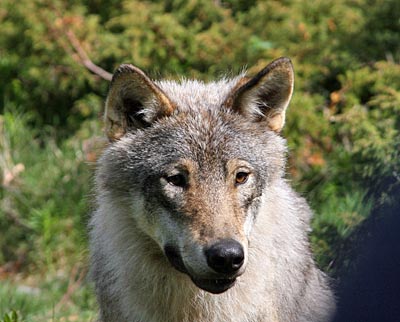
The wolves that live in Norway and Sweden today are actually Finns, as extensive studies of their genetic make-up have shown.

Hunters wiped out the original Norwegian wolf population in the wild around 1970.

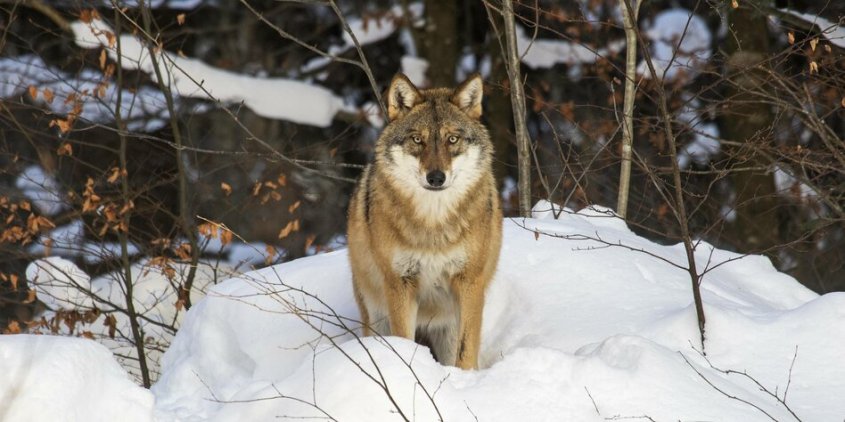
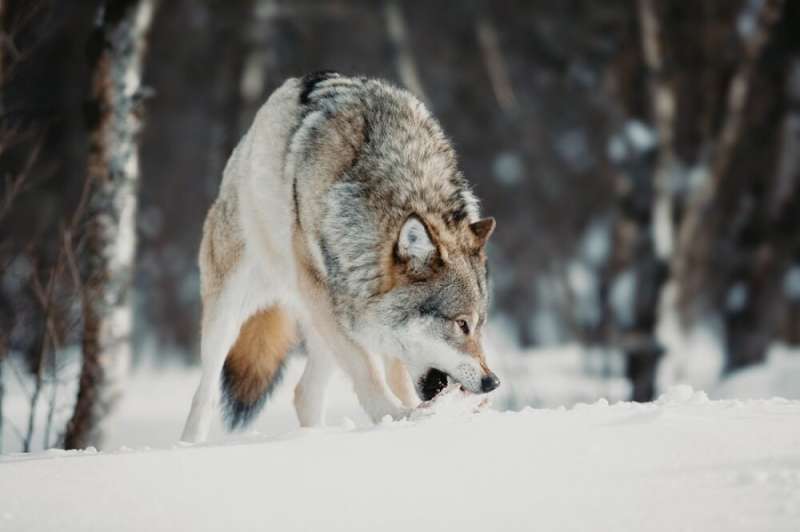
Solitary gray wolf / grey wolf (Canis lupus) hunting in the snow in forest in winter -Norway

“The original Norwegian-Swedish wolves probably had no genetic similarities with today’s wolves in Norway and Sweden,” says Hans Stenøien, director of the University Museum of the Norwegian University of Science and Technology (NTNU).

Stenøien is the lead author of a new report that looks at the genetic makeup of the Norwegian-Swedish wolf population in much more detail than has previously been the case.

“We did the largest genetic study on wolves in the world,” says Stenøien.

This is part of an extensive report on the wolf in Norway commissioned by the Norwegian Parliament (Storting) in 2016.
But by that time the real Norwegian-Swedish wolves had been gone for many years.

“Granted, some of the original Norwegian-Swedish wolves can still be found in zoos outside Norway.
But our wolves today are not closely related to them, “says Stenøien.

Disappeared and come back

The wolf came to Norway when the ice retreated around 12,000 years ago.
But around 1970 it disappeared from the Norwegian landscape and probably also from Sweden.
Above all, the high hunting pressure and conflicts with agriculture contributed to the decline in wild animals.

But apparently the species settled again around 1980.
Today more than 400 wolves roam the border area between Norway and Sweden.
They are considered to be a common population.

There used to be rumors that wolves had been released from zoos into the Norwegian wilderness, but that doesn’t seem to be true. In any case, it cannot be wildlife from the original Norwegian wolf population.
Instead, Finnish wolves seem to have expanded their territory.

“Today’s wolves in Norway and Sweden are most likely descended from wolves that immigrated from Finland,” says Professor Stenøien.

Where the wolves come from in Finland is not entirely certain, but they seem to be Finnish nonetheless.

Wolves threatened by severe inbreeding

Continue reading “The Norwegian wolf is extinct”