Month: January 2021

The Situation with Stray Dogs in the Republic of Azerbaijan.

WAV Comment –

We have asked for petition and have now produced a sample letter which you can see directly below.

Please go to the Facebook site at (11) Facebook for more; and in the comments there should be details of who you can send your letter to.

Here is suggested sample letter to copy and send.

SAMPLE LETTER:

I am a xxx citizen and very concerned regarding the situation of stray dog treatment in the Republic of Azerbaijan.

As I am aware, on the 30th of May 2018; Leyla Aliyeva announced that the shooting order of stray dogs had been stopped and will not ever be happening again.

The actions of this announcement from 2018 do not appear to have been kept. There is still (now, in 2021) an order to shoot stray dogs in many regions of Azerbaijan, including Baku, the capital.

There are many videos to prove that stray dogs are still being murdered despite the statement to the contrary made in May 2018. 

As I currently understand, the Republic of Azerbaijan has signed the European Convention for the Protection of Pet Animals.  The signature was undertaken on 22nd of October 2003, and ratified on the 19th of October 2007.

Like other EU member states such as Romania; and EU Candidate nations such as Serbia; corruption is paramount in these nations and animal welfare comes way down the list.  Like many other nations that have strays, the execution forces, such as those at Toplan, are paid murderers.  Who is paying them to murder and where does this money come from ?

According to this, since 1st of May, 2008 the European Convention should be in force in Azerbaijan.  I also accept that EU words and conventions really mean very little; as the EU always passes responsibility for actions back to individual states.  But still, saying that, actions which continue by the Azerbaijan government and dog catchers / facilities therefore go against the existing European Convention for the Protection of Pet Animals; and have done for several years.

Also; I must ask why does the ‘Toplan Center’ still violently capture and murder stray dogs ?   We also know that it murders vaccinated and neutered dogs, and also dogs which are not strays but which do have owners; why is this so ?

There are only a few dogs in the Toplan Center who are held alive just in case of an inspection. What has happened to all the others ? – we have proof of your actions and murders; do not dismiss it.

Now, in 2021, you should be promoting kindness, compassion and giving protection towards all animals.  Stray dogs are not wild, they are simply homeless.  You should be addressing this issue rather than adopting the one of killing; this brings shame on you currently.  This approach shows the world that Azerbaijan is still living in the past rather than the present.

I am also forwarding a copy of this (my) letter to the EU regardless to inform them of your current policy regarding strays and requesting they investigate further the funding for these mass dog murders.

Name: xxx

Nationality: xxx

—————————————————————————————

(11) Facebook

email addresses:
iorelations@heydar-aliyev-foundation.org
doc.office@heydar-aliyev-foundation.org
#azerbaijanstopkillingstrayanimals #azerbaijanstopkillingstraydogs
#4pawsbaku

Image may contain: outdoor
Image may contain: 1 person, text

Good Day!

I am concerned regarding the situation with stray dogs in the Republic of Azerbaijan.


As I am aware, on the 30th of May, 2018 Leyla Aliyeva has announced that the shooting order of stray dogs has been stopped and will not be happening ever again.

My question is why this promise has not been kept? There is an order to shoot stray dogs still in many regions of Azerbaijan including the capital of Azerbaijan, Baku. Many videos prove that stray dogs still get murdered. Why did you not keep the promise to stop the mass murders of dogs?

As I am aware, the Republic of Azerbaijan has signed the European Convention for the Protection of Pet Animals on the 22nd of October 2003 and ratified it on the 19th of October 2007. According to it, since 1st of May, 2008 the Convention should be in force in Azerbaijan. Your actions go against the European Convention for the Protection of Pet Animals.

Next, why does Toplan Center still violently captures the stray dogs and murders them? Why does Toplan Center still murders the neutered and vaccinated dogs?

They also kill the dogs who are not stray and have owners.

There are only very few dogs in the Toplan Center who are kept in case of an inspection that might occur. What happens to the others?
Why do you not promote kindness towards the animals? Why do you not protect them?

Please, see the attached links below:
https://m.youtube.com/watch?feature=youtu.be
https://m.youtube.com/watch?v=8aZuR5Qq6K8&feature=youtu.be
https://m.youtube.com/watch?feature=youtu.be
https://www.youtube.com/watch?app=desktop&feature=youtu.be&v=vHvpOxYYA60&fbclid=IwAR063eiCiKOcRMIwMpEp63LUx_-hqYljvGBh4v2pPcOJhlY9Nla-82m1MS0

Sincerely



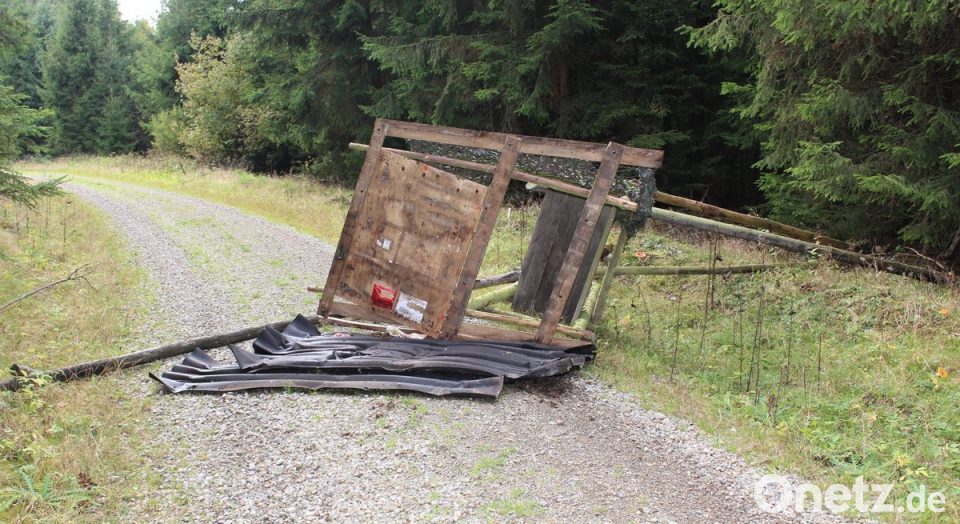
Germany: 8 destroyed high seats and a 75 year old man is the hero

The Kochel police cleared up a series of sawn high seats in the Walchensee area. The perpetrator is a former police officer. The pensioner confesses.

A former police officer has let his hatred of hunters atWalchensee” (Bavaria) run free
Since 2018 he has been sawing, among other things, several high seats
He was caught red-handed.

Icon image

The cases go back to 2018, the Kochler police chief announced on Wednesday.

A 75-year-old man from the southern district was identified as the perpetrator.

He confesses and it is a retired police officer

The man was caught red-handed in the forest by one of the victims in August 2020.
The investigation has been ongoing since then.
The officials in Kochel also examined cases from previous years. Until 2018, property damage in the Walchensee area of ​​the perpetrator could be proven, according to the Kochler police chief.

Specifically, there are eight cases with sometimes massive damage to so-called hunting facilities such as high seats and salt licks.

“In some cases, high seats had been completely cut, sometimes only the ladders were sawed,” reports police chief. The property damage is “in the very high four-digit range” (!!!)
The local Hunting Entitled (!!!) and the Bavarian State Forests are affected. Fortunately, no one was harmed in the acts.
It is possible that some high seats were even “climbed in ignorance of the danger”.

The perpetrator confessed to the damage to property.
“As a motive, he named personal problems with hunting wild animals.”

The 75-year-old confessed to some of the cases, while others could be detected by wildlife cameras or the location of the tracks.

“For example, we found traces of paint rubbed off on saws on the suspect.”
The Kochel police have worked through all the cases from previous years in this matter.
The perpetrator has so far not appeared as a criminal offense.

All reports will now be sent to the public prosecutor.

The perpetrator must expect a fine or even a low-threshold prison sentence.

https://www.merkur.de/lokales/bad-toelz/kochel-am-see-ort28931/pensionierter-polizist-75-saegt-hochsitze-um-90155675.html#idAnchComments

And I mean…First of all, respect and solidarity belong to the man.
In addition, for one more reason: despite his old age, he continued to try to eliminate the execution places in the forest.

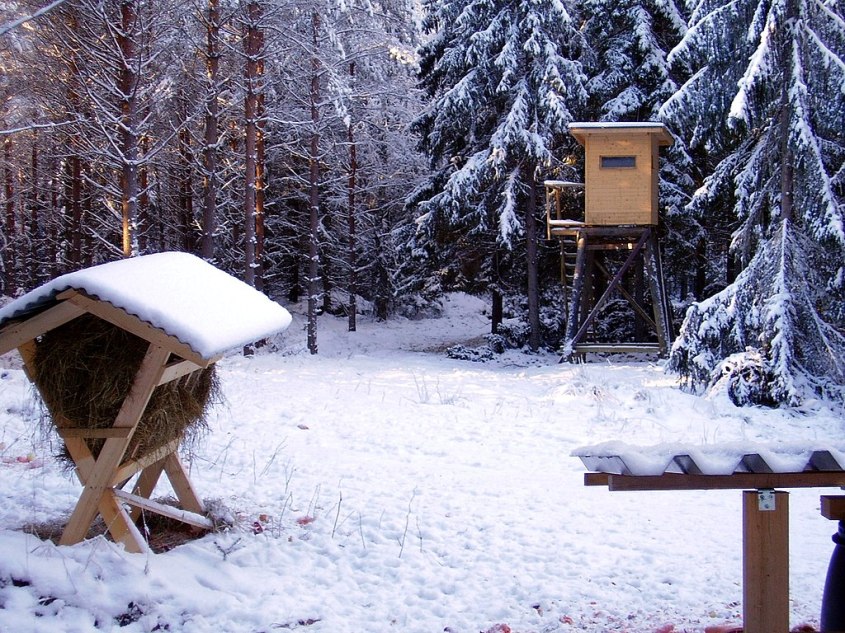
Some things should be clarified here about the status of these murder seats.
Not all are legal, but who dares to ask?
And each scrap of them costs a maximum of 200 euros, most of which are built by the hunter himself.

These “salt licks” are nothing more than bait that the hunters put in front of the high seats so that the future victims get used to them and visit the site regularly.
This is the only way the hunter can create a safe execution site for the future.

Of course, the hunters claim that by fattening them up, they help the weaker ones to survive the hard winter in the forest.
But if the winters are as mild as it was in 2020, it should go without saying that no hunter feeds.
But they do it anyway.

By Ohikulkija – Own work, CC BY-SA 3.0, https://commons.wikimedia.org/w/index.php?curid=30977723

So.. why are hunters so strongly against a possible feeding ban?
It is clear !! Because by regularly feeding the animals, any city hunter can play the nature boy in the fields and hallways and shoot a deer quickly and not sit and wait long in the high seat.

It is creepy when suddenly there is a bang in a high seat in the forest and animals that have been shot (but not dead) fight for their lives.

For someone who has experienced that, it is unforgettable

Therefore we are happy when these execution places are sawed down.
It is not forbidden.

My best regards to all, Venus

Eurogroup for Animals: Our Major Wins for Animals in 2020.

From ‘Eurogroup for Animals’ – Brussels.

Our major wins for animals in 2020

23 December 2020

What a special year 2020 was – not only for the world, but also for animal welfare. With the many tough events we faced this year, we want to take a moment to acknowledge and look back on the positive sides and the success stories for animals in 2020.

Farm Animals 

With the adoption of the Green Deal and the Farm-to-Fork Strategy, the European Commission sent a strong message and put animal welfare back on the EU’s agenda in early May resulting in the European Commission performing a ‘fitness check’ of the current rules in place on animal welfare in 2021. 

The European Parliament approved the setting up of a special Committee of Inquiry on animal live transportwhich is a crucial step towards making the revised Transport Regulation an effective tool to protect the welfare of animals transported within and outside the EU. 

After hosting a high-level online event on labelling of animal products and the publication of our report on animal welfare and food labelling, we welcomed to see the Council setting the course for a comprehensive labelling system that displays the well-being of animals over the whole animal food production cycle in the adoption of Council Conclusions in December

Next to our labelling report, we also published our report on broiler welfare – a groundbreaking new report presenting the first comprehensive scientific overview on the welfare of broiler chickens, showing improvements are feasible, urgent and should inform future EU legislation.

Groundbreaking news reached us in November when the European Parliament approved funding of a research project to find alternatives to high-concentration CO2 stunning or killing of pigs. Now the European Commission will invest 2 million Euro in applied research in an effort to move away from the inhumane procedure.

Lastly, we welcomed the Court of Justice of the European Union’s ruling which confirmed Member States’ right to introduce mandatory pre-slaughter stunning.

Companion Animals & Equines

While it is often agreed that our pets are not on the front stage when it comes to EU developments and protection, 2020 has set the scene for several strategic opportunities for dogs, cats and equids.

The Croatian Presidency of the Council of the European Union and Eurogroup for Animals’ expert workshop “The Illegal Pet Trade: Game Over” took place on 21 April 2020, in the middle of the COVID-19 crisis and just a year before the EU Animal Health Law will take effect. 100 participants from European institutions, Member States, academia and the animal welfare sector debated this pressing issue. They explored the shortcomings of the control systems of the online pet trade that are currently in place and looked at best practices in how to better protect animals, consumers and ultimately taxpayers, including how these could be rolled out across Europe as a whole. All these outputs have been collected into a major publication, the “Illegal Pet Trade: Game Over report”, and was handovered soon after the release to Commissioner Kyriakides. On 27th November, Eurogroup for Animals had a pleasure to meet Claire Bury, Deputy Director General of DG SANTE, the Directorate-General for Health and Food Safety of the European Commission.

Equines were not left aside. The seventh meeting of the EU Platform on Animal Welfare in June saw the announcement that the European Commission is to mandate a new reference centre for ruminants and equines. The 8th meeting of the PAW finally acknowledged the 3 documents Eurogroup for Animals developed with its member organisations, namely the Horse Guide, Donkey Guide and Horse Factsheets.

Wildlife

To counter the growing national calls to reduce the level of protection of large carnivores in the EU, member organisations joined forces to showcase the opinion of million citizens to keep protecting wolves.

In the aftermath of World Kangaroo Day, Eurogroup for Animals, with the support of the Intergroup on the Welfare and Conservation of Animals, held the event ‘Animal welfare in the EU-Australia trade negotiations and the EU’s role in commercial kangaroo hunting’.

Wildlife issues have been more than ever under the spotlight this year, mainly because of the pandemic and how the way we treat animals has an impact on zoonotic diseases.In the preparation of the release of the major EU Biodiversity Strategy, Eurogroup for Animals and its members started the Stop Pandemics Start here campaign to make sure the upcoming work of the EC will address the sources of pandemics; in other words, of we treat animals. As part of this major campaign, the keeping of exotic pets is a major issue. Earlier in June, we released the Updated legislative report on Positive List and we have  launched an EP petition on exotic pet trade.

With the outbreak of the virus in several mink farms, we decided to seize the opportunity to call for an immediate closure of mink farms and sent our Joint Open letter to the EC on mink farming and COVID-19.

Animals in Science

On 22 September, 10 years after the Directive, we joined the celebration of the First European Day for Humane Science with our members and other NGOs to call the EU to really start the work for Humane science and the phase out of animal testing.

Following calls from EU authorities for cosmetics ingredients to be tested on animals, Europe’s leading animal protection groups have sent a joint statement to MEPs urging them to uphold the groundbreaking cosmetics testing and marketing bans.

Early December Scientists acknowledged that COVID could spell the end of animal testing as drug makers turn to human organs on microchips

Trade

On 28 June 2019, the EU and Mercosur announced the conclusion of an unprecedented free trade agreement (FTA). As the text grants more market access for animal products without any condition related to animal welfare or sustainability, it will further fuel the intensification of animal farming, both in the EU (dairy and pig meat) and in Mercosur countries (beef, chicken). In addition, the cooperation mechanisms put in place on animal welfare and on Trade and Sustainable Development are weak. They cannot be enforced in the absence of political willingness or resources. Subsequently, Eurogroup for Animals believes the EU-Mercosur agreement is a bad deal for animals. 

Eurogroup for Animals called then for a renegotiationof the EU-Mercosur agreement and was satisfied to see the issues to be pushed back for further discussions.

Croatia: 12/18/20 Historical Moment: Firecrackers Finally Banned!

12/18/20 Historical moment: Firecrackers finally banned!

21 December 2020

Prijatelji životinja

The Animal Friends Croatia, which has been intensively lobbying for a ban on firecrackers for years, welcomed today’s vote on the Final Bill on Amendments to the Law on Explosive Substances and the Production and Trafficking of Weapons.

At the second reading, members of parliament unanimously supported the ban on firecrackers of category F2 and F3. Unfortunately, amendments by which the use of other pyrotechnics from these categories would be allowed only between the 31st of December and the 1st of January were not accepted.

“We are happy that, after eight years of our campaign to ban all types of firecrackers, today’s vote in Parliament was a long-awaited historic moment for Croatia. We thank the Ministry of Internal Affairs and members of parliament who accepted the appeals of associations, the public, experts, and institutions to stop the terror of firecrackers,” said Luka Oman, president of AFC. He added that it was a pity that the logical proposal that the use of other noisy pyrotechnics is allowed only on New Year’s Eve and New Year was not accepted, which should certainly be corrected in the next amendments to the Act.

He explained that the current permission to use pyrotechnics on December 27th, 28th, 29th, and 30th is illogical because nothing is celebrated on those days, and pyrotechnic explosions scare people and animals and often cause hand, arm, and eye injuries: “The goal is to reduce horrific injuries of children, as well as helping people who, instead of celebrating, have to spend the holidays locked in a house every year, under sedation, with the shutters down, fearing whether their terrified pets will survive the shooting or die of heart failure. ”

He reminds us that not so long ago all pyrotechnic devices of categories F2 and F3 were banned throughout the year: “Therefore, we consider these changes as the first steps towards greater safety of citizens and animals. We need to think about the well-being of pets, domestic and wild animals, the elderly, heart and other patients, people suffering from PTSD, as well as the protection of property and the reduction of air pollution.”

Read more at source

Animal Friends Croatia

Animal liberation is human liberation

They were human rights activists

Women’s rights activists, so-called fringe groups, who have eliminated socially acceptable injustices.

It always started small and was laughed at … but it grew!
And despite the most brutal police operations, human rights defenders won in the end because injustice is only injustice, and slavery is only slavery.

And now animal rights activists are on the street and there is no turning back
Because the liberation of animals is the consequent evolution of the liberation of humans.

We have to work hard for it.

Never have the odds of overthrowing the animal exploitation industry been better than they are today. Thanks to Corona.

Regards and good night, Venus

New Year’s Eve in Rome: idiots cause mass death of songbirds

Rome – In Rome, there was a mass death of songbirds on New Year’s Eve.

Terrorized by the loud cracks and the fireworks on the terraces and balconies of the houses, starlings collided en masse against the window panes of shops and apartments as well as against power lines and fell onto the streets.


Bird deaths were particularly high around Termini station. Because a majority of the animals overwinter there.

It is believed that they died of a heart attack.

Massensterben von Vögeln in Rom wegen Silvesterkrachern
Photo: Mr.Teerapong Kunkaeo / Shutterstock.com

Due to the ever milder winters in Italy, many migratory bird species no longer migrate south but stay in warm Rome. The animals overwinter in the trees of the Italian capital because they continue to find mosquitoes, flies, and other insects for food in Rome.

Less injured

Animal rights activists called for strict measures against the New Year’s Eve bang.

“Even if a ban on firecrackers was imposed in Italy, this is not observed. The result is that massive animals die every year on New Year’s Eve. Many pets are injured. This massacre must be put to an end,” protested Massimo Comparotto, President of the “Oipa” animal welfare association.

The New Year celebrations under Corona conditions resulted in significantly fewer injuries and deaths in Italy than in previous years.
The reason was the strict nationwide exit restrictions.

Firecracker bans, such as those issued for Rome, Palermo, Florence, and Milan, were ignored.

In Asti, northern Italy, according to media reports, a 13-year-old probably died from a firecracker. (APA, 2.1.20209)

Massensterben von Vögeln in Rom wegen Silvesterkrachern

And I mean…Firecrackers were banned everywhere anyway, at least in Europe.
It was perhaps the first time that European governments jointly decided on something good, for animals and people.
That also applied to Italy.
But there are always some idiots who light fireworks in the dark of the night despite the law and think they are resisting thereby the system

Soon Italy, like all of Europe, will be at an end, economically and socially.
The Italians should protest against this, and not at night, not with fireworks, but peacefully with other people during the day.

Otherwise, they, and all of us, will soon be in the place of the songbirds.

My best regards to all, Venus

Adidas is Developing Plant-Based Leather That Will Be Used To Make Shoes.

Adidas plant based sneakers

Adidas is developing plant-based leather that will be used to make shoes, its latest sustainability initiative after producing 15 million pairs of recycled plastic sneakers in 2020

Adidas developing plant-based leather to be used in shoes – Business Insider

Adidas is developing a plant-based leather material that will be used to make shoes. 

The material, which Adidas is working on with partners, will be made from mycelium, which is part of a fungus. 

The new material is one of several sustainability initiatives Adidas has in the works. The company said it produced 15 million pairs of shoes in 2020 that were made from recycled plastic waste collected from beaches and coastal regions.

Adidas will also use recycled polyester in 60% of its products starting in 2021 and has started developing a new recycled cotton material.

Adidas is going plant-based. 

The athletic-wear company announced on Monday that it’s working on a new material, a plant-based leather that will be used to make shoes. The leather alternative is made from mycelium, which is part of a fungus. 

Adidas said it is working on the plant-based leather with partners, but did not announce when shoes made with the material would join its lineup.

The company began offering a vegan version of one of its most popular shoes, the Stan Smith, in 2020, and has committed to banning fur from its products.

The new material is one of several sustainability initiatives for Adidas, which has stated a goal to end plastic waste. Adidas revealed that in 2020, it produced 15 million pairs of shoes made from recycled plastic waste and said its goal is to produce 17 million pairs next year.

The plastic used in the shoes was collected from beaches and coastal regions, Adidas said. 

Adidas added sneakers made of recycled plastic to its lineup in 2017 when it unveiled “Parley” versions of its popular Ultraboost running shoes. The shoes contain thread made from ocean plastic waste, which is incorporated into the laces, heel webbing, heel lining, and sock liner covers.

Beyond upcycled plastic, Adidas has started developing a new recycled cotton material and is already using recycled polyester in its product lineup — the company announced Monday that more than 60% of its product range will contain the material beginning in 2021.

Sustainability has been an emerging trend in the footwear industry for several years, with Adidas and sneaker upstarts like Allbirds leading the charge (the two companies are even collaborating on a low-carbon-footprint shoe together). More recently, companies like Everlane and Nike have also begun manufacturing their own more sustainable footwear. 

The trend is driven by sneakers’ popularity, particularly in the US, where they’re often seen as a status symbol. As Business Insider’s Dennis Green reported in 2019, greener footwear is likely to make a bigger impression with customers than other types of apparel. 

Plus, as Eric Liedtke, Adidas’ executive board member and brand head, told Business Insider last year, making sneakers more sustainable is a logical place to start given the complex nature of the manufacturing process.

“Footwear — it’s the greatest challenge, if you will,” Liedtke said. “You’ve got to take on the greatest challenge first and set the edge, or set the point on, bringing it to the rest of your product offering.”

England: A Wing and a Prayer: How Birds are Coping with the Climate Crisis.

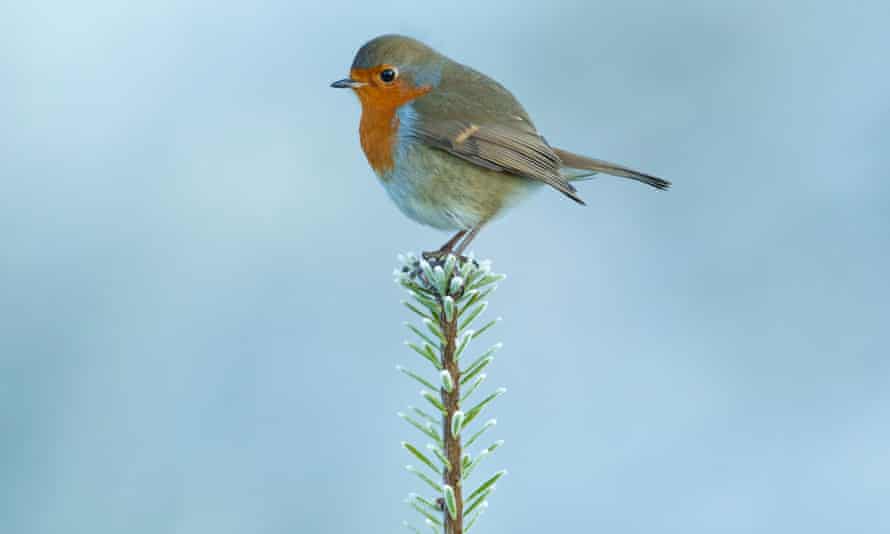
The robin
A longer breeding season benefits birds such as the robin, which produce two or more broods. Photograph: incamerastock/Alamy

A wing and a prayer: how birds are coping with the climate crisis

Some of our best-loved species are changing their breeding cycles and heading north in their fight for survival in a warmer world

https://www.theguardian.com/environment/2021/jan/03/a-wing-and-a-prayer-how-birds-are-coping-with-the-climate-crisis

Lockdown has sparked a renewed interest in our garden birds, with millions of us enjoying watching them from our windows. But could some species – including the common and familiar great tit – vanish from Britain’s gardens by the end of the century?

Researchers from the Norwegian University of Science and Technology, working with the University of Oxford, have modelled how great tits are reacting to the climate crisis. Specifically, are the birds able to respond to the earlier emergence of the caterpillars on which they feed their chicks?

Birds such as great tits have evolved to time their breeding cycle so it coincides with the peak of moth caterpillars that feed on oak leaves, which traditionally happens in late May and June. But as temperatures rise, so oaks are coming into leaf earlier, and the caterpillars have responded by hatching out earlier too.

This means that when the great tit chicks are ready to be fed, the peak of caterpillars is already coming to an end. Because the parent birds need to find 1,000 caterpillars every day for their hungry offspring, any mismatch is likely to dramatically reduce breeding success.

The researchers found that although the birds can respond to climatic shifts, they are not doing so quickly enough. Lead author Emily Simmonds estimates that the tipping point comes when oak leaves, and their associated caterpillars, appear 24 days earlier than usual.

The discovery that birds can and do respond to climate change by breeding earlier than normal was first made in the 1990s by Dr Humphrey Crick, a scientist working at the British Trust for Ornithology. He was analysing thousands of cards from the BTO’s long-running Nest Record Scheme, which had been filled in by amateur birdwatchers over the previous half-century, detailing the dates when eggs are laid and chicks hatch.

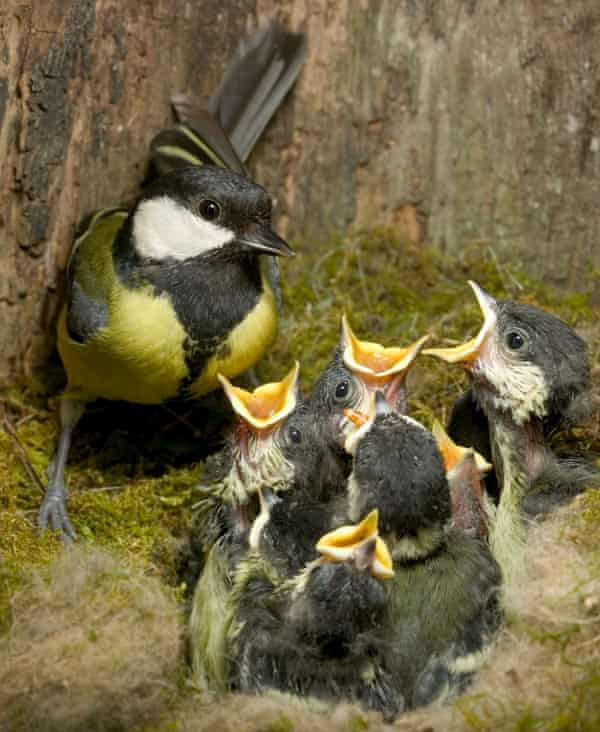
A great tit with lots of hungry mouths to feed
A great tit with lots of hungry mouths to feed. Photograph: Andrew Darrington/Alamy

Crick noticed a surprising trend: for many species, the date on which they laid their eggs had moved forward by an average of nine days. The resulting landmark paper, “UK birds are laying eggs earlier”, published in the journal Nature in 1997, provided some of the earliest empirical evidence that wild creatures were already responding to a warming climate.

A decade later, in 2006, I remember Bill Oddie introducing  Springwatch with the astonishing news that every blue tit nest they were monitoring had already fledged young – several weeks earlier than usual. Because blue tits only have one brood, they must respond very rapidly to changes such as earlier springs. If they fail to do so quickly enough, their numbers will plummet.

At the end of his 1997 paper, Humphrey Crick made this prophetic comment: “For birds, earlier nesting could be beneficial if juvenile survival is enhanced by a prolonged period before winter. Conversely, birds may be adversely affected if they become unsynchronised with the phenology of their food supplies.”

Less than a quarter of a century later, both parts of that prediction appear to be coming true. In the short term, a longer breeding season has benefits, especially fr birds such as the robin, blackbird and song thrush, which produce two or more broods of young. Starting to nest earlier in the year might allow them to squeeze in an extra brood, and so produce more offspring in total.

Professor James Pearce-Higgins, the BTO’s director of science, points out that our smallest birds, such as goldcrests, wrens and long-tailed tits, are benefiting from another aspect of climate change: the much milder winters of recent years.

He also points to the positive impact of our habit of feeding garden birds, which helps species such as blue tits, great tits and goldfinches. At present, he suggests that the advantages of higher winter survival rates outweigh the failure to synchronise with the spring food supply, though that may not always be so.

Another climate-driven success is the way many species are now expanding northwards. The latest European Breeding Bird Atlas reveals that, on average, the ranges of Europe’s breeding birds have shifted north by 28km (17.5 miles) since the original survey was done in the late 1980s – almost 1km every year.

This may not sound like much, but over time it will allow species once confined to continental Europe to cross the Channel and colonise the UK. Indeed, given that some species respond much faster than others, several (including cattle egrets and great white egrets) have already done so.

But as our climate becomes less predictable, with more extreme weather events such as storms, droughts and floods, what scientists have called the “honeymoon period” will come to an abrupt end.

As Professor Pearce-Higgins notes, ground-feeding birds may not be able to cope with prolonged summer droughts, which make it harder for them to find food: “One potential exception to this positive picture of warmer temperatures is thrushes and blackbirds, which rely on soil invertebrates. We know, from a study we have run recently asking schoolchildren to count earthworms in school playing fields, that the availability of worms – a major food source for many species – declines significantly in summer, particularly when it is dry.”

So, as we stand on the precipice of a runaway warming world, the future for many of our best-known and best-loved birds remains in the balance.

  • Stephen Moss is a naturalist and author who runs an MA in nature and travel writing at Bath Spa University. His latest book, The Swallow: A Biography, is published by Square Peg.