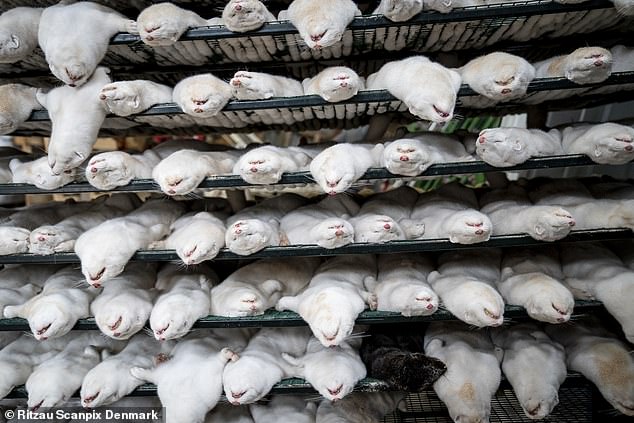
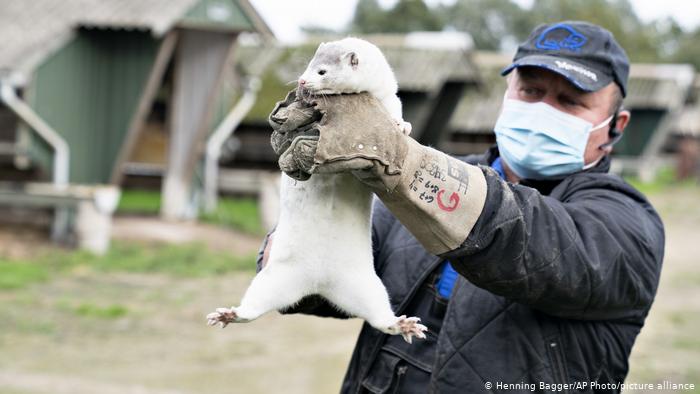
After months of negotiations, a majority in the Folketing agreed to pay mink farmers compensation.
It will be a costly proposition for Danish society if the Danish mink breeders who were ordered to kill their mink last year receive compensation.
This emerges from an agreement for which a large majority of the parliamentary parties voted after a very long negotiation process.
The agreement was made between the government, Venstre, the Radicals, the People’s Socialist Party, and the Liberal Alliance.
According to the agreement, the compensation for the mink breeders will be between 15.6 and 18.8 billion crowns (That’s about 2,4 billion euros).
The exact amount is not yet known, also because the case of every mink breeder has to be assessed. There were around 1,000 mink farms in Denmark. Part of the total compensation goes towards rescheduling the mink breeders.
Finance Minister says: “That is fair and appropriate”
“The agreement offers fair and reasonable compensation so that the mink breeders can get ahead,” says incumbent finance minister Morten Bødskov (socialists).
Some of the e mails given appear to be currently closed, and the administrator gets back to you about this if this is the situation. But some are still valid and we strongly suggest that e mails are sent to all regardless.
To make things easier for you, I have taken each province in turn and:
Supplied all the e mail contacts in block form – you only need to copy and paste (the block listing) into a ‘new mail’ on your computer.
Supplied a copy of the letter for you to enclose with your mail. Note these are different for each province, and so you must only use the specific one given for each area.
Over time, we are publishing the e mail block contacts and the covering letter for each of the 10 regions.
Probably 5 posts of which this is the first.
If you feel that this is a lot of work; do it in sections each day; finally, take a look at the videos below and then tell us this issue is not worth fighting for !
We ask you to take immediate action to crack down on the illegal dog farms, slaughterhouses, markets and restaurants that serve dog meat in your city. We request that an official document be issued, mandating that the following existing Korean laws be enforced by its government officials, police and judges:
Unauthorized processing of food waste fed to dogs in the meat trade is a violation of the Wastes Control Act, Article 15-2, Article 25, Section 3. Suppliers of food waste and transporters of food waste to dog meat farms are violating this regulation.
Food waste fed to dogs in the dog meat trade is a violation of the Control of Livestock and Fish Feed Act, Article 14, Section 1 & 2. Unauthorized collection of food waste and the act of feeding it to dogs in the meat trade is in violation of this regulation.
Excrement and resulting environmental damage produced as a by-product of the illegal dog meat farm is a violation of the Act on the Management and Use of Livestock Excreta Article 11. The excrement produced at dog meat farms causes environmental damage to the immediate and surrounding area.
The act of the slaughtering of dogs for human consumption is a violation of the Animal Protection Act Article 8, Section 1, Clause 4. The act of the slaughtering of a dog, without justifiable ground – such as out of necessity for veterinary treatment, or in circumstances of immediate threat, harm or damage to human life or property, is a violation.
The slaughter of dogs by electrocution is a violation of the Animal Protection Act, Article 8, Section 1, Clause 1. Inflicting injury or death to any animal by the following means: battery by tools, exposure to drugs, exposure to extreme heat or fire, electrocution and drowning is subject to legal punishment. Therefore, the routine slaughter of dogs by butchers and farmers by these methods is in violation of the Act. Further, electrocution as a method of slaughter is internationally recognized as an inherently cruel method of slaughter and banned globally.
The slaughter of dogs from an unauthorized slaughterhouse is a violation of Livestock Products Sanitary Control Act, Article 7 Section 1. The Livestock Products Sanitary Control Act, states that dogs are officially recognized and classified as “animals” that are “prohibited from being slaughtered and distributed as food for human consumption”. Therefore, those vendors operating dog slaughterhouses are operating outside of the parameters of the law and in violation of the law.
The slaughter of dogs for his/her own consumption is a violation of the Animal Protection Act, Article 10. The intent of the Act is to ensure that no animal is slaughtered in a cruel or revolting manner, and shall be free from unnecessary pain, fear, or stress during the process of slaughter. Therefore, the only humane way of slaughtering dogs would be by euthanasia (lethal injection). All currently practiced methods of slaughter by butchers, farmers and traders excludes euthanasia as a method of slaughter, therefore they are all in breach of this Act. This is also a violation of the Livestock Products Sanitary Control Act Article 7 Section 1 Clause 2. According to the Livestock Products Sanitary Control Act, the slaughter of animals for his/her own consumption is allowed only for the livestock animals that are publicly announced as classification of livestock in the Livestock Products Sanitary Control Act and dogs are not classified here.
The display and sale of dog carcasses in traditional outdoor markets is a violation of the Food Sanitation Act, Article 4, 5. Violation of laws banning the sale of harmful food due to the contamination from unsanitary and illegal slaughter of the animal and display of the dog carcass. For example, dog carcasses are routinely contaminated by microorganisms that cause human diseases and food poisoning; this can lead to serious and life threatening health complications. There are also strict laws that ban the sale of meat from sick animals, due to the fact that there is no quality control or formal monitoring of slaughter practices in the dog meat trade it is very likely that violation of these laws is happening routinely.
Dog meat restaurants’ sale of dog meat soup made with dog carcasses from an unknown source is a violation of Food Sanitation Act Article 44 Section 1 Clause 1. Uninspected livestock products must not be transported, stored, displayed, sold or used for manufacturing or processing of food for human consumption.
International coverage of the brutal dog and cat meat trade in South Korea has stained your city’s image. The time to end this tragedy is now. The favor of your reply is requested.
We ask you to take immediate action to crack down on the illegal dog farms, slaughterhouses, markets and restaurants that serve dog meat in your city. We request that an official document be issued, mandating that the following existing Korean laws be enforced by its government officials, police and judges:
Unauthorized processing of food waste fed to dogs in the meat trade is a violation of the Wastes Control Act, Article 15-2, Article 25, Section 3. Suppliers of food waste and transporters of food waste to dog meat farms are violating this regulation.
Food waste fed to dogs in the dog meat trade is a violation of the Control of Livestock and Fish Feed Act, Article 14, Section 1 & 2. Unauthorized collection of food waste and the act of feeding it to dogs in the meat trade is in violation of this regulation.
Excrement and resulting environmental damage produced as a by-product of the illegal dog meat farm is a violation of the Act on the Management and Use of Livestock Excreta Article 11. The excrement produced at dog meat farms causes environmental damage to the immediate and surrounding area.
The act of the slaughtering of dogs for human consumption is a violation of the Animal Protection Act Article 8, Section 1, Clause 4. The act of the slaughtering of a dog, without justifiable ground – such as out of necessity for veterinary treatment, or in circumstances of immediate threat, harm or damage to human life or property, is a violation.
The slaughter of dogs by electrocution is a violation of the Animal Protection Act, Article 8, Section 1, Clause 1. Inflicting injury or death to any animal by the following means: battery by tools, exposure to drugs, exposure to extreme heat or fire, electrocution and drowning is subject to legal punishment. Therefore, the routine slaughter of dogs by butchers and farmers by these methods is in violation of the Act. Further, electrocution as a method of slaughter is internationally recognized as an inherently cruel method of slaughter and banned globally.
The slaughter of dogs from an unauthorized slaughterhouse is a violation of Livestock Products Sanitary Control Act, Article 7 Section 1. The Livestock Products Sanitary Control Act, states that dogs are officially recognized and classified as “animals” that are “prohibited from being slaughtered and distributed as food for human consumption”. Therefore, those vendors operating dog slaughterhouses are operating outside of the parameters of the law and in violation of the law.
The slaughter of dogs for his/her own consumption is a violation of the Animal Protection Act, Article 10. The intent of the Act is to ensure that no animal is slaughtered in a cruel or revolting manner, and shall be free from unnecessary pain, fear, or stress during the process of slaughter. Therefore, the only humane way of slaughtering dogs would be by euthanasia (lethal injection). All currently practiced methods of slaughter by butchers, farmers and traders excludes euthanasia as a method of slaughter, therefore they are all in breach of this Act. This is also a violation of the Livestock Products Sanitary Control Act Article 7 Section 1 Clause 2. According to the Livestock Products Sanitary Control Act, the slaughter of animals for his/her own consumption is allowed only for the livestock animals that are publicly announced as classification of livestock in the Livestock Products Sanitary Control Act and dogs are not classified here.
The display and sale of dog carcasses in traditional outdoor markets is a violation of the Food Sanitation Act, Article 4, 5. Violation of laws banning the sale of harmful food due to the contamination from unsanitary and illegal slaughter of the animal and display of the dog carcass. For example, dog carcasses are routinely contaminated by microorganisms that cause human diseases and food poisoning; this can lead to serious and life threatening health complications. There are also strict laws that ban the sale of meat from sick animals, due to the fact that there is no quality control or formal monitoring of slaughter practices in the dog meat trade it is very likely that violation of these laws is happening routinely.
Dog meat restaurants’ sale of dog meat soup made with dog carcasses from an unknown source is a violation of Food Sanitation Act Article 44 Section 1 Clause 1. Uninspected livestock products must not be transported, stored, displayed, sold or used for manufacturing or processing of food for human consumption.
International coverage of the brutal dog and cat meat trade in South Korea has stained your city’s image. The time to end this tragedy is now. The favor of your reply is requested.
lant Based News has remade a TV advert that claims meat and dairy are ‘essential’.
The Agriculture and Horticulture Development Board (AHDB) launched its We Eat Balanced campaign earlier this month to highlight the alleged ‘nutritional benefits of enjoying red meat and dairy’.
The campaign, which costs £1.5 million, consists of an advert currently running on UK TV. It aims to showcase the UK’s world-class standards in food production and sustainability. There are three different endings featuring dishes using beef, lamb, and pork. All of which include a dairy accompaniment.
‘Meat and dairy naturally provide nutrients’
“An ideal diet is one that offers variety, nourishment, and enjoyment whilst remaining in harmony with the environment,” We Eat Balanced said. “To keep you and your family healthy it’s best to follow a balanced diet. Meat and dairy naturally provide nutrients, including the essential vitamin B12 not naturally present in a vegan diet.”
Speaking about the campaign, AHDB’s Head of Marketing Liam Byrne said: “The nation needs a bit of a lift as it’s been a tough time for everyone. So, now more than ever we wanted to create a campaign that feels uplifting and reassuring for consumers who are increasingly being told by the media to reduce their meat and dairy consumption.
“As such this is also a very important campaign for our levy payers as it tells the real story of food and farming from Britain.”However, PBN has decided to remake the advert – showing the harrowing reality of animal agriculture. “We’ve all got a lot on our plates right now but here’s something you’ll want to make room for,” the new ad states.
“The story of a food so brutal it steals calves from their mothers and the flesh of creatures we humans incarcerate. Then, markets it as something edible.
“The nutrients our bodies need to stay healthy exists in plants. Quit meat and dairy. Enjoy food without victims. Eat plant-based.”
Plant Based News’ ad
PBN’s co-founder Robbie Lockie, who produced the new ad, says he was ‘absolutely outraged’ by the claims AHDB made.“We’re in the midst of a climate crisis,” Lockie said. “It is absolutely essential we cut our consumption of meat and dairy.
“However, the makers of the original ad claim they wanted to help people feel good. Because the media is ‘always trying to get people to eat less meat and dairy’. This is not only incredibly irresponsible, it denies the fact that animal agriculture is a leading driver for climate change.”
Are vegan diets healthy?
Despite AHDB’s claims, the American Dietetic Association says ‘appropriately planned vegetarian diets, including total vegetarian or vegan diets, are healthful, nutritionally adequate, and may provide health benefits in the prevention and treatment of certain diseases’.
It adds: “Well-planned vegetarian diets are appropriate for individuals during all stages of the life cycle, including pregnancy, lactation, infancy, childhood, and adolescence, and for athletes.”
The biggest ever opinion poll on climate change has found two-thirds of people think it is a “global emergency”.
The survey shows people across the world support climate action and gives politicians a clear mandate to take the major action needed, according to the UN organisation that carried out the poll.
While younger people showed the greatest concern, with 69% of those aged 14-18 saying there is a climate emergency, 58% of those over 60 agreed, suggesting there is not a huge generational divide.
Even when climate action required significant changes in their own country, majorities still backed the measures.
In nations where fossil fuels are a major source of emissions, people strongly supported renewable energy, including the US (65% in favour), Australia (76%) and Russia (51%).
Where the destruction of forests is a big cause of emissions, people supported conservation of trees, with 60% support in Brazil and 57% in Indonesia.
Overall, the most popular actions to tackle the climate crisis were protecting and restoring forests, followed by renewable energy and climate-friendly farming. The promotion of plant-based diets was the least popular of the 18 policies in the survey, with only 30% support.
Gender was a factor in some countries, with at least 5% more men and boys saying there is a climate emergency than women and girls in 16 countries. However, in four nations – the US, Australia, Canada and the UK – significantly more women and girls were concerned about global heating.
The UNDP ran the “Peoples’ Climate Vote” in 50 high-, middle- and low-income countries, representing more than half the world’s people. Experts at Oxford University weighted the replies to reflect the population of each nation.
“The voice of the people is clear – they want action on climate change,” said Cassie Flynn, the UNDP’s strategic adviser on climate change.
“If 64% of the world’s people are believing in a climate emergency then it helps governments to respond to the climate crisis as an emergency.
“The key message is that, as governments are making these high-stakes decisions, the people are with them.”
Flynn said the survey connects the climate concerns of people, particularly the young, with governments at a time when accelerated action must be agreed, in particular at a UN climate summit in November. The climate crisis continued unabated in 2020, with the joint highest global temperatures on record.
“We are at a fork in the road and the poll says ‘this is how your future generations are thinking, in specific policy choices’ – it brings a way to envision the future,” she said.
Flynn heads the UNDP’s Climate Promise programme that helps countries take more ambitious climate action.
The poll found the highest proportion of people saying there is a climate emergency was in the UK and Italy, both at 81%. Australia was at 72% and the US at 65%, the same as Russia, and India was at 59%. Even the lowest proportion, in Moldova, was 50%.
The relatively low support for the promotion of plant-based diets may be because there are few plant-based options in some countries or people may have felt that diet is more of a personal choice, said the UNDP. Support was highest in Germany (44%) and the UK (43%).
The reason why more men and boys said there was a climate emergency than women and girls in countries such as Nigeria and Vietnam may be because girls have less access to education in those places.
The poll found that the more education a person had completed, the more likely they were to think there is a climate emergency. Why more women and girls are more concerned in the four English-speaking nations is unclear.
The poll was distributed via advertisements in video games and puzzles, including Angry Birds, Subway Surfers, Sudoku and Words With Friends, and this particularly helped reach younger people.
The idea came to Flynn when she was on the subway in New York City: “I looked around and everyone was on their phones and most were playing games.”
The data was collected between October and December 2020 and, despite the coronavirus pandemic, 59% of the people saying there is a climate emergency also said the world should “do everything necessary and urgently” in response.
Prof Stephen Fisher at Oxford University said: “The Peoples’ Climate Vote has delivered a treasure trove of data on public opinion that we’ve never seen before. Recognition of the climate emergency is much more widespread than previously thought.”
Regards Mark
Excellent by ‘The Guardian’ (UK Press) as always – click on the top Guardian link to see the data charts.
Wuhan, where Covid-19 was first identified, has now returned to a life resembling that before the virus swept in after China was able to control the outbreak of the disease with strict but necessary lockdown measures.
Seeing Wuhan’s success ought to bring a ray of hope to those around the world facing the worst of their country’s outbreaks; yet, in their annual retrospectives, American media is downplaying China’s successful containment measures and casting them as somehow an attack on core Western values.
The New York Times,MSNBC, CNN, and other outlets have indeed pointed out the fact that life in Wuhan has returned to normal, showing pictures of maskless night clubs, large celebrations, and other functions totally unfamiliar at this point to many across the world. But, according to these outlets, the measures were harsh and came at a “huge personal cost” to Wuhan residents.
These outlets also went on to lambast a new museum in Wuhan that details the city’s harrowing battle with the virus. According to them, the museum and other patriotic media reports about the events that took place in Wuhan are part of a “narrative” that the Communist Party of China (CPC) is trying to spin.
“China has spent much of the past year trying to spin the narrative of the pandemic as an undisputed victory led by the ruling Communist Party,” the New York Times wrote.
The paper also noted, although, with a different choice of words, that people in Wuhan believe the “narrative” and view early missteps in handling the outbreak with some level of forgiveness after seeing the abject failures of countries like the United States.
When one simply looks at the numbers, there is really no need to “spin” any “narrative” in the first place.
Revealed: all 27 monkeys held at Nasa research center killed on single day in 2019
This article is more than 1 month old
27 primates euthanized at California facility
Outcry over revelation that animals were not sent to sanctuary
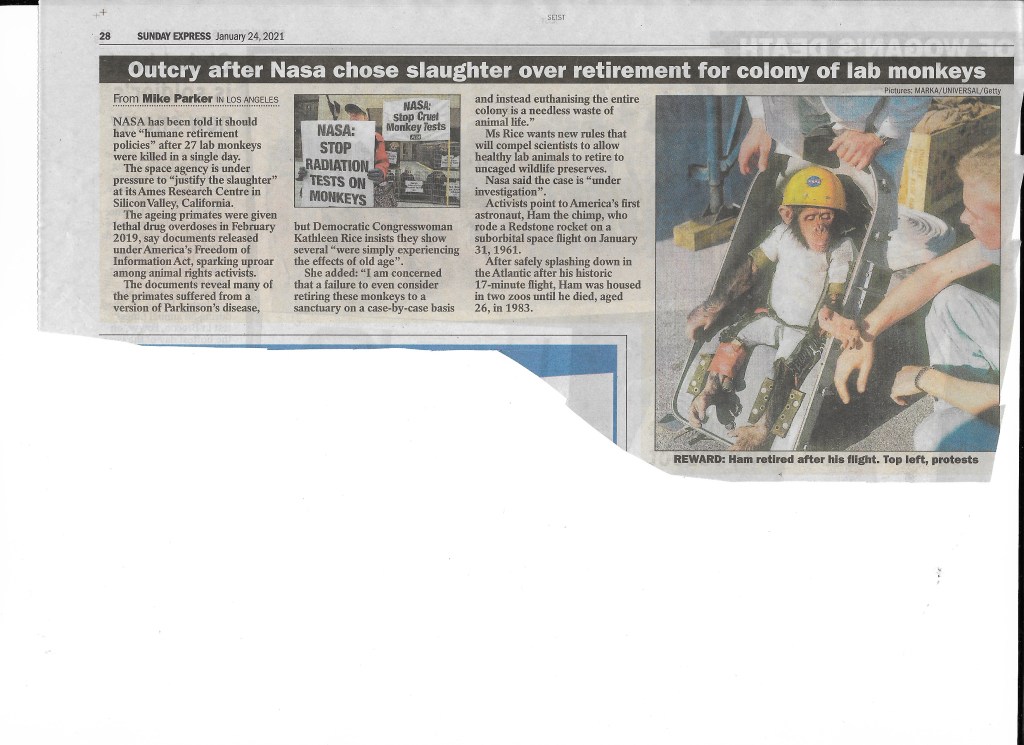
Every monkey held by Nasa was put to death on a single day last year, documents obtained by the Guardian show, in a move that has enraged animal welfare campaigners.
A total of 27 primates were euthanized by administrated drugs on 2 February last year at Nasa’s Ames research center in California’s Silicon Valley, it has emerged. The monkeys were ageing and 21 of them had Parkinson’s, according to documents released under freedom of information laws.
The decision to kill off the animals rather than move them to a sanctuary has been condemned by animal rights advocates and other observers.
The primates “were suffering the ethological deprivations and frustrations inherent in laboratory life”, said John Gluck, an expert in animal ethics at the University of New Mexico. Gluck added the monkeys were “apparently not considered worthy of a chance at a sanctuary life. Not even a try? Disposal instead of the expression of simple decency. Shame on those responsible.”
Kathleen Rice, a US House representative, has written to Jim Bridenstine, Nasa’s administrator, to demand an explanation for the deaths.
Rice, a New York Democrat, said she has been pushing for US government researchers to consider “humane retirement policies” for animals used in research. “I look forward to an explanation from administrator Bridenstine on why these animals were forced to waste away in captivity and be euthanized rather than live out their lives in a sanctuary,” Rice told the Guardian.
Nasa has a long association with primates. Ham, a chimpanzee, received daily training before becoming the first great ape to be launched into space in 1961, successfully carrying out his brief mission before safely splashing down into the ocean.
But the monkeys euthanized last year weren’t used in any daring space missions or even for research – instead they were housed at the Ames facility in a joint care arrangement between Nasa and LifeSource BioMedical, a separate drug research entity which leases space at the center and housed the primates.
Stephanie Solis, the chief executive of LifeSource BioMedical, said the primates were given to the laboratory “years ago” after a sanctuary could not be found for them due to their age and poor health. “We agreed to accept the animals, acting as a sanctuary and providing all care at our own cost, until their advanced age and declining health resulted in a decision to humanely euthanize to avoid a poor quality of life,” she said.
Solis said no research was conducted on the primates while they were at Ames and that they were provided a “good remaining quality of life”.
In recent years the US government has started to phase out the use of primates in research, with the National Institutes of Health making a landmark decision in 2015 to retire all chimpanzees used in biomedical studies. Critics of the practice argue it is immoral and cruel to subject highly intelligent, social creatures so similar to humans to such conditions.
However, other labs continue to use monkeys in large numbers – a record 74,000 were used in experiments in 2017 – with scientists claiming they are far better than other animals, such as mice, for studying diseases that also afflict humans.
Even when monkeys are retired from research purposes, the task of rehoming them in appropriate sanctuaries still proves haphazard.
“What tragic afterthoughts these lives were,” said Mike Ryan, spokesman for Rise for Animals, the group that obtained the freedom of information documents on the Ames primate deaths. “Nasahas many strengths, but when it comes to animal welfare practices, they’re obsolete.”
A Nasa spokesperson said: “Nasa does not have any non-human primates in Nasa or Nasa-funded facilities.”
The mandarin duck is a species of bird from the duck-bird family that is native to East Asia.
Like the wood duck, it belongs to the genus Aix.
In Europe, there are isolated overgrown park populations that have arisen from captive refugees.
The mandarin duck is one of the “glossy ducks”, whose name comes from the metallic sheen of their plumage.
It is one of the medium-sized ducks and reaches a body length between 41 and 51 centimeters.
The males weigh between 571 and 693 grams.
The females are slightly lighter with a weight between 428 and 608 grams.
The magnificent, colorful drake is easy to recognize by its green-metallic forehead, the chestnut-brown “whiskers”, the large white stripes over the eyes, and the strikingly large orange-colored wing feathers that are set up like a sail.
The gray-brown female is comparatively inconspicuous, has a white eye-ring with an elongated eyeliner, a white chin, and a spotted underside.
Mandarin ducks are very insensitive to cold.
Since they are also very local, they can be kept free in Central Europe.
They look for their food mainly in the country, where they also swallow large seeds such as acorns and beechnuts whole.
In China, the mandarin duck is a symbol of marital fidelity because of its distinctly monogamous way of life, as the ducks only change partners after a year.
In the Qing Dynasty, it was also used as a badge for civil servants of the 7th rank.
Fortunately, this type of duck is relatively seldom hunted because its meat is not considered to be tasty.
According to the IUCN, it is considered not to be endangered.
Text: “Together for the animals”
We very rarely hear that an animal species is not endangered.
And we are very happy about it!
Mattis’s day started normally today with the fact that he and his buddy Dina looked at the weather.
All the uncles and aunts that one could visit are in the same stable or in the immediate vicinity, but that is no reason to neglect beloved rituals during the stable season.
Then it’s off to the cool bathroom under the cow cleaning machine.
A giant baby can hardly fit under there, but hygiene should not be neglected.
Someone simply bends down a bit and takes advantage of the fact that one of these practical devices was attached at the ideal bottom height.
Then the next appointment is with mom, who checks the cleanliness and quickly goes back to the places where
one of them didn’t get there so well himself.
Mummy is just the best!
Now it’s finally time for a round of games and Aunt Chaya even missed a bale of straw.
This is immediately exploited by splitting the thing up and putting up a bold new hairstyle with it.
After all, Mom is not looking at the moment, Ochse has to take advantage of that.
After that, it’s almost time again to go to bed, put on the captain’s pajamas and end another day of adventure happily.
The alarms have been activated again in the Netherlands due to the appearance of a new respiratory disease that could have mutated and is being transmitted from goats to humans.
Researchers are studying the significant increase in human cases of pneumonia that are occurring in populations near the country’s goat farms.
According to studies carried out so far, the risk of contracting pneumonia increases between 20% and 55% in people who live near these farms.
Q fever killed 95 people 10 years ago
This is not the first time that a respiratory disease associated with goat farms has been transmitted to humans in the Netherlands. In 2007, an outbreak of Q fever killed 95 people and took three years to control, infecting thousands of people.
50,000 goats used to produce milk were slaughtered by the government to try to control the disease.
Q fever is a respiratory infection that particularly affects goats and sheep, and is found in the placenta, amniotic fluid, urine, feces, and milk of these animals.
About half of the 4,000 human cases recorded between 2007 and 2010, ended up developing complications, such as heart failure. A total of 50,000 people are believed to have been infected.
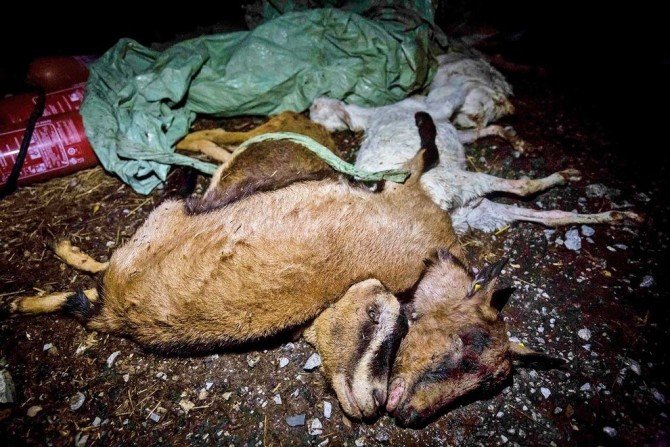
2010, Holland: More than 40,000 goats and sheep were killed with lethal injection.
The effects in humans vary, some people do not develop symptoms and yet others suffer from fever, chills, fatigue, and muscle pain.
The threat of zoonotic diseases and livestock
Experts from the UN and the European Food Safety Agency accuse factory farming of being behind most of the new infectious diseases in humans in the last decade. They also ensure that there is a risk that they are the origin of new pandemics.
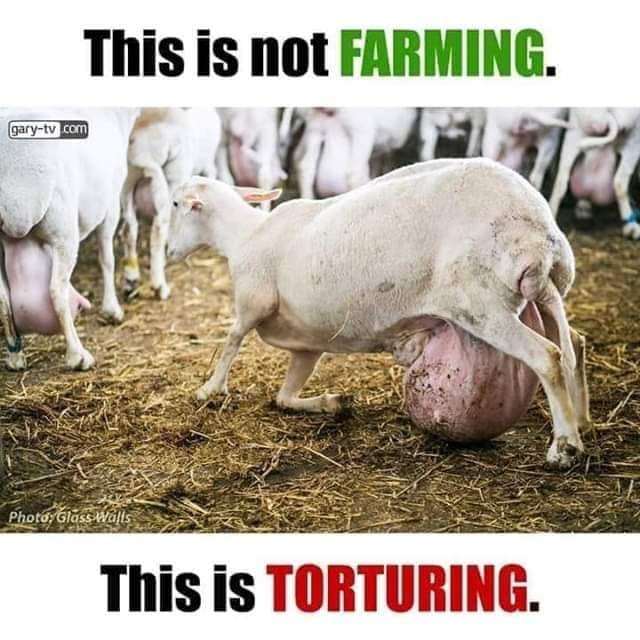
The terrible conditions that animals endure on factory farms; overcrowding, the overuse of antibiotics, and low genetic diversity make factory farming the perfect breeding ground for pathogens to spread according to recent studies.
And I mean…First of all, we lock up everything that is useful to us and torture that which cannot defend itself!
We create animal quality industries (meat/meat products, milk/dairy products, eggs, fish, animal skin …) stuffed full of antibiotics and hormones, are raped, tortured, tortured, and their babies are robbed and/or murdered over and over again, and when Ebola, SARS, SPAIN FLU, SWINE FLU, BIRD FLU, FLU, HANTA, MALARIA, HIV, SARS-COV-2, SARD-COV (new) arise and threaten us with contagion, we operate the well-known method of mass destruction.
Obviously, we haven’t learned anything from any of these signals.
Even worse is the fact that we have not yet overcome fascism.
Because the crimes against billions upon billions of non-human animals in the animal torture industry continue.
VEGAN 2020 – The Film is sponsored by abillion – where you can find recommendations and review vegan-friendly restaurants near you, food products and cruelty-free beauty items.


 New Year’s Eve celebrations in Wuhan © REUTERS/Tingshu Wang






 World Animals Voice