
In 2015, there were 767,622 animals used for medical experiments in the US, the lowest level since the United States Department of Agriculture began keeping records in the early 1970s. That included roughly 138,000 rabbits, 98,000 hamsters, 11,000 sheep, 46,000 pigs; 20,000 cats, 61,000 dogs, 173,000 guinea pigs, 28,000 “other farm animals,” and nearly 62,000 “nonhuman primates.”

In 2016, the number of animals used for scientific testing rose to 820,812. Last year, it dipped slightly, to 792,168. Today, according to Pew, 52% of Americans are against animal testing. However, there have never been more nonhuman primates used for lab experiment tests than there are right now.
Increased funding from the National Institutes of Health (NIH), which supports a majority of US primate research, is one factor behind the recent rise in primate testing. The other reason “the numbers are trending up, is because these animals give us better data,” Jay Rappaport of the Tulane National Primate Research Center in Covington, Louisiana, told Science magazine. “We need them more than ever.”

The NIH is currently in the process of rebidding at least two requests for proposals to maintain primate colonies in the US.
The NIH’s current contract with Tulane and the two Maryland firms requires those institutions to maintain facilities capable of housing over 900 nonhuman primates, 550 of which will be part of “breeding harems (!!) to achieve a production rate of 60-100 live births per year.” These monkeys will be used to test the efficacy of potential HIV vaccines, say the contracting documents.
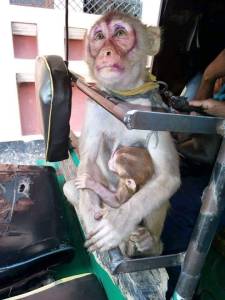
Activist groups have long tried to stop researchers from experimenting on primates. University of California-Los Angeles neuroscientist J. David Jentsch, who uses rats and monkeys in his work, has gotten razor blades in the mail, groups of protesters marching in front of his home, and threatening emails. In 2009, Jentsch’s car was blown up in his driveway.

That same year, members of the Animal Liberation Front (ALF) firebombed the Austrian vacation home of former Novartis CEO Daniel Vasella, because they believed his company had ties to Huntingdon Life Sciences, a British animal-testing lab (Novartis denied those allegations.)
A month earlier, ALF activists stole Vasella’s late mother’s ashes from a gravesite in Chur, Switzerland, and spray painted “Drop HLS Now” (referring to Huntingdon) on her headstone. Vasella’s sister’s grave was also vandalized. Novartis reported at least 10 other attacks on employees; two explosives were placed under two cars parked in Novartis board member Ulrich Lehner’s driveway in 2009, for example.

Best regards, Venus
 World Animals Voice