Month: November 2018

EU: A Little EU Experience On A Few Of Our Issues Of Concern.


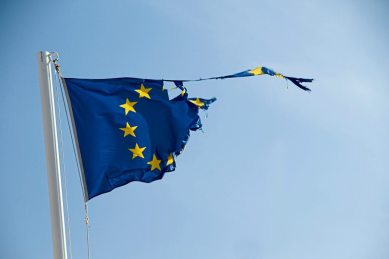
zerissene EU-Flagge am Stock


The UK voted 2 years ago to get out of the EU and take back control of its own future.

With the possibility of a deal now on the table (13/11/18) I though it may be a good time to look a little more at ‘EU departments’ and to question if the EU citizen is really getting a good deal for what (their) nation contributes to the EU.

Here is a formal list of the biggest to smallest contributors to the EU:


https://www.statista.com/statistics/316691/european-union-eu-budget-share-of-contributions/


UK – 13.5% – compared to Germany 19% and France 16.6%.  The 3 biggest contributors.

Move down to the other end and we see Luxembourg 0.25%, Bulgaria 0.34% and Romania 1.15%.  All percentages can be seen on the above link.

So, what do we get for this ?

We (as an organisation) have over 27 years worth of experience in live animals being transported around the EU and via our sister organisation ‘Serbian Animals Voice’  https://serbiananimalsvoice.com/  around 14 years of experience dealing with stray animal welfare in Serbia – not currently an EU member state, but a ‘Candidate Country’ to join.

With our experience we have written and produced a large amount of letters and questions to the EU over the years; especially (for live transport) the Health and Food Safety Commission (DG SANTE)  and for Serbia animal welfare, the EU Enlargement Commission to express our concerns before the EU door is opened up to Serbia.

DG has bothered to contact us at the odd interval; but the Enlargement Commission has never really bothered despite all our evidence abut non compliance with the EU’s very own ‘Rule of Law’ (Copenhagen agreement).


So, anyway, here is a formal listing of the EU Departments and Executive Agencies which ‘control’ the day to day operations at EU HQ.

Link – https://ec.europa.eu/info/departments_en   – this is from ‘Europa’; the formal site of the EU.

We see they list no less than 53 agencies and departments.  So lets go a little deeper regarding live animal transport and Serbia.  Live animals transport comes under ‘Health and Food Safety (DG SANTE) – and here is the link to their site from the above listing:

https://ec.europa.eu/info/departments/health-and-food-safety_en

From the link you can see the leadership and organisation; but then go a little deeper.  Below Martin Seychell you can download the organisation chart of just this Commission  – here is the link:  https://ec.europa.eu/info/sites/info/files/organisation_charts/organisation-chart-dg-sante_en.pdf

7 main departments (A to G); each with a head; and then each department being sub divided into different organisations – approximately 34 at our count; each having ?? number of employees.  On its own site, the FVO  http://ec.europa.eu/food/fvo/how_en.print.htm ; part of the Health and Consumers Directorate-General; says that it has at least 170 employees.  The FVO and the DG SANTE are really responsible for undertaking EU legislation compliance with EU regulations in all member states.  They do not and it does not work.

Moving on to Serbia and its application to join the EU; this is undertaken via the  European Neighbourhood Policy and Enlargement Negotiations which are headed by Commissioner Hahn – Link:  https://ec.europa.eu/info/departments/european-neighbourhood-policy-and-enlargement-negotiations_en

Here is a link to all the major persons (but not all staff) associated with this Commission – https://ec.europa.eu/info/departments/european-neighbourhood-policy-and-enlargement-negotiations_en#leadership


And here is an organisational chart of the structure:  https://ec.europa.eu/neighbourhood-enlargement/sites/near/files/near-org-chart.pdf

42 departments or more; each with staff and people working for them.


So by giving a little insight into just 2 of the 53 EU Departments and Executive Agencies that combine to produce the mighty EU machine; one would think that this; which does not even start to include MEP’s  – http://www.europarl.europa.eu/news/en/press-room/20130610IPR11414/elections-2014-share-out-of-meps-seats-among-28-eu-countries   – one would think that issues such as live animal transport and stray animal management could be undertaken by such a huge amount of staff.

Experience in both theatres of live transport and Serbian animal welfare show us there is NO REAL CONCERN at EU level.  Surely, paying all this money to the EU as taxpayers (UK – Mark) and (Germany – Venus); are we not right to ask exactly what the 2 sections of 53 are doing for issues that concern us ?

No; the EU does not want to know; instead it works to punish the UK for voting to leave the club and taking back control.  Other member states all seem happy to continue contributing finances as shown above; for getting what exactly in return ?

The EU system does not work.  It employs thousands and has a great website, but the reality is it does very little; if anything; to address the concerns of EU citizens over such important issues as live animal transport enforcement.


Still want to be an EU member state ?  the facts are above – you decide if it is financially worth it for very little return.

Regards Mark.


eu uk 4

Cuping in Germany: an illegal mass mutilation!


EU- Flagge


There was an audit of Health and Food Safety (DG SANTE) between 12 and 21 February 2018. The aim of the audit, was to assess the suitability and effectiveness of existing ones measures for preventing tail biting and avoiding the routine culling of tails in pigs”.

Who is DG SANTE?

It is the Directorate-General for Health and Food Safety of the Commission and responsible for monitoring the implementation of the relevant legislation. It is headed by Mr. Andriukaitis, who is known to us as “the do nothing man”.

A kind of police is DG SANTE, we can say, which controls (with its many sub-directorates) , whether agreed measures for the health of humans and animals are observed.

These directorates in Brussels are (May 2011):
Directorate A: General Affairs (6 departments)
Directorate B: Consumer Affairs (6 Departments)
Directorate C: Public Health (4 departments)
Directorate D: Health System and Products (5 Departments)
Directorate E: Food Production Safety (6 Departments)
Directorate F: Food and Veterinary Office (7 departments)
Directorate G: Veterinary and International Affairs (8 Departments)
 

These are further subdivided into related departments (see below on the link), so we ended up with a huge apparatus  that costs for us much money and usually without having a useful effectiveness.

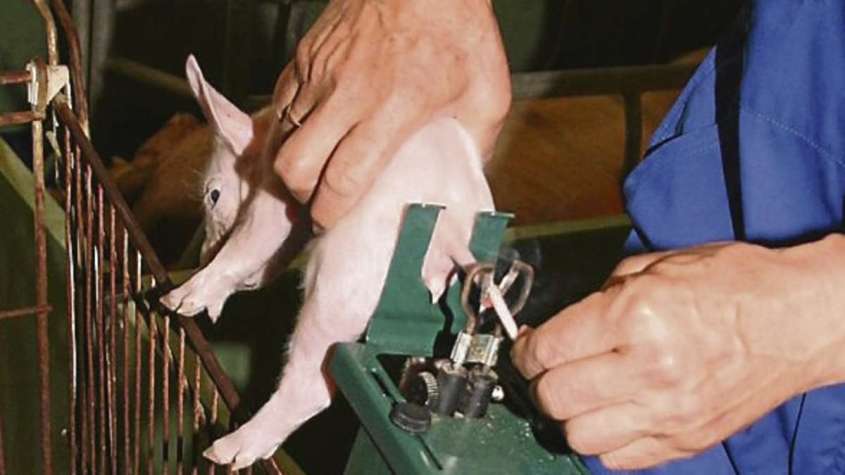
Ferkel unter Cupierungs Maschineg

The current situation in Germany

By crop we mean the cutting off of the tail of a pig. The purpose is: pigs are omnivores, they even nibble each other. The “specialists” call this “caudophagia”: tail biting.

Every four weeks, when the new piglets are there, the farmer comes and cuts off their tails, more precisely: the last third of the tail. He presses their tail tip against the glowing hot cutter. The top falls, the heat fuses the wound, the farmer puts the pig back into the bay.

That is nothing but a painful mutilation, an amputation.

Actually, what every farmer does is illegal. The German animal protection law, paragraph 6, prohibits the amputation of body parts in vertebrates.
The EU Directive 2008/120 / EC even clarifies the prohibition for pigs: “A cropping must not be carried out routinely.” Exceptions are allowed with veterinary approval.

Ferkel unter cupierenpg

But the exception has long been the rule in Germany. Experts appreciatethat up to 99 percent of the piglets from conventional farming are cropped.
A ringlet tail pigs have almost only in pictures.
Farmers talk about practicing animal welfare, and claim that without cupping pigs would bite each other and cause bloody acute injuries, bad abscesses, inflammation in the entire back area.

Cause of the (illegal) routine cropping.

The intelligent animals live there in a monotonous stable on full slatted floors and have no employment. They have no freedom of movement, no employment opportunity and no retreat. Due to boredom or stress they start to bite into the tails of other animals.
They suffer from the loss of their natural behavior and can not live up to their needs.     
In boars, however, tail biting is unknown.

Ohren beissen von Schweinepg

But what is the pig industry doing? It does not change the keeping conditions, but one adapts the animals to the Farma conditions, to make as much money out of them as possible! No cropped pigs, no one wants!

The result of the audit from 21. February 2018
They did not find a practicable solution for doing without cropping!!

The report concludes that the federal and state authorities’ strategies for reducing tail biting and avoiding the routine curbing of tails in pigs have not produced any concrete results, and are still routinely cropping tails in Germany, despite considerable sums of money spent on research and disseminated the respective results.

Certificates of established veterinarians justifying the need for cropping are not based on sufficient evidence that other measures have been taken to avoid tail biting. This and the lack of verification of these certificates during official controls lead to routine tail docking.

The competent authorities agreed that the initiatives of the Action Plan had not yet fully realized, but made it clear that this is a long-term project and that they assume that the continuous involvement of stakeholders and the establishment of new working groups will result in a appropriate effect will be achieved.

With other, simple words: they have controlled, and nothing has changed. They made suggestions but they did not punish anyone.

The pigs will continue to be chopped up with hot iron, and we will continue to give money to the peasants, so that they may respond to the suggestions of the audit and perhaps practice them.
Until then, it remains legal, which is illegal.

This is also a way to do a job.
However, it is the most ineffective and most sloppy way of all.

Click to access organisation-chart-dg-sante_en.pdf

My best regards, Venus


EU Commission: never again use the word “moral”!


zerissene EU-Flagge am Stock

MEP Stefan Eck: “Everything must now be done to put an end to this miserable, legalized animal cruelty!”

tiertransporte-LKW mit Schweinejpg

On 08.11.2018, the Committee on the Environment, Public Health and Food Law (ENVI) held the first debate on the “Report on the implementation of the Regulation on the protection of animals during transport inside and outside the EU (EC 1/2005 )” instead of.

Continue reading “EU Commission: never again use the word “moral”!”

EU: ‘Food and Veterinary Office (FVO)’ – Ever Been There and Used Its Information ? – Have a Look.

EU- Flagge

Over the last few days Venus and I have been looking further into EU live animal transport.  With years of investigation experience, I want to provide you with a section of the EU that is available to all; and yet seems to keep a low profile on its work with regard live animal issues.  Why is this ? – could it be like us, they also have no faith in the mighty EU actually taking any action against non compliant member states ? – Is it all just a job producing, money making, paper producing exercise that actually does very little, if anything, to improve animal welfare.

Venus will be producing a post soon re pig tail docking in Germany.  His is associated with an FVO audit report undertaken in Germany very recently.

The section of the EU is called the ‘Food and Veterinary Office’; or FVO for short.  Some of you may have come across this in the past; some not.  I will try to give a quick and simple summary of what the FVO is about and how you can access some (why not all ?) of its investigation reports; which I am sure, will be of interest to many of you.

Audits are continually undertaken by the FVO across EU member states; although not necessarily in the same year.  In their words:

In its function as “eyes and ears” of the Commission, the FVO verifies on the spot that applicable requirements in the areas of food safety, animal health and welfare and plant health are properly implemented and enforced by Member States and also by third countries. By contributing to the improvement of national control systems, the effective enforcement of requirements in the EU and third countries is enhanced. This, in turn, helps to ensure that:

  • Consumers can be confident that the safety of their food is protected by strict enforcement of controls.
  • Trade can take place under conditions of uniform and high safety levels, which allow markets to focus on price, quality and consumer preferences.
  • Exporters can harness the advantages of a single EU market, with high and uniform levels of safety enforcement, to promote their position on world markets.
  • The key role of food safety in wider EU policies, including obligations towards trade partners and developing countries, is supported by effective, non-discriminatory and transparent enforcement.
  • EU policies on safety, including their wider policy implications, are informed by the lessons from on-the-ground audit findings.

In its reports the FVO makes recommendations to the competent authority of the country concerned to deal with any shortcomings revealed during the audits. The competent authority is requested to present an action plan to the FVO on how it intends to address shortcomings. Verification of the completion and effectiveness of corrective actions through a number of follow up activities is an integral part of FVO activity. 


To find out more about the specific accessible reports produced by the FVO in its visit to any EU member state; you can click on the following link:


http://ec.europa.eu/food/audits-analysis/audit_map/index.cfm


Move the cursor over any (EU) country to see the number of audits, click on any country to see a list of audits which have been undertaken; and what they are about.

Lets pick Romania at random as an example.  If we move the mouse pointer over Romania on the EU map; we can see that no less than 8 inspections were undertaken by the FVO in 2018.  Then we are provided with a series of boxes; each relating to (only some) published audit reports undertaken.

For example; we can access report 2018-6477 which specifically deals with classic swine fever.  The report is available in a series of languages; each presented in pdf format.

Accessing the English pdf version, we can see that the report details the following:

FINAL REPORT OF AN AUDIT CARRIED OUT IN

ROMANIA FROM 25 JANUARY 2018 TO 02 FEBRUARY 2018

IN ORDER TO

EVALUATE THE APPLICATION OF ANIMAL HEALTH CONTROL MEASURES

RELATING TO CLASSICAL SWINE FEVER


So this for example, provides a lot of information into FVO investigations into swine fever application measures when they visited Romania during January and February 2018.  The specific report makes very interesting reading on the issue for animal welfare campaigners.

This is just one example relating to just one issue in one EU member state regarding animal welfare.  All issues cannot be covered by us in a month of Sundays, but we leave it to you to use the EU map and to go exploring different nations to see the issues of the current and past years.

The aim for us by giving this info ? – for activists to become more informed on what issues have specifically been investigated by the FVO in any EU member state.  Knowledge is news and information which can be taken further; and the FVO reports can then be used to do follow up reports; or to write to the national ministries involved; to ask them some (sometimes) embarrassing questions on what actions they have taken regarding the original FVO audits.  There are always follow up actions after an audit report; but do the nations actually take the actions on board ?

It is time to check other audits for all the member nations; but with Bulgaria for example; we see that there was an audit report done (2018-6571) on the ‘Import Controls for Food and Live Animals’.  As Bulgaria is the main route out for live animals exported from the EU to Turkey; it may well be worth a read to see exactly what the audit report says and to ask what, if anything, has been done as a follow up by the Bulgarian authorities ?

Some of the reports; as per this above case, are NOT yet published.  They are listed but are not yet accessi8ble; We wonder why ?

But we do know the dates and numbers of the reports; so asking questions and obtaining further information could be followed up with national MEP’s if required by you.

Further links and information:


https://ec.europa.eu/food/audits_analysis_en


Country Profiles – http://ec.europa.eu/food/audits-analysis/country_profiles/index.cfm


Videos – https://ec.europa.eu/food/audits_analysis/videos_en


Further information on the organisation and implementation of Member State controls in the areas of food and feed safety, animal health, animal welfare and plant health may be found in the websites of national control agencies.

Although not an EU obligation, some Member States publish their Multi-annual National Control Plans and Annual Reports on the implementation of these plans. In these cases links to these documents are included.

Link to MANCP (Article 41 of Regulation (EC) No 882/2004)
Member State links


Have a hunt around – you may come across a lot more info than you realised;

Regards Mark

First class corrupt governments!

Germany: Federal parliament rejects stop of long-distance transports!


deutsche flagge

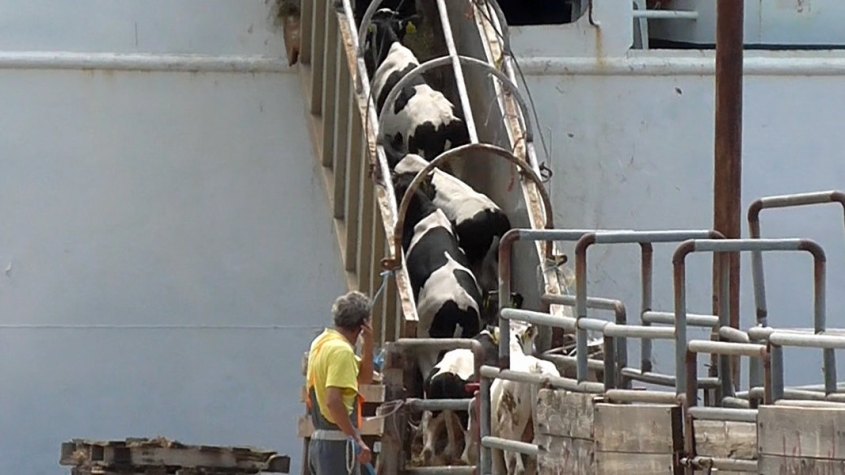
“It is a scandal that animals continue to be transported under terrible conditions to third countries. The outcry after the 37 degree reportage “secret thing animal transports” was once very large – but now you continue just as before, “said Dr. Rusche of the German Animal Welfare Association.

schiffstransport mit Kühenpg

In their application, the Greens called for a suspension of transports – as long as the requirements of the EU regulation on live animal transports in third countries are genuinely met – as well as limited transport times. The FDP (free democrats)  demanded the suppression of transports, if they do not meet the European minimum standards, as well as compliance with the EU Regulation with appropriate controls, reports the German Animal Welfare Association.

Continue reading “First class corrupt governments!”

This Remembrance Day, We Must Not Forget The Animals Lost In War.


This Remembrance Day, We Must Not Forget The Animals Lost In War

Not them, nor anyone or anything else that has made unimaginable sacrifices for every single one of us alive today.


·         Marc Abraham Vet, animal welfare campaigner, PupAid founder

Very few of us find this weekend lacking in emotion. Perhaps from our own personal experiences or just hearing stories and memories of war from older relatives, we all make a point of honouring the dead by wearing a poppy, respecting the two-minute silence, as well as attending our local Remembrance Parades too. All of these actions help us reflect deeply about how lucky we are as a nation; and how it’s all due to those brave heroes that fought, and still continue to fight, for our freedom in every bloody battle, conflict, and terrible war.

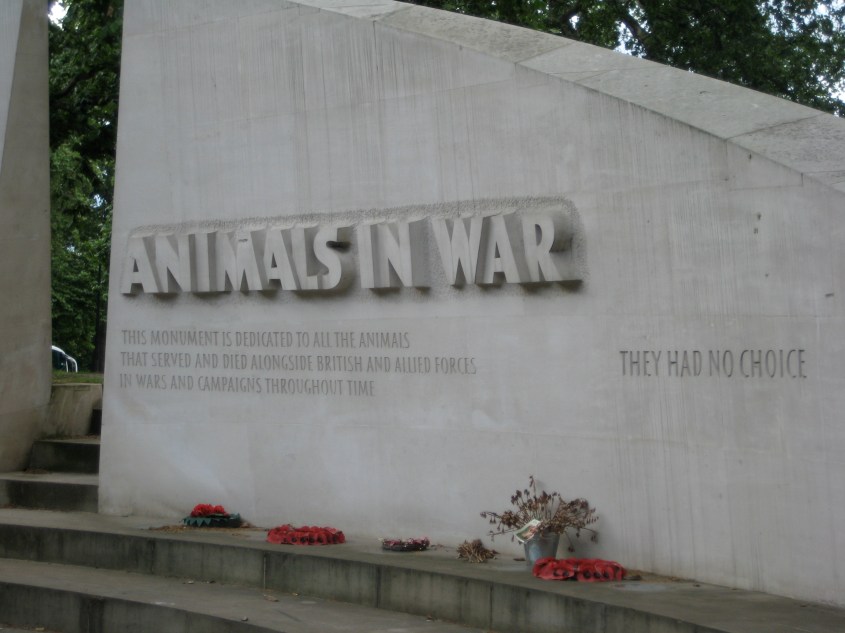
But as well as the millions of human heroes that gave the ultimate sacrifice, please also spare a thought this weekend for all the poor animals that also helped bring us peace, specifically employed by mankind, and employing all manner of skills, that both served and died alongside British and Allied forces in wars and campaigns. On the Animals in War Memorial in London’s Park Lane, there’s an inscription that simply reads “They had no choice.”

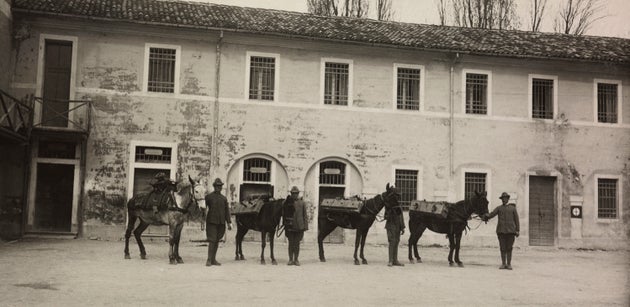
Famously of course, horses always formed the cavalry, able to draw heavy artillery and providing an incredibly useful all-purpose and reliable method of transportation. We’re all aware of Michael Morpurgo story ‘Warhorse’, but tragically eight million warhorses lost their lives during the Great War. Most died from disease, starvation, or exposure; one of mankind’s most noble and loyal servants reduced to shivering bags of skin and bones, some even resorting to chewing on their own rugs for food.

In the deserts, mountains, and tropics, with much tougher terrain, camels and elephants were better suited to help our soldiers, playing a crucial role in warfare; just like those oxen, mules, and donkeys that carried supplies, arms, as well as our dead and wounded. Mules serving in the dense jungles of Burma even had their vocal cords severed, ensuring their loud braying would not betray Allied positions to the enemy.

Unsurprisingly dogs also suffered high casualty rates as they were used to relay messages between soldiers in the trenches. Furthermore their excellent sensitivity to smell meant that they were employed to search for mines and trip-wires, commonly leading to in injury or death from resulting explosions. Some would rip their paws to shreds scrabbling through the rubble of bombed-out buildings in UK cities attacked in the Blitz, looking for survivors or bodies.

In contrast nowadays it’s rare for a mine detection dog to be killed or injured, as these dogs are trained not to step on the mines, and the way they are worked is very strictly controlled. Usually once a mine is detected the dog is trained to sit beside it as a sign to the handler that it’s found something. Furthermore dogs are often not heavy enough to set off anti-tank or anti-personnel mines. Serving teams of all nationalities, these explosive-detecting dogs are extremely well looked after, and deeply loved by their handlers; not really surprising since the handler’s life and often their unit’s moral is often determined on the close bond they share with their faithful four-legged pals when working under extremely stressful conditions.

Did you know that ‘Para-dogs’ were once dropped behind enemy lines to assist with covert operations? And in the Soviet Army, dogs even had explosives strapped to their backs to be used as anti-tank weapons, trained by placing food directly under tanks. The idea was that these apparently starved dogs would learn to associate tanks with meals, and would then proceed to run under any German tanks they saw to find their dinner. Unfortunately the Soviets vastly underestimated their dogs’ intelligence, as the first time they were used, instead of attacking the German tanks the hungry dogs recognised the Russian tanks used in training, running straight back under them instead. After this catastrophic misjudgment the use of anti-tank dogs was very quickly abandoned.

Unbelievably war isn’t just about man against man, often supported by these brave animals. Were you aware that during wartime some animals were even pitted against other animals? For example British carrier pigeons delivering crucial messages to Front line troops in both First and Second World Wars would suffer multiple attempts to prevent them reaching their destinations; German hawks were waiting to attack our unwitting winged messengers at the Pas de Calais. Between the hawks, the bullets, and Mother Nature herself, a staggering 100,000 pigeons were killed between 1914 and 1918, with many of these remaining avian survivors limping home with oil-clogged feathers, shot-away wings, and ripped-open necks. The difference made by these birds was absolutely crucial.

Then there were the cats such as ‘Frankenstein’ on warship HMS Belfast, who had his own hammock and was kept on board to protect the food stores from the many rats and mice. Canaries were also employed in wartime to alert sappers to gas; and last, but by no means least, the glow worms, by whose soft light World War I soldiers would read their maps in their last moments before going over the top. Even in modern wartime dolphins and sea lions are deployed to help detect naval mines.

We must never forget. Not them, nor anyone or anything else that has made unimaginable sacrifices for every single one of us alive today.

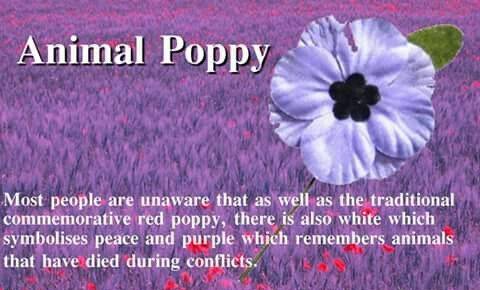
purple poppy 3

purple poppy 4

http://www.animalsinwar.org.uk/index.cfm?asset_id=1374


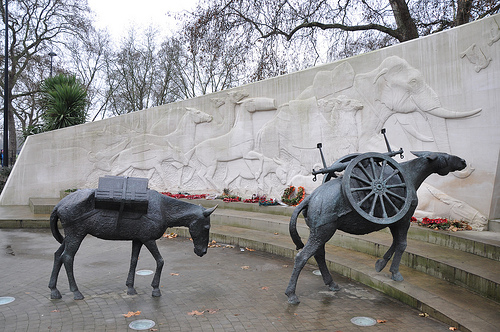
animals in war memorial london 1


Horses, Mules and Donkeys

Eight million horses and countless mules and donkeys died in the First World War. They were used to transport ammunition and supplies to the front and many died, not only from the horrors of shellfire but also in terrible weather and appalling conditions. Mules were found to have tremendous stamina in extreme climates and over the most difficult terrain, serving courageously in the freezing mud on the Western Front and later at Monte Cassino in World War II. Equally they toiled unflinchingly in the oppressive heat of Burma, Eritrea and Tunisia. There are many inspiring and often tragic stories of the great devotion and loyalty shown between horses, mules and donkeys and their masters during some of the bloodiest conflicts of the 20th century, as can be read in Jilly Cooper’s moving book Animals in War, published by Corgi.


Dogs

The dog’s innate qualities of intelligence and devotion were valued and used by the forces in conflicts throughout the century. Among their many duties, these faithful animals ran messages, laid telegraph wires, detected mines, dug out bomb victims and acted as guard or patrol dogs. Many battled on despite horrific wounds and in terrifying circumstances to the limit of their endurance, showing indomitable courage and supreme loyalty to their handlers.

Pigeons

More than 100,000 pigeons served Britain in the First World War and 200,000 in World War II. They performed heroically and saved thousands of lives by carrying vital messages, sometimes over long distances, when other methods of communication were impossible. Flying at the rate of a mile a minute from the front line, from behind enemy lines or from ships or aeroplanes, these gallant birds would struggle on through all weathers, even when severely wounded and exhausted, in order to carry their vital messages home.

Other Animals

Elephants, camels, oxen, bullocks, cats, canaries, even glow worms — all these creatures, great and small, contributed their strength, their energy and their lives in times of war and conflict to the British, Commonwealth and Allied forces during the 20th century.

This Memorial is a fitting and lasting tribute to them all.

animals in war 4


http://www.animalsinwar.org.uk/index.cfm?asset_id=1375

https://www.bbc.co.uk/newsround/28604874

https://www.iwm.org.uk/history/15-animals-that-went-to-war


USA: Federal Judge BLOCKS Construction On Keystone XL Tar Sands Pipeline.


USA-Flagge

tar sands 1

Dear Mark,

I have HUGE NEWS!

A federal judge just blocked construction on the Keystone XL tar sands pipeline and ordered the government to revise its environmental review of the reckless project.

The judge ruled that the Trump administration violated bedrock environmental laws when approving the proposed pipeline, which would carry 830,000 barrels of dirty, climate-busting tar sands oil each day from Canada’s boreal forest through America’s heartland. Among other things, the judge found that the administration’s environmental impact statement glaringly ignored the pipeline’s obvious impact on climate change, and the high risk of dangerous, hard to clean oil spills.

This court ruling is a major win for NRDC, our partners, Indigenous communities, and environmental activists like you who have been fighting tirelessly to stop this dangerous pipeline for over a decade.

And this news came just hours after 150,000 individuals from across the country — including tens of thousands of NRDC activists — submitted public comments to the State Department opposing its faulty, hastily-produced draft environmental impact statement for Keystone XL.

Read more about this momentous victory on NRDC.org and The New York Times, and then share the good news with friends and family.

NRDC

It has been three years since the Obama administration stopped the Keystone XL pipeline from moving forward. Under President Obama, the State Department, which has jurisdiction because the pipeline crosses the U.S./Canada border, concluded that the pipeline was just too dangerous — to our environment and wildlife, to our global climate and drinking water, and to local communities and tribes.

President Trump, backed by the tar sands oil industry, then revived the project by executive order just days after taking office, and he has been doing everything in his power ever since to ensure this destructive pipeline gets built.

But this court order, the result of a lawsuit by NRDC and our allies, sent a message loud and clear: the pipeline is a disaster for our climate, communities, and wildlife, and should be shelved forever.

Of course, the fight’s far from over. We must stay vigilant — the Trump administration is sure to keep pushing the Keystone XL pipeline forward. It might appeal the judge’s ruling, or the State Department may go back and amend their environmental impact statement yet again. But one thing is certain: NRDC, with your support, will keep working — in and out of court — to ensure this climate-wrecking pipeline never sees the light of day.

I hope I can count on you to stand with us in the weeks and months ahead. But today, please join me in celebrating this important victory.

Thanks for joining us in this fight.

Sincerely,

Rhea Suh
President, NRDC

tar sands 1

tar sands 2

Hanoi is a good example!


Vietnam png


Hanoi, Vietnam, will officially ban the dog meat trade by 2021, Southeast Asia Globe reports.

The announcement follows a statement released in mid-September by the Hanoi People’s Committee, which urges residents of the Vietnamese capital to stop eating dog meat. According to officials, the popularity of dog meat makes the city less favorable to tourists and can lead to the spread of diseases, including rabies and leptospirosis. Additionally, the committee hopes its efforts will encourage locals to “see value in treating animals humanely.”

dog-meat-vietnam-1.jpg

Shortly after the announcement, Ngoc Son Nguyen, director of the city’s Department of Health, issued a statement saying that officials would gradually phase out the dog meat trade, adding that it will no longer be available in the city center by 2021. Official statistics indicate that 1,000 shops within Hanoi still sell dog meat.

The decision was praised by the Animals Asia Foundation (AAF), a nonprofit organization that campaigns for the fair treatment of animals in East Asia. “This is not a cultural issue. We do not discuss whether people eat or do not eat dog meat,” said AAF chief representative, Tuan Bendixsen, in a statement. “The problem to be discussed here is that the AAF has a lot of evidence proving the cruelty in the entire process of killing dogs for meat, from transporting, confining to slaughtering them.”

dog-meat-in-hanoi-restaurants_1

“It is not right to treat dogs as farm animals like chickens, pigs or cows. And what’s more is that it is almost impossible to distinguish a dog raised in a farm for meat from those stolen from a family,” Bendixsen continued. Data from the Asia Canine Protection Alliance (ACPA) estimates that 20,000 dogs become victim to the trade each year, many of which are family pets who have been stolen from their homes.

Though cat meat is less popular, the committee asked citizens to stop eating cat meat as well, highlighting the cruel nature of the industry. The city government hopes that the Hanoi cat meat trade can also eventually be phased out.

https://www.livekindly.co/hanoi-becomes-vietnams-first-city-ban-dog-meat-trade/

My comment: WE , the Europeans criticize other countries because they are massacring and eating animals, who WE regard as pets.

WE execute pigs, cows, lambs, rabbits, ducks, chickens too … in the Dachau Farms, here, every day in millions.

These are also animals!
If we degrade useful animals to edible, because they belong to no one, and qualify the pets to non-edible, just because they are not farma animals and have a home, then we support the eternal suffering of the farma animals and abolish the suffering of the home animals.

Therefore, the fight against dog and cat consumption should not be conducted separately and not species-related, but as part of the overall fight against animal exploitation, animal slavery and disgrace for all the animals and all over the world!


all life is precious_n

Best regards, Venus